Album Review: Haken — Affinity ★★★★★ @InsideOutUSA @Haken_Official

With Affinity, Haken proves definitively that this band is in the upper echelon of musical talent. The album departs from what the band has usually done before, but whereas this would usually generate outrage and disappointment, Haken is not your usual band.

Instead of recycling their past glories and shoring up their dedicated fan base, Haken has boldly risked everything and created a unique, completely original musical offering. As if to demonstrate that every fibre of their being refuses mindless mimicry, Affinity deliberately chooses to mine musical inspiration from the 80s, but only in order to perform a kind of musical miracle: while referencing the past, it doesn’t repeat it; instead, it transforms it into a uniquely personal creative act.

The album opener, “Initiate,” gives minor clues that the album will be a fresh direction. But then “1985” follows fast on its on heels with a mind-blowing array of sonic references to the 80s, including unbelievably cool synth sounds harkening back to Peter Gabriel’s Security album (during the “map in hand / direction misaligned” section of “1985”).

Quite simply, “1985” is one of the greatest songs you will ever hear. It performs the feat of time travel back to 1985, creating an alternate universe where both Yes’ 90125 and Haken’s “1985” would be playing back-to-back on the same radio station. It is absolutely my favorite track on this album because everything about it, every twist and turn, is so incredibly satisfying. It manages to be both familiar and unexpected at the same time. I don’t know how the hell they did it! But it’s wonderful.

“Lapse” then gives the listener a chance to catch their breath, only to blindside them with the album’s 15:40 epic, “The Architect.” The complexity of this track means that it will take you longer to get into it, unlike the immediately accessible genius of “1985.” But the repeated listens will pay off big time as you acquire familiarity with the insanely great ambition of this ultimately successful track. My favorite parts are when Haken goes into King Crimson mode and does that time travel trick back to the 80s again for me.

Then comes “Earthrise” which is just a flat-out beautiful song, totally uplifting and inspirational, with a Sigur Ros-like “blast off to Mars now” vibe. From the beginning of the album to the end of “Earthrise,” 40 minutes have elapsed and the amazing richness of the music supplies you with more than enough mull over. For the longest time, I simply couldn’t listen any further, since I was overwhelmed by the sonic abundance of everything from “Initiate” to “Earthrise.”

But then after awhile I was able to add the last three tracks to my full listening experience of Affinity. “Red Giant,” “The Endless Knot,” and “Bound By Gravity” are all fantastic and full of delights. In total, they give you an extra 22 minus of music. But I still think of Affinity as one vinyl LP (everything up to “Earthrise”) plus one vinyl EP (the last three tracks). Sometimes I have time to listen to the LP; sometimes to both the LP and the EP. Either way, I consider it a testament to Haken’s retro-transmogrifying brilliance that they have me thinking with my 1980s brain in the very terms of vinyl time-logic!

If I had to register any complaint, it would only be with the record company’s idea of having a CD release of two discs: one CD containing the regular version of Affinity, another CD with instrumental-only tracks. Who the hell would ever want to listen to instrumental-only tracks? The people who do karaoke aren’t doing it to Haken, so I just do not see the point. For me, because the vocals and lyrics on this album are such soaring perfection, I consider it a desecration to remove them.

A better idea would be for the record company to include a 40-minute version copy of the album (everything up to “Earthrise”) on a second CD that looks like a mini vinyl record, to give away to friends. Then that friend would eventually be inspired to buy their own version, to get the full 60+ minutes experience, and to give away the smaller version to another friend, and so on. That would make so much more sense than having a wasteful second disc that you will only listen to once or twice at most. This second CD could even have a picture of a 3.5 floppy disc on it. And the CD case itself for both discs could be made to look like a 5.25 floppy disc. Okay, I will stop now with the crazy ideas from my 80s brain! But again, I credit Haken for causing my mind to time travel in such a joyful manner.

This stunning album is one of the best of the year. See you back in 1985, dudes! Back to the future. Five stars.

Trevor Horn: Two Shows with Yes

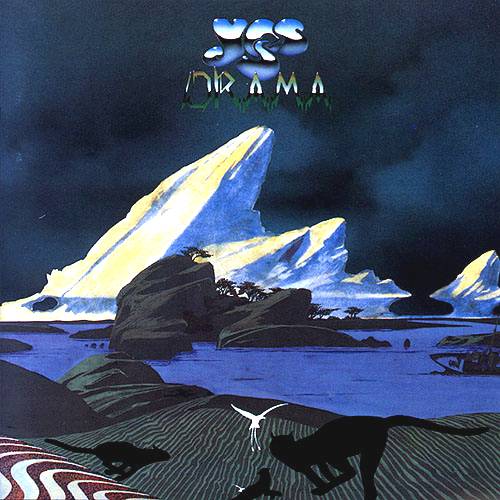
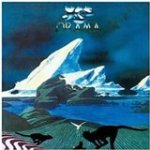
Yes_-_Drama
1980

TeamRock and Prog are reporting that Trevor Horn will be playing with Yes, live on May 9-10.  Amazing.

http://teamrock.com/news/2016-04-26/trevor-horn-to-join-yes-for-two-uk-shows

Album Review: The Syn — Trustworks ★★★★☆

Trustworks, the new album from The Syn, is magnificent. It’s a very easy listen, but it hits all the right prog/rock pleasure points. It’s so smooth, you could even use it as “starter prog” to get friends and loved ones hooked on the good stuff. It’s very soothing, but yet full of subtle musical skills.

I do like some tracks better than others. These are the ones that I think are absolutely fantastic: “Something That I Said” (5:10), “Lucifer Hesitating” (5:23), “The Wheel” (4:16), and the pull-out-all-the stops ultra-proggy closer, “Seventh Day of Seven” (14:50). Steve Nardelli‘s relaxed-dude vocal style works best on these four songs, and they are all super cool musical outings. I can’t get enough of listening to these tracks, whereas I frequently skip the others (especially the snoozily didactic title track).

Nardelli recorded Trustworks with co-producer Jonas Reingold and Swedish prog-rock band Moon Safari: i.e., Pontus Åkesson – guitars; Simon Åkesson – keyboards; Johan Westerlund – bass; Petter Sandström – vocals, acoustic guitar; and (now former Moon Safari member) Tobias Lundgren – drums.

There’s no school like old school. Do yourself a favor and get this album. It’s worth the price of admission simply for “Seventh Day of Seven” alone. But everything else is a bonus, and everybody will find a fave bonus track to dig. For me, that would be “The Wheel” — which is so groovy, I think that word may just need to make a comeback in order to allow us to properly describe this song.

Rock on, dudes!

The Top Ten Yes Albums

Yes Logo

Inspired by fellow Progarchist Erik Heter to post a “Top Ten” list, here are what I believe to be the ten best Yes albums. Whether you agree or disagree with my choices, feel free to add your two cents’ worth in the comments!

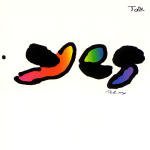
Yes Talk

10. Talk

An album by the Rabin/Anderson/Squire/Kaye/White configuration that never got the respect it deserved. I’ve always had a soft spot for it, particularly “The Calling” and “Endless Dream”. It strikes a nice balance between the full-on pop of 90125 and the prog of the band’s glory days. Check out Time Lord’s essay on this album here.


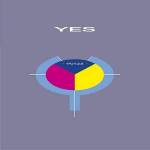
yes 90125

9. 90125

Speaking of 90125, the charm and attractiveness of its songs cannot be denied. It won Yes a new generation of fans, and when I need a dose of classic ’80s rock, it’s the album I go to.


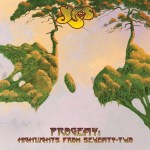
545488_YES_Progeny_LP_Jacket_Cover_13630.indd8. Progeny

Before this recent release of seven concerts from 1972, I would have placed Yessongs here. But the raw sound of these recordings makes them a really fun listen. Hear Rick Wakeman’s keyboards channel a local jazz DJ! Hear Jon Anderson tout a local vegetarian restaurant! And hear a young band at the peak of their powers playing the entire Close to the Edge album.

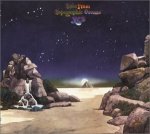
Tales_from_Topographic_Oceans_(Yes_album)

7. Tales From Topographic Oceans

In the rock world at large, this was considered the epitome of self-indulgence. I think Yes were ahead of their time. Nowadays, it’s normal for a prog band to record a 30-minute epic. In this album, there are some truly beautiful passages of music.


Yes Drama

6. Drama

Probably a controversial choice for this slot, but I love this album. It’s notorious for having Trevor Horn and Geoff Downes instead of Jon and Rick, but “Machine Messiah” and “Run Through The Light” are excellent songs. Chris Squire’s playing on this album is some of his best, as well.


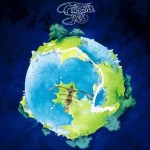
Yes Fragile


5. Fragile

“Roundabout”, “Long Distance Runaround”, “Heart of the Sunrise”, no self-respecting fan of prog music can be without this classic.


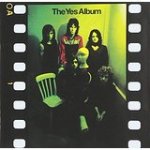
Yes Album

4. The Yes Album

This is the one where all the disparate elements of Yes first gelled. “Starship Trooper” and “I’ve Seen All Good People” defined early-70s FM radio in America. I still get chills listening to it.


relayer

3. Relayer

The harsh sound of the original mix of this album turned me off, but Steven Wilson’s new one is a revelation. It’s a shame the Patrick Moraz edition of Yes didn’t record more. They made some wonderfully challenging and exciting music.


Yes-close


2. Close To The Edge

The pinnacle of the classic lineup (and Bill Bruford’s finest hour). A contemporary symphony that will endure for a very long time.


Yes Going

1. Going For The One

The punk explosion of the mid-70s lit a fire under Yes, and the opening title track features some of Steve Howe’s most aggressive guitar. “Parallels” rocks unbelievably hard, while “Awaken” is my favorite long-form Yes song. For a much better and comprehensive appreciation of this album, read Erik Heter’s review here.


Agree with the list or disagree? Was I wrong to leave out Tormato or Magnification? Let us know in the comments!


Relayer: A Brief Retrospective

relayer

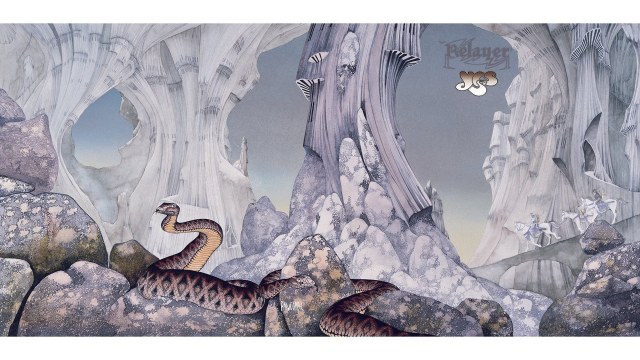
A visually stunning album cover. Profound and thought-provoking lyrics. Epic instrumentation and vocals. I could be describing almost any progressive rock album of note, but I am specifically referring to the underrated Yes album Relayer in this case. I say underrated because this album, featuring only three songs, all of which are worthy of the designation “progressive,” ended up wedged in between the controversial Tales from Topographic Oceans and the (relatively) lackluster Yes albums of the late 1970s/early 1980s.

First a brief comment on the sleeve design. Roger Dean is an integral part of Yes’ image, and his design for Relayer only bolsters the importance of his role. Inspired by images of war and the Knights Templar, Dean draws the viewer in to a world of fantastical images and drama, as the knights on horseback arrive to do battle with the twin snakes. Before one even listens to the album, he can already grasp its focus and themes: war and peace, victory and hope. Dean can capture in an image what Anderson, Squire, and Howe can capture in music.templar

The three songs are not only well-written, but they are also well-performed. This may seem like an understatement in regards to Yes, but this cannot be said about every song they released. The epic opener Gates of Delirium, inspired by Tolstoy’s even longer epic War and Peace, and featuring superb work on keys and synths from Patrick Moraz on his only Yes album, was best described by Jon Anderson: it is a “war song,” but not one that seeks to explain or denounce war, but rather a song that explores war’s aspects: there is a “prelude, a charge, a victory tune, and peace at the end, with hope for the future.” Sound Chaser, a frenetically paced tune featuring a true guitar solo from Steve Howe, solid drumming courtesy of Alan White, and a sizzling performance on bass guitar from the late, great Chris Squire, allows Yes to explore their jazzier side. The final tune, To Be Over, moves at a more relaxed pace, anchored by Howe’s electric sitar. It is a beautifully straightforward song, and it provides the perfect final touch on a visually and acoustically stunning album.

In sum, Relayer may not be the most renowned album in Yes’ extensive catalogue, but in this reviewer’s humble opinion, it is one of their finest works overall, and one that deserves more attention and respect.

YesYears: Twenty-Five Years Later

Remember YesYears?  It was one of the first really nice box sets to come out, back in the day when the only nice box set was that Bruce Springsteen one that had come out in the late 1980s?

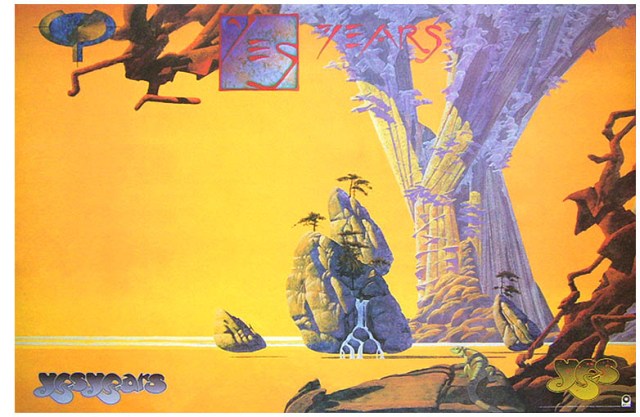
yesyears
YesYears–a Nice Fiction that Every Member of Yes Loved One Another, Beginning to Present

YesYears came out on August 6, 1991.  Union had come out at the very end of April that same year.  Unless you were really connected to the internet (not that easy in 1991), Yes fans just had to guess as to what was going on that summer with the band.  Was Yes really an eight-person band?  And, how long would that last?  YesYears seemed to present the eight as living in harmony with one another.  After all, while the four discs did not include anything from Anderson Bruford Wakeman and Howe, it did list them as a part of the really nice fold-out sleeve, tracing every aspect of Yes history from “The Warriors” to Yes incarnation #9.

Whether real or not, the packaging of YesYears certainly makes a coherent narrative of the band and everyone of its members from Alpha to. . . well, certainly not Omega!  Yes was alive!  Or, so it seemed.

At the time that YesYears came out, I was very poor (a second-year graduate student) and still listening to cassette tapes.  Despite the expense of the YesYears box set, I purchased the four-cassette package.  And, yes, it made a deep cut in my savings account.  Those were years when I would skimp on lunch (usually not even eating one) to spend the money on music or books.

Yes+Yes+Years+350639bAnd as far as I remember, I never regretted having bought that box set.  Sadly, though, the cassettes that came with it were not of the best quality, and I wore my copies out rather quickly.
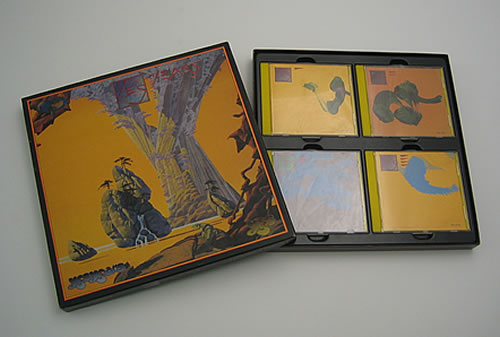
Jump forward two decades.  Today, in the mail, all the way from an Ebay seller in New Jersey, arrived a mint condition 4-cd box set of YesYears.

Wow, it is a thing of beauty.

I know that many of the songs that had not been readily available in 1991–such as Abilene, Vevey, Run with the Fox–are now very easily available.  Still, the 1991 box set is really, really gorgeous.  I actually paid less for this mint condition version (including postage) than I did for the cassette version 25 years ago.

Just as in 1991, I have no regrets.  The sun is out, my kids are laughing somewhere in the house, and I’m listening to disk three of YesYears.

Still amazingly beautiful. . . even a full quarter century later.

Yes: Bizarre, Beautiful, Utterly Human.

Ever since PROGENY appeared last year, I’ve been in a Yes-ish mood.  As I’ve already written in probably too many other pieces for progarchy, I have gone through massive Yes stages in my life.  Yes—at least YESSONGS—was the first prog album that really made an impression on me, though I was only five at the time.

welch yes story
Chris Welch, CLOSE TO THE EDGE.

And, I recently had the chance to remember, though briefly, 90125 on progarchy.

Strangely enough, unlike say my love of Rush or Talk Talk, my love of Yes has been hit and miss, hot and cold.  Intermittent.

My great friend, Liz, reminded me that I absolutely loved Yes in college and somewhat existed on campus as a Yes evangelist.  I was a bit skeptical about this.  After going back to letters and journal entries I wrote at the time—I was definitely VERY into Yes.  Liz’s memory is far better than mine.  My journal entries are full of me trying to explain and understand Yes lyrics.

At age 21, at least according to my own notes from the time, I was even rather convinced that Steve Howe’s guitar spoke its own language.  And, yes, I realize I’m starting to sound like a certain Glass Hammer album warning exactly of such dangers and fan obsession.

morse yes stories
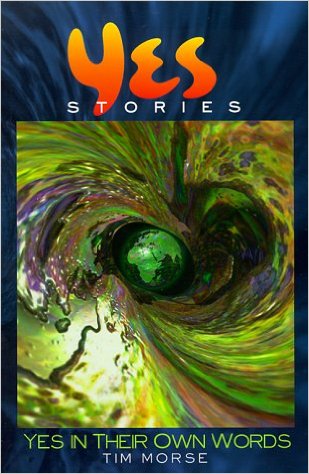
Morse’s Yes Stories.

Since Progeny came out, however, I’ve really jumped back into a very personal Yes fandom.  And, for better or worse, I recently reread three books about Yes: Tim Morse’s Yes Stories; Chris Welsh’s Close to the Edge; and one other (can’t remember the title at the moment).  I’m struck more than ever how utterly Yes was (and is?) one unbelievably dysfunctional family, always desiring to make art but really letting fame and money get in the way of this.  Regret and guilt sets in, confessions are made, penances promised, and Yes starts the cycle all over again.

And, yet, what incredible brilliance to emerge at times as well.  I’m not sure it’s worth fighting over which “phase” of Yes is really Yes.  Yes is what it is, what it was, and what it will be.  Trevor Horn is a part of it, just as Jon Anderson and Steve Howe are.  Chris Squire (RIP) is a critical figure, but Geoff Downes and Billy Sherwood are, too.  Even seemingly marginal figures in the Yes drama, such as Patrick Moraz and Eddie Jobson, matter deeply in the end.  I love Howe’s guitar work, but I also love Rabin’s and Banks’s.  Kaye, Moraz, Wakeman, Downes, Rabin—all incredible keyboardists.  Really, where does it stop?

Was Yes ever actually a group?  Maybe.  Maybe not.  I’m not sure.  And, I’m not sure if they were ever sure or even if there was really a “they.”

In reality, though, Yes is a bizarre, beautiful, organic association of wild egos, all-too human desires, and cosmic longings and glimpses into the realm of the spheres.

A Brief Remembrance of 90125

yes 90125
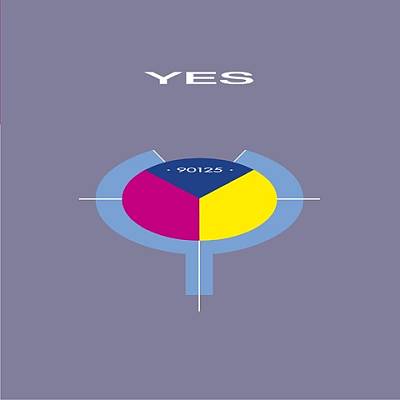
One of the most important reboots ever.  November 7, 1983.

Funny how certain moments leave profound impressions.  The winter months always make me think of Yes’s 90125.  I very well remember purchasing the album on its release, November 7, 1983.  For months, every night, I listened to it on my headphones, after dinner and in the dark, sometimes two or three times.

I’d been a good Yes fan since first hearing Yessongs in 1973.  As I’ve mentioned before on progarchy, I fell in love with every aspect of Yessongs–the art and music.

Of course, I knew 90125 represented a huge break with the past, but it seemed like a rather brilliant break.

I’ve never stopped loving 90125.  It’s pretty much been in constant rotation since I first heard it at the age of 16.

I wish I had something profound to write about it at the moment.  I don’t.  Except, thank you Trevor, Chris, Trevor, Alan, Tony, Eddie, and Jon.

Yes: Who Cares?

Before I start this short post, let me state two things.

  1.  I speak ONLY for myself, not all of progarchy.
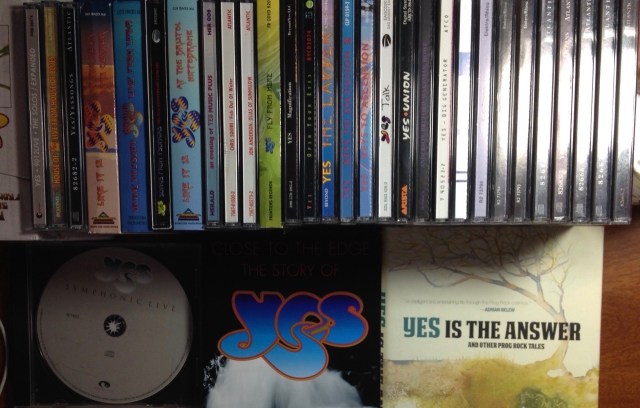
  2. Please don’t doubt my YesCred (see photo below)
IMG_1277 copy (1)
Well, it’s not complete.  I can’t find my copy of HEAVEN AND EARTH, for example.  And, I can’t find my copy of the book that has all of the Yes interviews in it–the one that explains the origins of each song.  Still, I bought each of these CDs, books, and videos because my soul said it was right and good, not because some PR guru told me to do so.

I’ve just seen the news that the Rock and Roll Hall of Fame has once again rejected Yes’s admission into its supposedly august confines.

http://www.npr.org/sections/thetwo-way/2015/12/17/460082433/cheap-trick-deep-purple-among-2016-rock-and-roll-hall-of-fame-inductees

Honestly, who cares?  I certainly don’t.

I thought it was really nice that Rush got in, but it had absolutely no affect on my love for Rush, one way or another.  Rush is Rush, whether the RnRHF recognizes the band’s brilliance or not.

The same is just as true for Yes.

For those of us who grew up with and on Yes, we have done so and chosen our loyalties based on our own personal standards.  If we’d run with the crowd, we’d not like Yes (or Rush).  We like some top 40 crud that mattered for all of two seconds.  Less if measured against all of western civilization.  We love Yes because they stand for something.  Succeed or fail, they tried, and they gave their all.

No one in Cleveland (or any other city) matters one iota to the legacy of Yes.  Yes is Yes.  It is what it is.  I’m sorry a board of civic leaders and PR corporate conformist types can’t see that–but should we expect them to?

Well, I know my answer.  It’s been way too long since I’ve listened to THE YES ALBUM.  Time to listen again.

Weirdos of the world, stay individual!


Science Fiction, Prog, and Prog Metal: A Lecture

Arjen, Lego Style
Arjen, Lego Style

I had the great privilege of lecturing for John J. Miller’s college course, Hon252, THE GOOD, THE TRUE, AND IRON MAIDEN.  If you’re interested, here’s my lecture on “To Tame a Land,” and the connection between science fiction and progressive music.  From Yes and ELP to Cosmograf and Aryeon.

iron miller