

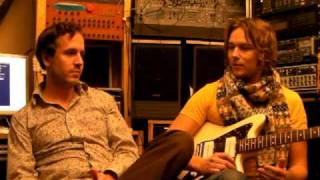
 I’m continuing with my Jonas Munk kick from two weeks ago, when I posted the fabulous Sun River stream, “Esperanza Villanueva”. “Sonnenblumenstahl” is a beautiful piece of Moebius/Roedelius/Plank-style krautrock from Munk’s and Ulrich Schnauss’s highly recommended 2011 full-length collaboration. Munk the guitarist and Schnauss the keyboardist have both left their influential mark on ambient techno, and together they make music that is generous, melodic, and open, combining the best of both their musics. This song could be from Cluster’s Sowiesoso (or Zuckerzeit, OR Grosses Wasser), but has a character uniquely its own.
Author: Craig Breaden
By profession, Audiovisual Archivist, Duke University, Durham, North Carolina. Sometimes hockey player and writer on and of music. Love my family, puttering around the house, and hearing the chimes at midnight.
The Place of an Artist
 Several weeks ago Progarchy contributor Bryan Morey posted an article, Keep Your Politics Out of My Prog, regarding musicians and the commercial risks they take when speaking their minds politically. Bryan is a passionate writer and has deeply held beliefs; nonetheless, I took exception with what he said and how he said it, and made my comments in the honest and positive forum that is Progarchy. All good. But…it stayed with me, and thanks to Bryan for spurring me to further thought, and now to writing more.
I also feel compelled to write now, this evening, because a musical icon yesterday made a political statement regarding recently passed legislation in North Carolina, the state in which I live, where I was married, and where one of my children was born. What has become known as HB2 is a law destructive of not only the Civil Rights Acts but of the grassroots, everyday work that millions of people in the South have undertaken in the last 70 years, to ensure that all are equal before the law. In canceling his show in Greensboro, North Carolina tomorrow, Bruce Springsteen made the following statement:
As you, my fans, know I’m scheduled to play in Greensboro, North Carolina this Sunday. As we also know, North Carolina has just passed HB2, which the media are referring to as the “bathroom” law. HB2 — known officially as the Public Facilities Privacy and Security Act — dictates which bathrooms transgender people are permitted to use. Just as important, the law also attacks the rights of LGBT citizens to sue when their human rights are violated in the workplace. No other group of North Carolinians faces such a burden. To my mind, it’s an attempt by people who cannot stand the progress our country has made in recognizing the human rights of all of our citizens to overturn that progress. Right now, there are many groups, businesses, and individuals in North Carolina working to oppose and overcome these negative developments. Taking all of this into account, I feel that this is a time for me and the band to show solidarity for those freedom fighters. As a result, and with deepest apologies to our dedicated fans in Greensboro, we have canceled our show scheduled for Sunday, April 10th. Some things are more important than a rock show and this fight against prejudice and bigotry — which is happening as I write — is one of them. It is the strongest means I have for raising my voice in opposition to those who continue to push us backwards instead of forwards.
I think as humans and citizens we should use the voices we have to speak out for what we believe to be the truth, what we believe to be right, and I admire Springsteen (someone whose politics, admittedly, I generally agree with) for using the voice he has and sending a message that needed sending to an increasingly retrograde Southern political establishment, on whom the shadows of segregation are again creeping. It would be the poor artist who would shrink from using their total voice, to contain themselves only to their primary medium, regardless of the size of their fan base. In digging deep, artists and musicians push boundaries, often at great personal and commercial cost, and the ones who are successful are without fail also the ones who are compelled to speak their minds in all aspects of their lives. It might be messy, it might not look great on paper, it might not live up to the images they can magically conjure in their art or the idealization we, their fans, have built up around them or integrity we ascribe to them. But we don’t get to have the one without the other, and any artist worth their salt, that I can think of, would not change their point of view or what they choose to say based on the sales of albums or tickets. In taking the action he did, Bruce Springsteen showed again why his band and his fans call him the Boss and why, over his 40-odd years as a professional musician, his artistry has remained so vibrant.
Soundstream Sunday: “Hallucinations” by Tim Buckley
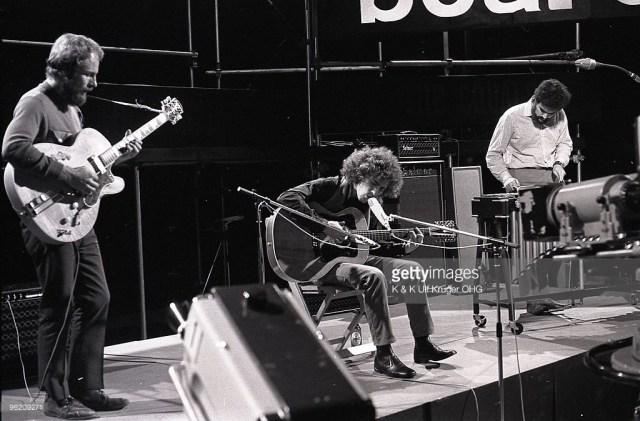 I realized last week when I featured the Sun River song “Esperanza Villanueva” that if I had a nickel for every time someone referenced Tim Buckley as a comparison (as I did in my intro) I’d be a rich man. But how many people have actually heard Tim Buckley? One of Jac Holzman’s/Elektra Records’ stable of brilliant, and troubled, artists, Buckley languished commercially while making music that thrilled his listeners and critics. He died young, a drug casualty (a tragedy echoed over two decades later by the untimely death of his equally talented son, Jeff), but left a deep, intense impression on the post-Dylan outsider folk and singer-songwriter scene he helped create. With his soaring voice and chiming twelve-string, Buckley leaned heavily into jazz, and the band you hear on this smoldering live version of “Hallucinations” — from London in 1968 — are jazzbos (not unusual in this fertile period in “folk” music, where Coltrane held as much sway as Guthrie). Where the studio version of the song feels overly-structured and baroque, here “Hallucinations” is free flowing, long form, Lee Underwood’s electric guitar, David Friedman’s vibes, and (sitting in from Pentangle) Danny Thompson’s bass creating a killer, punctuated Om. There was a time for me, glimpsed now across a thousand other Sunday mornings, when this song accompanied a drag or two off a joint and a walk across Central Park. To see the art.
Fieldwork: Alan Lomax online
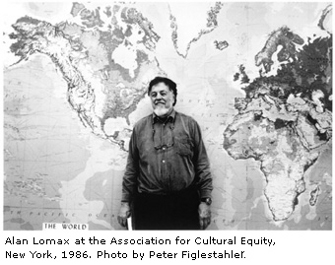 When Alan Lomax initially envisioned his freely available Global Jukebox, a project that would bring together the recordings of vernacular music and stories he and others made around the world, it was a far off dream that the advent of the internet could only hint at. The 17,000+ recordings he had made since the 1940s (and these, by the way, don’t include the recordings he made for the Library of Congress in the 1930s and 1940s) would need conservation work, digitization, and a robust search and delivery platform. Recently that work has been completed by the Association for Cultural Equity, a nonprofit founded by Lomax in 1983 “to explore and preserve the world’s expressive traditions with humanistic commitment and scientific engagement.”
Progarchistas should be aware of this archive because — in addition to its contents being at the root of much rock, including progressive rock, music — the work of Lomax, probably the best known and most prolific of field collectors, represents recorded evidence of how people, in the pre-internet era and often in conditions where even a radio was a luxury, lived day-to-day with the music and dances and stories they and their ancestors created, for entertainment and for their own cultural identity. What can this body of work mean to us, and how does it reflect, or not, constants in the way we experience and participate in music across cultures? The richness of this archive, and of Lomax’s endeavor, is endless food for such thought.
“…so put another dime in the jukebox, baby”
 Boston’s mega public broadcasting treasure trove, WGBH, has added to its Open Vault the interviews that went into the making of its epic 1995 documentary, Rock and Roll. Those of us who remember this 10-hour landmark from those foggy, hoar-bitten pre-Wikipedia days may think fondly of it as the only long-form documentary to take on the genre as a whole, from a reasonable distance from Rock’s genesis but while many of its prophets were still alive and interview-able. While the finished programs are not as yet available (no doubt due to copyright on the songs used in the film), video and transcripts of the interviews are here:
http://openvault.wgbh.org/collections/rock_roll/interviews
Of particular interest to progarchists (but who’s to say, since this is all gold), Derek Taylor’s interview: http://openvault.wgbh.org/catalog/V_5477939234A04D638139ECAD0FD8CC5B
soundstreamsunday: “Esperanza Villanueva” by Sun River
Sun River is a project including singer/songwriter Martin Rude and Causa Sui’s Jonas Munk and Jakob Skott. This track is from the self-titled album that came out in 2012, a lovely record that floats you down the river gently and a bit psychedelically. While Nick Drake and Tim and Jeff Buckley comparisons are tempting and not altogether inaccurate, with its freak folk aesthetic there’s more of a Devendra Banhart vibe going on, and the Shins also come to mind with the organic arrangements. Munk and Skott’s electro-acoustic accompaniment is spot on, perfect for Rude’s vocal and the songs. “Esperanza Villanueva” caught my attention from the outset, with its guitar break consuming the song in slow burn, but I highly recommend the album as a whole, for it is a beautiful achievement.
Return to Sky by Causa Sui
 Causa Sui’s new album Return to Sky is a salve for all that ails. Job getting you down? Return to Sky…. Currents in politics creeping under your skin? Return to Sky…. Need to plug in directly to the earth goddess and feel the electricity pulse through your body in its physical and pataphysical entirety? You know where to go.
With strong whiffs of stoner rock masking an ambitious aesthetic rooted in the great musical confluence that was 1969/71 — for witness here a tendency towards Hendrix’s Machine Gun, Can’s Tago Mago, Amon Duul II’s Yeti, and anything by Miles Davis in this fertile era — Return to Sky would roughly and more contemporaneously fit next to albums by Pelican or Comets on Fire, with a pronounced appreciation for gradation of the spectrum, a treatment of light I find northern European bands to be really good at. So the wah-ed and phaser-ed bass-heavy riffing is balanced by a gentler chorded counterpoint that gives the music a drift to go along with the drone. And while this is no doubt a band effort, guitarist Jonas Munk’s role here makes sense, although if you’re only familiar with his work as Manual, one of the great ambient artists of the last two decades, you may be surprised at his more traditional heroics with Causa Sui. Munk’s melodic reliability in either setting, however, is a kind of a haven, so that even the challenges contained in the art contain a soothing aural wash of sound/color.
There is a tremendous live feel to Causa Sui’s music, as if you’ve walked in on a band that’s really cooking and there are no mics and no crowd, they’re just getting off on the jam and the lightning. Return to Sky is the thunder.
Causa Sui on Facebook: https://www.facebook.com/causasuiband/
El Paraiso Records: http://www.elparaisorecords.com/artists/causa_sui
Impressions of The Madeira’s Ancient Winds
The first (electric) guitar hero? Dick Dale, no question.
The king of “surf” guitar, Dale’s technique was equal parts curling waves and Gene Krupa, combined with an utterly unique left-handed, reverse-string approach. His eastern European roots, and his quest for greater sonic force out of his guitar and his amps, also played a major role in his work, and his early 60s versions of Misirlou and Hava Nagila were reverb-drenched instrumental workouts of the highest order, sneaking through the back door of pop music and exerting a seminal influence on what would become the rock guitar pantheon. Indeed, it’s hard to imagine a Jimi Hendrix or Jimmy Page without Dick Dale’s shoulders to stand on. The template Dale created is hard to resist: amped, fast-picked, lightning runs utilizing eastern scales, riding atop thunderous drums. Rock and roll fierce. Done well and with a sense of mare incognitum, instrumental surf rock continues to be one of the most electrifying musics on the planet. While the 1990s lounge revival saw a parallel-track revival in surf music, with groups like Man or Astroman? revving up its retro appeal, in some ways as a genre surf rock has had a much deeper influence in the last two decades on the kind of forward-thinking instrumental guitar music produced by bands like Scenic and Pelican.
The Madeira (Ivan Pongracic and Patrick O’Connor, guitars, Dane Carter, drums, Todd Fortier, bass) conjured these thoughts when I first listened to the band’s latest release, Ancient Winds, a surf rave up that dishes, ostensibly, on the Mediterranean as surf rock epicenter. Using classic surf music as its primary touchstone, Ancient Winds still sounds utterly contemporary. The Madeira takes surf guitar tropes and adds edge, darkness, complexity: this is not a world that is as simple as it might seem. There’s no kitsch here, no hokum or retro, only a serious band that unpacks some serious chops and also works the riffs in a gleefully satisfying way, suggesting Moorish Spain as channeled through a Fender Twin Reverb. The opening track, Journey to the Center of the Surf, is aptly titled, conjuring its forebears with the staccato picking so central to surf rock, balancing dynamics that draw on speed AND more deliberate melodic lines, to draw a broad picture of what’s to come.
Like all the tracks on the album, it leaves you wanting more, which is the Ancient Wind’s appeal: a record where you can land on any track and find a great cut, where the reverb and amplification are so saturated they push the riffs close to the edge, folding them inward until they almost disappear into a beautiful Kashmir cloud; or where there’s a moment of reflection, like on Dawn in Cadiz; or where what seemingly begins as a Ventures spinoff turns into a dizzying variation of chords around a central theme far more complex than initially expected. The percussion and rhythm work complete the songs, filling in details and sympathizing with the moods set by the guitar’s main melodic lines.
I think the caliber of The Madeira’s work exists outside of the friendlier profile surf rock projected at its height of early popularity, of the boy-next-door image of clean cut kids on the beach enjoying sun and surf. Here is the rumble of Link Wray and the speed of Dick Dale, a raw danger that deserves greater exposure and acknowledgement in mainstream rock. Am I saying surf rock doesn’t get the serious respect it should in the larger rock world, that it unjustly languishes as a sidebar in the rock and roll text? Absolutely. While the gonzo humor and good times embedded in its outsize riffs and sonic force will always be part of surf rock’s appeal, the artistry and musicianship on display on Ancient Winds shows there are other shores the surf can land on.
Here be dragons, indeed.
In Vaults by District 97
 There are times on District 97’s new album, In Vaults, when a “because it’s there” vibe rises like a Himalayan peak from the Plain of the Killer Riff: a successful descent doesn’t always follow the climb. But that’s what this band has signed itself up for, and the risk-taking on record plays, happily, with the irony of vocalist Leslie Hunt’s American Idol background. All the nonsense that is associated with Hunt’s alma mater plays a like a game of One of These Things Is Not Like The Other, as the singer, evidenced by her work with District 97, is about the last thing you’d expect to come out of the Idol scene but simultaneously the kind of artist you’d want to actually win. So, In Vaults is downright, and mostly satisfyingly, weird, something that maybe could only come out of a Chicago-based metal band with a conservatory pedigree and an Idol runner-up with some serious jazz chops. It is an exhaustive — at times exhausting — record that, despite its bumps and its occasional tendency for showing off chops over songs, brims with an energy that damns torpedoes and old dudes like me.
It’s no surprise that the band has been embraced by the likes of Bill Bruford and John Wetton, with whom District 97 has toured and recorded. King Crimson and Yes is in the lineage for sure, but Soft Machine, Opeth, and Abbey Lincoln all have a claim to some of the ground District 97 has planted its flag on. The lurching, Coltrane slabs of sound erupting from Jim Tashijian (guitar), Patrick Mulcahy (bass) and Jonathan Schang (gonzo drums) back-and-foreground Hunt’s jazz phrasing and hard rock smarts with an inventiveness that can move instantly from crushing doom metal to modal jazz and all stations in between, not least of which is strong affinity for pop melody in (often too) small doses. Rob Clearfield’s keyboards are like a less bitchy version of Roxy Music, less self-important than Kansas or ELP — for the volume of notes he pumps out, none seem wasted.
In Vaults ups the ante on District 97’s more melodically charged Trouble with Machines. This is a band not short on ideas, and Jonathan Schang’s songwriting is up for articulating a range of lyrical emotions over arrangements that don’t let up. There’s no getting bored, although there’s also little room to slip into a groove of any duration, something that would build tension in songs as long as these, and something I think the group would be really good at (when it happens in “Learn From Danny,” the moment really pops). What we do get, though, is a hyper-shifting Zappa-fueled jazz rock buffet that goes to new places on the shoulders of giants, so that in “Takeover” the nod to Zeppelin’s “Black Dog” is like Zeppelin nodding to Fleetwood Mac’s “Oh Well.” There is a lot going on in In Vaults, and District 97 is on to something fairly unique in the prog scene, matched really only by Seven Impale (and perhaps it is the youthfulness of both bands that accounts for this): a palpable search for that seam that both delivers the goods while not dwelling on long-worn paths.
Finding Sublime: Tim Bowness And The Things That Matter

For such a uniquely talented vocalist and musician, Tim Bowness doesn’t need to fill the frame. As his band Henry Fool hinted on 2013’s excellent and slyly-titled Men Singing (https://progarchy.com/2013/08/12/men-singing-by-henry-fool/), what a voice is and what it has to say is as elastic as what we’re willing to hear. His long partnership with Steven Wilson in no-man likewise produces soundscapes that find a wholeness in laying back and cherry-picking essentials. Getting to the heart of what matters and why is a recurring theme in Bowness’s work, and It is fitting that Bowness’s new album begins with a song titled “Electric Teenage Dream,” the video for which sets images of jurassic 1950s technology against words echoing our slippery grasp on the electronic toys that so demand our attention.
Stupid Things That Mean The World is rich with rejoinders to a world running over with unfiltered shadowplay. Teasing out the meaningful from the stupid things (sometimes finding they might be one and the same), trying to jump start a false life on found truths, to, as one song says, “press reset,” is a central struggle, and Bowness’s emotive, low-key delivery makes the struggle immediate, engaging, and deeply moving.
With a voice embedded in British folk and art rock but defining a space entirely his own, Bowness sings towards a quiet grandeur. And yet while that stately-paced slow burn colors much of the record with the torch-driven songcraft common to his work (thinking particularly of no-man’s Returning Jesus), the album ignites under the heat Bowness brings to “Stupid Things That Mean The World,” “The Great Electric Teenage Dream,” and “Press Reset,” their detailed observations accompanied by taut arrangements moving from the apocalyptic to the pop. The moods he summons join together seamlessly, so this is indeed an album rather than a collection of songs, a conjuring of Johnny Hartman entwined with Nick Drake and Radiohead and autumn leaves falling. Jarrod Gosling’s artwork nails the vibe, with its feel of a classic EG Records album cover mirroring the hidden edges and complexities of the music within, and the credits are a who’s who of cross-generational art rock, including Bruce Soord, Peter Hammill, Phil Manzanera, Pat Mastelotto, Colin Edwin, Anna Phoebe, David Rhodes, Rhys Marsh, and members of the no-man live band (Stephen Bennett, Michael Bearpark and Sanguine Hum’s Andrew Booker), with Andrew Keeling providing string arrangements. It makes for a complete and satisfying experience, and again shows the kind of standard we’ve come to expect from the music Bowness creates.
Progarchy sat down with Tim via email to talk about the new album, his music and career, and what’s next for him.
The production on Stupid Things That Mean The World is immediate, it feels live, and you are upfront in the mix. What sort of decisions did you make to have this record sound the way it does?
I’d have offered opinions about mix/instrument levels, treatments and so on. Pretty much as I usually do on any project, except on my solo works no-one argues with me and I get rejected less! 🙂
I have ideas about sounds and approaches to music and inevitably I pursue those (for better or worse). I quite like live and direct approaches to drum, strings and vocal production in particular, and I also like allowing quieter elements to dominate busy arrangements.
Tell us about the title of the record, and what brought you to the themes you explore, particularly in “Electric Teenage Dream,” “Press Reset,” and the title track?
The title song is about a relationship, but not necessarily a romantic one. It could be about a collapsed close friendship, or life in a band or a business with a sort of kindred spirit.
The title concerns the small and seemingly trivial things that make us who we are or help us through our lives. It could be an old toy, art/music, shared intimate language, a belief system, an annual holiday, the image or idea of someone you loved in your youth etc etc. I was also thinking of something like the significance of the seemingly insignificant Rosebud in Citizen Kane.
Press Reset and At The End Of The Holiday are my two favourite lyrics on the album and have more of a short story quality about them. The first is a depiction of someone desperate to escape the pressures of their life, while the second is about a temporary escape from domestic difficulties. Press Reset’s theme is something that has interested me for a long time – people consciously disappearing from their own lives and families – and something that in retrospect I realised had happened in my own family.
The lyric to The Great Electric Teenage Dream is part of a larger project called Third Monster On The Left, which is about what it’s like for musicians of a certain age to make music at this point in the 21st Century. A few tracks from it appeared on Abandoned Dancehall Dreams and I’m hoping to present it as a complete project at some point in the future.
Know That You Were Loved was the last song written for the album and it’s possibly the most emotional song on the album. To an extent, it deals with death bed reminiscences and has roots in the work I used to do with the elderly at old people’s homes in the 1980s.
Cheery!
3) What’s your favorite song on the new record?
For very different reasons, Know That You Were Loved, Press Reset and The Great Electric Teenage Dream are my favourite songs on the album. Partly because they either achieved or exceeded my ideas of what the songs could be and partly because they were developing all the time due to some really nice contributions from the guest musicians.
4) You’ve said that this record and Abandoned Dancehall Dreams constitute a new chapter for you. Why do you think that is?
Due to my input in terms of writing and production, ADD and Stupid Things feel more like ‘solo’ works than anything else I’ve done.
In both cases, there was a lot less co-writing than on most projects I’m involved with. Also, with both these albums everything had to begin and end with strong input from me. I assembled the collaborators, booked the studios, provided the material, suggested the sonic approach and so on.
While I might contribute a fair amount to no-man, Henry Fool or Bowness/Chilvers, my input is still being filtered through somebody else’s wishes, opinions and organisational ability, so they’re very much collaborations.
5) What’s your approach to arranging on your solo records as opposed to other projects like no-man?
I think my approach to arranging varies from project to project and song to song as arrangements have to work for the benefits of the song or the musicians involved in the recording.
A good example of differences between projects would be the piece Press Reset. If I’d have presented the song to no-man (for example), Steven would have most likely complicated the final section’s chords and not allowed through the more simplistic pummelling coda rhythm. Conversely, Steven may have simplified compositional aspects of Know That You Were Loved while suggesting a more dense arrangement. Basically, if I’d have presented Press Reset to no-man, Peter Chilvers, Henry Fool or Memories Of Machines, the finished result would have been different and in some cases radically different due to the involvement of other people.
6) You have a distinct, instantly recognizable style, and a signature delivery. What/who shaped your development as a singer?
Ultimately, as with the music, what comes out is instinctive and natural. It may sound corny, but my singing’s my emotional response to whatever music I’m singing over really.
When I started out, my singing inspirations would have been the likes of Kevin Godley, Peter Hammill, Peter Gabriel and David Bowie. Later on, I really liked Paddy McAloon, John Martyn, Nick Drake, David Crosby, Mark Eitzel and others, plus female singers such as Joni Mitchell, Billie Holiday, Nina Simone and Kate Bush.
I hope I’ve developed my own voice over time. It’s something I don’t think about much when I’m actually singing, so I’m not sure how much influence from others comes through.
7) How would you describe your writing process?
Anything that works basically.
Songs can come from me writing on acoustic guitar or playing on my synth or programming within GarageBand or Logic. I can either start with a strong sense of something I want to create, or an idea can naturally emerge out of the process of just playing.
Songs like Know That You Were Loved, I Fought Against The South and Everything You’re Not/Everything But You developed out of me playing on the guitar. The likes of Press Reset and Smiler At 52 came out of programming and then making the pieces more organic and loose with instrumental additions. The Warm-Up Man Forever came out of a combination of looping, playing keyboards and programming.
When I co-write, it can be in real time (generally me with a pianist or a live band) or retrospectively working from existing backing tracks.
8) Can you talk a little bit about Jarrod Gosling’s artwork for Stupid Things and Abandoned Dancehall Dreams?
I think Jarrod’s got a really distinctive style and I used him in order to distinguish the look of my work from the look of no-man’s, and also to reinforce the sense that the solo albums represented a new chapter for me.
Artwork is important to me. I started buying music in an era when the imagery of album covers was a significant part of the music experience and I’ve never lost that fascination with attention to detail or the evocative link between sounds and image.
Jarrod’s a lovely guy and very easy to work with. He listens to other people’s ideas without compromising his own singular style.
9) As someone who is not only an artist but also involved in the business of music, what’s your take on the way music is distributed today?
A big and complex issue!
The internet has been a blessing and a curse to musicians. It’s allowed Burning Shed to thrive internationally in a way that would have been difficult before, so the immediacy of access has mostly been a positive thing for the company. I’ve always felt that Burning Shed has pushed forward traditional ideas – elaborate packaging, physical product, conceptually intentional albums – via an innovative, contemporary medium.
On a personal level, I feel extremely lucky that I can still release music I believe in and that there’s still an interest in what I do. Also, the internet has allowed Burning Shed to thrive internationally in a way that would have been difficult before.
10) What are you reading? What’s a current favorite record, and why?
I tend to read several books at the same time, so at the moment I’m reading Chuck Palahniuk’s Haunted, Clive James’s Sentenced To Life, Kent Haruf’s Our Souls At Night and Pete Townshend’s Who I Am. I recently finished Station Eleven by Emily St. John Mandel which I enjoyed, but the best book I’ve read in recent years is E L Doctorow’s Homer & Langley. It’s a brilliantly written chronicle of obsession and retreat from the world.
Musically, I go through phases of listening to back catalogues by artists (currently David Crosby, Stephen Stills, Bill Nelson/Be Bop Deluxe and The Who) and new things. Of late, I’ve liked albums by Sanguine Hum, Keaton Henson and Troyka (a really interesting contemporary UK band who are carrying on the Progressive tradition of 1970s Rock influenced Jazz).
What’s next for you?
Immediately, a new Bowness/Chilvers album. We’ve completed 90% of a follow-up to California, Norfolk and it really feels like a progression from that album. Lyrically it’s more dense and musically it really shows how Peter’s work has evolved since he’s been working with Brian Eno and Karl Hyde. I’m looking forward to hear how it develops.
Tim Bowness, Stupid Things That Mean The World (Burning Shed/Inside Out Music, available July 17, 2015: https://www.burningshed.com/store/timbowness/product/71/6640/).
 Progarchy