

 In 1966-1967 Los Angeles was Arthur Lee’s dark kingdom. Brian Wilson owned the sun, Jim Morrison traveled the other side, and while the Byrds and Buffalo Springfield gave L.A. its folkie hippie face, Lee’s band Love fashioned a punk muzak masquerade that fifty years on will still not relent. Their capstone album, 1967’s Forever Changes, is one of the handful of perfect rock records, but it is a difficult masterpiece, borne of a drug-addled band falling apart on the heels of some minor pop success (thanks to their cover of Bacharach/David’s “My Little Red Book” and the blazing protopunk of “7 and 7 Is”), as their chief admirers and competitors the Doors were surpassing them in popularity, commercially beating them at their own game. Forever Changes is not instantly recognizable for what it is, and its easy melodic beauty — indebted to the Tijuana Brass, smooth jazz, and surf instrumentals — supports a poetry far more complex and subtle than anyone else in rock was writing at the time, save perhaps Van Morrison.
Forever Changes really began with Love’s second album, Da Capo (1966), its first side moving away from the Byrds influence so evident on their first LP (as good as that record is), towards a baroque fusion of Spanish-inflected pop jazz mixed with fierce punk aggression. By the time they came to record Forever Changes in the summer of 1967, Lee had refined this sound to create, with the band’s other songwriter, Bryan MacLean, a seamless set of 11 songs beginning with the plaintive loneliness of “Alone Again Or” and concluding with a rumination on the album’s title in “You Set the Scene.” Engineer and co-producer Bruce Botnick (known primarily for his work with the Doors, labelmates to Love on Jac Holzman’s groundbreaking Elektra Records), who had produced the band’s two previous records, has been credited with motivating the band to record, and in creating the album’s sonic consistency. The airy breeziness of the tunes and Lee’s at times affected vocal approach are often in stark contrast, and yet ultimately work with, the grim lyrical themes — mortality, war, racial division (Lee and guitarist Johnny Echols were black men in a very white rock scene), broken love — and the words are so deftly written and rendered that there is no belaboring the evident point: the Summer of Love is bullshit. These kind of dynamics create a layered masterwork that sustains prolonged discovery. Forever Changes is a slow grower, it reveals itself over time, but once its hooks are in it will not let go. I think it’s interesting that while the album tanked in America it hit #24 in Great Britain in 1968, and can be seen as being influential on both British progressive and punk rock. It’s no mistake that it was in London that Lee so successfully revived the album as a live performance in 2003, the recordings from which demonstrate the undiminished power of the songs (and, surprisingly given his rough life, Lee’s chops).
“Maybe the people would be the times or between Clark and Hilldale” opens side two of Forever Changes and contains in its three and a half minutes a snappy, bass-and-brass driven portrait of the transience of life — the comings and the goings and the intersections — surrounding the Whiskey a Go Go and the Sunset Strip, the heart of Love’s Los Angeles. Others feel more confident in their interpretations of the song, but it makes me feel good because wrapped inside this sunny tune, where at one glorious moment in the break Lee doubles the trumpet as if he’s Tony Bennett, there is room for thought and contemplation, and even if I can’t say for certain what was going through Arthur Lee’s mind when he wrote the words, perhaps that’s what makes this and other of Love’s songs feel so universal.
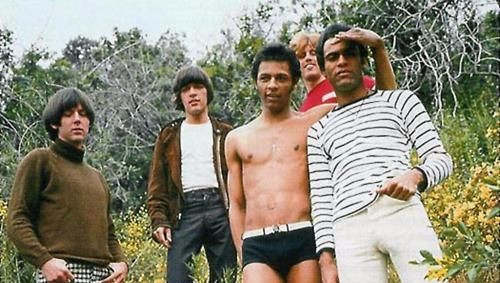
*Above image: Love, the Forever Changes lineup, in 1967. (l-r) Michael Stuart-Ware, Ken Forssi, Arthur Lee, Bryan MacLean, and Johnny Echols.
soundstreamsunday presents one song or live set by an artist each week, and in theory wants to be an infinite linear mix tape where the songs relate and progress as a whole. For the complete playlist, go here: soundstreamsunday archive and playlist, or check related articles by clicking on”soundstreamsunday” in the tags section above.
 There were only a handful of them, American rock bands in the late 1960s who sunk the kind of roots that North American progressive rock could grow from. Spirit was one of them, and by the time they released their fourth album in 1970, they’d covered enough territory that they managed to have both a pop single, in the garage rock monster “I Got Line On You,” and a back catalogue of albums critically respected for their sophistication in arrangement and playing. Although recently dwarfed by the attention given to their instrumental “Taurus,” which Led Zeppelin may have heard and used, probably unwittingly, for “Stairway to Heaven,” Spirit’s albums up through Twelve Dreams of Dr. Sardonicus are rich canvases that, some have observed, may seem too eclectic, don’t always sum the band’s talents as they could. So that when you look for a definable Spirit sound, it eludes definition. I can see this, but at the same time Spirit’s appetite for musical movement was its guide, a definable point not being the point at all.
 When the Polish band
  Like Rush, the
  Outside the fact both groups employed players of a violin/viola in their lineups at one time or another, and possessed songwriters of legend, you’d be hard pressed to find common ground for
 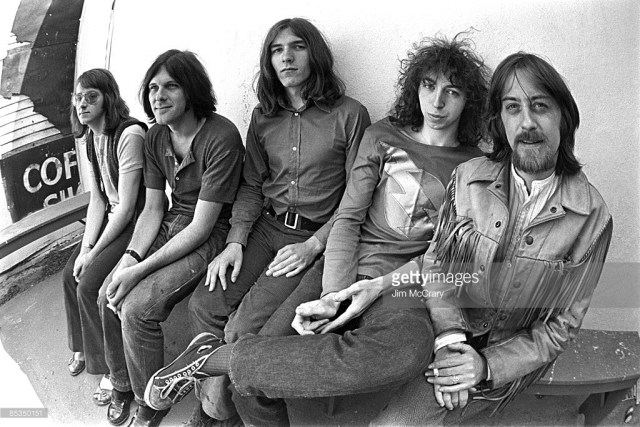 With deep roots in the mountains of north Georgia, young Hedy West presented authenticity and authority in her singing of old time folk music. By the early 1960s she had become a mainstay of the growing traditional music revival in America, having written the often-covered “500 Miles” and dazzling audiences with
 The embrace of Arthurian legend and Tolkien-esque fantasy by British musicians in the 1960s and 70s — fueled undoubtedly by mixing the sounds of the folk revival with psychedelics and horrified revulsion at an overly industrialized and de-personalized world — worked to create some truly exotic hybrids in a scene that had also been profoundly influenced by American blues music and the sheer power of electric instrumentation. But whether it was Donovan or Led Zeppelin or Uriah Heep taking on the Roundtable and Middle Earth, there tended to hang over this music a hippie haze that could just as easily turn towards the naively dumb as the innovative. (Spinal Tap’s “Stonehenge” sequence is funny because it’s so spot-on, and as a Zep and Rainbow fan I laugh, and squirm, whenever I see it.) Leave it to Pentangle to get it right. As Bert Jansch introduces “Hunting Song” as a “13th-century rock and roll song” on this stellar performance from the band’s 1970 BBC special, his is a voice of wry authority. A key figure in the development of acoustic guitar playing in the 1960s, and a songwriter who found inspiration in the dark power of traditional music, Jansch was a musician who masterfully summed the denominators of blues and jazz and folk music early in his career, and until his death in 2011 was a guitarist’s guitar player. While Pentangle could not be said to be Jansch’s band, as it also included a cast of equals including guitarist John Renbourn, bassist Danny Thompson, drummer Terry Cox and vocalist Jacqui McShee, they built on the ground Jansch cleared in the mid 1960s along with
  In 1977, the same year Jethro Tull recorded
 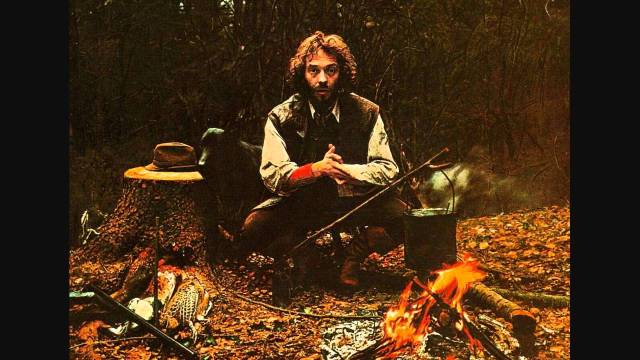 By 1977 Jethro Tull was beginning to wear out its welcome in punk-crazed Britain, but the band was still in its prime creative period. Since 1971’s Aqualung, Tull had been working toward a singular brand of progressive rock, fusing its blues and jazz leanings with the sound and presentation style of traditional songs to create, in the hands of Ian Anderson and his cracked, acerbic writing and vocalizing, an often wickedly pointed baroque folk songbag. Songs from the Wood gave full voice to Tull’s rural idylls, and provides a kind of bookend to what the
  Progarchy