
Who wouldn’t love this cover? Holy schnikees, it’s gorgeous. Admittedly, I’m a rather huge fan of Jerry Ewing. But, he’s outdone himself with this one. I’m drooling. . . .


Who wouldn’t love this cover? Holy schnikees, it’s gorgeous. Admittedly, I’m a rather huge fan of Jerry Ewing. But, he’s outdone himself with this one. I’m drooling. . . .
In the annuls of Rush history, Presto feels like one of a couple of forgotten albums. It drops right in between what many consider the end of the keyboard era and the start of the return to a more straight approach to rock music. However, the keyboards are not absent on Presto and in fact work really well and help elevate this album to being one of the band’s best.
Presto, released in 1989, is Rush’s 12th studio album and eighth to receive the expensive (at least to the buyer) re-mastered treatment – available this week. It’s the fourth release in the Super Audio CD format by Audio Fidelity. It’s also the third Rush studio album recorded in the DDD format – digital recording, digital mixing and digital transfer. It’s hard to argue a case for an overhaul but it worked well with Counterparts and Hemispheres
View original post 824 more words

Growing up in the 1980s, I was certainly well aware of MTV. I assume many of us here at progarchy were.
Now, music videos are more or less a thing of the past, but I still love this Rush video. Seems like they perfected the art just as it was dying.
Of course, tragedy would strike Rush very quickly after this, and Rush 2.0 wouldn’t emerge until 2002.
With one day left in 2014, enjoy this great video from 18. . . almost 19. . . years ago. Ridley Scott meets Monty Python.
Review of Bjorn Riis, LULLABIES IN A CAR CRASH (Karisma Records, 2014). 52 minutes. Six songs: A New Day; Stay Calm; Disappear; Out of Reach; The Chase; Lullaby in a Car Crash.

Without a doubt, my favorite Porcupine Tree song is “Arriving Somewhere But Not Here.” If you could take the best of that 12 minute song—its moodiness, its psychedelic atmosphere, its thundering bass and guitar, its surrealism—and expand it to 52 minutes in length, you’d have Riis’s solo album, LULLABIES IN A CAR CRASH.
Of course, you might also find yourself with a slightly less depressing version of Pink Floyd’s ANIMALS or THE FINAL CUT or a less religious and more nordic version of Talk Talk’s SPIRIT OF EDEN.
Whatever you’d have, you’d be listening to and holding something of intensity, struggle, and beauty. LULLABIES couldn’t be any moodier, frankly. In fact, if you’re feeling the holiday blues at all, don’t come near this album. If, however, you’re in a good state of mind, in a darkened room, wearing your state-of-the-art headphones, and sipping a vodka-tonic, then you’re a blessed listener. It won’t get better than this.
Indeed, this is the perfect early 1980s album, the type of album that you could (and probably will, even if you’re now in your 40s) listen to again and again and again, trying to immerse yourself in the very Riis-Hollis-Waters-Wilson atmosphere: thick, claustrophobic, and all-pervasive.
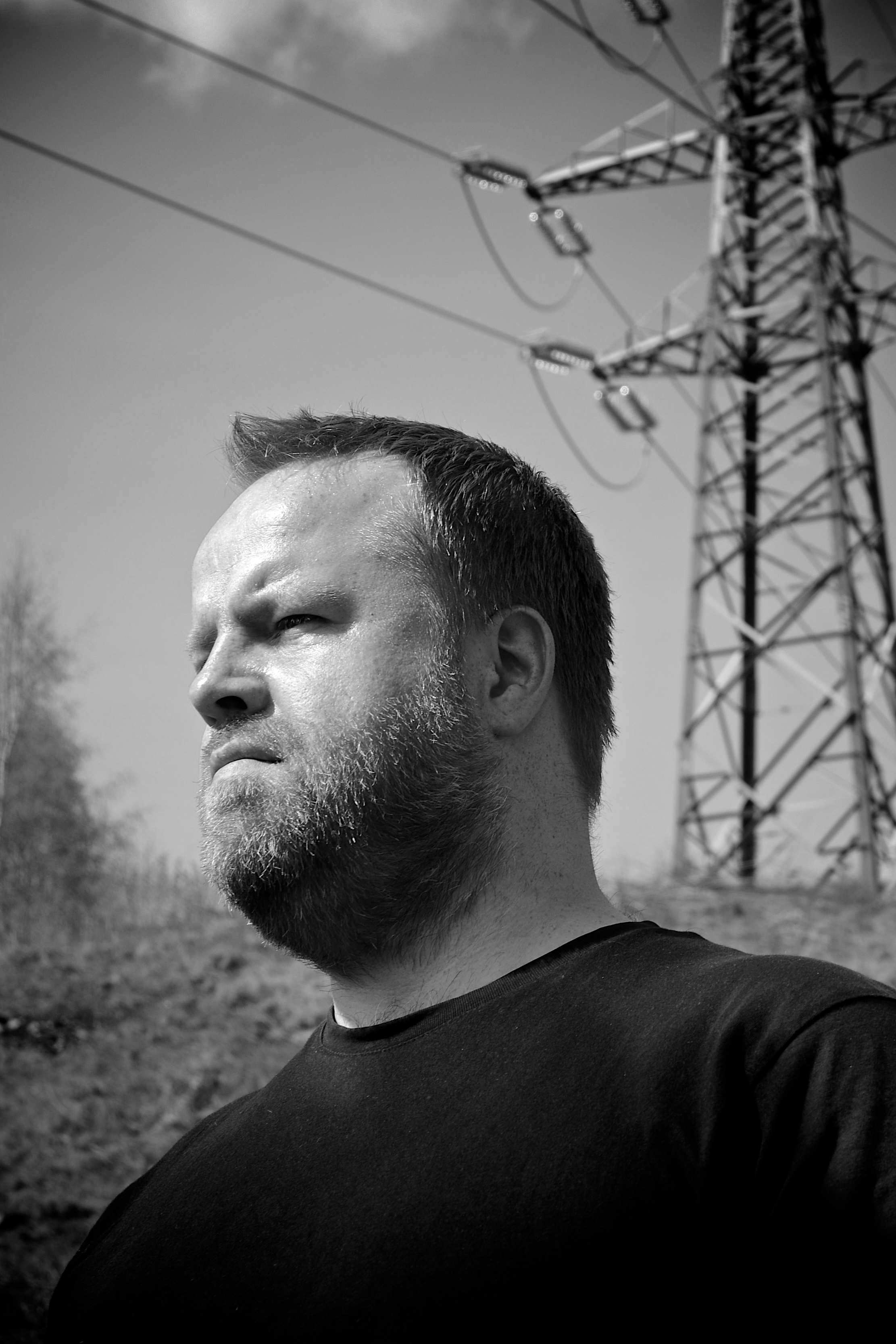
No one can avoid comparing Riis’s work here or with Airbag to Floyd and PT. Yet, there’s something distinctively Riis-ian, too. This is no mere cover band. By no means. In large part, Riis brings three critical things to each of his albums: 1) a haunting vocal style; 2) the uncanny ability to allow his music to flow, organically, as did Mark Hollis; and 3) an outrageously fine sense of audiophilia.
Of course, has there been a misfire from any Scandinavian prog release since Roine Stolt’s mind-bogglingly good THE FLOWER KING? Not that I know of.
Riis ably follows in this noble tradition.
To learn more, visit Riis’s official site: http://www.bjornriis.com/about/
The WordPress.com stats helper monkeys prepared a 2014 annual report for this blog.

Here’s an excerpt:
The Louvre Museum has 8.5 million visitors per year. This blog was viewed about 140,000 times in 2014. If it were an exhibit at the Louvre Museum, it would take about 6 days for that many people to see it.
I had no idea this thing existed until about 10 minutes ago. I really want one. Call me a materialist pig dog!
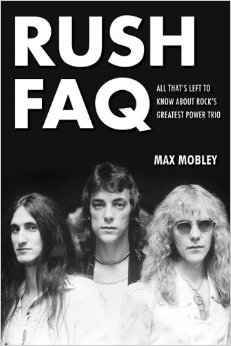 Don’t let the title–which has to be one of the worst titles in book publishing history–fool you. RUSH FAQ is an excellent book.
It’s not just one of the best books on Rush I’ve ever read (and I’ve pretty much read them all), it’s, simply put, a great book. Insightful, factual, captivating. Mobley can write like no one’s business. He’s a huge Rush fan, but he allows this aspect to become playful part of the book. I’m always a huge fan of good writing–whether it’s Dante or about the latest software upgrade for the Mac. This is excellent writing. And, frankly, it’s the equivalent in the book world of what BEYOND THE LIGHTED STAGE is in the movie world.
Why the title of the book? Not a clue. I ordered this assuming it would be a reference book, and I had almost no hope that I would enjoy it. What a happy shock I got when the UPS man delivered it. RUSH FAQ is so far from a reference book. . . it’s a great series of coherent essays. Love it.
I’ll write a real review soon. But, for now, order the book and enjoy.
The book: Max Mobley, RUSH FAQ: ALL THAT’S LEFT TO KNOW (Milwaukee, WI: Backbeat Books, 2014.)
I hope this isn’t obnoxious. . . but I want to let every progarchist (writer and reader) know that I’m very, very happy to return to the actual day-to-day editing of progarchy, along with Chris and Carl. I’m sorry I had to fade out of the scene for past few months, but I was really overwhelmed with work and family matters. Nothing is wrong–in fact, everything is going extremely well at work and with family. But, there was just too much to do for a bit there, and I let events overwhelm me. All has passed, and my life has calmed down.
And, now that all has returned to normal, I realize just how much progarchy means to me.
A huge thanks to Carl and Chris, my co-founders, for being patient with me, and for welcoming me back as an equal. So, as of December 27, we’re back to mutual editorial duties, though Chris said I can keep the title “Founding Father.” Granted, I’m no George Washington. . . but, I’m more than happy to have the accolade.
But, seriously, I hope you all (all y’all in Texas) realize how much I love this website and what it stands for. And, I’m incredibly proud of what we’ve accomplished in just a little over two years.
As I see it, sites like progarchy match the current music scene very well. Just as record labels are failing as the market continues to decentralize through the web, so I hope those establishment rags–such as Rolling Stone and NME–fall big time. This is the time of the entrepreneur and artist, not the time of the corporatized and tapioca-addled propagandist.
For all intents and purposes, WE ARE THE NEIL PEART generation, and we offer whatever nasty gesture we can at the establishment that has done so much to promote conformity rather than excellence.
Let us never sell our dreams for small desires!
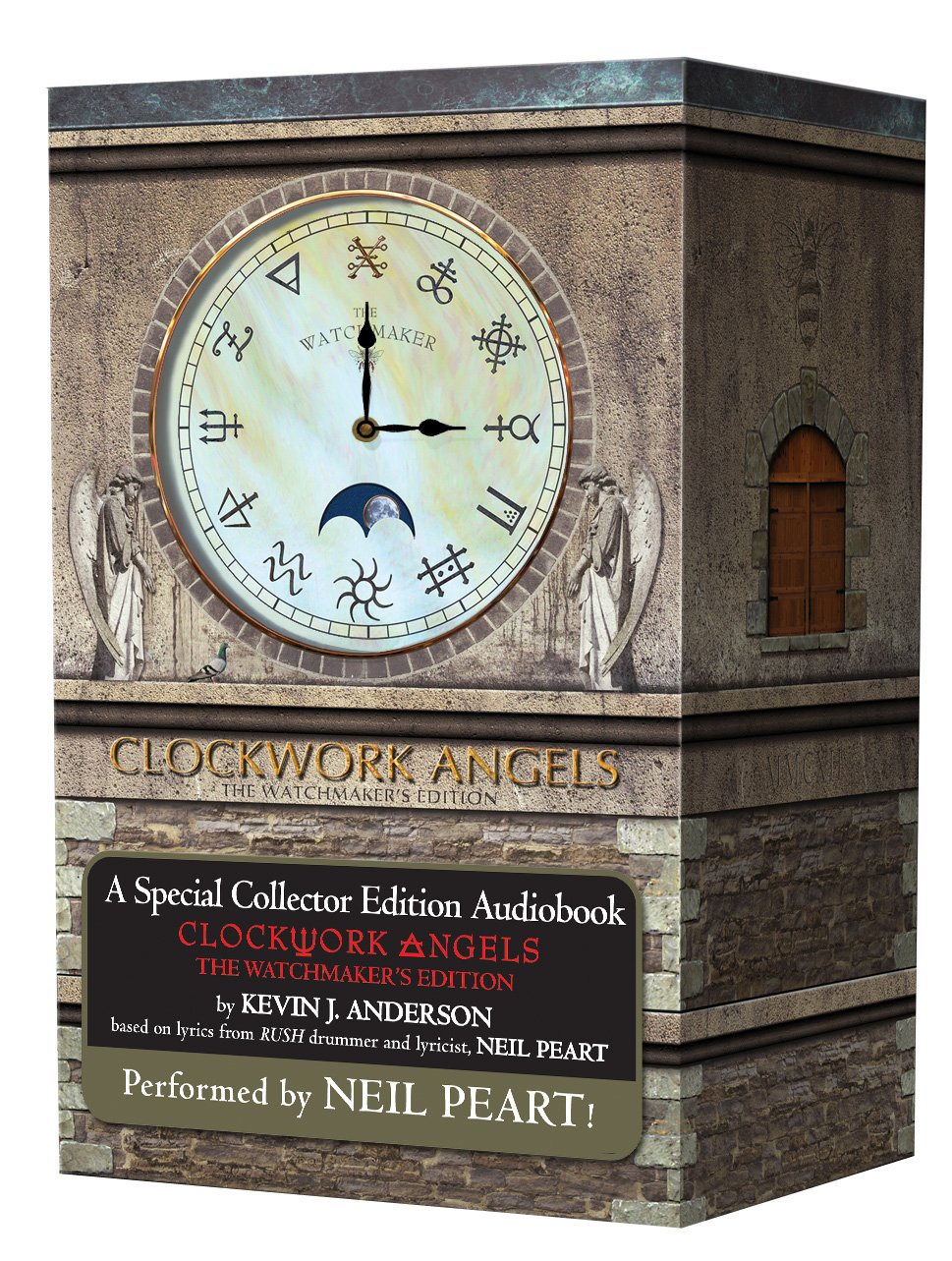
A review of Kevin J. Anderson, CLOCKWORK ANGELS: THE COMIC SCRIPTS (Monument, CO: Wordfire Press, 2014); from a story and lyrics by Neil Peart.
Birzer rating: 10/10.
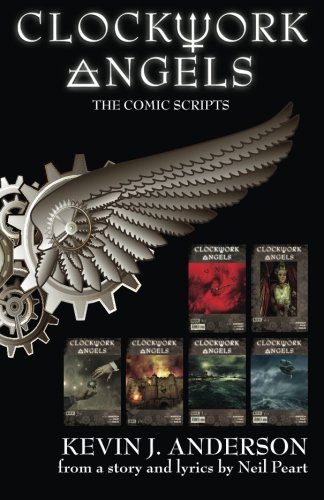
Two things need to be stated before I even get into the heart of this review. Well, ok, let me put this in active form, before my students yell “foul!” I, Brad, need to state two things before getting into this review.
First, one could write a long and interesting article just about the convoluted and circuitous publishing history of CLOCKWORK ANGELS. And, why not? What a fascinating history. In the beginning, CLOCKWORK ANGELS was an album by Rush (remember, though, the first two songs came out almost two full years before the album itself).
Then, it was a best-selling novel by Kevin J. Anderson and Neil Peart.
Then, it was a huge worldwide rock concert tour, a live album, and a live concert DVD.
Then, it came out from BOOM! Studios in comic book form, illustrated by the extremely talented Nick Robles, over six issues. These six issues, of course, will be released in graphic-novel form in the spring (April 2015) with, I’m guessing, an intro or conclusion by Peart.
Now, however, CLOCKWORK ANGELS has come out from Anderson’s WordFire Press as THE COMIC SCRIPTS.
Soon, there will be a sequel, CLOCKWORK LIVES, which Anderson has only recently happily finished with the equally happy blessing of Neil Peart.
It’s possible the whole cycle might start over with the sequel.
And, if Rob Freedman is correct, CLOCKWORK ANGELS will probably grab the fancy of some Hollywood producer, direct, and acting talent, and it will be made into a major motion picture. If so—and, let’s pray this happens—the script is completely written, the scenes already storyboarded by Anderson, a true master of the art.
Second caveat. It’s no secret—at least to readers of progarchy—that I’ve been following the career of Neil Peart very closely since the spring of 1981. Since the age of 13, Peart has been as much a part of my life as has Ray Bradbury, J.R.R. Tolkien, Mark Twain, T.S. Eliot, and the list could go on.

Since some time in the early 1990s, however, I can also state the same about Kevin J. Anderson. Among modern science-fiction writers, the only other person I’ve followed as closely is J. Michael Straczynski. I’m absolutely fascinated by their writings as well as the trajectory of their careers. Each is a expert of his craft and an imaginative perfectionist. Each is also very much in-tune with his audience and the possibilities the internet presents. And, as probably well known, each has advanced the cause of progressive rock in a variety of ways. Straczynski had done so by promoting the career of Christopher Franke and Anderson by writing with Peart, producing the story and lyrics (along with his wife) for Roswell Six, and through a myriad of other ways. Each, also, fully embraces the comic and graphic novel worlds. Straczynski tends toward horror and the gnostic, and Anderson tends toward science fiction and the mythic, but, otherwise, the two have a great deal in common.
So, these two caveats stated, let’s get back to Anderson’s latest, THE COMIC SCRIPTS.
Even from a cursory examination of Peart’s song lyrics, the story of CLOCKWORK ANGELS seems a nicely updated version of 1978’s HEMISPHERES. There’s the side of order, and there’s the side of chaos. The hero, choosing not to embrace either extreme, finds a via media, making his own path and his own choices. He finds, in reality, that his choices are limited, however, but choice does exist. So, free will exists, but it does so only within certain bounds.
Anderson’s novel offers a wondrous exploration of Peart’s universe. Employing the literary devices of utopia and dystopia, Anderson, a sci-fi demigod, gives the story a much needed and beautifully executed Tolkien-esque and Chestertonian fairy-tale ethos and atmosphere. We discover why the Clockmaker craves surety and the Anarchist disorder. We also discover why Owen must reject both and become, for all intents and purposes, the everyman version of Cygnus.
Not limited to lyrics for twelve songs merely, Anderson explores, lulls, mulls, and lingers. With his deft hand, the world of Owen and the CLOCKWORK ANGELS becomes rich, full, and tangible. Though many have labeled this world as Steampunk—a label neither Anderson nor Peart would deny—it is much more than Steampunk as well. The pastoral quality of parts is truly pastoral and adds the Tolkienian fantastic to it all. Indeed, Anderson’s best writing—while always superb—truly shines when he is detailing the cultures that arise in distant and rural landscapes.
Equally important, though, is that Anderson is not only a great friend of Peart’s, he’s also a huge fan of Rush (and Hugh Syme). These loves show in almost every word and on every page of CLOCKWORK ANGELS. For those of us obsessed with Rush, Anderson ably rewards the reader, throwing into his novel (and the comics, and, thus, THE COMIC SCRIPTS) Easter eggs galore.
What surprises me most about THE COMIC SCRIPTS, however, is how utterly and brilliantly visual Anderson’s imagination is. Frankly, after having read much of his science fiction and some of his detective fiction, I really have no right to be surprised by any of this! Anderson is a genius at nearly every level, but he is especially excellent in and at creating a MYTHOS around, behind, and near every one of his novels. There’s a reason major international serials praised his own renditions of the XFILES as some of the best sci-fi of the 1990s. Sure, the XFILES was a great TV show. But, Anderson’s skill made the characters and the MYTHOS a thousand times better. I suppose my surprise at Anderson’s ability to visualize and imagine is, if anything, an indication of my own lack of imagination.
Looking at THE COMIC SCRIPTS, one readily sees that Anderson anticipated and then directed every single panel of the comics. He describes the emotions on the faces as well as the technology that will (certainly) jolt the reader into a sort of glee. Anderson presents every aspect of the CLOCKWORK world in all of its alchemical madness and glory.
By describing every thing visually, Anderson paints an interesting portrait of this world that could tease the Rush fan and the sci-fi/fantasy reader without end. Some day, lit crit folks will have a field day deconstructing all of this. For example, per both Peart’s and Anderson’s desires, the reader never actually sees the faces of the angels. This must be left to the individual mystery and imagination. Or, one sees that the symbol of the order-loving Clockmaker is a beehive and honeybee. The beehive looks suspiciously like the symbol of Utah, the Mormons, and the former State/Empire of Deseret. Is this intentional? I don’t know.
Or, how about the description of our hero, Owen? He is truly everyman—“He is non-ethnically specific,” Anderson explains. He “should have darker/olive skin, dark eyes, dark hair.” Anderson describes the cities of his world as Manhattan with a twist of old Berlin with a huge touch of the art deco. Could this be Gotham? Metropolis? Dark City? Of course.
Ok, but what surprises me most? That Hollywood hasn’t snatched up Anderson in a major way. Holy Moses, this guy can think, he can write, and he can imagine.
So, should you buy this latest offering from Anderson?
Do you like Rush? Yes.
Do you like science fiction? Yes.
Do you like intelligence and imagination in your fiction? Yes.
Do you like the visual arts? Yes.
For me, THE COMIC SCRIPTS is another brilliant exploration of the CLOCKWORK world. But, even if you’d never heard of Rush or even if you’ve never read the novel or the comics, this is still well worth owning. Anderson’s writing is so good, and his visual imagination is so fascinating, that THE COMIC SCRIPTS could easily (and does) stand on its own as a screenplay or as an actual stage play.
I promise—you’ll be riveted from pages 10 to 253.
Enjoy. And, Merry Christmas.
 This just appeared through email:
Apologies from the band for a recent lack of email updates. Over the summer, the mailing list grew too large to manage using our Outlook email client and we were no longer able to send updates. We have now moved the mailing list onto purpose-built software and will be able to provide more regular updates.
Unfortunately, the failure of our mailing list coincided with the announcement of three Big Big Train gigs at Kings Place in London next year. All the tickets for these shows have sold out but we will be playing further gigs in future years and will ensure early warning via the mailing list and social media.
Big Big Train filmed live performances of a number of songs at Real World studios in August 2014. These performances will be released on Blu-Ray and DVD in the autumn of 2015. At Real World, the band were joined by Rachel Hall on violin and vocals and Rikard Sjöblom on guitars, keyboards and vocals. We are pleased to announce that Rachel and Rikard have now joined both the live and recording line-up of the band.
The band has written around two hours of new songs. Recording of these will be completed for album releases in 2016 and 2017. An EP, featuring three new songs, will be released in April 2015.
We would like to take this opportunity to wish you a Merry Christmas and a Happy New Year!
Andy, Danny, Dave, David, Greg, Nick, Rachel and Rikard
Big Big TrainFollow BBT on Twitter: http://www.twitter.com/bigbigtrain
Join the BBT Facebook forum: http://www.facebook.com/groups/bigbigtrain

 Progarchy