Farrokh Bulsara was born on this day in 1946; he died on November 24, 1991. Freddie Mercury would have been 70 years old if still alive today. From RollingStone.com:
To mark what would have been Freddie Mercury’s 70th birthday, Queen guitarist and actual astrophysicist Brian May announced that an asteroid orbiting around Mars and Jupiter has been named after the singer.
“I’m happy to be able to announce that the International Astronomical Union’s Minor Planet Center has today designated Asteroid 17473, discovered 1991, in Freddie’s name, timed to honor his 70th Birthday,” May said in a statement. “Henceforth this object will be known as Asteroid 17473 Freddiemercury.”
Not content with the Queen singer sharing his last name with a planet, May teamed with the International Astronomical Union to reveal Mercury’s asteroid at a Montreux, Switzerland celebration for Mercury, who died in November 1991, roughly around the time Belgian astronomer Henri Debehogne first discovered the asteroid.
Early Queen, especially “Queen II” (my favorite Queen album as a whole), incorporated many elements of progressive rock, featuring all sorts of interesting chords, time changes, and wild lyrical material. A perfect example is “Fairy Feller’s Master Stroke”, penned by Mercury, which is based on the singer’s obsession with the mid-19th century painting of the same name by English artist Richard Dadd:
“Innuendo”, the group’s final album prior to Mercury’s death, had some prog-gish moments, notably on the lengthy and adventuresome title cut, which featured a stunning flamenco guitar solo by the great Steve Howe:
Although Mercury was flamboyant and extroverted on stage, he was quite shy in private (and rarely did interviews), and some of his reflective nature is found in a large number of songs, including the rather gut-wrenching cut “Who Wants To Live Forever?”, from the 1986 album “A Kind of Magic”:
Collins, as you might recall, is a drummer and singer who once was part of a legendary prog-rock group. In recent years he has kept a low profile. Why? An August 17th piece in the New York Times catches up with Collins:
After decades as the drummer and post-Peter Gabriel lead singer for Genesis, as well as a commercially dominant solo run as the poster boy for pillowy ’80s pop excess, Mr. Collins retired as a not-quite-beloved rock elder in 2011. As with most musician goodbyes, the dormant period didn’t last. (Presciently, Mr. Collins had called his tour in support of the 2002 album “Testify,” his most recent release of original material, the “First Farewell Tour.”)
Since announcing his resurgence last year, Mr. Collins, 65, has performed at a handful of charity events, in addition to starting the process of reissuing eight of his solo albums.
The piece is a lead-up to an August 29th performance by Collins at the opening ceremony for the United States Open tennis tournament in Flushing, Queens. Collins explains that he’s been busy with family, recovering from “war wounds” including surgery on a bad back, which led to foot problems, which was then followed by some problems with his left hand. He’s also been working on a memoir, which appears to be quite open and honest about his failed marriages (three of them), drinking problems, depression, and such. Of his varied career, he says:
I think, with some critics, I became synonymous with an era of music that they didn’t like, and they were suspicious of all success, which is understandable. You end up painted into a corner that it’s impossible to get out of. I don’t lie awake and think about this, but I withdrew in 2005, and I think I was quite honest about why: I wanted to write myself out of the script.
When the reissued albums came out — which I was reluctant to do at first, until I found some way I could be proud of it — I thought, “This is exactly what I’d hoped for.” Of course, records sell differently now than when I was making them, so it wasn’t a question of cashing in. It was giving people a chance to re-evaluate this person that had become a whipping boy for the ’80s. I was so pleased that people were able to say, “I re-looked at this, and it’s better than I thought.”
All of which leads up to this video of Collins performing yesterday in NYC at one of my favorite sporting events, The U.S. Open (yes, tennis is a favorite sport; I own 68 rackets). The first song, “In the Air Tonight”, is very well done; note the drummer, who is Collins’ 15-year-old son, Nick. The second song, “Easy Lover”, is performed with Leslie Odom Jr. (“Hamilton”) and is utterly boring.
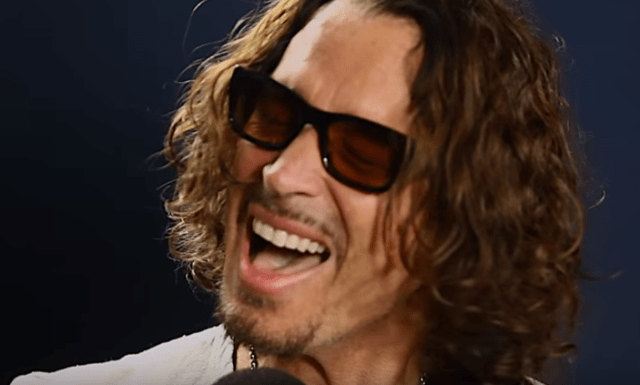
Nearing the end of his stunning two-and-a-half hour concert last night at the Hult Center here in Eugene, Oregon, a clearly delighted Chris Cornell noted that while he had enjoyed his two previous stops in Eugene, this particular night was “special”. He was quite right. I was at his October 19, 2013 show at The Shedd—a smaller and more intimate (that is, cramped) venue—and while it was a very good show, Cornell topped it last night with a generous mix of newer and older tunes—a total of 26 songs in all— the occasional accompaniment of Brian Gibson on keyboards and cello, and a vocal performance that rivals any I’ve heard from him—and I’ve listened to numerous live performances on albums and via YouTube.
Simply put, Cornell’s songs are demanding, requiring the sort of range, strength, stamina, and flexibility that very few singers can pull off on a regular basis. And there have been times when the strains of traveling and performing have taken a toll on Cornell’s voice, especially on Soundgarden tours. But the legendary singer and songwriter (Soundgarden, Audioslave, Temple of the Dog, solo) is, without doubt, in a wonderful place as an artist, making great new music and embracing his older songs with unashamed enthusiasm. Late in the set, introducing “Black Hole Sun”—a huge hit that he has sung countless times—Cornell mused that he didn’t understand why some artists end up “hating” those defining hits. “If you don’t want to sing it,” he said, “don’t write it and record it in the first place.” And then he tore into the song as if he had written it just last week, clearly thriving on the interplay between his acoustic guitar riffs and Gibson’s dynamic cello excursions. Continue reading “Rockin’ genius to the Hult: Chris Cornell’s magical evening in Eugene, Oregon”→
Yes, the title is an exaggeration. Perhaps it should be “albums no one admits to listening to or liking”! I’m sure there are plenty of others who like some of these albums. In fact, a few of these albums sold quite well. But reviews tended to be tepid, mixed, or worse. And in certain circles (yes, I’m looking at you, Rolling Stone magazine), most of these albums were either panned or scorned. Or they were simply ignored. (Deep question: “If Chris Cornell makes an album with Timbaland and no one listens to it, does it really exist?”)
The bottom line, I suppose, is that these albums tend to not fit comfortably into the larger body of an artist’s or band’s work. It might be that the album simply isn’t as good as other albums; or, it tended to be dismissed or downplayed because of apparent shortcomings or actual flaws. But, for me, these are often the most interesting albums, even if they are not the best albums. Just as really great people become more human and thus more fascinating when their flaws or failures are revealed or recognized, great artists reveal something in work that is “left field” or somehow not considered to be 10/10 material. (And, yes, I do consider ABBA to be a great band. Really. I’ll explain why soon enough.)
This post began with a comment on an interesting thread in respond to Craig’s post titled “The Place of an Artist”. Frankly, I enjoy that Progarchy.com usually avoids getting into various political and social debates; I spend most of my real work (as editor of Catholic World Report and writer for other outlets) addressing controversies, disputes, and dogfights over a wide range of issues. At the end of a long day of apocalyptic, to-the-death scrapping, it’s fun and far more relaxing to debate “Yes vs. Genesis” and “Jazz vs. Blues” and so forth.
That said, the topic of artists as commentators and/or activists is both compelling and important. And prog rock, which is the dominant genre discussed here, is known (overall) for lots of commentary on political, social, and even religious matters.
Anyhow, I initially wrote, off the cuff, the following:
I have to say, I nearly go nuts whenever I–being a die-hard jazz nut (with some 8,000 jazz albums)–have to listen to jazz musicians pontificate about social and political issues. I’d say that 96% of them have clearly never studied or read a lick of political philosophy or anything related to a meaningful understanding of principles, movements, issues, and such. It’s almost all group think and parroting the usual faddish nonsense. Of course, that sort of thing happens on both the left and right, but the arts tend to be dominated (and I think that’s an accurate term) by those who grovel before the altar of secular, neo-socialist, chronologically-snobbish, relativistic statism. So it goes. I say that if a musician wants to subject me to his views, then perhaps he might want to listen a CD of me singing operatic arias and Black Sabbath tunes.
(I should note that I actually only have about 5,000 jazz albums. Lost my head there.) I then decided to follow up with a more thoughtful response, which is as follows:
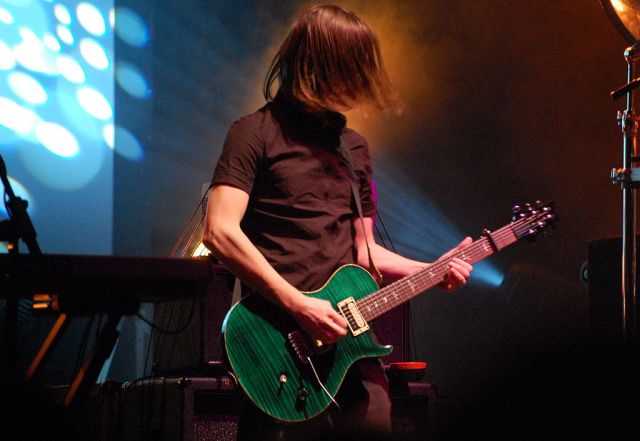
Steven Wilson live with Porcupine Tree at Arena, Poznan, Poland. 28 November 2007. (Wikipedia)
John Kelman of AllAboutJazz.com has written an excellent piece about the trajectory of Steven Wilson’s career, intertwining details about Wilson’s music, career choices, and closest collaborators:
I originally posted this a year ago, to mark the 99th anniversary of Sinatra’s birthday on December 12th. After reading this USA Today article on Sinatra’s influence on “the world”, I thought it made sense to re-post it to mark the centenary of his birth.
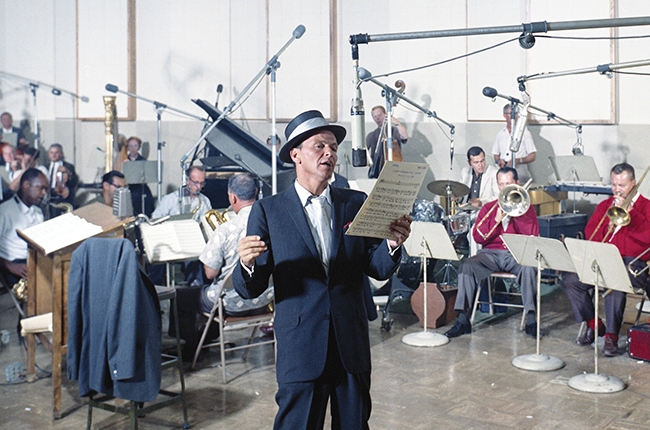
Sinatra in studio in the 1950s, during his Capitol years.
“Well, yes, of course,” you said, upon reading the headline. “Everyone knows that Old Blue Eyes was not just a crooner, but a prog crooner, and thus the grandfather of prog rock! Does it really need to be said again?” Yes, it probably should, despite the abundance of articles on the topic (ahem). Especially since today marks what would have been The Chairman of the Board’s 99th birthday if he was still among us. Sinatra was born on this day in 1915, in Hoboken, New Jersey, and would go on to be one of the best-known, best-selling musical artists of the 20th century, rivaled in sales and popularity by only a handful of artists and groups.
Now, to be clear, I’m not saying that Sinatra was a “prog rocker”. I might be a Sinatra fanboy—I have over 1,200 Sinatra songs in my iTunes library and listen to some of his music nearly every day—but I’m not insane. At least not that insane. What I am saying is that Sinatra did a number of things on the musical front that were either quite unique or very notable (and probably little known to most people), that pointed toward key elements and attitudes making up what we now call “prog”.
Well going through the actual lyrics on the record, I seemed to find a lot of recurring themes of love and heartbreak and the passage of time. Where were you drawing from emotionally and ideologically when you were writing the record?
I sort of let that happen kind of on its own and then I sort of have a better perspective on what it all means to me a couple of years later, usually [laughs]. It’s moods and ideas that just sort of occur to me is the best way to put it and I tend to not put that under a microscope too much and the closest that this comes to a concept record really is in that I wanted it to be stripped down and I wanted it to kind of feed this type of acoustic touring that I’ve been doing over the last several years and I wanted that to become a kind of a living thing with new music and generating new ideas, as opposed to always a look back.
So I think like anything else – like a Soundgarden album or like an Audioslave album, the lyrics are often and the lyrical ideas are often inspired by the music and by the mood of the whole thing. And that ends up in this case being love and loss and heartache and the things that everybody goes through.
Has your approach as a song writer changed much over the years or is it similar to how you first started?
I’ve always pretty much done the same thing, which is whatever works [laughs]. So, that is always a moving target I think. Whatever it sort of takes to feel like not only am I writing but it feels good and it feels like I’m writing something that means something to me. I don’t think I’ve ever had writer’s block, I think I’ve just gone through periods where I’ve written things that I don’t particularly like. I guess that’s what writer’s block is maybe, I don’t know. But for me the process is always a moving target. …
When you read a lot of the reviews surrounding the record so far, a lot of the talk has been about just how strong your voice is shining through. How do you rate your voice at this stage of your career? For a lot of artists it can go away and become weaker and for others who work at it it can get stronger and it seems to be the general consensus that your voice is almost as strong as it ever has been.
Well I think it’s different and I think that mostly to do with what I try to make it do and what I want it to do and what’s important for me that it does. You know my approach to singing and what I want it to sound like and the songs that I write are really very different than 20 years ago or 30 years ago even. Really I think it’s more of an artistic issue than anything else. But I also think that there’s a dedication to craft in a sense and maybe that’s not fair and everybody’s different but I think of singing – I approach it as an instrument because it is, it’s a reed instrument really.
There’s a lot of factors that go into creating the particular tones that you want to try to create. The same that there would be if you were a trumpet player or if you played strings or you played the saxophone. Over the years with the amount of experience that I’ve head I’ve figured a lot of things out and have become a lot more experienced and getting a lot more out of what I believe it can do – getting my voice to do things I didn’t think it would do. That sort of learning curve never really goes away.
The entire interview is well worth reading. (Soundgarden fans: the band is planning a 2016 album.) And, as a bonus, here is Cornell performing “Josephine” from the new album; I happen to know it is one of TimeLord’s favorite Cornell cuts—and rightly so!
John Kelman writes regular reviews at my favorite jazz site, AllAboutJazz.com–and he appears to have probably forgotten more about King Crimson than most of us know about the legendary (and still very active) prog band. Here is the opening of his detailed and excellent review of King Crimson’s THRAK BOX: Live and Studio Recordings 1994-1997:
After three years spent extensively focusing on its 1972-’74 lineup—documented over a massive 66 CDs, DVDs and Blu Rays (plus some additional downloads) on Larks’ Tongues in Aspic (40th Anniversary Series Box) (Panegyric, 2012); The Road to Red(Panegyric, 2013); and Starless (Panegyric, 2014)—King Crimson turns the clock ahead 20 years to an almost completely different lineup, a radically different sound and a far more unwieldy six-piece incarnation dubbed “the double trio” on THRAK BOX: King Crimson Live and Studio Recordings 1994- 1997. Like its predecessors, the box is part of the group’s ongoing 40th Anniversary Series, which began in 2009 with the release of new stereo and surround sound mixes of the progressive rock progenitor’s earth-shattering 1969 debut, In the Court of the Crimson King, its highly influential 1975 studio swan song for the ’72-’74 group, Red and the divisive album that series remixer (until now) Steven Wilson dubbed “the album that stereo couldn’t contain,” 1970’s now more recognized classic, Lizard. As usual, alongside the box sets come CD/DVD-a sets with the new mixes, original mixes, and a smaller collection of bonus material.
Unlike the three boxes from the past three years, however, THRAK BOX was constructed with a different purpose in mind. Those previous boxes—while each containing the studio (or more accurately, in the case of Road to Red, studio/live conglomeration) or live album that was its core raison d’être—focused more heavily on live recordings: largely audio only and ranging from low to high fidelity, and sourced from audience bootleg cassettes, soundboard recordings and full, professional multi-track tapes.
Recording technology had come a long way, in terms of portability, ease and cost in the two decades separating the ’72-’74 lineup from the double trio that expanded the ’80s Crimson lineup of guitarist Robert Fripp, guitarist/vocalist Adrian Belew, bassist/Stick player Tony Levin and electro-acoustic drummer/percussionist Bill Bruford with two younger newcomers: Stick/Warr guitarist Trey Gunn and another electro-acoustic drummer/percussionist, Pat Mastelotto. Both newcomers came to the group through associations with Fripp: his Guitar Craft classes and/or the King Crimson co-founder’s collaboration with singer/songwriter David Sylvian on 1993’s The First Day and/or its live follow-up, ’94’s Damage. Every note the group made was recorded…and in high fidelity. Releasing a box like the Larks’ Tongues box—which included every known note played by the band (more to the point: every known note recorded by the group, which was far from all-inclusive)—would not just be an absurdly oversized box that would dwarf those that came before, it would have served no real purpose.
The double trio represented a more decided return to being an improvisational band after King Crimson’s largely form-focused ’80s incarnation, of which only one of its three studio recordings has, thus far, received the 40th Anniversary treatment: 1981’s groundbreaking Discipline, which introduced an entirely different Crimson, featuring the group’s sole remaining founding member (Fripp) and the only holdover from the ’72-’74 group, (Bruford). But the double trio was still heavily predicated on structure—whether it was blistering instrumentals or some of the most radio-friendly songs Crimson had released to date—and so a box containing a large number of live recordings would simply have been overkill.
And so, instead, THRAK BOX is a set of 12 CDs, two DVDs (one audio, one video) and two Blu Rays (also one audio, one video) that tells as complete a story of the 1994-1997 King Crimson as any pathological Crimhead would need, ranging from the early early studio recordings that resulted in, as Fripp called it, the 1994 calling card VROOOM EP, which also suggested that this new incarnation was going to be, quite possibly, the densest, most angular and most flat-out aggressive Crimson yet, to (in addition to the 2002 remaster of the double trio’s only full-length studio recording) new stereo and surround sound mixes of 1995’s THRAK—this time done by current Crimson guitarist/vocalist/flautistJakko M. Jakszyk, with input and approval from/by Fripp.
As a longtime admirer of the musical magic of Soundgarden and Chris Cornell, I had high hopes for Cornell’s new solo album “Higher Truth”. I was not disappointed. On the contrary, the album exceeded my expectations; I think that TimeLord is right on the mark in giving the album 5 stars. I’ve listened to the album some 30 times or so now, and keep finding new aural delights, whether in the abundance of fabulous melodies, or the subtleties (yes, subtleties!) of the vocals and harmonies (all of them by Cornell), or the fabulous production.
On top of that embarrassment of riches, SiriusXM radio recently released a video, now going viral, of Cornell performing “Nothing Compares To U”, which was a major hit for Sinead O’Connor a quarter century ago (was it really that long ago? Yep.). Many folks apparently think O’Connor wrote the song, but it was actually written by Prince for his side project, The Family, and it appears on one of his hits compilations. Cornell, as he did with Michael Jackson’s “Billie Jean”, employs a more bluesy sound, augmented by cello and additional acoustic guitar. The result is dynamite:


 Progarchy