Let’s bring the prog back!

Dimo-Eye-Planet

“Let’s bring the prog back!”

That’s the rallying cry at the end of the new Sound of Contact email newsletter.

If you sign up for their mailing list, you will get a link to a free download of the instrumental version of “All Worlds, All Times.”

Here’s the close of the newsletter, with the rallying cry:

We’ve been promising you something good for free and now it’s here. The first of many cool things you’ll be able to hear about and receive just by being part of SOC’s mailing list. Previously unreleased, this instrumental version of part 4 of the song Mobius Slip is more like its original state when it was improvised in the studio and recorded in just a few takes. The band was jamming on the part 2 and 3 sections of the song when they just kept going and part 4 “All Worlds All Times” was created spontaneously. Dave Kerzner’s 2 minute+ keyboard solo at the end was also done in one take. This is SOC “in the zone” exploding with raw emotion and their progressive rock influences shining through. You can hear the intricate interplay between the guitar, keys and Simon’s distinct drumming. Lyrics were later written to this section to wrap up the story of the album. But the instrumental version has a life all its own. This is a gift to Sound of Contact fans and a big thank you for your support!
Note: Please don’t share the song with others or upload it to YouTube or anywhere on line. We ask you to simply tell anyone you know who might like it to sign up for our newsletter and they will be able to receive this song and more in the future. A big thanks from the band! Let’s bring the prog back!

The Sound of Sound of Contact

Simon Collins (SC) and Dave Kerzner (DK) explain the sound of Sound of Contact in their latest interview:

How would you describe your music to those that are yet to hear your work?

SC: We create mental atmospheres spanning a wide spectrum of sonic territory from ambient sci-fi infused Space Rock to vintage Classic and modern Progressive Rock. That said we all have a pop sensibility that really shows in our songwriting. Most importantly when all is said and done, the song is king. There’s a variety of moods and mental atmospheres here that we wish we could find more of these days, but there seems to be a void in music today. In a way, we’ve sub-consciously ended up creating the kind of music we would want to buy and love to listen to ourselves.

DK: Yeah, if you were to think of classic rock bands from the 70’s and bring forward some of the styles of songwriting such as dramatic chord changes, wide dynamic range and picturesque soundscapes fused in with a modern alt rock or even somewhat futuristic film score type sound you’d get an idea of what to expect from Sound of Contact.

You can also listen to Dave having a chat over at Epic Prog: [Part 1] [Part 2]

Dave really knows his prog. Watch him in action below on keys (and with Nick D’Virgilio on drums) at Progfest ’94:
 

Return of the Giant Progweed

Audioholics has an awesome interview with the band members of Sound of Contact, both collectively and individually.

Simon Collins says there: “The band I used to dream about when I was a kid has now arrived and I’m bloody excited about it!”

Oh yes. We are too, Simon!

Check out what Simon (SC) and Dave Kerzner (DK) say when they are asked about why they are doing prog:

SC: This band is exploring new sonic ground but also playing homage to some of our favorite music.  We don’t really look at it as just prog-rock.  There is pop sensibility in the band and it’s on the album, so we don’t look at it that way.

DK: I don’t have a problem being associated with the “prog-rock” label because that’s ultimately a good thing. We’d love nothing more than to do our part in helping to bring that adventurous, experimental and eclectic style back into the fold. I personally miss the excitement of new albums coming out with rich atmosphere, story, dynamics, mood and thought-provoking lyrics. I hope we see more and more of it to be honest. It’s fuel. Fortunately there are some classic albums of this genre to listen to and discover for people who are new to it. But it’s nice to offer new music of that nature to the world. To me it’s a form of giving back. This is what motivated me to want to make music in the first place. The art and beauty of it.

Dave Kerzner also gives the details there on his insanely great keyboard and synth collection:

  • Yamaha CP70
  • Kawai EP-308
  • Hammond C3 Organ with Leslie 122
  • Hammond L100 with Leslie 145
  • RMI Electra Piano
  • Arp Quadra, Solina and Arp 2600
  • EMS Synthi AKS
  • Oberheim 8 Voice SEMs and OBXa
  • EML 200 Modular
  • Serge Modular
  • Roland System 100
  • Sequential Circuits Prophet 10, Prophet 5 Rev 2 and Prophet T8
  • Wurlitzer 200A, 270, 140B
  • Hohner Electra Piano, Pianet N, Clavinet D6, Cembalet
  • Baldwin Electric Harpsichord
  • Vox Continental and Farfisa organs
  • Roland VP330 Vocoder
  • Yamaha EX-1, CS60
  • Rhodes Mk1, Mk2, Mk5 and Suitcase 88
  • Minimoog Model D
  • Moog Taurus I
  • Univox MiniKorg
  • Arp ProSoloist
  • Mellotron M400
  • Eigenharp Alpha
  • Haken Continuum Fingerboard
  • Yamaha Motif XF7
  • Nord Stage 2 73 and 88
  • Nord Wave
  • Prorphet VS rack
  • Yamaha FS1r
  • Kawai K5000r
  • Kurzweil K2600
  • Roland V-Synth rack and 5080
  • Korg EX 8000
  • Oberheim Matrix 1000
  • Arturia Origin

Whoa! Built for prog, I must say.

And don’t miss the cool interview over at Gigs and Festivals, where the guys reveal their favorite tracks on the Dimensionaut album:

SC: I really love ‘Cosmic Distance Ladder‘ as it is one of few tracks on the album that came out of pure jamming and chemistry. It captures the sound of our band in the sense it really highlights all of our musicianship and our ability as a band to create a mental atmosphere.

DK: It’s hard to pick one but if I had to then maybe ‘Omega Point’ would be my choice because it was done in only one take and the music just came out of thin air it seemed. We wrote the words around this jam in the studio and that has a raw energy to it that I really like. Plus the lyrics are a mind trip.

As for me, my favorite Prog Song of 2012 was Flying Colors’ “Infinite Fire.”

But for 2013, the track seemingly destined to take the title is “Möbius Slip“!

What more needs to be said? “Salvation found!”

The Spiritual Vision of Dimensionaut

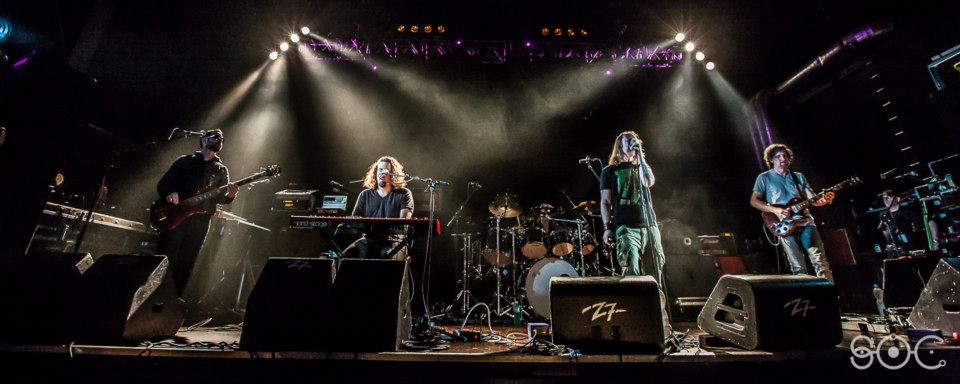
Sound of Contact LIVE at Z7 in Switzerland—Photo by Andy Wright

I have been contemplating the spiritual riches of Dimensionaut, the truly awesome prog masterpiece from Sound of Contact.

For me, the album does what prog does best, with that characteristically proggy ability to immerse the listener in a cosmic philosophical meditation.

To give another example: One of my absolutely favorite tracks from Big Big Train, “The Wide Open Sea,” does this sort of musical meditation stunningly well.

So, to encounter in Dimensionaut an album-length, equally successful exercise in that kind of philosophical and spiritual meditation, is a real thrill. And it’s an even more remarkable achievement if we consider that Dimensionaut is the equivalent of a vinyl double album.

Here is how I would slice it up for a deluxe vinyl gatefold edition:

SIDE 1:
01. Sound Of Contact (02:05)
02. Cosmic Distance Ladder (04:43)
03. Pale Blue Dot (04:44)
04. I Am Dimensionaut (06:25)

SIDE 2:
05. Not Coming Down (06:01)
06. Remote View (03:54)
07. Beyond Illumination (05:53)
[featuring Hannah Stobart]

SIDE 3:
08. Only Breathing Out (05:57)
09. Realm Of In-Organic Beings (02:52)
10. Closer To You (05:05)
11. Omega Point (06:30)

SIDE 4:
12. Möbius Slip (19:36)
I – In The Difference Engine
II – Perihelion Continuum
III – Salvation Found
IV – All Worlds All Times

If people approach Dimensionaut with an open mind, they will have to admit that this double album is an incredible achievement. Amazingly, it is prog that is accessible to everyone, and yet it does not shatter its integrity with any compromises.

All the negative reviews that I have read, and any reservations that I have heard expressed, stem simply from invidious comparisons, which are completely unfair.

Rather, if you clear your headspace of all preconceptions and genealogical obsessions, and just enter into the spirit of the music, the musical conclusion is inescapable:

With Dimensionaut, the Spirit ever lingers… undemanding contact in your happy solitude!

(I append below an interesting video in which Simon Collins and Dave Kerzner talk about the album’s story concept. They affirm that the musical journey explores not just dimensions of science fiction and romance, but most especially a serious spiritual dimension.)

Dimensionaut: Carry On the Awesome Prog

No son of mine?”

No way!

Simon does his dad proud with Dimensionaut, an incredibly satisfying new concept album that instantly and undeniably enters the running for the Top Ten prog albums of 2013.

And I am happy to report that the disc was created in my corner of Canada:

In 2010, Simon, Dave, Matt and Kelly went to record at Greenhouse Studios in Vancouver in different trio combinations with engineer Chris Holmes. The music and story of “Dimensionaut” was born.

Joining the team to mix the album was veteran engineer Nick Davis (Genesis, XTC, It Bites) who came from England to Canada to mix at The Warehouse in Vancouver. The album was mastered by Gavin Lurssen and Rueben Cohen of Lurssen Mastering.

In 2012 Simon Collins and Dave Kerzner found themselves working again on a Genesis song but this time it was by the invitation of Steve Hackett who was putting together his album “Genesis Revisited 2”. The album includes both Simon and Dave participating on vocals and keyboards for the epic Genesis song “Supper’s Ready”.

Hey… no wonder it sounds sooooo good!

This is great stuff, progarchists. Crank it up and enjoy it!

I am happily giving it my top rating — five stars.

Carry on, my awesome son

… we will have prog when you are done!

SOUND OF CONTACT – ‘Dimensionaut’

01. Sound Of Contact (02:05)
02. Cosmic Distance Ladder (04:43)
03. Pale Blue Dot (04:44)
04. I Am Dimensionaut (06:25)
05. Not Coming Down (06:01)
06. Remote View (03:54)
07. Beyond Illumination (05:53)  [featuring Hannah Stobart]
08. Only Breathing Out (05:57)
09. Realm Of In-Organic Beings (02:52)
10. Closer To You (05:05)
11. Omega Point (06:30)
12. Möbius Slip (19:36)
I – In The Difference Engine
II – Perihelion Continuum
III – Salvation Found
IV – All Worlds All Times

Check out the thoughtful review over at Power of Metal by Jason Spencer.

Radio Resurrection

Video Killed the Radio Star

Rocco Pendola argues that “Pandora has done more for local and indie artists in the last 30 minutes than the music industry has in the last 10 years”.

Further, he envisions a way that Pandora can really revolutionize the music industry:

Pandora can leverage the massive amount of data it collects—for example, what do people listen to and where do they live?—to do more local concert promotion, but also front the costs a band has to pay to get into local venues. And/or it can take over the chore of selling those tickets. Organize it as a massive contest. Make it a way of life. I don’t care. But set up a situation where Pandora does the dirty work for the local musician.

If it’s truly in Pandora’s DNA—and I know it is—if Pandora really cares about independent music—and I know it does—it will take the next step. There’s no reason not to. Pandora has everything to gain, nothing to lose. There’s little risk and much reward … if Pandora goes all-in with local music, starting in Hollywood and other major markets.

And his argument is worth reading all the way through to his conclusion:

If Internet radio—a rapidly growing and primary mechanism for spins, sales and promotion of music of all types—is healthy, artists of all sizes benefit. A healthy Internet radio can put more resources into providing the best user experience possible and sales and marketing, which will pump up local music scenes, sell concert tickets and drive digital record sales.

Internet radio—no matter how they pay their royalties (compulsory like Pandora or through direct deals like Spotify) and no matter how they deliver their music to listeners—needs to band together. They must form a bloc to expose the music industry for what it is—a short-sighted bunch of connected entities committed, more than anything, to keeping things exactly as they are, even as they see patterns of consumption and engagement change around them.

The Death of the Artist in Everybody’s Collection

Dan Flynn pays tribute to the greatest album cover artist ever, Storm Thorgerson, in “The Death of an Artist in Everybody’s Collection“:

His greatest critical if not commercial triumph may have come not with his pre-fame friends in Pink Floyd but with a similarly experimentally minded artist. Peter Gabriel didn’t name his early albums. Hipgnosis’s cover art did. The singer’s third solo effort, officially titled Peter Gabriel like the two albums preceding it, unofficially became “Melt” because of the arresting black-and-white image of the singer manipulated to look as though his flesh dripped off his face. Thorgerson created that one, as well as “Scratch,” in which Gabriel’s fingernails leave a trail of white streaks. Thorgerson’s car appears on—what else?—“Car” by Gabriel. Akin to The Beatles’ “white album,” Gabriel’s early releases go by the names the cover graphic bestowed upon them rather than their proper titles. …

If cassettes and CDs supplanting vinyl didn’t signal the end of cover art, then certainly digital downloads did. The LP record awarded Thorgerson a canvass a foot long by a foot wide. Steve Jobs reduced these visuals to roughly the size of a Starburst candy. Small is the new big. Something gained, something lost—what we reclaim in shelf space we miss in aesthetic beauty.

Storm Thorgerson understood visual for people who understood aural. He also knew when to die. Cover art, like the vinyl discs they protected, play about as vibrant a role in contemporary pop culture as the Victrola. Album art is sadly gone. So is the man who most excelled at creating it.

Vinyl Worship

big_big_train_-_the_big_difference_machine

Jason Notte reflects in “Where Music Gets Physical: A Boston Memoir“:

As much as music listeners dig cloud-based music and having their MP3s and channels follow them wherever they go, there’s still a desire for the physical, the ownable, the “real.” CDs don’t fit that mold anymore, as the digital files on them exist in far better form in far more accessible places. …

Vinyl, however, makes the argument for music as a religious artifact — an idol worthy of worshipping, rather than a ubiquitous score for life’s most mundane tasks. Putting music everywhere makes it permanent Muzak and makes quality an unnecessary luxury. …

With vinyl, it’s artists themselves that get the place on the pedestal. Buying records, like creating a library of books, isn’t just about entertainment or passing time. It’s about amassing knowledge and culture and putting them on display. Much as a bibliophile might reserve prime shelf space for classics or Pulitzer and Nobel winners, a record buyer reserves vinyl purchases for works of artistic, esoteric or sentimental value.

Use the Force — Listen to Prog

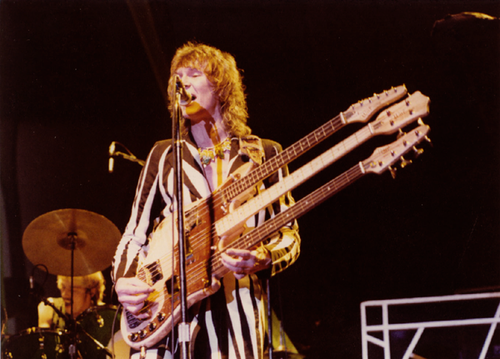
Chris+Squire+YesChrisSquire

Mark Judge has a nice meditation over at Acculturated.com:

Urban Outfitters now has a section dedicated to vinyl records. The one in my hometown of Washington is in Georgetown, and as I walked to it I had a flashback to the 1980s when I regularly went to any one of the three record stores around Wisconsin and M Streets to shop. There was a mediative, contemplative aspect to the process. You’d get into a kind of peaceful spiritual state as you browsed, awash in the album artwork, the music, and thoughts about love, art, and life. It was like praying.

The piece is called “Star Wars and Vinyl Records: Evidence That Technology Will Not Save Us”!

Record in a Bag

Hollerado’s new single is free from iTunes this week.

You’ll want to buy the whole album (Deluxe Version) of these upper-echelon Canuck indie rockers.

But be sure to download their previous bag of awesome tunes for free from their Web site: Record in a Bag.

O Canada!