Metal Mondays: Unleash the Archers delivers another concept album @UnleashArchers

The Georgia Straight has a great article on Unleash the Archers. In it, we discover that Time Stands Still is indeed a concept album:

… Brittney Hayes—aka Brittney Slayes, the vocalist and lyricist for the band—joins us at a Granville Street coffee shop to explain it to us.

“It’s about, basically, the struggles of being an independent band in Canada,” she says. Hayes is pleasantly nerdy and bespectacled off-stage, seeming more like a history geek—which she is—than a charismatic metal frontwoman. “It was all written before we were signed [by Austrian label Napalm Records]. Each song is about a different obstacle you have to overcome as an independent band.

“‘Frozen Steel’ is about metalheads in Canada, and how passionate they are, and how they would brave a winter storm to go to a show because they love metal so much.”

It’s a good bet, now that we’ve been given the magic decoder ring, that “Tonight We Ride”—which spawned a Mad Max–themed video, filmed in the Nevada desert using props from the Death Guild Thunderdome camp at Burning Man—is about facing up to the challenges of touring.

And the anthemic high point, “Test Your Metal”? “It’s about hometown heroes, really—about these bands that are so good but they just won’t tour or do anything. It’s like, ‘Get out there! Show them what you can do! You’re frickin’ talented, you’re incredible, why are you sitting at home playing to the same people every night?’ ” …
Metal Mondays: Megadeth — “Elysian Fields”

Gettin’ in the mood for the new Megadeth album

Wanna be doin’ it right here on Metal Mondays…

So here’s a Progarchy blast from the past for today’s metallic muse…

Roger Scruton on the Tyranny of Muzak

love-pump

From an interview last month with Roger Scruton:

CWR: You are a famous critic of modern pop music. How were you able to construct such a sympathetic and insightful portrait of one of the main characters in your novel, The Disappeared, who is both an ardent fan and performer of heavy metal music?

Scruton: I wanted to enter the soul of someone whose sense of his masculinity had been damaged, and who compensated through this kind of dramatization of the primordial male. I also think that metal is the creation of people with real musicality, who have developed the muscle of music as though by weight lifting, and lost that beautiful, inner, female thing, which is the sung melody.

CWR: How can young people be best introduced to good music at an early age? What is the optimal way to inoculate them against the adverse effects of bad music on their souls?

Scruton: I think it is very important to learn to sing in choirs, and if possible to learn an instrument, even if only the recorder or the guitar. To read music, to play for yourself, to sing melodically — all these establish the link between music and the inner life which will serve to inoculate the young person against the worst kind of musical influenza.

And now you can listen to an MP3 of Scruton on BBC Radio 4 on “The Tyranny of Pop.”

Keeping in mind that Scruton is talking about bad music, how is it possible to disagree with him?

UPDATE: the BBC transcript is also available.

On Chrissie Hynde’s life experience: “Reckless: My Life as a Pretender”

Joseph Bottum has written an excellent review of Chrissie Hynde’s new rock ’n’ roll memoir Reckless: My Life as a Pretender. Here’s a taste:

Chrissie Hynde clearly intends the book instead as an attempt to understand why she was so driven to seek powerful experiences.

To her credit, she indulges in none of the sentimentality that insists on risk-taking even as it demands that none of the risks issue in bad consequences. The narrative she lays out in Reckless is one of ceaseless motion. As a young woman, she saved up $500, bought a plane ticket to England, and dove headfirst into the nascent punk rock scene of the early 1970s. She sought what she imagined her Midwestern American upbringing had deprived her of, and she got it.

In England she had peculiar love affairs with Ray Davies and Iggy Pop, wrote music reviews, worked at clothing stores and other menial jobs alongside people like Johnny Rotten, did drugs with future members of the Clash, and got to know people in the London music scene from David Bowie to Nick Lowe. And all of it added up to . . . less than she expected. Less than she wanted. Less than she needed. The cool affect of her voice and stage persona were well earned. She had seen and experienced an enormous amount by the time she achieved stardom at age 27, but she never quite figured out how she was supposed to feel about it.

All the deaths along the way have made her realize, in the retrospect of a woman in her sixties, how reckless she had been—in the literal sense of the word: unreckoning of consequences. She was lucky not to have died herself, on several occasions. Lucky to have had success find her. Lucky to have met the people she met. Lucky to have had her parents. Lucky, for that matter, to have had opportunities for experience, however hard she had to pursue them.

That American cult of experience is an old one. I suppose it could be traced back to the pioneers, trailing off to the West—or back to the American Founding, for that matter. Such revolutionaries as Ethan Allen and Samuel Adams are hard to understand without it. At the beginning of the 20th century, the wanderings of Jack London formed a central part of his literary hero status, and after the Second World War, the cult of experience—the notion that many and varied experiences lie at the root of wisdom—reached new heights with the beatniks and their hippie successors. That’s the vision Chrissie Hynde pursued into the underground world of punk, and the vision she pursued in her music.

If you are interested in writing more on this topic — “What is the significance of the rock and roll quest for experience?” — then I encourage you to submit your own reflections on that topic (with reference to Chrissie Hynde, or to any other musician of your own choosing) in manuscript form to The American Journal of Semiotics for its Special Issue on Music.

Thieves’ Kitchen — The Clockwork Universe

Roger Trenwith has a great review of a great album; here’s a taste:

Amy Darby has one of those unaffected voices that trace a lineage of female contemporary jazz and folk singers back to Barbara Gaskin, Jacqui McShee, et al, and in places, even Joni Mitchell is brought to mind. The overall feel is of a decidedly folk-tinged Canterbury air, but fronted by the lush occasionally jazz, occasionally prog rock-styled guitar of Phil Mercy, who is certainly influenced by Steve Howe … and influences do not come much better than that. When Johan Brand is adding his best pounding Rickenbacker bass sound to the mix, then the “Yes go to Canterbury” bus is well and truly on the road, particularly so with the intro to Prodigy. Suffice to say none of this is plagiaristic or intentional, and the end result is Thieves’ Kitchen and no-one else.

An album to get lost in, the intricacy is combined with great delicacy on the baroque piano ballad Astrolabe and its instrumental companion, the beautiful closer Orrery, tracks that punctuate the longer vocal songs. Surrounding those two tunes we have all manner of complex instrumentation always delivered without bombast, complementing the theme of the album perfectly, which narrates stories of naturally imperfect human contact and interaction with precise science and technology.

The focal point of the album is the twenty minute The Scientist’s Wife, a tale of a spouse’s estrangement to her husband’s questing obsession, and a “long ’un” that fully justifies its length. The music drives along with purpose searching for the end goal in much the same way as the protagonist’s husband is striving for his own answer. It takes over five minutes before the “wife” makes herself heard, calming the building musical insistency to sing her lament for days past when she was the light of her husband’s eye, only to be slowly martyred on the altar of the grand experiment. Some lovely flute work from Anna Holmgren only serves to underline the melancholy…“When I sing, I sing alone; I’m fading to grey”. The experiment recommences, the band let loose amongst the unfathomable cogs and pivots. Some great guitar work from Phil bursts through the intricate turning mechanisms, before we return to melancholy, ending with “Charming strangeness, a beautiful mind” from Amy and followed by Anna’s sad flute. Quite lovely.

LSD and the best cover ever of “Bohemian Rhapsody”

LSD = Lake Street Dive.

This is totally hilarious and completely awesome. One of the greatest covers I have ever seen and heard! Hat tip to Carl for alerting us to this.

A few comments from Carl:

I discovered Lake Street Dive via the work of lead singer Rachael Price, who is a fabulously gifted jazz singer. While still in a teen, in 2003, Price received an honorable mention at the Montreux Jazz Festival’s International Jazz Vocal Competition and the following year she was a semi-finalist and the youngest competitor in the history of the Thelonious Monk Institute Vocal Competition. Despite her impeccable jazz chops, she never received the sort of adulation heaped upon female jazz singers such as Diane Krall. In 2004 she began performing in Lake Street Dive, consisting of classmates from New England Conservatory of Music in Boston: Mike “McDuck” Olson (trumpet, guitar), Bridget Kearney (upright bass), and Mike Calabrese (drums). The band was the brain child of Olson and was originally envisioned to be a “free country band” (!). All four members have a deep background in both classical and jazz music, and all four have made known their love for 1960s R&B, soul, rock, and related music. And, in fact, the band first started to gain traction when a self-shot video of their performance of Michael Jackson’s “I Want You Back” went viral.

So, hardly a prog band! But anyone who prefers their pop to be quirky, smart, occasionally edgy, often fun, and always played with impeccable chops and taste, Lake Street Dive is the band for you. And they do have fun taste in cover songs, ranging from ABBA to Fleetwood Mac to Hall & Oates (their version of “Rich Girl” is smokin’, as they say) and Paul McCartney.

Their cover of “Bohemian Rhapsody” is part of a series of Halloween vidoes they’ve produced in recent years. On one hand, it is quite campy (perfectly fitting for a Freddie Mercury classic) and quite fun, but also impressively sang and played, with some rather brilliant instrumentation. At the heart of it all, as always, are the harmonies and the lead vocals of Price. (Anyone interested in 3:30 of vocal bliss should watch her sing “What Am I Doing Here”).

Return of the Giant Phil Collins

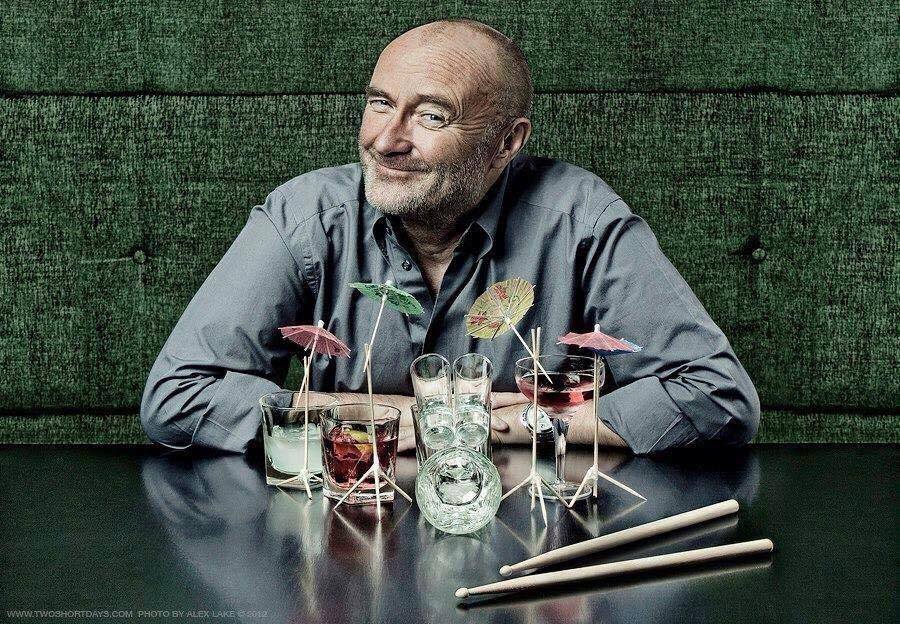
phil-drinks

He’s baaaaack

The musician also said he’s planning a new solo album and a tour. His last studio album was 2010′s collection of Motown covers, “Going Back.” Before that, he briefly reformed with Genesis in 2007 and released a solo album, “Testify,” in 2002.

He warned Genesis fans not to get their hopes up, though. Collins wants to see how the solo tour goes first.