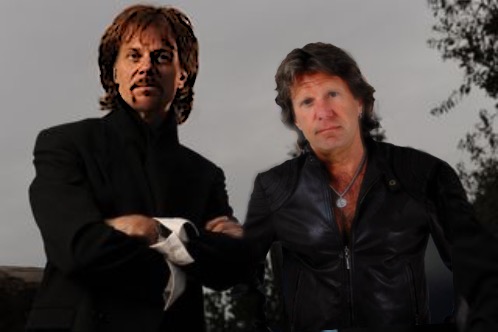
To be perfectly Franck

Franck Carducci“Where have all the great showmen gone?” I opined in Prog magazine earlier this year. In other words, who are the artistes that are taking that step beyond playing to offer a performance that also offers theatre, circus – and even a touch of Vaudeville?

The artiste who inspired this question has just been on vacation in New York – and I cannot think of a better place for him to experience a whiff of the greasepaint lingering close by on Broadway.

Before he goes to the Crescendo Festival in France on 21st August then plays further dates in France and the Netherlands next month to wow more audiences, ladies and gentlemen, let’s give a huge cheer for Franck Carducci, the Superstar Mad Hatter, whose musical stock is slowly but surely rising as he continues to conquer Europe in his own inimitable but never understated way.

Frenchman Franck has spent his career drawing on a range of musical and literary influences that now shape his music and, more importantly, his show.  A prog muso friend summed it up perfectly when he remarked at a recent show at how well Franck and his trusty band of musical adventurers have managed to devise a big show from relatively small but nevertheless dramatic components.

And there’s the secret of their success. There is no huge Roger Waters “everything but the kitchen sink” theatricals involved. Instead, there are cleverly designed costumes and a couple of randomly unusual instruments involved in their concert set pieces. The rest is down to an innate talent that blends elements of psychedelia, classic rock, prog and even six-part harmonies into a finely tuned and utterly compelling two hours.

Having first encountered Franck a couple of years ago in Southampton, his cheery, warm, friendly demeanour and total belief in what he does were both refreshing and highly contagious.

His influences include classical literature and history (he is big on the Ancient Greeks), classic rock, (one of his ambitions is to support Alice Cooper) as well as the prog classics, especially Genesis. In fact, one of his most memorable moments was supporting Steve Hackett, who told him not to give up on his dream then guested on his second album Torn Apart in 2015.

More significant breakthroughs came  last year, firstly when he and the band were greeted to a standing ovation at the legendary Loreley prog festival in Germany. This was quickly followed up in the United Kingdom, when, after the Saturday night headliners at the British prog festival, Summers End,  elected to go on early evening, several of us “in the know” implored everyone to stay to watch Franck and company.

The magnificent performance they subsequently delivered nearly blew the roof off the modest Drill Hall in Chepstow and prompted my Prog piece.  Further endorsement of their burgeoning popularity came earlier this year when they were voted Classic Rock Society’s Overseas Act of the Year.

So what’s the alchemy here? Well, Franck is primarily the band’s bassist and singer, but his onstage persona is that of Master of Ceremonies – with a twist.  His opening number, Superstar, sets the tone as he arrives on stage in shades, cowboy hat and outrageously hairy waistcoat, having to use his personal “security” man to fend off the advances of an amorous lady admirer.

The admirer is one of the many roles assumed by the very talented and beautiful Mary Reynaud.  She is traditionally the band’s support act as well as being an integral part of the show, especially her seductive dancing seldom seen elsewhere in prog. Her solo work – just her and her trusty acoustic guitar – demonstrates her  song writing skills and unique voice which is sweet and powerful in equal measure.

Included in the line-up is Franck’s long time friend and collaborator, guitarist Christophe Obadia, who is one of prog’s more eccentric personalities, acting as a great foil for Steve Marsala, who is the quieter and more sensible of the band’s guitarists.

Keyboard player and Franck’s “security guard”, Olivier Castan and drummer Antonino Reina (“he comes from Sicily”) complete the line-up.

The show simply could not work if there was not a great affection and empathy between the members of the all-star cast. For example, a mutual love of classic rock riffs sees Obadia and Marsala trading licks on some of the legends such as Smoke on the Water and Sweet Child of Mine.

The music is pure rock, fantastically infused with psychedelia and some delicious curios, for example, the use of a theremin without which Good Vibrations would never have vibrated. Mary’s invocation of its extraordinary sounds involves provocatively using certain parts of her body while Obadia’s oscillations are more shock horror than X rated!
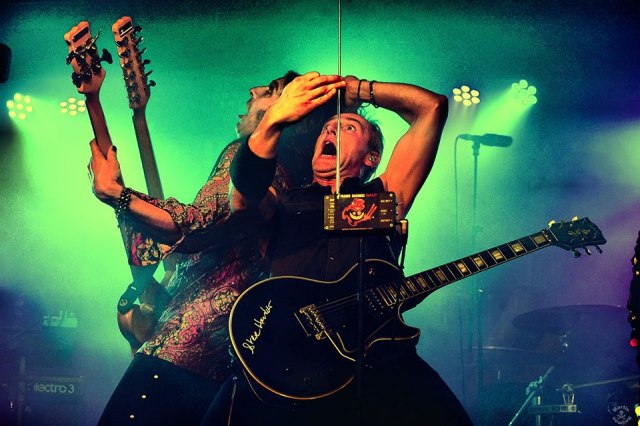
Theremin

Obadia oscillates

As well as her belly dancing solo on stage, Mary also has very differing starring roles in two of their most memorable songs. The recently introduced beautiful, bluesy ballad, The Angel, is a show stopper, Mary arriving on stage in her angel wings, lit by LED lights, which, when she spins, whirls into extraordinary patterns of colour.
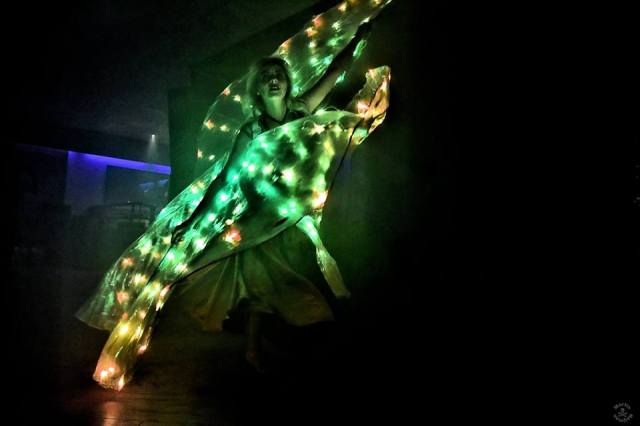
Angel Mary

The Angel Mary

Then there is Alice’s Eerie Dream, and where to start with this epic? As Franck in his Mad Hatter attire explains, this is the true story of Alice in Wonderland, when her adventures caused her to become a lady of the night.  It’s a long and compelling tale, Mary becoming Alice in her fabulous corseted dress and mask,  trying to seduce the band members in turn. But it is left to Obadia to finally fend her off, using the throaty strains of an enormous didgeridoo. Yes, you did read that correctly!

As well as classic rock, the band can also stun with their vocal dexterity in the brilliant six-part harmony of On The Road To Nowhere with just Franck strumming acoustic guitar as occasional accompaniment.

Their love of prog classics stretches to them delivering their own interpretations, Pink Floyd’s Eclipse giving a chance for audiences to exercise their vocal chords and more recently, they have introduced their own interpretation of Supertramp’s School with other members of the band taking their lead on vocals.

Well, that’s being perfectly Franck. He’s an entertainer, a showman, a musician, an actor and above all, a real star. Franck Carducci 1
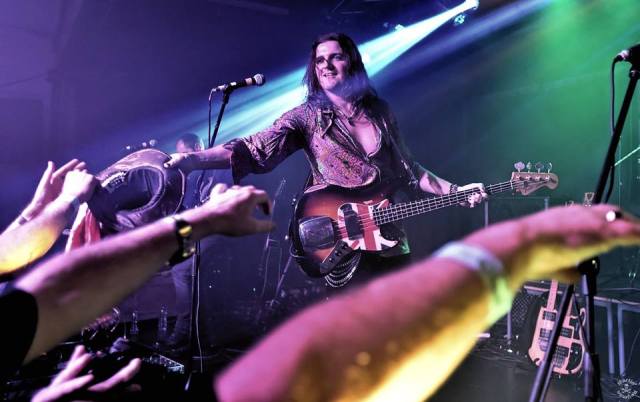
Photographs by Martin Reijman


Tears for Fears Tour 2019 – Fan Travel Info — Tears and Kooks International (Tears for Fears Travel Fans)

We hope this basic info will provide you with a reasonable hotel you can stay in while you travel plus links to the venue so you can explore and be ready for each show. Remember to take care of your travel documents such as passport and passport card. Keep your passport card with you at […]

via Tears for Fears Tour 2019 – Fan Travel Info — Tears and Kooks International (Tears for Fears Travel Fans)

Tom Timely Chronomonaut Video #4

Tom “The Elf King” Timely has released a new video–this one from August 1983.  He’s approaching Hawkins, Indiana, rather quickly.

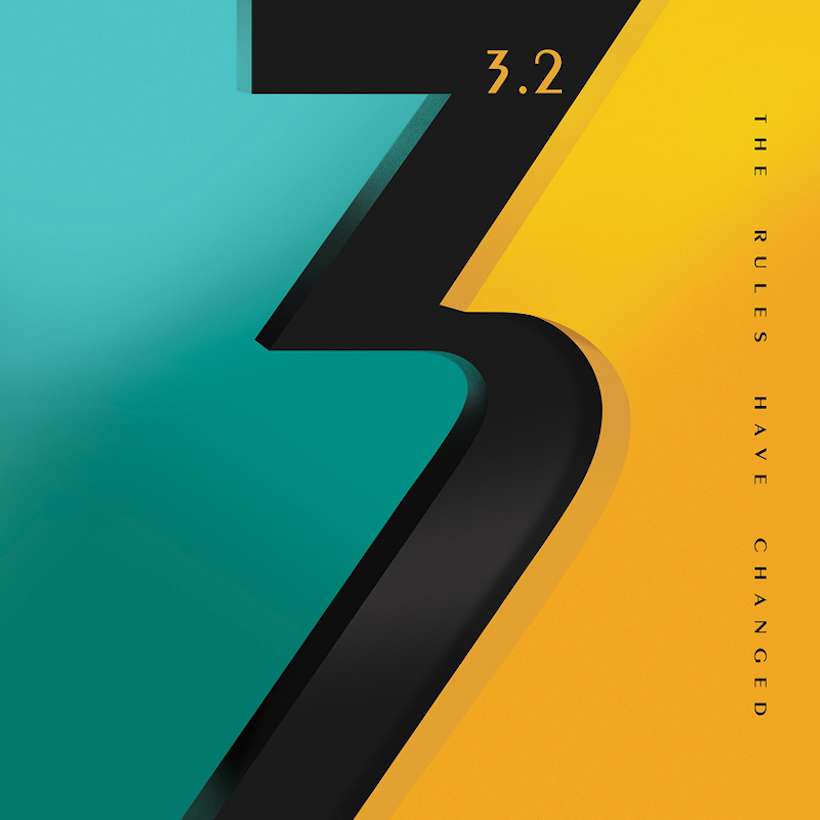
3.2, The Rules Have Changed: Rick’s Quick Takes

“And I hold the love of who you are
The passion your hands brought to my ears
The music’s blood became our bond
A good man, that we honor here.”
— Robert Berry, “Our Bond”

Robert Berry has pulled off something remarkable.  The Rules Have Changed, Berry’s new effort under the moniker 3.2, succeeds at a daunting task — paying deeply felt homage to the late, great Keith Emerson, whose shocking death thwarted the collaboration the duo were planning after 30 years apart.  Painstakingly crafted, packed with inspired musicianship on songs that tackle weighty, thoughtful themes — matters of life and death, in fact — it’s music created to touch the heart, and to last.

My first, astonished impression was how completely Berry assimilates Emerson’s style and sound, makes it his own, and takes it to thrilling new places.  True, there was already material to work with before Emerson’s death — an unused composition from the early days of 3, Emerson’s ideas that later formed the backbones of three more songs, as well as Berry’s Celtic-tinged “This Letter” and the upbeat single “Powerful Man.”

But beyond the achievement of playing every instrument himself — Carl Palmer-style drums, bass, guitar, and virtuosic keyboards — Berry is absolutely dialed in to what made Emerson’s music so special.  The eight songs here take expansive, unpredictable forms, launching inventive salvos of extended melody and harmony,  deployed in a dizzying mix of classical, jazz and rock idioms that shoulder each other aside with gleeful abandon.  Whether the tune’s a collaboration or a solo effort, Berry nails this every time.  All the classic Emerson colors are present and correct, too: lyrical grand piano; detuned uptempo boogie licks; spitting, sinuous Hammond organ lines; majestic multi-tonal synthesizer riffs and pads; and of course, lead Moog solos that will melt your face off.  (Berry’s no slouch on lead guitar and bass, either.)

Crafting lyrics to match the impact of this music had to have been an uphill struggle — but again, Berry has risen to the task.  He celebrates the sweet mystery of love for all it’s worth — love of parents and children in “Powerful Man,” love of a spouse, kids and grandkids in “This Letter.”  He confronts the challenges of leaving a legacy (“What You’re Dreamin’ Now” and “Your Mark on the World”) and time’s inevitable passage (“One by One”).  The title track, in memory of Magellan’s Trent Gardner, and the Emerson tribute “Our Bond” look loss, despair and death itself in the face, courageously grieving without flinching.  Even the ultimate question — does anyone guide our path? — turns up as the subject of “Somebody’s Watching.”  In sum, these lyrics are powerful, rich and mature, with nary a cliche in sight — exactly what was required.

I’m not exaggerating: this fine album pays the best tribute possible to Keith Emerson, taking the potential embodied in 3’s 1988 debut, To the Power of Three, and realizing it to the full.  Robert Berry never stood still after his halcyon days with Emerson and Palmer, as his solo albums, production work, and collaborations with Greg Kihn, Ambrosia, Alliance and December People attest.  Still, The Rules Have Changed may well be the achievement of his career; it honors a mentor he respected and loved and reveals his own talent and passion in action at the highest level.  Here’s hoping Berry can bring the planned international tour of 3.2 (complete with 3’s live guitarist Paul Keller) to a town near you soon!  In the meantime, listen for yourself:

robertBerry_keithEmerson

— Rick Krueger

Metal (and Rock) update – 7 August 2018 —Man of Much Metal

Just as I complete my mini-series, looking at the music still to come in 2018, I receive news of a whole host of new music coming our way throughout the remainder of the year. So, what better than an impromptu post that updates you on what I have found most interesting over the past few […]

via Metal (and Rock) update – 7 August 2018 —

The Mystery of the Three Quarters by Sophie Hannah — The Rockin’ Chair

Harper Collins [Published 23.08.18] This is the third novel from Sophie Hannah featuring Agatha Christie’s famous detective Hercule Poirot. It is the first one I have read by the author and I am pleased to report it does recall those classic Agatha Christie mysteries. ‘The Mystery Of The Three Quarters’ is set in 1930’s London, […]

via The Mystery of the Three Quarters by Sophie Hannah — The Rockin’ Chair

Triple Feature: Corque, Grill, and Hago — The PROG Mind

https://bandcamp.com/EmbeddedPlayer/v=2/track=3831457911/album=2316277551/size=large/bgcol=333333/linkcol=0f91ff/tracklist=false/artwork=small/

I offer some words about three exciting new releases.

via Triple Feature: Corque, Grill, and Hago — The PROG Mind

Blue Öyster Cult – Mirrors (Review) — HEAVY METAL OVERLOAD

Blue Öyster Cult had hit it big with 1976’s Agents Of Fortune but they were starting to sound like they were going through the motions by the time of 1979’s Mirrors. The slick Tom Werman production and generic songwriting displays little of the band’s usual esoteric adventurousness. The pastiche Moon Crazy should never have seen […]

via Blue Öyster Cult – Mirrors (Review) — HEAVY METAL OVERLOAD

LaserCD North American Preorder: RIVERSIDE

Screen Shot 2018-08-07 at 9.41.25 AM
Yes, a screenshot.  Just in case you thought we at progarchy.com weren’t classy.

LaserCD has been designated the official store for the North American release of Riverside’s forthcoming album, WASTELAND.  Thank you, LaserCD!

To order (and read the excellent editorial writeup), go here:

https://www.lasercd.com/cd/wasteland-import-mediabook-preorder

Soft Machine: The Jazz-Rock Years

Continuing the saga of Soft Machine, who’ve already kicked off a 50th anniversary world tour (coming to North America this fall), and whose new album Hidden Details can be ordered at Bandcamp.  Click here for Part One of this series, covering the band’s psychedelic years of 1966-69.

When last we left our heroes, quoting their website,

The base trio [of Mike Ratledge on organ, Hugh Hopper on bass and Robert Wyatt on drums and vocals] was, later in 1969, expanded to a septet with the addition of four horn players, though only saxophonist Elton Dean remained beyond a few months …

Cuneiform’s archive release Noisette reveals Soft Machine shaping a new sound onstage.  Recorded live at Croydon in January 1970, this quintet set is dominated by Dean’s and saxophonist/flutist Lyn Dobson’s uninhibited blowing.  The psychedelic song suites have nearly vanished; Wyatt only sings on “Hibou, Anemone and Bear,” where he’s given a completely solo moment, and material from the first two albums is exiled to the end of the show.

With Dobson out, the remaining quartet pulled together live recordings, studio inserts and tape experimentation to produce the four suites (one per side) on 1970’s double album Third — their first for Columbia Records.   Hopper’s “Facelift” and Ratledge’s “Out-Bloody-Rageous” sandwich upbeat jazz workouts (asymmetric rhythms, harmonized sax sections, fired-up, skittery solos from Ratledge, Dean and guests) between Wyatt-less intros and codas — avant-garde improvs, classical fanfares, minimalist cycling keyboard riffs.  Wyatt’s vulnerable, stream of consciousness epic “Moon in June” was the only vocal piece — and he played most of it (drums and keys) himself, with Ratledge and Hopper tacked on for the playout.  Ratledge’s “Slightly All the Time” is the most integrated piece here, with the core group and guests swinging over appealing grooves and ratcheting up the excitement via Ratledge and Dean’s solo work.

Rough-edged it may have been, but Third was perfectly timed; with Miles Davis’ Bitches Brew pulling jazz toward rock, Soft Machine was heading for the same destination from the opposite direction.  The album gained attention, kudos and sales across Europe and the US, and the Softs became the first band to play at the Royal Albert Hall’s classical Promenade Concerts.

Continue reading “Soft Machine: The Jazz-Rock Years”