Chronicle of a Progressive Woman Pt1–Alison Henderson

[Ed. note–I’m thrilled beyond words to share webspace and writing space with Alison.  She’s been one of my favorite prog writers for a long time, and I’ve found through correspondence she’s as spunky and witty as she is kind.  So, thank you for joining us, Lady Alison.  The pleasure is all ours.]


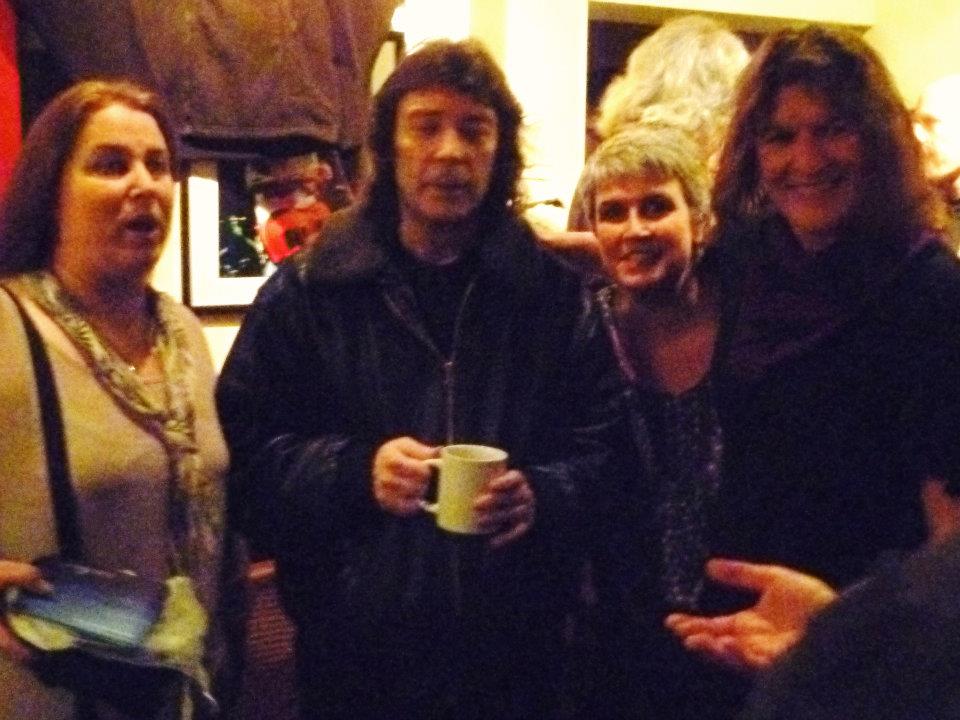
It never ceases to amaze me to this day how very few ladies love prog. Even in these “enlightened” times, it still seems as though we continue to be an endangered species but well worth preserving.

Though there is a thriving private Ladies of Prog Facebook group, here in the UK, the physical and spiritual home of prog, there is a relatively small group that make up the Sisterhood of the Prog. We all know each other, we get on really well together and we all share a passion for a very diverse range of bands.  From conversations I have had with fellow lady proggers, it seems that IQ and its offshoots are a particular favourite along with Frost*, It Bites, Steve Hackett and of course Rush (though the debate still rages on as to whether they truly are a prog band).

My  long standing joke is that there is never a queue for the ladies’ washroom at concerts: in fact at the classic Transatlantic concert at the Shepherds Bush Empire in London two years ago, I would guess there were less than 100 lady attendees among the 2,000 strong audience.

So I can only go by my own personal experiences of prog which started longer back than I care to mention and can be traced to a chance meeting with an older man on a family holiday in Majorca. I was 12: he was 15 for the record. He was  a huge fan of Curved Air who had just announced their arrival through their debut sensation Air Conditioning and on the strength of that, my first record purchase was Curved Air 2 from the proceeds of six weeks’s baby sitting. It was simply the whole package which appealed – that classic edgy sound with Darryl Way’s haunting violin and Sonja Kristina’s sultry singing being the real appeal.

So while my school friends getting steamed up over David Cassidy and assorted Osmondpersons, my prog world became full of astonishingly beautiful men with long hair and languid features who played just as spectacularly as they looked.  I also had a platonic male friend into prog who played me Meddle by Pink Floyd after which I wrote a very long prose poem based on Echoes involving a stranded submarine and astral projection. How I wish I had kept hold of it.

Along came Fragile and suddenly, life made perfect sense. Here was the music on which to build the soundtrack of your life. So I  retreated to my bedroom for the best part of three years to listen and learn from this extraordinary music, and tuning in every Saturday afternoon to Radio One for the weekly gospel of prog according to the Rev “Fluff” Freeman. He even wrote me a letter starting “Dear lovely Alison”  after I sent him an essay about the virtues of Patrick Moraz joining Yes.

So the foundations were set in prog stone in an early age, crystallised by going to see Yes for the first time on the Relayer tour and the subsequent seven or eight times in the various permutations. They will always be my prog torchbearers because of the way they have fused so many styles and influences to produce something totally original and memorable, well, at least until before June last year but that is another story.

There have been some long intermissions since because life does have a habit of getting in the way but the prog ideology within was always there, albeit temporarily snuffed out by circumstance.  However, Yes have always been there when the going got tough. I do remember listening to The More We Live/Let Go from Yes’s Union album and crying for the first few times I heard it because it reminded me of where I wanted to be rather than being in a very destructive marriage. And when that marriage broke up, Jon Anderson was there with In The City of Angels to tell me it was all going to be okay through Top of the World, For You and Hurry Home.

So prog has saved my life, restored my sanity and informed my reality every step of the way since.

In conclusion, how do I explain this eternal love of prog? Easy, really. The best music takes you on a journey and offers an experience which is both personal and profound. It lets you decide what you want it to be and every definition you give is right, because there is no wrong. It is all down to perception and interpretation, and the wonderful musicians who provide it never tell you how you should think or feel while listening to it. That makes all prog fans free thinkers who find their own level in the music and then celebrate it with other aficianados. It is a totally unifying force of expression.

And there is so much more. Without Sonja Kristina, I could never have had an early perception of what it means to be a liberated, independent and creative female. Without Jon Anderson, I could never have understood and interpreted the wonders of life then re-arranged them into a lifelong philosophy. In his words  and part of my mantra, “I count my blessings, I can see what I mean”.  And in Keith Emerson, and I shall keep it clean, I got to appreciate the more physical side of prog – and at last I finally got to see him with Lake and Palmer two years ago. That is now more or less the full prog set seen live.

Prog has been my life, my philosophy, my fun and my passion. That I can write about it now is a dream come true and also getting the chance to finally meet some of the legends that make it. It has been so influential in shaping who I am and the way I think. And so far as I am concerned, prog rock chicks will always like it over 20 minutes long with a three weird key changes, an undanceable time signature  and an organ solo. My case rests!
A Guest Post–One Journey to Prog

[N.B.  This was a comment that appeared for approval, and I was so taken with it, that I thought it would make a great post.  Hope you agree.  And, welcome to Erik and a huge thanks to you for taking the time to write]


by Erik H.

I’ve been waiting to find time to answer this post, now I finally have it. I can state, with great precision, the time and place that the prog gene became irrevocably encoded into my DNA (or awakened from dormancy, if you will): June 23, 1979, approximately 9 PM to midnight, Rupp Arena, Lexington, KY. I was a few days past my 15th birthday and had in my hands one of the presents I received – a ticket to see Yes in concert. They were touring in support of Tormato and on their 10th anniversary. The stage for the show would be ‘in the round’, a revolving stage at the center of the arena.

I knew very little about Yes at that time. In school, a month or so prior when the concert had been announced, some friends there had assured my I should go and that it would be worth it. I casually mentioned to some in my family that I would like to go, and it was taken as the hint it was, resulting in the ticket I later received. Still, I hadn’t really sought out to listen to any Yes prior to the night of the concert and knew very little of what we call ‘prog’. Unbeknownst to me, I actually had one prog album in my collection by then – ’2112′ by Rush, but I nevertheless did not know much about any genre of prog. I just knew I liked that album without wondering if there was more music like it.

So off to the concert I went that night, not having any huge expectations other than to enjoy myself and have a good time listening to a band play some music. You could say I got much more than I bargained for, in a good way – and in a life-changing way. Simply put, I was blown away. This wasn’t just a rock band, and this wasn’t just a rock concert I was witnessing, it was something completely on another plane. While I was unfamiliar with their catalog at the time, I clearly remember them playing ‘Future Times/Rejoice’, ‘Heart of the Sunrise’, a great acoustic guitar solo by Steve Howe, and the dreamy harp/organ section of ‘Awaken’. It was quite apparent that these guys were significantly more talented than most other rock musicians out there, and quite apparent that the guitar, bass, and keyboards were particularly unique relative to any other music I had ever heard. Thankfully, this would only be the first of six times I would have the pleasure of seeing Yes in concert.

Leaving Rupp Arena that night, I was not just impressed, but I was *hooked*. Within a year I had every album between ‘The Yes Album’ and ‘Tormato’, and was anxiously awaiting the release of Drama (although saddened that Anderson and Wakemen had left by then). But Drama impressed me quite a bit as well.

During the same period, I became familiar with some of the other popular progressive rock bands of the time, acquiring albums by Pink Floyd, Jethro Tull, ELP, and more Rush. As the years went by, my search for more progressive rock led me to some of the neo-prog bands of the 80′s and into the back catalog of other 70′s prog bands I had previously missed, such as Gabriel/Hacket-era Genesis, Rennaissance, various solo works, and so on. And in the last decade plus, thanks to the internet, I’ve run into the happy problem of discovering that there is more prog out there than I will ever be able to listen to in my lifetime.

There is plenty of other music that I like and have listened to over the years outside of prog. But prog is still unequivocally my first musical love and will remain so until the day I die, and I can trace it right back to the fateful Saturday night in Rupp Arena.

A Pilgrim’s Prog-ress

I balked for a few moments at the temptation of writing an indulgent, long, complex, and idiosyncratic post about my journey to and into prog, and then realized: hey, this is Progarchy.com! If I cannot string together tenuously-related, semi-mystical concepts and conceits imbued with mythical overtones, quasi-autobiographical meta-narratives, and intertwining (and purposely confusing) philosophical musings here, then what’s the point of this wonderful blog? (No need to answer that, as I’m already soloing  on my inner Moog without regard for the boring 4/4 time signature others might wish to force upon me.) Actually, much of what follows was already presented in a long-ish comment I left on a previous post below. But Brad, as he often does, inspired me to do more, even at the risk of embarrassing the shy and retiring Olson clan. So here goes.

I was oddly oblivious to most music until my early teens. This was due in part to being raised in a Fundamentalist home and church, both of which largely frowned on rock music as the rhythmic spawn of the devil, meant to corrupt good morals and encourage bad haircuts. Yes, the stereotypes do hold, at least to some degree.  I heard a lot of church music (classic Protestant hymns, some of them very good) and mostly bland to bad contemporary Christian music. Then, around the age of fourteen or so, I started listening to the radio (one station, weak signal) and began to slowly accumulate a few tapes. My road to prog went through AOR acts such as Journey, REO Speedwagon, Loverboy, Foreigner, and Styx, with a helping of popular mid-80s albums by ELO, Elton John, Toto, and Queen. I found the standard rock of the day (including some of the stuff above) to be rather dull; I was fascinated by the more extended songs of Elton (the early 1970s albums especially), Queen, Asia, and the Moody Blues. I’m happy to say I was hooked on “Bohemian Rhapsody” long before “Wayne’s World” re-presented it to my generation. Also, I thought the usual popular, party music about sex, drugs, and rock ‘n’ roll was mostly shallow, even if occasionally diverting. Which is another way of saying I secretly listened to my share of Van Halen while playing some laughable air guitar (oh, wait, all air guitar is laughable). I did not, however, ever party. Seriously.

Around 1985 or so, I bought a copy of “The Best of Kansas”. That opened the door to prog. There was something about the mixture of Livgren’s lead guitar, Steinhardt’s violin, and Steve Walsh’s amazing voice, along with lyrics soaked in spiritual longing and Americana, that grabbed me by the scrawny neck. Over the next three or four years, I ended up collecting everything by Kansas, Kerry Livgren (solo and with AD), and Steve Morse (solo, Dixie Dregs, etc.). My favorite Kansas albums are “Song for America” and “In the Spirit of Things”, although they weren’t the chart-toppers that “Point of Know Return” and “Leftoverture” were. I also went on a serious Moody Blues binge, focusing on the early stuff, prior to their more pop-oriented work of the mid-’80s. Then I really got into Yes (both Rabin-era and the early classic albums with Howe), Rush, and Pink Floyd; in fact, while in Bible college (1989-91), I freaked out some of my more staid classmates with my obsessive interest in Pink Floyd, Queen, Queenrÿche, and King’s X (and, yes, I also listened to Petra, David Meece, White Heart, White Cross, Russ Taff, and Margaret Becker). King’s X was a major revelation, especially the brilliant, crunching, melodic beauty of “faith hope love”, which was a masterful blend of hard rock, metal, prog, blues, and Beatle-esque harmonies. And I recall very clearly driving across the Montana plains to school in Saskatchewan, blaring “Fly By Night” and other brilliant Rush tunes. Ah, to be young again.

A quick aside here, in the spirit of musical indulgence: while in high school, I also developed a semi-secret soft spot for country artists such as Johnny Cash, Johnny Horton, and Jim Reeves. And two composers: Mozart and Brahms. I tried to get into opera (our family doctor, who owned a massive classical collection, gave it his best shot), but couldn’t get there. I would try again in the late 1990s, failing again. And at one point I must have listened to Eric Clapton’s 1989 comeback album, “Journeyman”, about a thousand times. Go figure, as it’s the only Clapton album I’ve ever fixated on. Okay, back to prog.

In my early-to-mid twenties (1989-1995), I launched into Van Morrison, Seal, Jeff Buckley, Radiohead, and jazz, five of my big musical loves ever since (I’ll eventually write some disturbingly long posts about each, I hope). My interest in prog advanced in fits and starts. Yes was a constant, as I worked through most of the band’s catalog, with excursions into solo projects by Jon Anderson, Trevor Rabin, Rick Wakeman, Bill Bruford, and Steve Howe. The next big breakthrough was Dream Theater in the late 1990s, followed by Spock’s Beard, then Porcupine Tree and a bunch of others. Then, around 2004, I “discovered” Frank Sinatra, which led to the purchase of about 1,000 Sinatra tunes (favorite album: “In the Wee Small Hours”). I mention Sinatra because I have the semi-crazy idea of writing a blog titled, “Sinatra: Grandfather of Prog?”, that will either get me ejected from Progarchy, or enshrined in the Progarchy Hall of Fame.

I fully agree with Brad: we are living in a new, golden age of prog. There is such a stunning array of prog and prog-ish music to be had, I’ve long given up hope of keeping abreast of it all. Current favorites, in addition to the already mentioned acts, include Pain of Salvation, Threshold, Riverside, Muse, Animals As Leaders, Big Big Train, Anathema, Devin Townsend, Three, Astra, Blackfield, The Pineapple Thief, King Crimson, Headspace, and Mars Volta. But there are still huge holes in my prog knowledge and experience. I’m making prog-ress, but the road continues to rise and wind ahead. Which is exciting, as it means there is more to discover and hear.

High praise from a brilliant man, Blake McQueen

From Blake McQueen of prog outfit and class act, Coralspin:

Progarchy is a new US prog site that’s made a big splash already in only a few days of existence. This is not surprising as it’s headed up by that indefatigable trailblazer for modern prog (especially British modern prog) Brad Birzer. There’s even a review there of us…

http://coralspin.com/2012/10/16/progarchy/

Thanks, Blake!  I’m eager to tell my students about the trailblazer part.

Mini Review: Van Morrison’s Astral Weeks

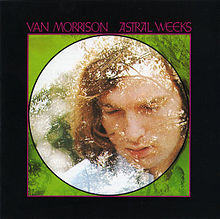
ImageVan Morrison, Astral Weeks.  1968.  This album is an insightful and penetrating introspection without ever falling into pure naval gazing.  And, nobody writes better about the beginnings of love than Van Morrison.  Possibly there exists something profound in the Celtic soul.  Chesterton argued that the Irish were those the Gods made mad.  Perhaps, this explains something.  Or not.  As I understand it, the album was done in only three sessions with the jazz musicians–who had never met one another–being given the music when they entered the studio.  Happily, it possesses of the overproduced pop sound of its predecessor, Brown Eyed Girl.  Astral Weeks is perfect for an autumn day.  Or, really, for any day.

Gig Review: Adventures In The City Tour

A write-up of last week’s York gig from Touchstone and The Reasoning‘s Adventures In The City tour is on my journal page at last.fm. Here’s a short link to it: http://bit.ly/adventcity

Inheriting Fine Words

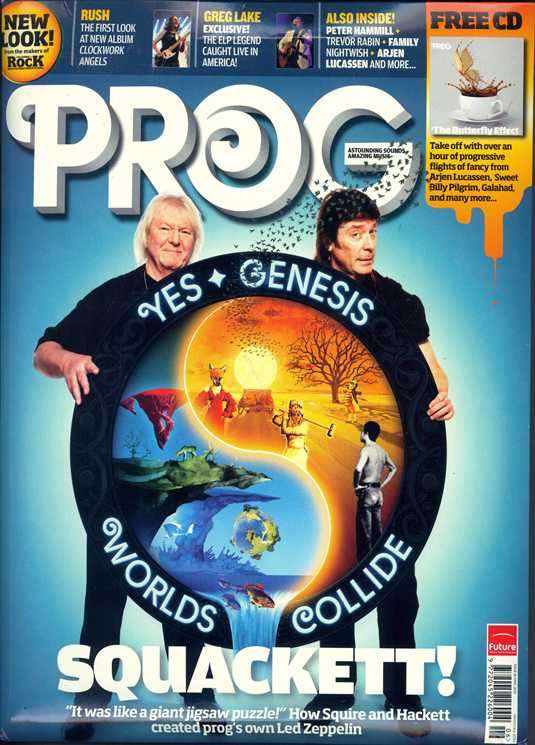
Image[I sent this to PROG magazine last May; sadly, the magazine chose not to print it.  So, here it is, now safely lodged at Progarchy.–Brad]

May 24, 2012

Dear PROG,

Kudos for yet another brilliant issue (#26). I’m amazed and inspired by the sustained excellence in writing, photography, graphics, and layout. I even like the ads. Every thing in its right place and always accomplished with characteristic British taste, intelligence, and wit.

Having listened to progressive rock for four decades, I am firmly convinced that we are now living in the glory days, built upon the traditions and experiments of the past. Raised on a healthy diet of lyrics by Neil Peart and Mark Hollis, I’m especially taken with the quality of lyric writing in recent years. How can we listen to Big Big Train’s “Underfall Yard,” Gazpacho’s “Dream of Stone,” or Tin Spirits’ “Broken” and not realize that these artists are the heirs not only of Dvorak, Brubeck, and Davis, but also of Coleridge, Wilde, and Eliot?

Yours, Brad Birzer (Hillsdale, Michigan, USA)

Do You Know JACK?

The JACK Quartet, Live in Kalamazoo Michigan, 10/19/2012
(Wellspring Theater, EPIC Center).

Taking seriously prog guru Birzer’s marching orders, and addressing “any music that is good, true, and beautiful,” I’d like to make sure that all of you know JACK. (I would NOT want anyone to be able to say that readers of Progarchy don’t know JACK!)

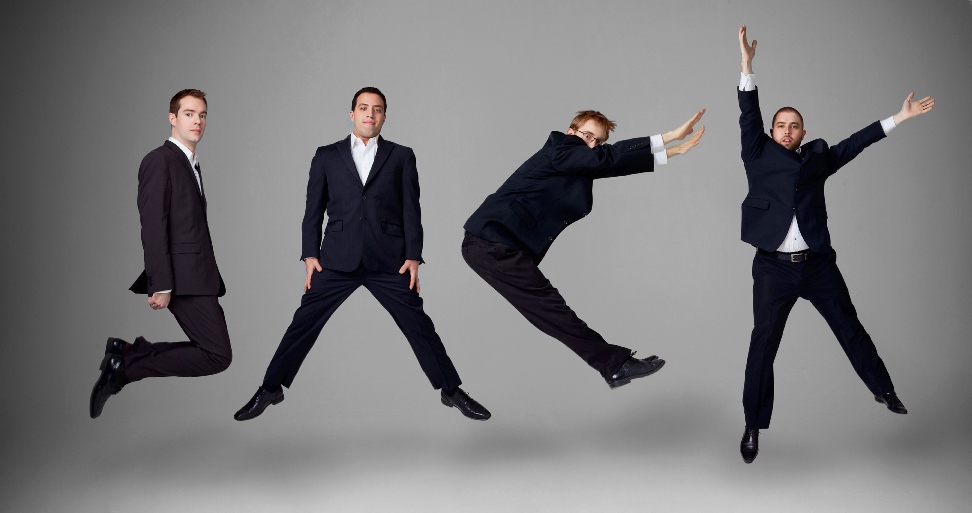
If you don’t know JACK yet, they are a string quartet (violinists Christopher Otto and Ari Streisfeld, violist John Pickford Richards, and cellist Kevin McFarland), and they have been making a fairly big splash over the last few years over in the more “academic” “new music” bins.  They have already developed an international reputation, especially through their revelatory recordings of Iannis Xenakis’ quartets.  Their name is an acronym composed of the first letters of the members’ first names, but they very much live up to the musical impetuousness that the name suggests.

Image

I’ve known about them for a while, but last Friday night in Kalamazoo Michigan, I got to see them perform in person for the first time.  It was one of those nights when multiple accidents on the Interstate bring the traffic to a halt, so the 45 minute lead-time I had planned on between arrival and concert time was obliterated, and I had to walk in fifteen minutes after they started.   Hence, I unfortunately missed their rendition of three pieces by Guillaume de Machaut, arranged by violinist Ari Streisfeld.

But then they launched into the 5th string quartet by Philip Glass, and any frustration about having to walk in late melted away.  Glass has been one of the most visible composers in recent years working at (and often obliterating) the boundaries of more “academic” composition and supposedly more “popular” genres of music.  To watch the total bodily involvement of the members of JACK in the performance of this music was breathtaking.  If you know what it looks like to see a great string player absorbed in an excellent classical piece, and also what it looks like to see the head begin to nod and the posture pulsate in that serious rock-aficionado sort of way, imagine BOTH sorts of movement brought towards you on the crest of the wave that I consider one of Glass’ most subtle and engaging pieces.  I have rarely seen a more striking embodiment (as opposed to a mere presentation) of Glass’ music.

After a break, they returned with a fascinating reading of Guillaume Dufay’s Moribus et genere, an “isorhythmic motet” from the 1400’s arranged for strings by JACK violist John Pickford Richards.  I do not consider myself much of an early music fan, but Richards’ arrangement and JACK’s performance very nicely highlighted the resonance of some early compositional techniques with contemporary composition.  Appropriately more restrained, and nicely showing JACK’s professional polish.

But finally, the highlight:  Tetras by Xenakis.  I have heard a fair number of recordings by Xenakis, and even seen some pieces performed.  But I have never been so profoundly struck by the way in which the members of JACK seem to understand Xenakis, to be able to live his music in performance, as opposed to “presenting” it.  All of the sounds (many of which still tend to strike some listeners only as “noise”) were profoundly musical sounds, irreducibly beautiful sounds.  The precision of the chamber ensemble performance was thoroughly energized by the primal level at which the players “got” the music, and pushed us as listeners to “get” it as well.

After the concert, I had a chance to talk to the members of JACK.  Ari Streisfeld enthusiastically agreed with my assessment that skillful transgression of genre divisions is at the heart of what is most exciting and inspiring in music today.  This has already been true for decades in music by Glass, Xenakis, and a host of other recent composers.  Kronos and others have made the transgression increasingly visible in accessible and popular ways.   Watching JACK perform, however, reinforces my sense that young musicians are increasingly feeling this excitement at a more visceral level, breathing this inspiration as well as grasping it well at the theoretical and performance levels, making it their dwelling, their home.  These are guys who have been weaned on Bach and John Zorn.

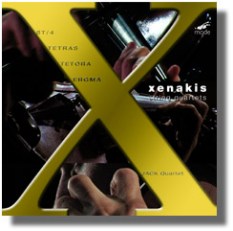
If you have not yet heard JACK’s excellent recording of Iannis Xenakis’ quartets (the Xenakis Edition, volume 10, on Mode), consider bringing your prog-sensitized ears to it as soon as you can!

JACK’s website:  http://www.jackquartet.com

JACK on Facebook:  https://www.facebook.com/jackquartet

The Xenakis quartets on video at Amazon (also available on CD and digital download):
http://www.amazon.com/The-JACK-Quartet-Xenakis-Quartets/dp/B001SGVDQK

Image

First uses of “Progressive Rock” in English

ImageAmerican music critics rejected the progressive rock genre as pretentious and over-the-top, a regression of culture, almost from its very beginnings.

Though “progressive jazz” had been used as a term of approbation of and for non-trendy, non-danceable jazz since the late 1920s, the term “progressive rock” saw print only for the first time in the English language (and, I presume, anywhere) in 1968 in the Chicago Tribune.  This first mention of prog carried no deep disgust or glorious praise, just a simple and descriptive recognition that this was not regular pop or rock.

In the fall of the same year, the New York Times (August 4 issue date) lamented that by making “the leap from sewer to salon, pop music has ceased to be an adventure.”

While certainly “ musically advanced,” the Times continued, progressive rock had made its art “emotionally barren.”  Even the most intellectual of critics, the paper continued, could see that the “new, cerebral audience has endangered that raw vitality” of rock.

A few months later, the Times (November 24 issue date) again proclaimed that the “rock hero (who is almost always a social outcast)” should be nothing less than “a liberator in musician’s drag.  His sexual display in the face of institutionalized repression becomes an act of rebellion. . . . It is immune to the censorship of ideas because its dialectic is purely rhythmic.  To do away with revolution in rock, one would have to ban the music itself in its nature as a charged version of blues.”