Gabriel on “In Your Eyes”

Yesterday, rollingstone.com published a nice piece on Peter Gabriel’s song, “In Your Eyes,” just as the artist is about to release a 25th (a year late) anniversary special edition of 1986’s SO.  

‘I liked the idea and I liked the song, but it didn’t make the grade and it didn’t feel like we’d quite got the chorus to work,’ says Gabriel. ‘I’d always liked the emotion of the verse, so when we were looking for something else to try at the front of ‘In Your Eyes,’ I started working around with the melody from ‘Sagrada Familia.’

Read more: http://www.rollingstone.com/music/news/peter-gabriel-builds-up-in-your-eyes-live-in-athens-aa987-premiere-20121016#ixzz29YjsLNqx

It’s great to see that Rolling Stone is *finally* starting to take prog and prog-related things seriously.

David Crosby and Kronos

From the most recent issue of Classicrockmagazine.com, page 146:

Don’t waste your time doing hard drugs.  The pot’s okay, but he coke and heroin are a complete waste fo time.  It nearly killed me, and I would have loved not to have wasted all that time doing the hard stuff.  Time, it turns out, is the final currency.  To waste it is a sin.  And I wasted a lot of it.  But you can’t do anything but learn and move on.  There’s an argument that says you have to go through a lot to become who you are, but I hate to think I had to go through that to become me.–David Crosby

5 reasons I love prog

I mostly agree with Pete (below) about defining prog: it is both rather impossible and, at some point, isn’t helpful. Still, I like trying to define it. But rather than doing so directly, I want to skirt around the edges of the task and simply toss out five reasons why I love prog, in no particular order (nor are these the only reasons):

1. Prog takes big ideas seriously; it asks deep questions; it tackles major themes and topics. More specifically, it addresses core questions about the nature of man, the relationships between people and between the Divine and mankind, the purpose of this mystery called “life”. Bon Jovi, on the other hand, does not. (And, yes, some prog albums fail miserably; some are even embarrassing. But at least they aren’t just about sex, pot, and being a teenage idiot.)

2. Prog musicians can play their instruments; they know how to sing, and how to write and play complex music. They have mastered multiple time signatures and chords and such. They were playing ordinary rock songs at age fourteen, then moved on to suites and movements and opuses; they are, in other words, adults. I happen to really like that. Prog musicians are aware of other forms of music; many of them are accomplished classical and jazz musicians. The Sex Pistols, of course, mastered nothing—probably not sex, or pistols, for that matter, and certainly not living a good life.

3. Prog doesn’t give a rip about Top Tens and award shows. If a real prog group ever made it to the Grammy or MTV award show, I would immediately conclude that hell had either frozen over or I was actually in hell. (Now that I’ve written that, I’m sure someone will point out such an appearance. Still, the basic point stands, especially in 2012.)

4. Prog, at its best, creates a world and escorts you through that world, in a way that perhaps only great classical or jazz can do. This transport is difficult to explain or define, but it is quite distinctive. Put another way, there is an inherently dramatic quality to prog that is consistently part of the genre; prog has a soundtrack quality, but without need of a movie.

5. Prog has a unique visual quality, as evidenced by prog album covers (see Pete’s post below), but also by its cinematic and often epic qualities. Some prog music is bad on an epic scale because it aims for something really epic. Meanwhile, Justin Bieber (or whatever his name is) is bad on a minute and microscopic scale because, well, he aims to made 8-year-old girls scream. And don’t me started on Nickelback.

Next up: my favorite dozen “almost prog” albums!

Those Album Covers

I remember it being a “nice” day in the small town where I grew up.  I’m not sure what time of year it was; it might have been Spring.  I’m guessing it may have been the Spring of 1972, in which case I would have been twelve years old.

I had a friend.  He was one of those friends you have when you’re younger, who seems to know so much more than you do about so many things.  He seems to have been places, to have experienced things.  THINGS, in a pregnant sense (in German one would say Sachen).  We went into his house, and into his room.  I don’t remember any details about how we became friends, or what had happened before we went into his house.

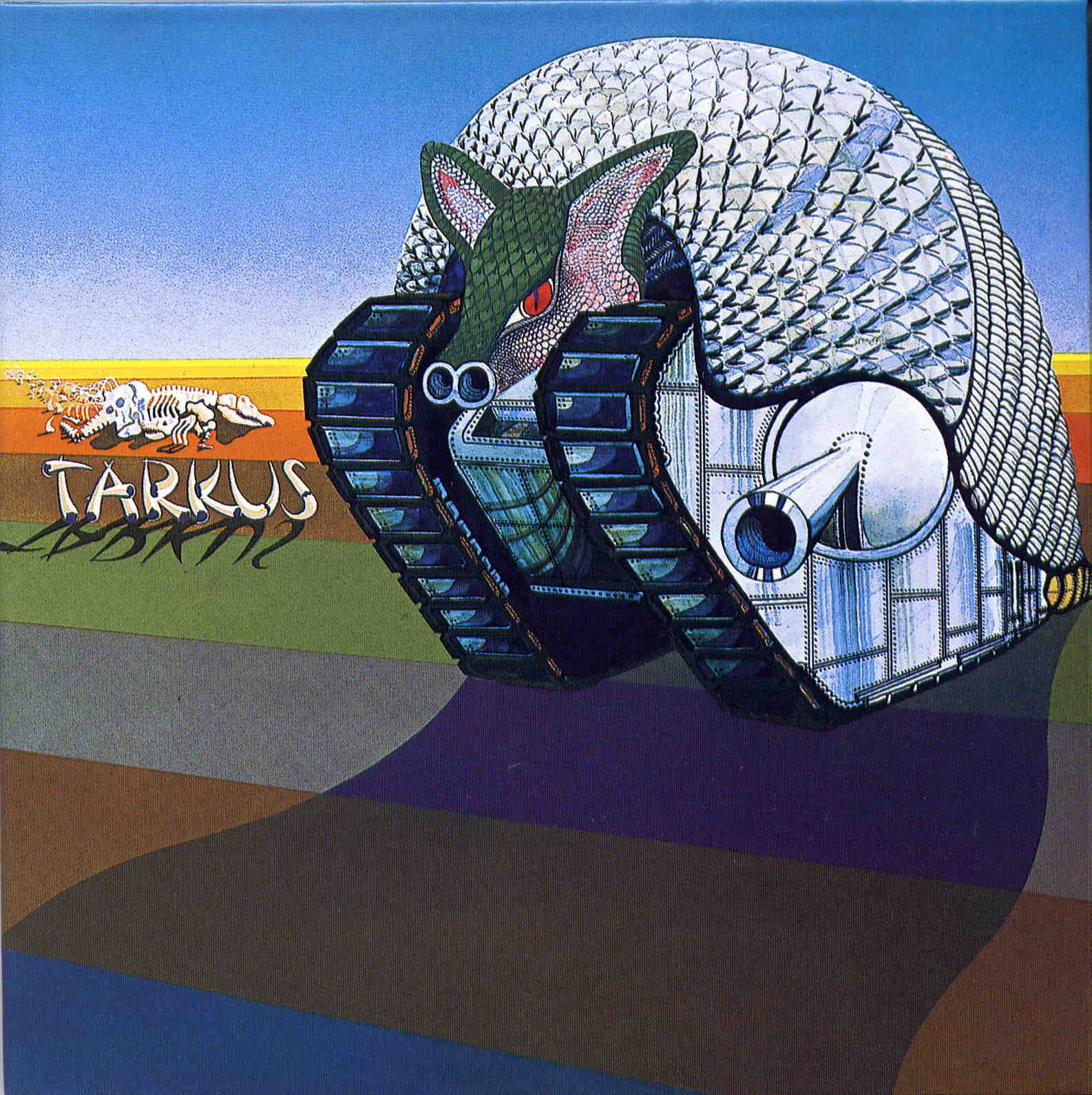
ImageBut I remember those album covers.

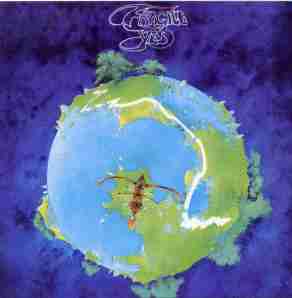
Oh, sure, we had albums at home, including a few that were mine, which I played on my little portable (mono) record player.  The Beatles, Herb Alpert and the Tijuana Brass (remember Whipped Cream and Other Delights?), Glenn Gould’s Goldberg Variations, The Beach Boys, Simon & Garfunkel.  But the album covers that my friend showed me that day were different.  Two of them stand out in my memory especially vividly:  Tarkus (Emerson, Lake & Palmer), and Fragile (Yes), both released in 1971.  As I look back on it now, seeing those two album covers corresponded with some kind of awakening within me.  I knew not only that these were different, but also that the difference was important.  This was not “popular” music that I had heard on the radio.  Nor was it “classical,” the other main category in my classification schema at the time.  When my friend played them, I was not at all surprised that they sounded like something totally new (to my ears, at least).

What was so special about those covers?  Admittedly, the background against which they seemed special to me was quite limited.  My exposure even to the Beatles was rather spotty; I was vaguely aware of how their covers had gotten more strange, but I think the main one that I actually owned at the time was the U.S.-only release, The Beatles Again (a.k.a. Hey Jude).  I was used to covers on which the most prominent features were images of the performers.  When I first saw both Tarkus and Fragile, I experienced something that I wouldn’t have the vocabulary to describe until a number of years later.  Phenomenologists like to talk about the play of presence and absence, how an absence can be a presence of a sort.  The absence of an image of “the band” leaped out at me from both covers. It was a palpable presence for which I was not prepared.  The absence of an image provided a springboard from which the art on both albums could leap, seemingly not only into my eyes but maybe (so it felt) into my soul.

ImageBut it wasn’t just “artwork.”  The images on these album covers (by William Neal and Roger Dean, respectively) were fantastic, in the root sense of that term.  They violently insinuated themselves into my perception as essentially interstitial things.  What I mean is that they had a “between” feel to them that was jarring, piercing, disconcerting, but also deeply attractive.  It was not simply that I did not have a category for them; they both seemed to shine with some sort of resistance to categorization.  Both immediately suggested a narrative that unfolded in some world or time or dimension that both was and was not this one.

They most emphatically were not “psychedelic” (think Iron Butterfly’s In-A-Gadda-Da-Vida).  Even later, when I knew a little bit more about performance- (and listening-) enhancing drugs, there was never a point where those covers became anything that could be captured by any hushed murmuring of “Wow, far out!”  They were not simply abstract, either.

As I remember those covers, and the revelatory feel of that day when I first saw them, I think about the “genre” to which they supposedly belonged.  (It was that same friend who introduced me to the term “progressive rock,” though I’m not sure whether it was on that day or a bit later.)  I think about how I tried to talk, in early high school, as if “prog” were the only kind of music worthy of the name ‘music.’  I think of how that label seemed to submerge into the miasma of my later teenage years, but also to rear its head here and there.  I think of how it came to seem an historical curiosity and an object of nostalgia.  I think of how it has reemerged in my life by way of certain friends whose fealty to the concept of “prog” apparently never flagged or wavered as much as my own did.

I recognize the inescapability of talk of genres, but I often find myself very skeptical of them nowadays.  Arguments regarding what is and what is not “prog,” which I once would have entered into passionately, now seem tiresome to me.  They often strike me as little more than specific manifestations of the need to bolster the goodness (sacredness?) of what I love by way of establishing the profanity (usually just the “suckiness”) of what Others (“They”) love.

But since I’ve been thinking lately about those two album covers, I find that something of that youthful fealty still stirs in my breast.  I wonder if this remainder, this echo of a love for something that tries to escape any particular bin in the record store that might be aimed at a taste, considered as a marketing target, is still somehow important.  I wonder if there is perhaps a resistance in prog to particular sociopolitical “bins” that is also essential.  Since having my attention called to the later work of Rush, to the wondrous explorations of Big Big Train, I wonder if there’s a vital resistance, a stubborn but honorable refusal, that has gone by the name ‘Prog’ over these recent decades, that is more a flame to be kept lit than a curiosity to be archived and displayed.

It’s an aesthetic hope to which I give voice, not a claim that I make.  I remember that day in 1972 now as a sort of birthday of that hope.  May it live long, and may it be more than simply an aesthetic hope.

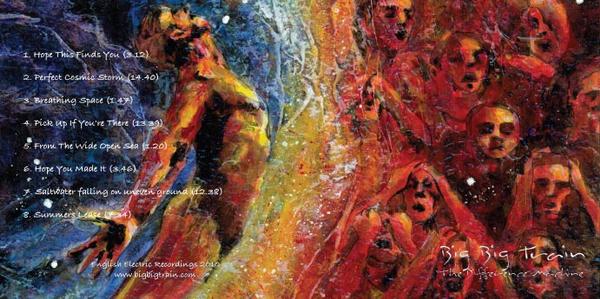
Going to Ground: A Review of Big Big Train’s Difference Machine

[An outrageously and somewhat circuitous review of “The Difference Machine” by Big Big Train (original release: 2007; reissued 2010).]

To see a little further/down below a mist hung over the fields/and the stars are falling away like raindrops on glass/further apart/slowing spinning dark–Greg Spawton/BBT, 2007

Being a Kansas Anglophile

For as long as I can remember, I’ve been an Anglophile.  And, I use this term inclusively: I’m fascinated by the history, cultures, and languages of the British Isles, and all of its inhabitants—from the Celts and Picts to the Angles and the Saxons and even the barbaric, invading Danes (and many others, of course).  I’m sure much of my love of all things English (and British) comes from my earliest readings of Tolkien and his vast mythology, all of which [ ].  I’m also married to a McDonald, who happens to be more German and Swedish than Irish, but the name . . . that blessed Celtic name.

But, I’m taken with so many other persons as well, some real and some fictitious and some a bit of both in larger British history: Bran the Blessed, Arthur, St. Patrick, St. Augustine of Canterbury, St. Bede, St. Boniface, Alcuin, Alfred the Great, Harold of Hastings, the nobles, temporal and spiritual who challenged King John at Runnymede, Sir Thomas More, Edmund Burke, William Pitt, Winston Churchill, C.S. Lewis, Owen Barfield, T.S. Eliot, etc., etc.  And, this is just the short list.

Despite this noble lineage of great men, the British people have somewhat paradoxically chosen Arthur, not the much more victorious Alfred the Great, as “the central figure of national heroic legend.  So wrote the nearly forgotten British (himself half Welsh, half English) historian, Christopher Dawson, in 1936.  After all, he believed, the British loved lost causes, especially if the loss came in the face of extreme opposition while defending what is right, good, and just.  Indeed, he argued, giving one’s all for the good of British society remains a fundamental part of the British character, as proven in the last several centuries by figures such as the Irishman Edmund Burke and Anglo-American Winston Churchill.

Such a fascination with lost causes gives the British a properly melancholic and, simultaneously, noble national character.

All of this played to my Kansas upbringing, staring across the wheat fields and sandhills, wandering what might exist beyond.

Big Big Train

When I bask in the music of the very, very English progressive rock band, Big Big Train, I feel—at the deepest possible levels—each of these quintessentially British traits: perseverance for the good no matter the cost; and a singular melancholic intensity.
 The Difference Machine flies/you can see stars right through it/your mum or your dad or your kids; or the love of your life/bring light to the dark spaces between us/Stars bu8rn through the coins on my eyes.”–Greg Spawton/BBT, 2007

Though I do not fully understand all of the lyrics (and this is good, mystery is a fundamental part of art, to my mind), I can’t help but think English nobility and melancholic intensity as I listen to my most recent BBT purchase, the 2007 The Difference Machine, reissued last year.

Indeed, I first bought it as an mp3 download.  I was so taken with the subtlety of the music, the instrumentation, and the lyrics, I happily reordered the full CD version.  I’m glad to have done so, as the quality, not surprisingly, is so much higher.  I’ve now listened to the “The Difference Machine” multiple times and in a variety of different situations: on my iPod while out for exercise; through my car stereo while driving; and on my kitchen stereo while baking (one of my loves—yesterday, I was baking English oat bread while listening to the CD).  Frankly, there’s no bad place to listen to BBT music—as long as it’s not as mere background.  It would be shame and a slap at real art to listen to this as anything other than what it is and how it was recorded—to enjoy it fully, to immerse oneself in it.

As with every other BBT release, this one simply stuns me, and it does so even more with each new listen.  I treasure each new listening, for I keep discovering new things, more beauty, more sadness, and more creativity.

While there exist a number of bands and musicians I follow—and I’ve been listening to progressive rock since 1972, when I was four—there are only a couple of bands that totally absorb my interest.  Those bands have been (in order encountered):

Yes (especially, “Fragile” through “90125”); Rush (especially, “Permanent Waves” through “Power Windows”; “Vapor Trails” to present); Talk Talk (especially, the last three albums); and The Cure (especially, “Faith” through “Wish”).

To these four groups, I also include the music of Kevin McCormick.  But, while I can objectively state his music is as good as anything I’ve ever heard, I also must admit, he’s been one of my closest friends since 1986, so a bias toward him rather strongly exists.

I would also include Gazpacho, the music of Matt Stevens, Roine Stolt, Arjen Lucassen, and Neal Morse in their many forms, and anything Matt Stevens does.

Back to my claims.  So, I’ve been listening to prog consistently since the earlier 70s, when my older brothers introduced me (probably unintentionally).  Not only have I listened, collected, and analyzed prog for much of my life, I’ve also been a radio DJ, having my own prog show in college.  I write this only to suggest that I’ve given this all a lot of thought—in between, around, above, and under academic projects, teaching, and family obligations.

So, with all of this explanation to the above nearly forty-year old list, I add a fifth band of excellence: Big Big Train.

If Yes’s “Close to the Edge” and Genesis’s “Selling England by the Pound” best represented the 1970s; if Talk Talk’s “Spirit of Eden” best represented the 1980s, then, BBT’s last full LP, “The Underfall Yard” best represents the last decade of music.  [Yes, I know I left out the 1990s, I’m still thinking about this one]

A huge claim, I know, but I very much believe it true.  And, for my good friends reading this, you know if I equate anything to “Spirit of Eden” (an album I’ve obsessed over way too much), I’m serious.

To me, Big Big Train—its history, its perseverance, its openness to its listeners and followers through the internet, especially, its musicianship, its desire for reaching perfection, its poetic and imagist lyrics—represents the very best of what exists in music today.  This is far from feint praise, for there’s a considerable amount of competition out there—some almost equally fine music from groups as diverse as Porcupine Tree, Gazpacho, and others.

BBT only increases my love of things English.

Going back through the reviews and history, I see that Big Big Train almost broke up after the recording of “Bard.”  Thank God, they didn’t.  While Bard is the only album of BBT’s I’ve not heard, I’m quite positive—given where they’ve gone since Bard—BBT was just catching its stride around the making of that album.  Though I have a feeling—and I don’t know any of what I’m about to write this from personal knowledge, only from the interviews, lyrics, etc.—the current members of BBT must have gone through some very powerful trials and shakeups.  Like the best of those who came before them, Greg Spawton and Andy Poole, original band members, persevered.  Where they’ve gone—especially with “The Underfall Yard”—is almost certainly not something they could’ve expected a decade or so ago.  Instead, “The Underfall Yard” is a product of long struggle, experience, and craftsmanship; one of those unbought graces—but one that can’t arrive without extreme dedication to an artform.

Signals fail/A moment of time/lost, home/salt water, silence.–Greg Spawton/BBT, 2007

The Difference Machine

As noted earlier, my version of “The Difference Machine” came out last year.  In his own description of the album, Spawton writes:

The Difference Machine received significant critical acclaim and, at the time of writing, is our best-selling CD.  After the release of Gathering Speed, we  invested the proceeds in our studio to ensure we could record music at the highest possible quality for an independent band.  Furthermore, Andy had gained considerable experience as an engineer and we felt much more confident in our ability to get the most out of our studio.  The Difference Machine is a concept album – a ‘small’ story; the loss of loved ones as life progresses, set against a ‘big’ story; the death of a distant star.  The songs for the album were written  quickly. The prog rock / post-rock crossover thing was now fully formed and everything flowed very smoothly.  Indeed, a  number of other songs which didn’t make it onto the album also came out of the writing sessions (BramblingHope You Made It and a 17 minute track – The Wide Open Sea.) The main musical motif for the album is set out early on in the opening track – an instrumental called Hope This Finds You. Played on viola by Becca King, the theme is restated briefly in Pick Up If You’re There before returning at the end of the album in the closing section of Summer’s Lease. Other musical motifs abound, some buried deeply in the music, some combining with others to form new themes. For example, the main album theme on the playout of Summer’s Lease is intertwined with a motif from Perfect Cosmic Storm which is initially set out in an understated manner on electric piano, before returning as the grand closing section of the song.  There’s a lot of this on The Difference Machine – it is an album which is intended to pay repeated listenings with new discoveries.

After having given this beautiful album innumerable listenings, I can confirm Spawton’s own description of it.

There are eight tracks on the 2010 version of “The Difference Machine.”

The opening track, “Hope this finds you”—a short but powerful instrumental, captures the essence of the entire album, setting out the themes of wide open space, and vast emptiness, but, with the entrance of the viola, a deep and abiding sorrow appears, thus closing the space into something intensely personal, even intimate.

“Perfect Cosmic Storm” begins with a strange signal and some dissonance.  A disembodied voice beckons: “signals go to ground” and then, circling the listener, cries “For me there is not hope at all.”  From what I can tell, immersed in this man’s longing and despair, he believes he has either died or is on the edge of death.  His life flashes before his eyes, and “before I go to ground,” he catches a glimpse of some of the happiest things of his existence: kids, parents, and all good that connects one good thing to another, allowing us to transcend this overwhelmingly dark life.

At over fourteen minutes, “Perfect Cosmic Storm” is a masterpiece in every way.  Every voice and every instrument finds its exact place, and while much of the music is chaotic, there is an order to it all (especially beginning at 5:47 into the song, when the sax (itself, used here as an instrument of despair)), just as there is for the man (in the lyrics) dying. When, at 6:30, the singer comes back in with “Signals go to ground,” the listener breaths a sigh of relief.  No relief remains permanent, though—as dissonance and counter harmonies continue throughout the track.  Musically, the listener is left with the feeling that the protagonist has some massive choice still confronting him.

Spawton’s lyrics make this a truly great song.  But, of course, a number of other things also make this song one of near perfection.  Nick d’Virgilio’s drums and Dave Meros (of Marillion)’s bass are some of the best of each I’ve ever heard.  Though he can play anything, D’Virgilio was made to play the music of Spawton and Poole.  Phew.

The third track, “Breathing Space,” is exactly what it seems.  A profound openness emerges during this song, and one feels as though the protagonist has realized either that he’s not quite dead or that he has some kind of redemption and permanent happiness awaiting him.  It must be early evening, though, as crickets chirp, and space signals continue to emanate from somewhere.

In track four, “Pick Up if You’re There,” the protagonist, now realizing that the abyss is not all that confronts him, searches for signs of life.  He climbs a hill, but only sees a mist below him and, when looking up, sees stars falling.  Spawton offers some of his best poetic moments in lyrics to this song.  The drums, bass, and organ are especially strong on this track, driving the protagonist toward some thing, whether that some thing be good or ill, a purgation of the worst or the best.  “You can almost taste the pain/you can almost touch it.”  And, again, D’Virgilio’s drums and, this time time (especially beginning around 4:39 into the song), Pete Trewavas’s bass is nothing less than breathtaking, as is Tony Wright’s flute at 8:40 into the track.  But, the jam (especially the interplay of drums, bass, and Greg’s organ) beginning around 10:05 is my favorite part of the album.  That protagonist is heading somewhere and fast.  I still not quite sure where, but I know he’s moving at an outrageous speed.  “One by one the signal’s fail/the sky is full of comet’s tails/–pick up if you’re there.”

“From the Wide Open Sea,” a track foreshadowing, in title and theme, the final track of BBT’s 2010 ep, “Far Skies Deep Time,” serves the same function as track three.  The listener can relax, at least momentarily, as the spacey keyboards swirl.

Track six, “Hope you made it,” is another short song.  Despite it’s relative brevity, the song’s lyrics cast much doubt on the fate of the protagonist.  Life seems to break this man, and the best escapes him.  “Mercury falling over the snow fields/the passage of time/as the notes in the margins/the last day of summer/the last day you loved her.”  Is all of life nothing more than sporadic marginalia?

“Saltwater (falls on uneven ground)” is my favorite track.  After a hauntingly false introduction, the song quickly changes direction, and we have an Eliot-esque man, a “hollow man” unable to keep some centricity to his life.  And yet, as typical with BBT, a brief hope emerges.  The sky brightens, and though the ground is frozen, the protagonist hears his love—or what he thinks is his love—walking behind him.  From my perspective, lyrically, this song serves as the most important moment of the album.  The protagonist, as close to death as possible without actually crossing into the shadow realm, sees before him the cold and relentless grasp of winter.  As he does, voices of men and beasts (a cat that sounds strangely Pink Floyd-esque) as well as the signals from space swirl around him.  BBT offers several minutes of a really laid-back jam (ok, I have no other way of explaining this).  At 8:41, the protagonist, surrounded by a cold winter death, suddenly remembers the glories of summer, “days without end/exploding with fire.”  If without end, the man only has to claim these as his true eternity.  “Extraordinary again,” the lyrics conclude.

The final track, “Summer’s Lease,” gives us no settled answer.  Summer conquers winter, and love rears its profound head among the prevalent pain of the world.  But, the protagonist still seems somewhat lost.  At 3:14, the song becomes relentless, frantic.  “Where did you come from/where will you go to?/Don’t go away (repeated several times),” the protagonist cries.  Every instrument seems to explode here.  At around 4:56, the song becomes simple again—a rhythmic return to the rather melancholic themes of the album as a whole.

“Signals fail/a moment of time/lost home/salt water, silence/where did you come from /where will you go to?/Don’t go away.”  And with these lyrics, backed by Spawton’s best keyboard work of the album as well as that pursuing viola of Becca King and sax of Tony Wright, the story ends as the piano fades out.  “Summer’s lease” seems to have run out.

Again, I’m not quite sure where I’m left.  I, Brad, am deeply satisfied, musically.  But, what of the protagonist of the album?  Did he make it to eternal happiness, eternal damnation, or just simply nothingness?


Summation

Well, if it’s not clear by now, I think the world of this lp.  If “The Difference Machine” is not a part of your collection, it should be by the time you finished this outrageously long review.
Overall, while I consider “The Underfall Yard” to be the gold standard of our time (hence, on my professorial scale, earning an A+), I would award The Difference Machine a solid A.  Its sins, such as they are, are sins of omission, not commission.  After so many listens to The Underfall Yard, I’ve come to expect the guitar work of Dave Gregory, the vocals of David Longdon, and the drum work of Nick d’Virgilio on every song.  While Spawton and Poole have offered us everything they have (and, if this is as good as it gets—which is spectacular–but those of us who know BBT know that they only get better) on The Difference Machine, The Underfall Yard has all of the best of its predecessor with the permanent addition of Gregory and d’Virgilio and with the hypnotic voice of David Longdon.

A small conundrum

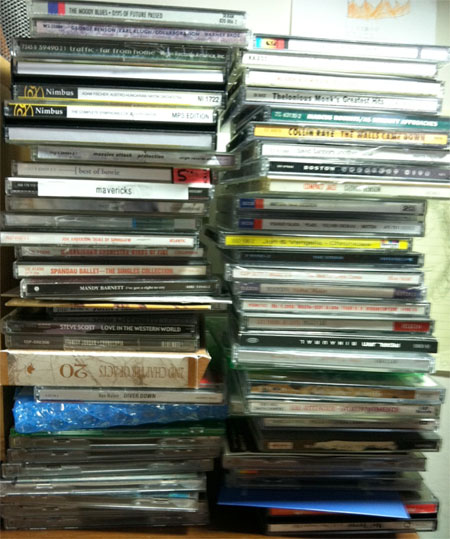
I’m so torn! Do I try to read all of Brad’s fabulous posts or do I try to rip all of these CDs that have been sitting on my desk for several weeks now? Hmmm. For the record (heh!), there isn’t much prog here. However, the prog that is in the pile is a bit obscure: “Olias of Sunhillow” by Jon Anderson (1976). Also a Jon and Vangelis album, “Chronicles” (1994), which is probably construed as “New Age”. As well as some Traffic (“Far From Home” and “John Barleycorn Must Die”), Massive Attack (“Protection”), Moody Blues (“Days of Future Passed”), and a bunch of jazz (Monk, Marcus Roberts, Lee Ritenour, Stanley Jordan, David Sandborn, John McLaughlin, George Benson, etc.). Oh, and some good classical: the complete symphonies of Haydn (Adam Fischer with the Austro-Hungarian Haydn Orchestra) and Britten’s “War Requiem”. Dare I mention the guilty pleasures? Van Halen’s “Diver Down”, Spandau Ballet’s “Singles Collection”, 2nd Chapter of Acts (Best of…), and Boston (“Greatest Hits”).

Okay, I’ll read Brad’s posts. And await judgment on my questionable tastes…

Coralspin’s Honey and Lava (2012)

Coralspin, “Honey and Lava,” (Altrospire, 2012).  New on the prog scene, Coralspin hails from England.  Much of the music on this excellent release has the feel of something Trevor Horn or Trevor Rabin might have produced around the time of Yes’s 1984 MTV masterpiece, “90125.”  Certainly, Coralspin has its roots in the early to mid 1980s, especially with its big guitars and its big keyboards.  Whether one likes the music of Horn or Rabin or not, no one could honestly dispute the audiophile proclivities of each man.  The same can be written of Coralspin’s Blake McQueen.  The production of this album is simply stunning–this hit me from the first moment I put it in my cd player, and it continues to impress me with each listening.  It’s not just the keyboards and guitars that stand out , no matter how much they predominate on most of tracks.  The bass and the drums are crisp, offering this album a much more punctuated and professional feel than some of its 80s ancestors.  Indeed, I wish Horn and Rabin would’ve mixed Chris Squire’s bass at this level on 90125.  Amazingly enough, almost all of Honey and Lava was recorded in McQueen’s home, and he later mixed and engineered it.  He’s, simply put, a master audiophile, in the same league with Steven Wilson or Rob Aubrey.  The lyrics on this album are wonderful as well–mythic, pointed, hard, soft.  Everything has its place, and its place is very good.  If I were forced to make a comparison (and, as far as I know, I’m doing this out of my own free will), I would compare Coralspin to The Reasoning.  There’s the obvious fact that the lead singers of each are women, but the comparison between the two is much, much deeper than what some silly academic might have pronounced twenty years ago as worthy of revelation.  The structures of the songs–as approached by Matt Cohen and Blake McQueen–have a definite similarity.   Both love mythic lyrics as well, and each wisely uses the voice not only to convey the meaning of the lyrics but also to convey the meaning of the very music itself.  For what it’s worth, I’m a very proud owner of Honey and Lava, and I eagerly await the follow up.

The Fierce and the Dead forthcoming UK Tour

Prog guitarist extraordinaire Matt Stevens has sent out a nice thank you, request, and notice regarding the very quickly forthcoming U.K. tour.  Of course, all North American Progarchists are jealous, but we’re also very happy for our British brethren.  Matt, play your heart out, as you always do.

Hi Brad [Yes! A personal email from Matt!]

I just wanted to say a massive thank you to everyone who shared the link and photo for the Fierce And The Dead/Knifeworld/Trojan Horse tour last week. Hundreds of you shared it!! Amazing 🙂 We really need this tour to work for us, financially it’s really difficult and we really hope to break even so we can continue to gig and make records. Word of mouth is so important and what you’ve done will make a big difference.

There is now an animated VIDEO promo featuring snooker legend and prog DJ Steve Davis again:

http://www.youtube.com/watch?v=NnaBtWeR1wg&feature=youtu.be

If you could share the video that would be amazing 🙂 If you can post it on your blogs, facebook, forums and twitter it will really help.  Everything counts at the moment, this is really make or break time for the band.

Thanks to everyone who came to the gigs this weekend – lots of you out and that’s really appreciated, lets hope that the same people come to the Fierce And The Dead tour 🙂

Here is the info for the tour:

STABBING A DEAD HORSE

Knifeworld, The Fierce And The Dead and Trojan Horse are to undertake a three way, week long tour of the UK in late October/Early November. We’re proud to say that the tour is sponsored by Prog Magazine, Rock-A-Rolla and Z-Vex Guitar FX.

Expect gnarled Northern experimentalism from Manchester four piece Trojan Horse. Acoustic loop wizard Matt Stevens ‘gone electric’ delivers angular and epic swathes of post- riffery with The Fierce And The Dead while eight-piece Knifeworld, fronted by Cardiacs and Guapo guitarist Kavus Torabi and including members of Chrome Hoof, deliver dense, soaring, kaleidoscopic prog.

Here’s the full letter:  http://www.reverbnation.com/c/fr5/artist_158359?eid=A158359_14950393_46610553&fsc=7414a21cb7f

Spirit of Talk Talk: A Well-Deserved and Respectful Tribute

The sound experience which I prefer to all others, is the experience of silence.

John Cage

A shared pleasure among some of the writers of this blog is an appreciation for the 1980’s British group Talk Talk. They began as a slick synthpop band, but quickly outgrew that genre. By the time they released Colour of Spring, their third album, their music had become something unique and very special.

Spirit of Eden came next in 1988, and the music press was utterly befuddled when confronted with a real work of art that had an almost sacred feel to it. In my 1992 edition of Rolling Stone Album Guide, J. D. Considine rated Spirit of Eden one star, saying, “Good bands usually improve over time, while bad bands generally just fall apart. But Talk Talk took a different approach with its musical growth; instead of getting better or worse, this band simply grew more pretentious with each passing year…..by Spirit of Eden, Mark Hollis’ Pete Townshend-on-Dramamine vocals have been pushed aside by the band’s pointless noodling.”

What Considine and other critics didn’t get was Mark Hollis’ and producer Tim Friese-Greene’s desire to pare the music down to its absolute essentials. This included the use of silence as a compositional element. Spirit of Eden works, because everything extraneous is ruthlessly stripped away, and we are left with the beauty of the bare structure of the melodies. Just as the most effective way to get an audience’s attention is to speak softly, Talk Talk used space and “pushed aside” vocals to draw the listener into their music. And a funny thing happened. As the years passed, the reputation of Talk Talk grew in stature, and Spirit of Eden is now seen to be the visionary and influential work of art it was back in 1988. Case in point: it’s hard to imagine Radiohead’s Kid A ever being released without Talk Talk’s groundbreaking work.

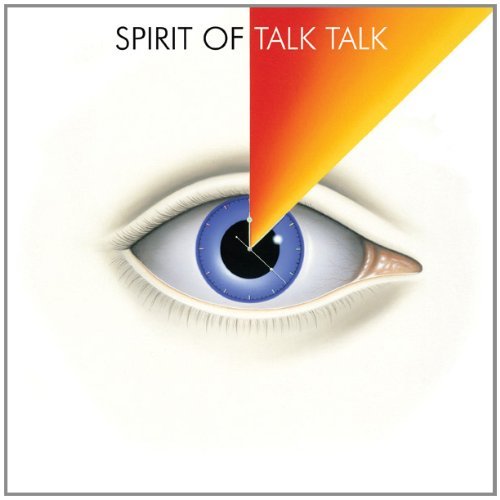
Which brings me to the topic of this post: a Talk Talk tribute album that has recently been released by Fierce Panda Records. Spirit of Talk Talk is a 2-disc collection of Talk Talk songs interpreted by 30 different artists. Alan Wilder, of Depeche Mode and Recoil fame, is the executive music producer and supervisor. James Marsh, the artist whose distinctive visual style was as much a part of the Talk Talk experience as their music, has done the cover art (Marsh loves visual puns: look for the clock in the cover shown above).

Tribute albums can be dicey affairs, often being attempts by deservedly obscure artists to get some attention. Spirit of Talk Talk is an album of respectful and sensitive interpretations of the original songs, while providing new insights into them. Imagine how even the poppiest early songs from The Party’s Over would sound if they were done in the style of Laughing Stock, and you get an idea of what this collection sounds like. The song selection favors tracks from Spirit of Eden and Laughing Stock, with some songs getting two different interpretations.

The first track, “Wealth”, performed by Lone Wolf, sets the tone for the album with a beautiful rendition that is almost liturgical in its plea to

Create upon my flesh
Create approach upon my breath
Bring me salvation if I fear
Take my freedom
A sacred love
Create upon my breath
Create reflection on my flesh
The wealth of love
Bear me a witness to the years
Take my freedom
Let my freedom up
Take my freedom for giving me a sacred love

Other highlights include a smoldering Duncan Sheik/Rachael Yamagata duet on “Life’s What You Make It”, King Creosote’s folk-polka performance of “Give It Up”, an intimate acoustic jazz performance of “April 5th” by the Matthias Vogt Trio, and the final song, “I Believe In You” by Arcade Fire’s Richard Reed Parry, whose hushed, multi-tracked vocals conjure up echoes of Thomas Tallis.

One of the most pleasant surprises for me has been hearing the Laughing Stock songs in a new light. I had not fully appreciated their beautiful melodies and lyrics until these interpretations showed me new facets of them. It’s been like seeing an old friend after several years’ absence, and discovering even more reasons for the friendship.

Even though it has been more than twenty years since Talk Talk has recorded, it is nice to see them finally get the praise and respect they deserve. Since it seems unlikely we’ll ever hear Mark Hollis sing again, we’ll have to make do with Spirit of Talk Talk. Fortunately, Fierce Panda has offered us an excellent and worthy substitute.

Lone Wolf Performing Wealth: