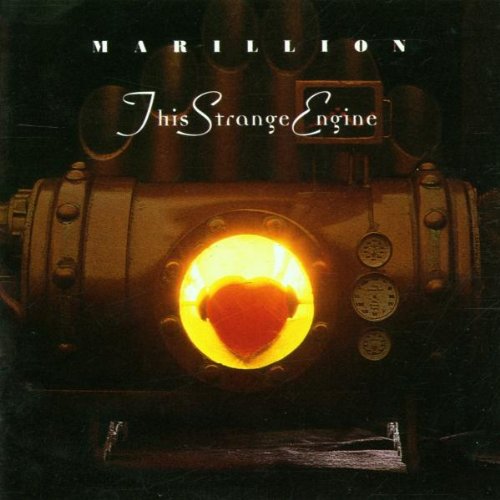
This Strange Engine: Happy 20th, Marillion!

51OCGCpqsvL
Originally released, March 1997.

Twenty years ago, this month, Marillion released its album, THIS STRANGE ENGINE.  It should be remembered that this is the fifth album to feature the voice and lyrics of Steve Hogarth.  As such, reviewers still (not that the debate has eneded, even in 2017) had to compare the Marillion of Fish to the Marillion of Hogarth.  While THIS STRANGE ENGINE earned its just share of good reviews, it also had reviewers crying that while Fish had innovated, Hogarth rested.  AllMusic went so far as to label THE STRANGE ENGINE “ordinary.”

If only.

Granted, Marillion had just come off two of its most powerful and unrelentingly intense albums–BRAVE and AFRAID OF SUNLIGHT–but this should not lessen the power of THIS STRANGE ENGINE.  Rather, it should add context.

Continue reading “This Strange Engine: Happy 20th, Marillion!”

soundstreamsunday: “An Ending (Ascent)” by Brian Eno

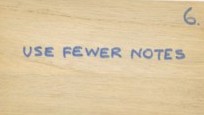
eno_obliquestrategyIn completing a year of soundstreamsunday, I turn away from the “infinite” in the project’s subtitle (“a weekly infinite linear mixtape”) and towards the analog finite-ness of the cassette mixes that so defined life pre-ipod.  In my early creative life this was my primary medium, the 90-minute blank TDK, bound to its two-sided loop, on which I could conduct a mix corralling the works of others.  The collage confines of the mixtape start with a four-cornered frame, defined beginnings and endings that are also transitional and act like the Mobius strip, so the loop, if constructed well, becomes more suggestive of a continuing spiral.  As the last two-sided audio medium developed, the eraseable cassette tape shouted its message: do what you will, the ending will take you to the beginning.
brianenovisualmusic6 - Edited

In this context, Brian Eno’s “An Ending (Ascent)” from Apollo: Atmospheres and Soundtracks (with Daniel Lanois and Roger Eno) is one of many possible natural links between U2’s “The Three Sunrises” and the first song in the series, Sun River’s “Esperanza Villanueva“; and, as I write this, it also occurs to me that the song’s title reflects what I’m trying to achieve, a pivot, a soft stop in a rising continuum.  In the words of one of Eno’s Oblique Strategies: “Repetition is a form of change.”

brianenovisualmusic9 - Edited

Eno is a theorist/strategist, a rock and roll Zelig moving through the histories of glam, punk, ambient, prog, and new wave.  His is an intention minus the contrivance.  He locates boundaries so as to cross them, so as to observe them, to flip the within and the without.  To conflate the end with the beginning.

*Images above of Eno’s “Oblique Strategies” cards. First published in 1975, the deck’s pithy advice on jumpstarting the creative process is one indicator of Eno’s wizardly musical midwifery.

soundstreamsunday presents one song or live set by an artist each week, and in theory wants to be an infinite linear mix tape where the songs relate and progress as a whole. For the complete playlist, go here: soundstreamsunday archive and playlist, or check related articles by clicking on”soundstreamsunday” in the tags section above.

Rock and Roll isn’t Dead, But It is Dying… Right in Front of Our Eyes

The WSJ has the data. As one generation slowly dies off, the next generation has no comparable stars to fill the void. The result? The disappearance of rock and roll as a cultural phenomenon. In other words, music is just not as important in the lives of the younger generation. We are witnessing the twilight of the rock gods:

Continue reading “Rock and Roll isn’t Dead, But It is Dying… Right in Front of Our Eyes”

The Night Siren: The Peaceful Resistance of Steve Hackett

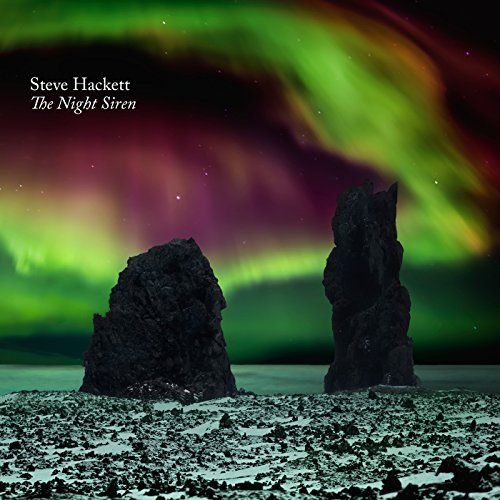
Steve Hackett, The Night Siren (InsideOut, 2017)

Tracks: Behind the Smoke (6:58), Martian Sea (4:41), Fifty Miles From the North Pole (7:08), El Nino (3:52), Other Side of the Wall (4:01), Anything But Love (5:56), Inca Terra (5:54), In Another Life (6:07), In the Skeleton Gallery (5:09), West to East (5:14), The Gift (2:45)

I think we all know by now that Steve Hackett is a genius. Over the last several years of this current wave of progressive rock, it seems that everything Mr. Hackett has touched has turned to gold. Indeed, he recently told the fine folks over at Prog magazine that he is currently in one of the most creative phases of his life (Prog 73). Considering his remarkable musical catalog, that is saying a lot. It rings true, however, when The Night Siren and his previous album Wolflight are concerned. They are some of the best albums of his solo career.

Both of these albums include a lot of what some might call “world music.” He features instruments and musicians from all over the world, including Azerbaijan, Scotland, Iceland, and Israel. He even includes both Jewish and Palestinian singers from Israel on the same song. Throughout all of this mix, Hackett’s message is clear: if we can have peace through musical collaboration, why can’t we have world political peace? This is certainly an excellent question to which it seems world leaders have no answer.

One might think that this conglomeration of disparate instruments and styles would create an off-putting wall of noise, but nothing could be further from the truth. Hackett masterfully blends these different influences with his signature guitar licks. The result is truly breathtaking.

Continue reading “The Night Siren: The Peaceful Resistance of Steve Hackett”

STARDUST 20 Years Later: The Flower Kings

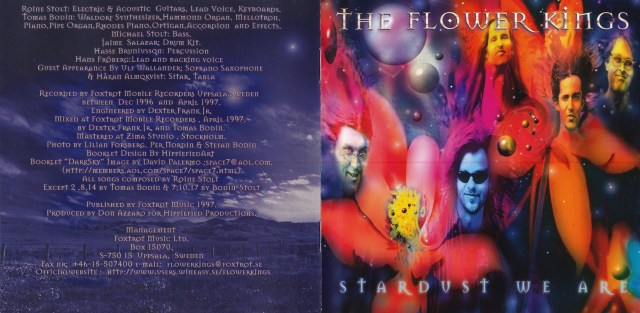
The Flower Kings, STARDUST WE ARE (Insideout Music, 1997).  Two disks, 20 tracks.

IMG

Every once in a while, I see some progger comment on the internet, “I don’t get The Flower Kings,” to which I always want to yell: “What’s not to get?  Hippie prog love and lots and lots of it.”

Admittedly, I’m a huge fanboy when it comes to Roine Stolt and The Flower Kings.  I’ve listened to them so much over the past two decades that there’s no way I could ever be objective when analyzing the band or its music.  To me, every album by The Flower Kings is a small but mighty celebration of the goodness in the world.  Each album represents a mood, a state of mind, a sense of being.

Continue reading “STARDUST 20 Years Later: The Flower Kings”

Richard Barbieri’s Prog-Electronica Genius

richardbarbieriI was first exposed to that exotic, amorphous musical genre called “electronica” in junior high by a friend who listened to what we called “weird stuff”. I’m not even sure what it was; some of it was from Japan. It made a dent in my memory banks, however, because until then my musical interests had been confined to some classical (Brahms! Mozart! Good!), Top 40 rock (Queen! Also good!), and lots of mediocre CCM (Not good!). During my high school years I listened to a good deal of The Alan Parsons Project, in part because of the huge hit “Eye In the Sky”; I eventually collected all of the APP albums. Parsons, of course, has straddled the worlds of progressive rock and mainstream pop/rock with his production prowess, writing, and work with keyboards and Fairlight programming. In hindsight, his music opened the door in various ways to music that was more overtly electronic.

(A quick, semi-related aside: A good friend in high school, who spent a lot of money on a fabulous car stereo system, liked to alternate between playing—very loudly—the raunchy rap of 2 Live Crew and the muzak of Yanni: the first to demonstrate his system’s bass; the latter to show off it’s high end. I’m not sure which music scarred me more.)

In the late Eighties and early Nineties there was an explosion of so-called “New Age” music (which had been around since the Sixties and whose identity has been hotly debated for decades), much of which was ambient or involved whales bellowing, birds chirping, and flowers clapping their petals. I mostly  ignored it, but did eventually latch onto the music of Patrick O’Hearn, whose solo albums on the Private Music label were lush, complex, mysterious, evocative, and never boring, even at their most sedate. O’Hearn, like all of the finest electronica artists, is the master of tone and mood; the music is rarely about virtuosity—unlike wide swaths of prog rock—but about constructing layers and movements. I liken it to a painter who builds layers of luminosity into his work through patient precision (more on the visual arts parallel in a moment).

Not surprisingly, there was a lot of cross-pollination going on between some “New Age” artists and various progressive rock groups and musicians. O’Hearn, who has legit jazz chops—he studied with jazz giant and bassist Gary Peacock—played with Frank Zappa as a youngster, and then with the new-wave band Missing Persons; the Private Music label featured a number of musicians with deep ties to progressive rock. (Another good example of this relationship can be found in Jon Anderson’s albums with Kitaro and Vangelis.) In the 1990s I bought several albums by Moby, Portishead, Björk, Aphex Twin, and Massive Attack, even while I ignored (for whatever reason) other key artists (Brian Eno, for instance).

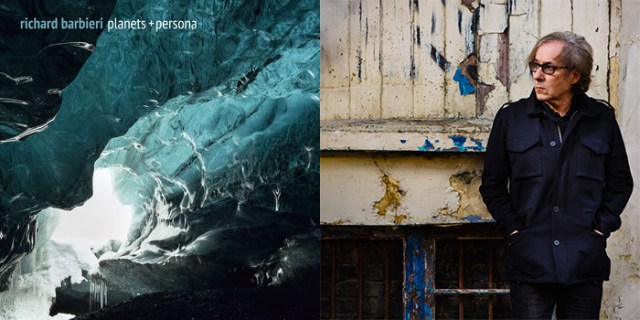
Richard Barbieri is, of course, no stranger to prog fans, being a key member of Japan and Porcupine Tree and having worked in a number of other settings. His new album “Planets + Persona” [Kscope Music] is his third solo album, following 2005’s “Things Buried” and 2008’s “Stranger Inside”, both of which I enjoyed quite a bit. The three albums are similar in many ways, but this new album seems, to me, to be warmer, more organic (or acoustic), and more contemplative. Geno Thackara, at AllAboutJazz.com, explains it so: Continue reading “Richard Barbieri’s Prog-Electronica Genius”

Richard Barbieri News from Kscope

Richard Barbieri

Richard Barbieri’s third solo album ‘Planets + Persona’ is OUT NOW, check out the 360° video for “Solar Sea”.

“What other planets are out there? Could there be any life 40 light-years away?” – The new 360° video for Richard Barbieri’s track “Solar Sea”, explores these questions, imagines these new worlds – colliding planets, ice crystals inside a hollow comet, volcanic asteroids spewing molten lava into open space and a breathtaking finale.

Richard Barbieri

WATCH HERE www.kscopemusic.com/rb

Continue reading “Richard Barbieri News from Kscope”

Soundtracks and Dark Knights

bat1

Does anyone have any idea how to categorize movie soundtracks?

Certainly, by its very nature, prog is cinematic, often eerily so.  But what about actual sound tracks?  Do soundtrack composers–aside from Trevor Rabin–think of themselves as classical artists?  Rock?  Or, are soundtracks their own strange genre?

Why do I ask, you ask.

Since BATMAN BEGINS first came out in the theaters, I’ve regarded it as one of my two or three all-time favorite movies.  It didn’t beat out my favorite, Hitchcock’s ROPE, but it came really close.  In fact, I liked it so much, that I never quite made it through THE DARK KNIGHT, as I felt that second movie undermined everything the first accomplished.

Continue reading “Soundtracks and Dark Knights”

What Do You Do With a Problem Like Elbow?

ArticleSharedImage-68091

Elbow has yet to make it big in Jap. . . the United States.  I’m not sure why.  Their sensibilities should be perfect for a variety of radio formats here.  But, sadly, Elbow remains generally unknown.  I first came across them because Greg Spawton of Big Big Train recommended Elbow as well as Mew as two of his favorite bands.

Then, of course, Peter Gabriel produced a stunning version of the band’s “Mirrorball.”

Since 2009, I’ve ordered the bands complete catalogue, much to my own personal happiness.  For whatever reasons (and I’m sure there are several, but they remain unexamined; Socrates would not approve), my favorite albums from the band are THE SELDOM SEEN KID and BUILD A ROCKET BOYS!

Continue reading “What Do You Do With a Problem Like Elbow?”

Birzer Bandana: Becoming One

There’s a new band on the prog block: Birzer Bandana, which is Progarchy’s own Brad Birzer (lyrics) and Salander’s Dave Bandana (music and performance). According to Brad’s liner notes, his lyrics were jumpstarted by the science fiction classic A Canticle For Leibowitz, and the opening track, “Awash”, definitely conjures up images of a post-nuclear wasteland.

Awash in light, bathed and comforted
Head… deadly, deadly, deadly heat
Burns the skin and the retinas
Irradiated skies baptize the earth.

Bandana’s music is appropriately somber and evocative of someone trudging through desert sands. Olga Kent’s beautiful violin lends an exotic air.

Things pick up a bit in the second song, “Dance”. I love Bandana’s double-tracked vocals here, and the combination of acoustic guitar,  hand percussion (tabla?), Kent’s bewitching violin, and some classic-era prog organ make for a terrific track. Imagine late-period Beatles collaborating with Pink Floyd, and you get an idea of how this one sounds.

Continue reading “Birzer Bandana: Becoming One”