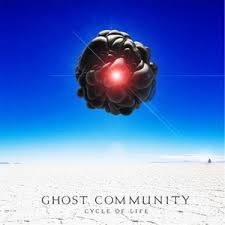
A review of Ghost Community, CYCLE OF LIFE (2016).
Tracks: Rise Up; Mirror Lakes; Anything and Everything; Blue December Morning; Ghost Community; and Cycle of Life
Ghost Community: Jake Bradford Sharp (drums); Matty Cohen (bass); Moray Macdonald (keyboards); Simon Rogers (guitars); and John Paul Vaughn (vocals).
Imagine if Styx hadn’t gone down the AOR and pop road in the second half of the 1970s, but instead had remained deeply embedded in the prog tradition of the early part of that decade.
Imagine, for just a glorious moment, that we remembered Styx not for KILROY WAS HERE, but rather for CRYSTAL BALL and EQUINOX? Then, throw in some British rockers to replace the ones from Chicago. Then, add the perfectionist and never-wavering mighty bassist and Welshman, the brilliant and steadfast Matt Cohen.
What you might find yourself with is a little piece of perfection in a rather dreadfully fallen world.
And, thus, you’d hold in your hand, Ghost Community’s CYCLE OF LIFE.
From the opening note to the closing one, Ghost Community is nothing if not utterly earnest. I’m not sure if everyone in the prog community would classify this as strictly prog—but, then, really, what is? The more unclassifiable the better—at least to me, when it comes to art as well as to individual human lives.
I must admit a bit of bias here. I have rather proudly enjoyed the friendship of Matt Cohen (though, strictly through the internet) for many years, and I find him to be one of the most compelling artists of our day. He loves to rock, he loves to get things exactly right, and he possesses the will power of ten great men. No matter what life throws at him, Cohen NEVER sits down and he never wallows. He thinks, and he acts. And, the world is so much better for it.
He’s also one incredible bass player.
As I listen to this album, I can’t help but feel immense satisfaction. It’s full of intensity and enjoyment. There are great lyrics, great playing, great flow, great engineering, and great production. There’s nothing more to desire. At one level—hence, the comparison to early Styx—the album is rather obvious and straightforward. Upon several listens, however, especially when paying attention to the lyrics, several more layers emerge—all quite subtle and nuanced. My guess is that even a decade of listening will still reveal more nuances.
This is an intelligent release, an excellent contribution to the current wave of prog rock. Maybe more rock than prog, it’s a delight.
“Light up, everybody.”



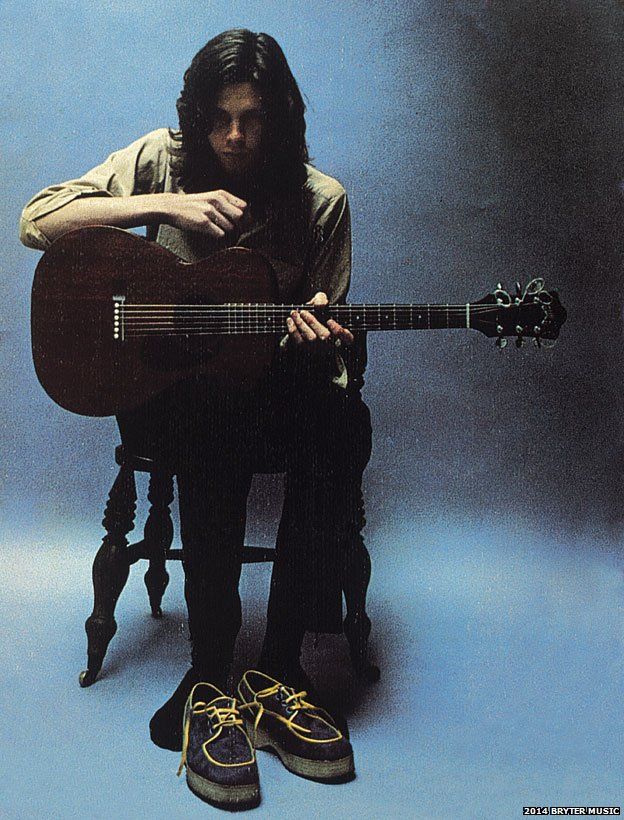 Across three years and three albums, Nick Drake produced singular, autumnal music that in its vision and genius defies era and genre. An extraordinary guitarist, lyricist, and gifted writer of melody, Drake was a lone wolf, debilitatingly shy, and thus his records were midwifed, by producer Joe Boyd — to this day Drake’s champion — and arranger Robert Kirby, along with various luminaries from the British folk rock/jazz scene. Richard Thompson, one of the players, estimates Drake probably sold only 5,000 albums in total when they first appeared, and it would take a VW ad a generation after his death to bring his music to a wider audience, but Nick Drake’s discography carries a timeless beauty, the light of late fall, and I hear in it the expressiveness — pain, humor, love — of Van Morrison and the soft, breathy sway of Joao Gilberto. “Northern Sky” from Bryter Layter is to my mind a perfect song of deep love and yearning, informed by the sensitive playing of John Cale, Dave Pegg, and Mike Kowalski. It wasn’t the breakthrough Drake expected (Island Records declined to release it as a single), and, perhaps disillusioned by his own overt attempt at and ultimate failure to make a commercial record, it’s believed to be one of the reasons he stripped down his sound for Pink Moon. And yet “Northern Sky’s” shimmering, jazz-inflected pronouncement, “I never felt magic crazy as this,” and its bell-like arrangement, is as fitting and whole a description of Nick Drake’s music as any I can imagine.