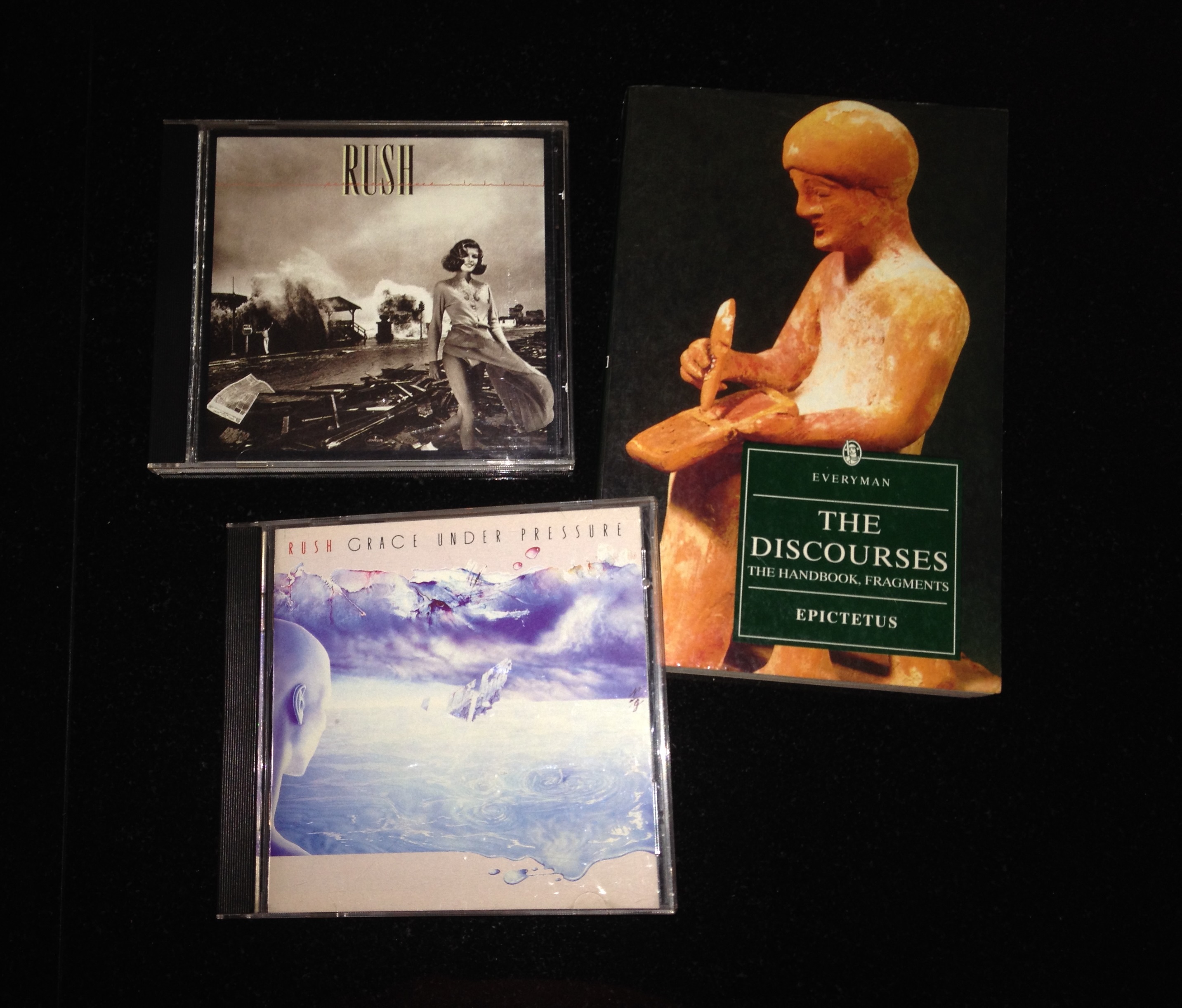
The Stoic Wisdom of Neil Peart

Seneca. Epictetus. Marcus Aurelius. Neil Peart.Rush Discourses

(This is where you do a double take).

No, that wasn’t a misprint.

Rush lyrics (penned almost entirely by Peart from their second album onward) cover a lot of ground. Individual songs meditate on the dreariness of the suburbs, the balance between heart and mind, the individual vs. the collective, intolerance, the perils of fame, nationalism, the tensions of art vs. commerce and so forth.   When you step back a bit to take a wider view, themes that stretch across a number of songs or even albums begin to emerge. Among those that emerge over the course of Rush’s output are themes of Stoicism. So let me just proclaim that Neil Peart is a Stoic and that Stoicism is a significant component in his philosophical approach to life itself.

I should probably give a brief primer on Stoicism here, and will do so with a bit of trepidation, as there are several other contributors to this site whose knowledge of this school of thought and philosophy (or any philosophy) vastly exceeds my own.

The Stoic school of thought originated with Zeno of Citium, who began teaching it in Athens around 300 B.C. It was later adopted by the Romans, including the famous three listed above. A fundamental tenet of Stoicism is to live in agreement with nature, i.e. “the way things are.” Another one is to learn to distinguish between those things which are under one’s control and those things that are not – and to not worry about the latter. A exceptionally difficult goal to attain to be sure, but one well worth striving for. Contrary to popular opinion, Stoicism does not teach the suppression of emotions, but rather that emotions are instinctive reactions to events, while our judgments of the same can either arouse or cool those emotions. Balance is key.

So how does all this tie in with Rush lyrics? Let’s take a look.

Continue reading “The Stoic Wisdom of Neil Peart” →

District 97 preview

Attention all Progarchists! Time Lord relays and endorses the following message to you all:

Hi everyone,

We’re delighted to give you a sneak peak at a track from our upcoming 3rd studio album. The song is called Takeover, and was filmed on June 12, 2014 at Martyrs’: https://www.youtube.com/watch?v=qCyjk-g5T48. Please share this video!

If you’d like to hear this and the rest of our new music on a new album, please consider contributing to our Kickstarter, which launches August 25th!

Kickstarter Launch Shows
In celebration of the Kickstarter Launch, we’ll be playing some live shows. There are 2 confirmed so far, with more to be added:

Thursday, 8/28 @ Double Door
Chicago, IL
w/The Chinese Professionals, Riddle House
8 PM, tickets at http://www.doubledoor.com/event/648139-district-97-chicago/

Friday, 9/5 @ Q-Bar
Darien, IL
w/Riddlehouse
http://q-barandgrill.com/darien/

Other News
Chicago is getting its very own Progfest this October! We’re really happy to be playing alongside bands such as Spock’s Beard, Stick Men, Richard Sinclair and many more. Join us for what should be an amazing weekend:

PROGTOBERFEST, 10/25-26
REGGIES ROCK CLUB
2105 S State St, Chicago, IL 60616
tickets at http://www.ticketfly.com/purchase/event/631771

Thanks for your support everyone!

Jonathan & District 97

New Rush Book No Longer Sold Out

Definitely a must own.

rvkeeper's avatarrush vault

stock

Thanks for the big show of support for my book, Rush: Life, Liberty, and the Pursuit of Excellence. The book has been listed as sold out on Amazon, but as of today the site says it’s in stock. The book was released on Monday, and it’s gratifying to see interest in it among fans of the band.


The book is my effort to show that Rush’s music is unique in just how consistent it holds to a few philosophical moral principles. Starting with the band’s bold statements in “Anthem” and “Something for Nothing” and ending with the 12 chapters of Clockwork Angels, the band over its 40 years has built virtually every piece it’s written on a bedrock of Aristotelian virtue ethics. This idea isn’t unique to me. Several of the contributors to Rush and Philosophy, which came out in 2011, talk about the Aristotelian connection in the…

View original post 395 more words

Brett Kull of Echolyn Co-Producing the New Fractal Mirror CD

News from a favorite band, FRACTAL MIRROR:

All Fractal Mirror artwork by Brian Watson.

Our second album, Garden of Ghosts is being co-produced by Brett Kull and Fractal Mirror.  We expect to release it in October/November 2014.  Early buzz from friends and other musicians around the studio has been great!

  • We will start a pre-order campaign in early September with an immediate download of one of the album’s tracks available at the time of the order.
  • We also have been filming some of the recordings and we will be posting clips on our Facebook page.

The album is also being mixed by Brett, who has graciously added acoustic and electric guitars and is responsible for many of the background/harmony vocals.   We can tell you that with Brett’s assistance the music sounds great (to us at least!) and we are excited to get to the finish line.   There will also be special guest appearances by Larry Fast, Don Fast on guitar and sitar, Jacque Varsalona, and Charlotte Koperdraat on background vocals, with a special appearance by the Echolyn choir.

A brief history:

The origins of Fractal Mirror can be traced back to the mid-eighties when three friends from Amsterdam started to make music together influenced by bands from the famous 4AD label and artists like David Sylvian and Japan. At the same time a new wave of progressive rock was expanding its listening audience with bands like IQ, Pendragon, Twelfth Night, Marillion and Pallas but especially the virtually unknown Canadian band Terraced Garden having an influence on their writing.

Ed and Leo continued making music together into the 21st century, focusing on the Alternative or Progressive audience. They met their drummer and lyricist via the Big Big Train site and met the challenge of transatlantic recording and communications with the release of Strange Attractors to very positive reviews. Their music is song based and there are no long instrumental passages or difficult time signatures. The music has a dark, raw edge and they often use the Mellotron. In March 2014 Fractal Mirror signed a deal with Third Contact, a record label owned by Larry Fast (Synergy/Peter Gabriel). They released the physical album in US and Canada and digitally worldwide on March 18 2014.

For Garden of Ghosts, Frank wrote most of the lyrics while traveling and sent them over to Leo/Ed, who then write the music.  Our ability to work together remotely has evolved, as has our music and recording skills.  Garden of Ghosts will contain a full lyrics booklet and an explanation of the songs, which focus on how our memories evolve over time, how we connect and relate to each other in this new digital world.

***

“Fractal Mirror have made a strong opening statement with a fine combination of upbeat, crafted pop rock songs nicely offset by the darker,  melancholic and somber pieces.  An album to return to often…” Bob Mulvey of The Progressive Aspect, UK

“One might call it New Wave/prog or alt rock/prog. I can, however, state unequivocally, it’s gorgeous, stunning, moody, intense, brooding, uplifting, inspiring.”  Brad Birzer, Progarchy

“How do these guys manage to sounds so accessible yet so critically hypnotizing? “ Lady Obscure,

“Fractal Mirror gives the mid-tempo rock bittersweet without instrumental showboating , recalling much REM and Bowie, sometimes with touches of  the Kinks.  MusicSphere (France)

www.fractalmirror.net

https://www.facebook.com/fractal.mirror

https://fractalmirror.bandcamp.com

fractalmirror@gmail.com

Happily PROG-ed.

logo-prog


August 11, 2014

Well, I admit it. Freely admit it. I was more than wrong.

Last week, I was pretty much banging my head on the wall trying to get the new PROG iPad app to work. Despite following the instructions, I just couldn’t get the thing to work. By the way, for those of you who know me personally, you won’t be surprised that 1) I couldn’t get it to work; and 2) I was frustrated.

Strangely enough, some technology comes to me immediately, and I can flow gracefully through, with, and around it. Other technology confounds me and makes me feel like a total idiot. Generally, I get along well with computers, but, equally, I can’t figure out cell phones worth a . . . well, you get the idea.

Part of my frustration came from the obvious fact that PROG is my favorite magazine, and I love basically everything that Jerry Ewing does.   So, I wanted my PROG!

After some very kind help from Ally at TeamRock this mornin, I was able to get my first new, improved, and enhanced issue of PROG.

And, holy schnikees, was it worth the wait. Using the same format as CLASSIC ROCK, the new PROG app allows for deep reading, support for hunting through the maze of web information surrounding a band or album, and, graphically, jumps off the page of the iPad. In other words, TeamRock has figured out what most traditional publishers still don’t understand—how to explore and utilize the possibilities of the iPad to their very limits. Good for them. And, great for us.

So, I didn’t get immediate gratification last week. I am now more than satiated. Thank you, Jerry and Ally. Thank you very, very much.

My faith is restored. Yours, Brad

Yes to Forever

Will Yes be the first band to transcend generations?

From an awesome new interview with the excellent Jon Davison:

But even with all the lineup changes, Yes’ music retains a dynamic, unmistakable identity that manages to end up being bigger than its individual players. 
That’s right, and it’s similar to the way classical music works. Long after those marvelous composers, like Chopin and Bach and all of them, passed, and the centuries moved forward, their music lives on. It’s not so much about the personality anymore. And people have a hard time seeing that now, because obviously the members [of Yes] are still alive, apart from [original guitarist] Peter Banks, who passed away last year. But it’s so easy to associate the music with the personality, and that causes a lot of conflict among fans. But ultimately, it’s about the music, and just taking the music forward. And there will always be a Yes. And I’m a lover of Jon Anderson as much as I’m a lover of Chris Squire, but you can’t fight it. And when something has that power to it, it’s beautiful, and beauty transcends all of that personality, and it’s always gonna belong, you just can’t put a cap on it and say, “Well, the original members aren’t doing this music anymore, so it’s over.” That can never be. It just can’t be.

It reminds me of the music of Frank Zappa, who composed so much great material with many different lineups — and many different lineups have performed it.
Yeah, that’s exactly it. Art just transcends so much. And when there’s something beautiful and powerful, it’s going to thrive, and you can’t stop it. Each lineup of Yes reflects a new, fresh kind of flavor, if you will. In the grand scheme and topography of Yes. So I think that’s kept it going. I think that’s kept it really fresh. Even the later albums, with “Open Your Eyes,” and so on, those albums are less popular, perhaps, but there was always a nice freshness there, the music was alive, and I think that has to do so much with the unique lineups that keep evolving.

In a recent article, Yes bassist Chris Squire joked, but in a somewhat serious way, that Yes will be around in a hundred years.
For me, when I hear the classic Yes stuff, yeah, I definitely hear that this is a ’70s band — there’s a lot of aspects in it that reveal that. But at the same time, it’s futuristic music. It’s like this thing you can’t quite pinpoint. It’s, like, way ahead of its time. And I still think we haven’t arrived at the point where, OK, we’ve arrived to the full realization of what Yes is. No, it’s like it’s still in the future, and I think that’s why it goes over so many people’s heads.

It’s definitely rock and roll, but at the same time, it has this transcendental quality that you can’t quite pinpoint.

New demo from Ezekiel Graves/Gravaphone

artworks-000087721505-fnusjh-t500x500Ezekiel (Zeke) Graves has a new demo out under the name Gravaphone.  Graves’s music, which I’ve reviewed on the pages of Progarchy before (https://progarchy.com/2013/11/15/chthonic-journey-by-ezekiel-graves/) emerges from his North Carolina upbringing but is also informed by deep soundings of electronic music, British folk, and Krautrock.  I saw him perform this song live a few months ago, accompanied by a Fender Rhodes and fiddle, which gave the song a unique coloration, but I like what he’s done with it here as well, made it darker, spare, and electric.

https://soundcloud.com/gravaphone/new-state-demo

Rob Reed solo: SANCTUARY

rob reed ad sanctuary

***

Sanctuary is the fulfillment of a lifetime’s dream and ambition in music Rob Reed has held since first hearing Tubular Bells in 1973 at the age of seven. Last year, he decided to focus his abilities on creating his own one-man project.

The album is played, produced, mixed and engineered by Reed and he’s brought in Oldfield collaborators Tom Newman and Simon Heyworth, who respectively co-produced and mastered the new work.

Reed learned to play all the instruments used on the record – grand piano, guitars, bass, mandolin, glockenspiel, vibraphone, marimba, timpani, banjo, recorders, organ – and… tubular bells ! The Synergy Vocals choir, singer Anghared Brinn and some extra percussion by Tom Newman completed the picture.

Rob says: “I wanted to play all the instruments, and for them all to be real – no synthesisers. The next four weeks were a bit of a blur as the music just came out. It turned out to be the most enjoyable album I’ve made.” Conscious of the need to be inspired by Mike Oldfield’s iconic album, rather than just copying it, Reed adds “I worked hard to make the melodies stand on their own.”

And the result has reaped dividends, with Rob noting Heyworth’s reactions: “He told me that when he heard it, he closed his eyes and he was back in Manor Studios in 1973.”

Rob is hopeful that the two-part piece can be performed live with a 12-piece band soon.

Sanctuary was released on July 21 via Tigermoth Records on CD and DVD 5.1. A 180g vinyl is available via Plane Groovy, and each copy comes with a download coupon.

***

The Philosophy of Rush

I am curious to see how Robert Freedman explains “Aristotelian individualism” in his book, Rush: Life, Liberty, and the Pursuit of Excellence (Algora, 2014).

Tibor Machan’s Classical Individualism: The Supreme Importance of Each Human Being, Studies in Social and Political Thought (New York: Routledge, 1998) discusses it in the following way, as recounted by Irfan Khawaja:

Machan distinguishes between two brands of individualism, Aristotelian and Hobbesian. Hobbesian individualism, on his account, is the problematic form, characterized by nominalism about universals, subjectivism about value, and atomism about human nature. Aristotelian individualism is the “classical” and defensible form, characterized by conceptualism about universals, objectivism about value, and what we might call biosocial essentialism (my term) about human nature. On this latter Aristotelian or classical view of individualism, Aristotelian individuals ought to be the primary unit of analysis in normative theory, and the primary concern of a legitimate social system. Each of us ought to strive, as Aristotelian individuals, to regard the pursuit of our own happiness as our overriding moral obligation. A just social order would respect that obligation by protecting the conditions that facilitated its optimal pursuit by each of us. Machan argues that the anti-individualists mentioned above are successful in their attacks on Hobbesian individualism, but fail to distinguish between it and Aristotelian individualism, which they leave entirely unscathed in their criticisms. (For a concise statement of Aristotelian individualism, see CI p. 170).

Among the criticisms Machan works to overcome in CI is the objection that the very idea of “Aristotelian individualism” is incoherent. Aristotle, after all, is well known for his dictum that “man is by nature a political animal.” Anti-individualists have often used this Aristotelian thesis to argue against individualism as follows:

1. Aristotle was correct to argue that humans are by nature political animals;

2. But individualism denies this Aristotelian truth;

3. Hence, individualism is false.

The argument raises a dilemma for Machan: if classical individualism is Aristotelian, it can’t be genuinely individualistic; but if it’s really individualistic, it can’t be genuinely Aristotelian. So, the criticism goes, Machan must choose between his commitments to Aristotelianism and to individualism.

Machan, however, believes that he can have both Aristotelianism and individualism simultaneously. Granting the existence of contrary evidence, he isolates a solid core of textual evidence for a form of individualism in Aristotle and generally in the Aristotelian tradition. The plausibility of Machan’s argument derives from the fact that individualism is in fact a pervasive theme in several important elements of Aristotle’s philosophy. Thus some support for individualism comes from Aristotle’s metaphysics of entities which, to quote Eduard Zeller, makes “the Individual…the primary reality” in Aristotle’s ontology, and gives it “first claim on recognition” (CI, p. 175). Some of it comes from Aristotle’s theory of action, which is the locus classicus of the agent-causal theory of free will that Machan defends elsewhere in the book. Some of it comes from Aristotle’s theory of value, which makes an individual organism’s flourishing that organism’s ultimate end, and the source of the norms that guide its life. Some of it comes from Aristotle’s theory of practical reasoning and virtue, which places a high premium on ordering one’s life by one’s own rational choices. Some of it even comes from the most anti-individualist part of Aristotle’s philosophy, his politics. In a justly-celebrated study, Fred D. Miller Jr. has recently argued that Aristotle’s political theory gives a central place to individual rights and a “moderately individualistic” theory of the common good.[21] Machan usefully points to similarities between this Aristotelian conception of individualism and various historical influences on contemporary life, from Christian and Islamic theology, to classical liberalism, to the thought of the American Founders, to the writings of Ayn Rand (CI, Preface, chs. 1, 14, 15).

One of the virtues of Machan’s discussion is that he manages to maintain a healthy sense of perspective on the texts, making a good case for Aristotelian individualism while acknowledging the existence of other ways of reading the texts, and some texts that contradict his interpretation. The purpose of appealing to the texts is to identify two forms of individualism at a fairly high level of generality, and the evidence that Machan cites is more or less sufficient for this task. In this respect, Machan’s approach differs drastically from that of some of his critics (e.g., John Gray) whose modus operandi consists in making bold, unsupported, and occasionally downright wild assertions about the relationship between Aristotle and individualism. A close reading of the Preface, and of chapters 1, 4, 14, and 15 of CI should give such critics pause, and give others a lot to think about.

Having made the case for the coherence of an Aristotelian form of individualism, however, it’s a separate task to make that case relevant to contemporary life. Aristotle lived nearly 2400 years ago in a slave-owning, deeply misogynistic society, and explicitly deprecated the value of productive work. In fact, Aristotle’s view of productive work—that it is a morally inferior task performed by morally inferior people whose products can be expropriated at will (cf. Politics 1254a4-8)—is not only the antithesis of Machan’s individualism, but is arguably one of the sources of opposition to it. Historically, Aristotle’s conception of productive work was invoked to justify the slave trade; today, it remains entrenched in the views of those advocates of redistribution who believe that “the needy” have de facto property rights in the labor and talents of “the able.”[22] Drawing on Locke and the other classical liberals, Machan works to detach these Aristotelian prejudices from Aristotle’s more fundamental claims (e.g., those mentioned above), and then connects those fundamental claims with an essentially Lockean politics. One of the best results of this approach is Machan’s treatment of the so-called “tragedy of the commons,” which he renames the moral tragedy of the commons, and conceptualizes in a way that is both clearer and deeper than that of its “original” author, Garrett Hardin (CI, p. 49). The idea of a moral tragedy of the commons has deep roots in Aristotle’s critique of Platonic communism, and in Locke’s theory of property; Machan redeploys the concept to offer cogent criticisms of redistribution and environmentalism that maintain continuity with the Aristotelian and Lockean arguments (CI, chs. 5, 10, 11, 12, passim).