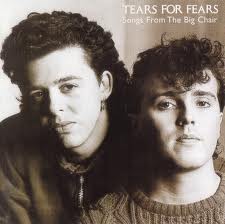
About as good as pop gets: Songs from the Big Chair (1985)

tff sftbcOk, so it’s not a perfect album, but it’s about as good as pop gets.

***

As I finished my junior year of high school, Tears for Fears released its second album, the first to make it huge in the U.S., Songs from the Big Chair.
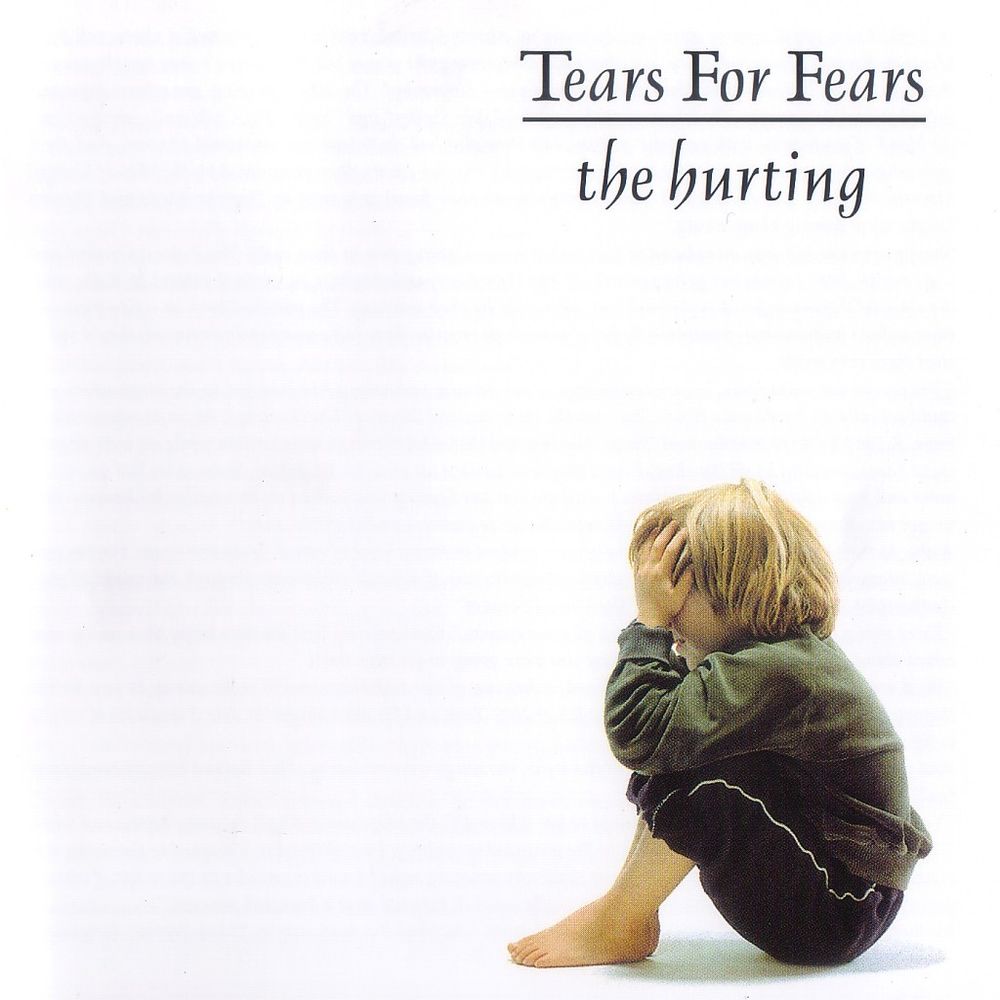
The hurtingThe first album, The Hurting, proved the sheer brilliance of Orzabal and Smith, but it also felt very, very, very, very (ok, I’ll stop–but, really, very) constricting.  As Orzabal and Smith released their primal screams and healed their own hurts, the listener entered into a sort of padded but rhythmic asylum for 41 minutes and 39 seconds.

Possibly the breath would simply disappear if that album went on 21 more seconds.  Imagine Andy Summers shouting “mother!” or Phil Collins begging for his “mama” but with serious prog sensibilities.  Well, you get The Hurting.  Enough.

In contrast, Songs from the Big Chair, though still thematically dealing with emotional and mental trauma, sends the listener into realms of openness and euphoria.  The entire album is full of possibilities, full of what might have beens–all of them good, a cornucopia of aural pleasures.  For the listener, Songs from the Big Chair is one huge intake of morning air in the Rocky Mountains.  This is pop at its purest, achieved, really, only by the Beatles and XTC.  Rarified.

Side one (yes, I’m old enough to remember sides).  Frankly, the two American hits, “Shout” and “Everybody Wants to Rule the World”, are the weakest tracks on the entire album.  But, that said, they’re still brilliant.  “Shout” is righteous pop, filled with a soaring guitar that might fit nicely on a Big Country album.  “Everybody Wants to Rule the World” is a clever dig at oppression and imperialism, dressed in a sunny tune.

Both of these songs played so often on radio and MTV in the mid 1980s in the United States that it’s impossible for me to avoid thinking about Apple Computer, Ronald Reagan, the Icelandic summit, or John Hughes when hearing even a few notes of either.

“The Working Hour,” track two, rings with jazz flourishes and an urgency lyrically and musically.  It begins with pure taste, as brass and keyboards gently dance around one another.  Though only one second shorter than “Shout”, the song has much more depth to it.  It’s Orzabal’s guitar work, however, that makes the song so beautiful.  That, and his voice–the depth and anguish of it all.  It all ends up being a song that never ages, never becomes tiresome.

Track four on side one, “Mother’s Talk,” has the percussive feel of much of The Hurting but without the claustrophobia.  Indeed, it feels far more Latin American and than it does European.  Or, perhaps, it has a bit of Peter Gabriel in it.  Whatever it is, it works wonderfully, a perfect way to end side one.  As with The Hurting, the lyrics are gut-wrenching and desperate, dealing with the fears of conformity and the inability to resist what is clearly dangerous in a community.  In the end, the weak person destroys not only his own soul but the very integrity of society as well.
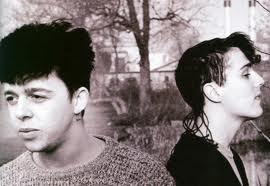
tff 80sSide Two, a dramatic tale from beginning to end.  Starting with ominous notes from a grand piano, Orzabal picks up lyrically from the previous album.  “I believe,” he cries in his best croon, an affirmation that the therapy expressed in The Hurting has accomplished something.  Well, at least that’s his hope. By the end of the song, however, Orzabal expresses nothing but doubt.  Who are you to think that you can shape a life?  No, too late.

The song slides perfectly into “Broken”–less than three-minutes long, but full of 80s production–with big and angry guitar, a relentlessly driving bass, and intricate keyboards.  “Between the searching and the need to work it out,” Orzabal laments, he deceived himself by believing all would be well.  Impossible.  “Broken.  We are broken.”

Then, the haunting line: a moment only between being a child and being a man, seeing one’s life in continuity, all that is good and all that is wrong.  Tempus fugit.  A moment.

Back to full-blown, over the top, crooning pop: “Head over Heels.”  Sheesh, Orzabal explains, I just wanted to talk, to enjoy your company.  I didn’t realize this was going to get so deep, so quickly.  He then explains that his family desired so much of him and for him.  He.  Well, he just wanted some freedom to find his own path and his own creativity.  So hard to do.  “I’m on the line, one open mind.”

As the song fades out with a chorus of “la-la-la-la (repeat x20),” Orzabal’s voice twists and the album returns to “Broken,” ending, strangely, with a live audience cheering wildly.  As the audience’s applause dies down, swirling, psychedelic keyboard and hypnotic voices emerge.  Again, with the tasteful guitar of side one.  The final six minutes of the album seems like something that might have appeared on a pre-pop Simple Minds or a Tangerine Dream album.  Electronica not for dance, but for centering and psychic probing.

The lyrics to the final song, “Listen,” conclude nothing but add a certain mystery to the whole album.  Only a few lines repeat: Russia attempts to heal, while the pilgrims head to America.  Meanwhile, Orzabal chants his desire to soothe feelings and bring mercy.  Spanish voices cry in bewilderment.

The final noise of the album: percussion that sounds as though an ocean wave has overcome all.

*** 

For me, the album is the sound track to my senior year of high school.  My debate colleague and one of my life-long friends, Ron Strayer, and I listened to the album over and over again, adding the b-side “Pharaohs.”

Frankly, I think the overwhelming popularity of Tears for Fears in the 1980s and some of the pretentiousness of their lyrics has relegated them merely to 80’s status, locked in that decade as though a museum piece.  They deserve more applause and attention from those of us who love music.  I never particularly liked The Seeds of Love (1989), but I think Elemental (1993) and Raoul and the Kings of Spain (1995) are some of the most creatively crafted rock/pop albums ever made.
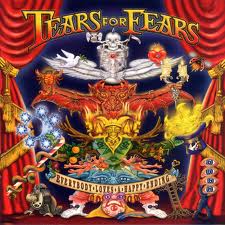
tff everybody lovesThough, the final Tears for Fears album, Everybody Loves a Happy Ending, could be an XTC-style Dukes of Stratosphere paean to the Beatles, it works.  It has some of the best pop written. . . well, since Abbey Road.  “Who Killed Tangerine?” especially has to be one of the most interesting pop songs of all time.

But, these are topics for other posts.  For now, enjoy a rediscovery of Songs from the Big Chair.

Castoriadis on Music

I’d like to share these words regarding music, from a rather underappreciated philosopher/social and political theorist/psychoanalyst named Cornelius Castoriadis (1922-1997).  Castoriadis, for whom the idea of creation was of central importance, was greatly admired by Ornette Coleman, among other musicians.

In truth, the ground against which the musical figure rises up, its proper ground, is a silence such as would not exist in its absence, and which it creates by its being: a silence which is, for the first time perhaps in the history of the world, Nothingness. Everything which surrounds music, conditions it, everything which it presupposes, remains laughably exterior to it. Even if, as is almost inevitable, we only ever listen to it ‘impurely’, still the musical figure rises up through an abolition of the world. Its only ground is nothingness, silence — a silence which it does not even bring into existence as its background, for it annexes it without violence and makes it be as its own part. And, listening, we can have only one wish: that this should never end or that everything else should end, that the world should never be anything other or that it should be this very Nothingness.

Cornelius Castoriadis, Crossroads in the Labyrinth (MIT Press, 1984), p. xxvi.

20 Looks at The Lamb, Prologue: “Regards”

LoriodVingtMy favorite work by composer Olivier Messiaen is Vingt regards sur l’enfant-Jésus, which translates as something like “twenty looks at the infant (or child) Jesus.”  “Regard” in French suggests a way of looking, a perspective, a “gaze,” as it has been rendered in some philosophical translations from the French.  Messiaen ‘s work consists of twenty pieces for solo piano, each of which is a musical regard (gaze, contemplation, way of looking) of a devoted Catholic Christian directed toward Jesus Christ.  The entire work requires a couple of hours for a full performance.  It was written for Pianist Yvonne Loriod, Messiaen’s second wife.

What I wish to begin here could seem rather sacrilegious or blasphemous to some, or perhaps overly loaded with religious baggage to others, but I’ve decided to try it anyway.  Inspired in part by Messiean’s approach, I want to direct twenty regards toward the album, The Lamb Lies Down on Broadway (1974) by Genesis, which is probably my very favorite album that gets classified as “prog.”  I’ve found that it’s an album to which few listeners are indifferent.  It seems to be one of those albums that is loved by a great many, but also dismissed or even vilified by significantly more than a few.  For some (including me, I believe) it is the pinnacle, for others it is a paradigm case of narcissistic excess, or perhaps just a “dud” after the sometimes-preferred pinnacle of Selling England by the Pound (1973).  I hope to show (performatively, so to speak) that it is worth at least twenty looks.

One of the ways in which the French word ‘regard‘ has gained prominence in philosophy has been through its usage by “existentialist” thinkers, especially by Jean-Paul Sartre.  Sartre famously writes about “the look” of the Other that falls upon me (in his book, Being and Nothingness).  In that discussion, the suggestion is that what I see is not just the Other, who then sees me.  Rather, I see the Other’s seeing of me.  A regard, in this sense, for some philosophers and social theorists, is part of what makes it possible for me to see myself, or to be in any sense an object of my own gaze.  In that context, the idea of a regard includes not just a “beholding” or a mere “looking-on,” but a seeing-as…  It implies judgement, valuation, potential accusation, potential responsibility.  A regard is not the occurrence of physiological vision; it is a seeing that is pregnant with significance.  The more recent French thinker, Michel Foucault, titled one of his books Naissance de la clinique: une archéologie du regard medical, which is rendered by the English translator as The Birth of the Clinic: An Archaeology of Medical PerceptionRegard is “perception” not in a narrow physiological or psychological sense, but in the sense of a wholistic sense-making perspective, a whole framework from which, within which, or in terms of which one sees.

Lamb74It is in this rich sense that I believe Messiaen “gazed” musically, and that I wish to “gaze” at a double album’s worth of music.  I share the beginning of this “essay” (attempt) before actually composing its twenty movements.  I’m not sure why it seems important to me to stick to that format of twenty movements, but it does.  It will be a kind of discipline, helping me to think rather carefully as I go along about how my regards should be individuated, and how they should be distinguished from each other.  The object of all of the gazes will be a work of art (Genesis’ album), but I want to give free reign to the problematic way in which the writing that I do is also a work of art.  (I’m dancing about architecture, as the saying goes.)

I’ll number the looks as I present them, though of course it might become clear later that they should be placed in a different order, assuming that the order matters at all.  I recognize that a lot will be at stake, for some others as well as for myself.  I recognize that what will be at stake may be positive or negative, or may sometimes be difficult or impossible to fix as positive or negative.

I hope that readers who are not as favorably disposed to “religious” or “spiritual” matters (however you define those overused terms) can be patient with me in this endeavor, or at least that you are able to ignore me if you wish.  There is no ulterior motive here either to subtly coerce or to argumentatively convince you to embrace anything in particular of a “religious” or “spiritual” sort.  But I can no more prevent my regards from being saturated by struggles with faith than could Messiaen (or, I am inclined to think, Peter Gabriel).

I invite you to accompany me, but only if you want to.  Let us look.

First Look —->

The Perfect Storm: Riverside at the O2 Academy, Islington, London on Thursday 14th March 2013

To paraphrase Wikipedia…a “perfect storm” is a term that can be described as a confluence of different related phenomena that combine to create what can be referred to as the “perfect situation” to generate an event (its first use was allegedly to describe a ‘perfect storm’ of applause).

And yes, things came together pretty nicely on Thursday night.

I have to admit I was a reluctant attendee, not because I don’t like Riverside, far from it. Unfortunately I had undergone a seriously bad day at work, leading to the cancellation of my holiday booked for the next day 😦  I also had a dose of ‘man-flu’. So I didn’t feel that inclined to trudge for an hour plus up to Islington; drink gratuitously (polish vodka maybe?) and get home well after midnight.

Things started getting better as travel connections were good and we (Nigel and I) managed to get to the venue fairly early and caught half of the set of the first of the three bands, Dianoya. Hailing from Poland, like Riverside, they were an engaging and enthusiastic Progressive Metal band and, as the set continued, there were various appreciative nods from some of the ‘older’ members of the audience (me included).

I have always liked the Academy, quite small but never a crush. Even a shorty like me can usually get quite close and get a good view. The acoustics are impressive which is important for an audiophile like me. The bar(s) are very ‘adjacent’ and I like the industrial ‘feel’…the ceiling is full of open girders and ducts; wires and lights. It’s a pretty ‘hip’ place and is used as a late night disco for the ‘younger’ folks after all we oldies are tucked up in our beds. At this point I should also name in dispatches the lighting crew, who added to the ambience considerably with a subtle yet creative lighting display.

Two pain killers taken earlier followed by the quick sloshing down of an (incredibly expensive) pint of lager had given me a renewed vigour. And there was not much waiting required for the second act, Jolly, who herald from the great New York City. They produced a powerful cocktail of heavy, experimental, art rock characterised by slow openings, fast bass lines and high quality guitar playing. They aroused my curiosity and I was quite intrigued to find out more. But please forgive me when I say their Facebook band profile is a load of pretentious twaddle; either that or it’s a very long-winded ‘p*ss take in Spinal Tap style. Nevertheless a strong support act.

A move towards the back (to meet another friend) put me in the perfect listening position, at the apex of the classic ‘audio-triangle’, as Riverside took the stage. This Polish progressive rock band led by the virtuoso bassist and singer, Mariusz Duda, have just released their new album, ‘Shrine of New Generation Slaves’ (SONGS),  intelligently reviewed recently by my fellow Progarchists, Nick and Erik here:

Riverside – Shrine Of New Generation Slaves

https://progarchy.com/2013/02/15/self-imposed-slavery-riversides-shrine-of-new-generation-slaves/

The band has been gaining popularity following their critically acclaimed 4th album, Anno Domini High Definition (ADHD) released in 2009. Having gradually veered towards a more classic rock sound from their predominantly metal roots, Riverside have been compared with both Tool and Porcupine Tree. Lyrically far less disturbing than Tool they still retain a heavy guitar riff style and the inclusion of powerful keyboards and potent bass lines give the band an added depth, complexity and uniqueness to their sound.

Mariusz Duda at the O2 Islington
Mariusz Duda at the O2 Islington

Tonight’s set focussed on the new album and ADHD.

Having just been to one of my Top 10 gigs of all time (Steve Wilson at the Royal Festival Hall, London), how lucky I was to see another band at the peak of their powers.  Displaying outstanding musicianship; exemplary timing and an almost telepathic understanding, Riverside are seriously talented. Understated guitar (from a scary looking lead!); extraordinary depth to the keyboards; complex bass patterns weaved by spider-like hands and beautifully sympathetic drumming. Virtually faultless, the only (small) downside was Mariusz’s voice, slightly let down by the flu (I read subsequently that their Sheffield gig the next day had to be cancelled).

There was no showboating; no unnecessary solos; no ego trips displayed. Professional to the last, Riverside were clearly enjoying their evening and showed a genuine desire to engage the audience. And this was reciprocated. How refreshing to see people of all ages. And clearly popular in their home country with plenty of London’s Polish community turning up. Riverside have clearly broken down that difficult barrier that exists for so many Progressive Rock bands…this is not just music for follicly challenged over 50s.

Having been impressed with their last 4 releases, I can say, indubitably, that they sound better live than on record, delivering an electrifying power that is beyond a recorded medium.

Great gigs are not just about the band, they are about the whole experience…the audience; the venue; the lighting; the acoustics.; the beer, absolutely everything ! All these factors combined beautifully to create the ‘Perfect Storm’ and at £19 a ticket it was a steal.

To those interested here is the set-list, with my highlights being tracks 2, 4 and 8:

New Generation Slave – SONGS

The Depth of Self Delusion – SONGS

Feel Like Falling – SONGS

Driven to Destruction – ADHD

Living in the Past – Memories in My Head

We Got Used to Us – SONGS

Egoist Hedonist – ADHD

Escalator Shrine – SONGS

Encores:

Left Out – ADHD

Conceiving You – Second Life Syndrome

Lucid Dream IV – Rapid Eye Movement

Use the Force — Listen to Prog

Chris+Squire+YesChrisSquire

Mark Judge has a nice meditation over at Acculturated.com:

Urban Outfitters now has a section dedicated to vinyl records. The one in my hometown of Washington is in Georgetown, and as I walked to it I had a flashback to the 1980s when I regularly went to any one of the three record stores around Wisconsin and M Streets to shop. There was a mediative, contemplative aspect to the process. You’d get into a kind of peaceful spiritual state as you browsed, awash in the album artwork, the music, and thoughts about love, art, and life. It was like praying.

The piece is called “Star Wars and Vinyl Records: Evidence That Technology Will Not Save Us”!

Help Leah Write, Record, and Produce Her 2nd Album

leah-metalThe North American Metal Maiden herself, Leah McHenry, is working on her second album.  As our Chris Morrissey detailed in two long pieces last fall, Leah is an astounding artist on the rise.  We’re very happy (indeed, quite thrilled) to support her.  While I don’t know metal in the way that Chris does, I can state that Leah is incredibly talented.  She’s, to my mind, what Sarah McLachlan should’ve become after her third album, 1993’s FUMBLING TOWARD ECSTASY.  Actually, Leah’s first album, OF EARTH AND ANGELS, lyrically as well as musically, is every bit as good as anything Sarah McLachlan did with her first thee extraordinary albums.  After 1993, McLachlan started playing it safe, writing great pop ballads but nothing to match what she did between 1989 and 1993.  Unlike McLachlan, Leah will almost certainly never lose her edge.  Her creativity and integrity seem to be as limitless as the strength of her rather Celtic voice.

On a personal note, I have had the brief opportunity to get to know her a bit through the internet.  She’s as kind and interesting (she’s a mother of four!) as she is talented.  She has a long and fulfilling career ahead of her.

Here (below) is what Leah has posted as an appeal.  Please support her as you can.  She’s been invited to be a member of Progarchy, and she’s welcome to post or review here anytime.  Though, of course, she’s got her family and career to think about.  Regardless, we will continue to sing her praises.–Brad, ed.

+++

I am an emerging celtc-metal artist and songwriter from Vancouver, BC Canada.

In 2012 I released my debut independant album “Of Earth and Angels.”

People have described me as “The ENYA of heavy metal” and “Loreena Mckennitt meets Delain.”

I’m very influenced by celtic, world, and new age music as well as my love for symphonic metal. Fusing different genres together is a challenge I enjoy and that others seem to enjoy hearing!

I have a growing fanbase through the internet, purely from word-of-mouth and social media, since I haven’t had the time to promote my music from touring (I’m a stay at home mom). Despite that fact, I’m absolutely amazed at the number of enthusiastic fans I’ve gained and continue to gain every day!

That is pretty amazing, especially because while I’m committed to being a full-time mother, people are discovering my music all over the world and raving about my album!

This is great! But now fans want MORE from me. If you liked my first album, there is a LOT more where that came from!!

What I Need & What You Get

A production like mine is not cheap, but it’s nothing compared to what big labels spend! The following is an estimate, and one category may need more than the other category, but for simplicity’s sake:

  • $1000 for pre-production
  • $10000 will pay for my producer and studio time
  • $5000 will pay for musicians
  • $8000 for mixing and mastering (this would be a bargain).
  • $3,000 for album artwork, photography, and replication
  • $3,000+  publicity and radio promotion (U.S., Latin America, Europe)
  • $5,000+  videography and editing for official video releases

*** If we can raise more than our goal, we can take the music worldwide. That means radio and press, tv and film, official videos and MUCH more.

leah-magicI’ve chosen a flexible campaign, which means I can if I don’t hit the campaign goal, I can still use the funding that is raised. But it will mean we will need to re-evaluate where and how the money is spent and adjust it accordingly.

Depending of the size of your generosity, all contributors will get something very special from me 🙂

Your contribution and support means the world to me. It means I can:

  • Continue to be there for my family
  • Focus on writing high-quality material that the world will love
  • Have the potential to become known world-wide and still be an independent artist
  • Gives tangible support to the female-fronted metal scene!

Other Ways You Can Help

If you feel you want to contribute and aren’t able to monetarily:

  • Help me spread the word by sharing my campaign with your social networks by using the Indiegogo share tools!

Thank you! Thank you! Thank you!

Fierce And The Dead sign to Bad Elephant Music for 2nd Album

[I was very happy to wake up on this Sunday morning to find this press release and this note from one of our friend, Matt Stevens, and his outstanding and innovative band, The Fierce and the Dead–Brad, ed.]

Photo © TheChaosEngineers.  For information:  info@thechaosengineers.com
Photo © TheChaosEngineers. For information: info@thechaosengineers.com

B.E.M. is delighted to announce partnering with The Fierce And The Dead for the production, release and worldwide distribution of the band’s second full-length album.

The Fierce And The Dead – guitarists Matt Stevens and Steve Cleaton, bassist and producer Kev Feazey and drummer Stuart Marshall – was originally born out of sonic experimentation when making Matt’s second solo album, Ghost, and they’ve developed into one of the most original bands in the UK rock scene. Their unique brand of instrumental rock music, fusing rock, post-rock, punk and progressive elements, has made a big impression though one full-length album and two EPs, and their incendiary live performances, most recently as part of the Stabbing a Dead Horse tour of the UK with Knifeworld and Trojan Horse.

David Elliott, founder and CEO of Bad Elephant Music said: “We’re proper made up to be working with The Fierce And The Dead. They’re absolutely our kind of band, and lovely guys too. I’m looking forward to hearing what Matt, Kev, Stuart and Steve are going to produce for us, and of course it will be an absolute monster. Collaborating with a band of TFATD’s calibre is a huge honour for us, and we welcome them with open arms to the BEM family.”Foghat Matt

Matt Stevens, on behalf of The Fierce And The Dead, said: “We are extremely pleased to partner with Bad Elephant on this album, they are true music lovers and believe in supporting the artist. This will allow us to make the music we want to make and have the support to help us gain a wider audience, without in anyway compromising our vision for our new album. And they like a good curry, which is nice.”

The as yet untitled album is scheduled for release in the Autumn of 2013.

Bryan Ferry and The Jazz Age

Any of Progarchy’s Roxy Music or Bryan Ferry followers are probably already well aware that one of Britain’s greatest vocalists of the rock era has released an instrumental album.  A hot jazz album at that.  Ferry’s project was to recast a handful of his classics — for in addition to his distinctive voice the man is a fine songwriter — as Dixieland standards.  The improbable outcome of this ambition is that it works, and then some.  I think this is due to the soundness of the songs, Ferry’s deep feel for melody, and the rich layering that Roxy and his solo bands brought to the originals.  There are a lot of horizons these songs could veer off towards, and to hear “Avalon” and “Virginia Plain” receive a Hot Five treatment could make you think they were written for that type of performance.  “Love is the Drug” becomes a haunting Cab Calloway standard, and it’s possible to hear Ferry’s early influences — there is no way he could not have loved Calloway’s “Minnie the Moocher.”
Ferry brought to these interpretations the desire to emulate not only the arrangements of old jazz records but also their sound.  The band he put together recorded with one vintage microphone in the middle of the room — although he concedes each musician was also miked separately (which more easily accomplished the “stepping up to the microphone” of soloists of the jazz age) — with the entirety mixed and released in mono.  I supposed one could see affectation here, and there are plenty of Ferry followers who would rather the man write new songs or partner with Eno or whatever….  But Bryan Ferry has made a career and art out of affectation, and that he does it so well on The Jazz Age is a real testament, I think, to his talent as a songwriter and his skill as a performer.  I should emphasize, too, that this is not Rod Stewart reinterpreting the standards in front of a full orchestra, or “Pickin’ on Roxy Music,” but rather in its eery mono-ness conjures the craziness of Raymond Scott, the wooziness of the American swamp.  There is edge here.

Last month Bob Boilen interviewed Bryan Ferry on NPR’s All Songs Considered, and while I’ve been a fan of Ferry since Roxy’s Avalon came out, I found his thoughts on his new record illuminating of his career as a whole.  Check it out here.

The Modern Condition: Cosmograf’s “The Man Left In Space”

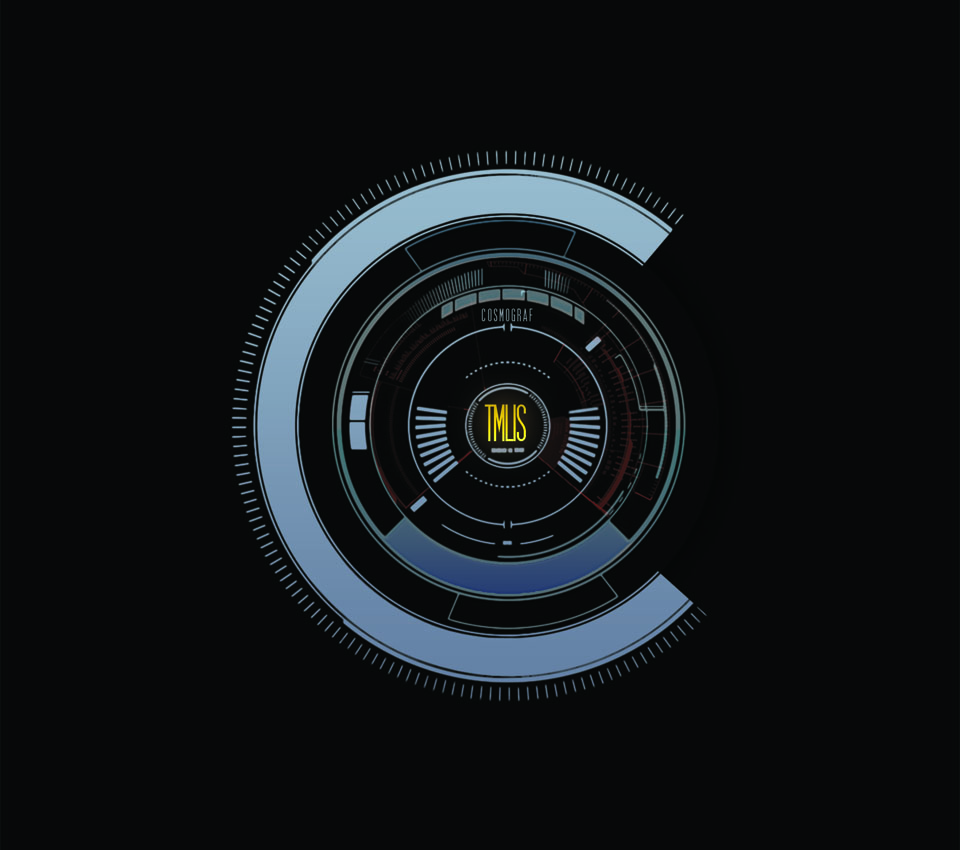
cdcover-tmlisFrom its cover image reminiscent of the all-seeing camera eye of 2001: A Space Odyssey‘s HAL computer, to the final track “When the Air Runs Out”, Cosmograf’s  new album, The Man Left in Space, is a profound meditation on the tragedy of modern man’s surrender to ambition and technology, and the ensuing isolation that results.  

Beginning with a bewildered astronaut, Sam, asking, “How did I get here?”, the listener is transported to the near-future, where Sam is questioning his motives for agreeing to a mission to “change the human race”. Can over-achievement bring satisfaction and happiness?

Ambition brought me here.

A winner in my field.

Dare to be a dreamer.

Find your fate is sealed.

Hidden truths revealed.

Through memory flashbacks, snippets of dialog with the ship’s android, and sampled audio of actual NASA space missions, we share Sam’s growing sense of melancholic disconnection with reality.

I take these pills. They help me numb the pain.

They stop me from feeling blue.

I feel the days getting longer now.

I’d like to dream, but I’ve forgotten how.

He’s even reduced to crooning a love song to his “beautiful treadmill” that will “keep my soul in grace”. Throughout, the ship’s android is monitoring Sam and vainly attempting to create a normal environment.  Earth’s Mission Control tries to contact him, but they cannot get through. Sam realizes that without human contact, he will eventually slide into madness. No simulation, no matter how realistic, can replace the touch of another person.

Eventually, the “man left in space” is forced to face his own mortality:

10 minutes more and the air will run out.

This craft will fall into the sun.

My chance of returning is none. None. None.

As the last chords of the final song fade away, the ship’s android repeatedly asks, “Please respond, Sam?”

Robin Armstrong, who is Cosmograf, has constructed a beautiful, allegorical warning for those of us who would replace face-to-face communication with all the technological means at our fingertips: emailing, texting, Tweeting, “liking” on Facebook, etc. Right on cue, Google is coming out with “Google Glass“, which will add even more distractions to our interactions with others. We must resist the temptation to withdraw into self-imposed isolation and foster real relationships, regardless of the risks.

The Man Left In Space would not be the success it is without having superb music to complement its message. Every track is extraordinary, and the album really must be listened to in its entirety. Highlights include “Aspire, Achieve”, which begins with a delicate acoustic guitar melody and vocal harmonies that shift into crunching metal worthy of Ayreon’s best work. “Beautiful Treadmill” has an indelible hook that will have you singing along in no time. The instrumental, “The Vacuum That I Fly Through”, featuring the marvelous Matt Stevens on guitar and Big Big Train’s Nick D’Virgilio and Greg Spawton on drums and bass respectively, rivals anything Pink Floyd ever committed to tape. Trust me, it’s that good.

Finally, some praise for the artwork. In this age of digital downloads, it’s worth it to get the physical CD. The booklet that comes with the album is essential to fully appreciating the  album. The illustrations remind me of the incredibly realistic sci-fi artwork Shusei Nagaoka did for Electric Light Orchestra’s Out of the Blue album from the late ’70s. The attention to detail is amazing: every page features readouts of various gauges, creating the feeling that you are involved in monitoring Sam throughout his doomed journey. The ship’s android is named ESA-1410-4MY, which pops up in several places and adds to the sense of technological surveillance and control of Sam.

Even though we have yet to finish the first quarter of 2013, Cosmograf’s The Man Left In Space is certain to be in many Top Ten Albums of the Year lists.

Enjoy “The Vacuum That I Fly Through”:

Update: A brief, but illuminating interview with Robin Armstrong.

How To Review An Album

Sid Smith has some interesting things to say about his approach to reviewing albums on his blog, Postcards From The Yellow Room.

Definitely worth a read if you have a few minutes to spare.