From Blake McQueen of prog outfit and class act, Coralspin:
Progarchy is a new US prog site that’s made a big splash already in only a few days of existence. This is not surprising as it’s headed up by that indefatigable trailblazer for modern prog (especially British modern prog) Brad Birzer. There’s even a review there of us…
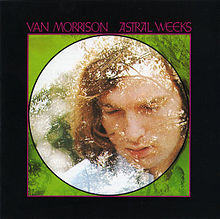
Van Morrison, Astral Weeks. 1968. This album is an insightful and penetrating introspection without ever falling into pure naval gazing. And, nobody writes better about the beginnings of love than Van Morrison. Possibly there exists something profound in the Celtic soul. Chesterton argued that the Irish were those the Gods made mad. Perhaps, this explains something. Or not. As I understand it, the album was done in only three sessions with the jazz musicians–who had never met one another–being given the music when they entered the studio. Happily, it possesses of the overproduced pop sound of its predecessor, Brown Eyed Girl. Astral Weeks is perfect for an autumn day. Or, really, for any day.
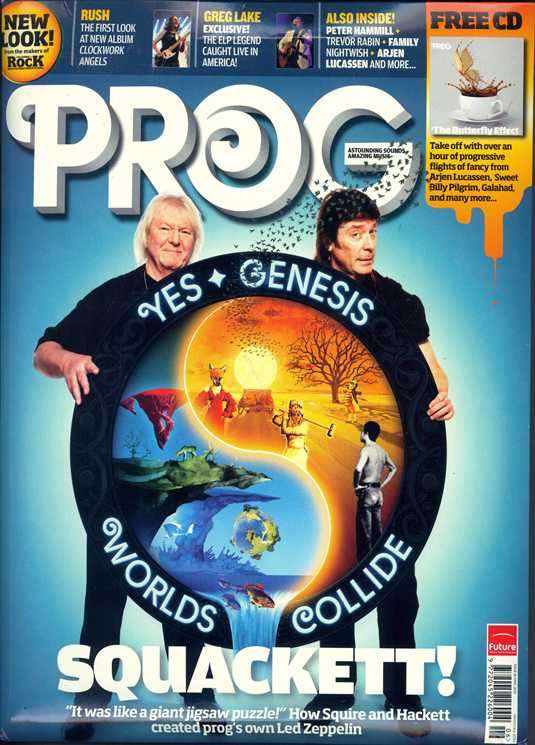
[I sent this to PROG magazine last May; sadly, the magazine chose not to print it. So, here it is, now safely lodged at Progarchy.–Brad]
May 24, 2012
Dear PROG,
Kudos for yet another brilliant issue (#26). I’m amazed and inspired by the sustained excellence in writing, photography, graphics, and layout. I even like the ads. Every thing in its right place and always accomplished with characteristic British taste, intelligence, and wit.
Having listened to progressive rock for four decades, I am firmly convinced that we are now living in the glory days, built upon the traditions and experiments of the past. Raised on a healthy diet of lyrics by Neil Peart and Mark Hollis, I’m especially taken with the quality of lyric writing in recent years. How can we listen to Big Big Train’s “Underfall Yard,” Gazpacho’s “Dream of Stone,” or Tin Spirits’ “Broken” and not realize that these artists are the heirs not only of Dvorak, Brubeck, and Davis, but also of Coleridge, Wilde, and Eliot?
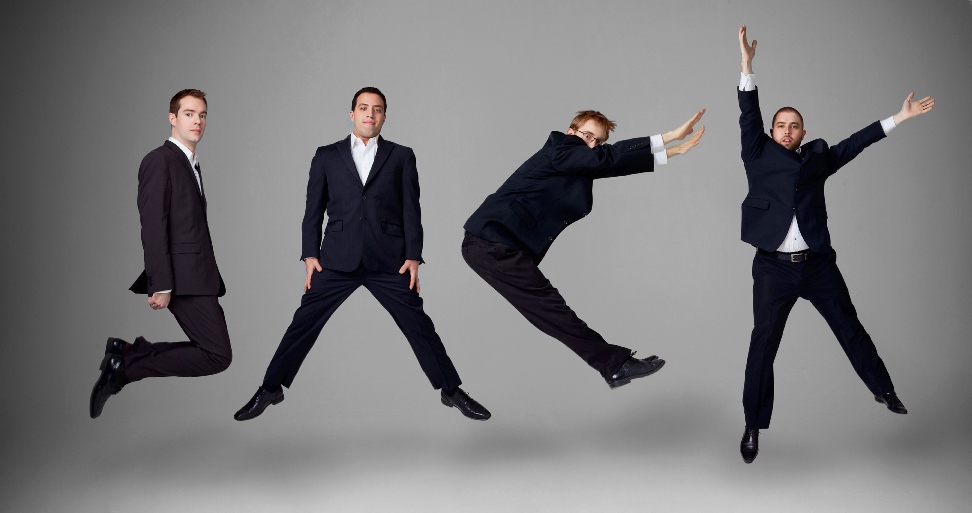
The JACK Quartet, Live in Kalamazoo Michigan, 10/19/2012 (Wellspring Theater, EPIC Center).
Taking seriously prog guru Birzer’s marching orders, and addressing “any music that is good, true, and beautiful,” I’d like to make sure that all of you know JACK. (I would NOT want anyone to be able to say that readers of Progarchy don’t know JACK!)
If you don’t know JACK yet, they are a string quartet (violinists Christopher Otto and Ari Streisfeld, violist John Pickford Richards, and cellist Kevin McFarland), and they have been making a fairly big splash over the last few years over in the more “academic” “new music” bins. They have already developed an international reputation, especially through their revelatory recordings of Iannis Xenakis’ quartets. Their name is an acronym composed of the first letters of the members’ first names, but they very much live up to the musical impetuousness that the name suggests.
I’ve known about them for a while, but last Friday night in Kalamazoo Michigan, I got to see them perform in person for the first time. It was one of those nights when multiple accidents on the Interstate bring the traffic to a halt, so the 45 minute lead-time I had planned on between arrival and concert time was obliterated, and I had to walk in fifteen minutes after they started. Hence, I unfortunately missed their rendition of three pieces by Guillaume de Machaut, arranged by violinist Ari Streisfeld.
But then they launched into the 5th string quartet by Philip Glass, and any frustration about having to walk in late melted away. Glass has been one of the most visible composers in recent years working at (and often obliterating) the boundaries of more “academic” composition and supposedly more “popular” genres of music. To watch the total bodily involvement of the members of JACK in the performance of this music was breathtaking. If you know what it looks like to see a great string player absorbed in an excellent classical piece, and also what it looks like to see the head begin to nod and the posture pulsate in that serious rock-aficionado sort of way, imagine BOTH sorts of movement brought towards you on the crest of the wave that I consider one of Glass’ most subtle and engaging pieces. I have rarely seen a more striking embodiment (as opposed to a mere presentation) of Glass’ music.
After a break, they returned with a fascinating reading of Guillaume Dufay’s Moribus et genere, an “isorhythmic motet” from the 1400’s arranged for strings by JACK violist John Pickford Richards. I do not consider myself much of an early music fan, but Richards’ arrangement and JACK’s performance very nicely highlighted the resonance of some early compositional techniques with contemporary composition. Appropriately more restrained, and nicely showing JACK’s professional polish.
But finally, the highlight: Tetras by Xenakis. I have heard a fair number of recordings by Xenakis, and even seen some pieces performed. But I have never been so profoundly struck by the way in which the members of JACK seem to understand Xenakis, to be able to live his music in performance, as opposed to “presenting” it. All of the sounds (many of which still tend to strike some listeners only as “noise”) were profoundly musical sounds, irreducibly beautiful sounds. The precision of the chamber ensemble performance was thoroughly energized by the primal level at which the players “got” the music, and pushed us as listeners to “get” it as well.
After the concert, I had a chance to talk to the members of JACK. Ari Streisfeld enthusiastically agreed with my assessment that skillful transgression of genre divisions is at the heart of what is most exciting and inspiring in music today. This has already been true for decades in music by Glass, Xenakis, and a host of other recent composers. Kronos and others have made the transgression increasingly visible in accessible and popular ways. Watching JACK perform, however, reinforces my sense that young musicians are increasingly feeling this excitement at a more visceral level, breathing this inspiration as well as grasping it well at the theoretical and performance levels, making it their dwelling, their home. These are guys who have been weaned on Bach and John Zorn.
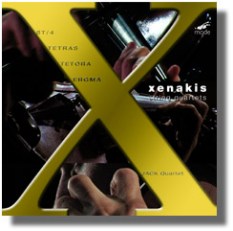
If you have not yet heard JACK’s excellent recording of Iannis Xenakis’ quartets (the Xenakis Edition, volume 10, on Mode), consider bringing your prog-sensitized ears to it as soon as you can!
American music critics rejected the progressive rock genre as pretentious and over-the-top, a regression of culture, almost from its very beginnings.
Though “progressive jazz” had been used as a term of approbation of and for non-trendy, non-danceable jazz since the late 1920s, the term “progressive rock” saw print only for the first time in the English language (and, I presume, anywhere) in 1968 in the Chicago Tribune. This first mention of prog carried no deep disgust or glorious praise, just a simple and descriptive recognition that this was not regular pop or rock.
In the fall of the same year, the New York Times (August 4 issue date) lamented that by making “the leap from sewer to salon, pop music has ceased to be an adventure.”
While certainly “ musically advanced,” the Times continued, progressive rock had made its art “emotionally barren.” Even the most intellectual of critics, the paper continued, could see that the “new, cerebral audience has endangered that raw vitality” of rock.
A few months later, the Times (November 24 issue date) again proclaimed that the “rock hero (who is almost always a social outcast)” should be nothing less than “a liberator in musician’s drag. His sexual display in the face of institutionalized repression becomes an act of rebellion. . . . It is immune to the censorship of ideas because its dialectic is purely rhythmic. To do away with revolution in rock, one would have to ban the music itself in its nature as a charged version of blues.”
A few days ago, Progarchist and classical philosopher Chris Morrissey asked about our first introductions to music.
The youngest of three boys, born in the summer of love (September 6, 1967—only 3 months and five days after the release of “Sgt. Pepper’s Lonely Hearts Club Band” by the Beatles), and coming of age in the late 1970s and early 1980s, I grew up on progressive rock: Yes, Kansas, Genesis, and the Moody Blues. We faithfully shunned the 3-minute pop format and we sought mightily the 20- and 30-minute epics of European (usually liturgically derived) symphonic music with rock instrumentation and bizarre time signatures.
I remember hearing lots of longish, prog songs as early as 1971 or 1972. Though I’ve never played an instrument with any degree of passion, I’m assured by my mom and two older brothers that I was obsessed with music even as a toddler. Somehow, I figured out how to crawl out of my crib and down the stairs to the family stereo. Even as a one-year old, I would wake the entire household up, blaring the Banana Splits or Snoopy and the Red Baron at 3 in the morning.
My first great awakening came, though, from seeing the sleeves of YesSongs. I spent hours trying to figure out how the animals made it from one floating island to the next. And, I’ll never forget the first time I played side one of YesSongs—I was overwhelmed by the depth and complexity of it.
As is now well recognized, the prog lyrics as well as the cover art tended to be fantastic, pretentious, overblown, and theological. There have even been some interesting scholarly articles about progressive rock thriving in the western and midwestern states of America, mostly among middle-class, conservative kids. And, of course, we, with great confidence, derided disco and top-40 music through junior high, high school, and college. Disco and top-40 music, as we understood it, were decadent and vacuous. As far as we were concerned, progressive rock artists (and some New Wavers) were the only real musicians outside of the classical and jazz world.
In many ways, progressive rock helped define my own childhood and teenage years. I will never forget seeing abolitionist John Brown on the cover of a 1974 Kansas album (it sparked all kinds of historical questions re: Kansas, abolitionism, and the American Civil War); hearing Pink Floyd’s “The Wall” at the University of Notre Dame in the fall of 1979; being introduced to Rush’s 1981 “Moving Pictures” in the Liberty Junior High School library in Hutchinson, Kansas; or listening to Yes’s “Fragile” over and over again and trying to figure out the “deep” meaning of the lyrics. In high school, I worked as on overnight D.J. at a local rock station (KWHK), which doesn’t exist anymore. And, while in college at Notre Dame, I had a Friday-night progressive rock show (WSND) my junior and senior years, often playing two hour blocks of Rush or other groups.
As powerful as any of the albums just mentioned, though, was my first listen to Talk Talk’s Colour of Spring in the spring of 1987 and, even more so, my first listen to Talk Talk’s Spirit of Eden in September 1988.
My comrade in arms in college was the singer of the most popular band on campus, St. Paul and the Martyrs. They even opened for Phish when Phish played on campus, spring 1990. The leader singer, Kevin McCormick, even became my oldest son’s godfather! Now, he’s a well-known classical guitarist and even a Progarchist.
But, I’ll never forget the two of us listening to Spirit of Eden for the first time. We were just stunned and in complete silence as we explored every note and every silence of the album.
Having turned 13 in the autumn of 1980, I also, of course, grew up with New Wave: Thomas Dolby, Kate Bush, The Police, The Cure, Oingo Boingo, XTC, Siouxie and the Banshees, and Echo and the Bunnymen. Over the Wall!
Our local Kansas radio station—KWHK—had briefly been formatted for New Wave, so I was able to get every new album sent by the record labels. The one that hit me hardest was XTC’s Skylarking.
My college radio show at Notre Dame focused on progressive rock, as mentioned above, but I threw in a lot of New Wave. New Wave just seemed the more radio-friendly version of progressive rock. And, by the early 1980s, progressive rock seemed to have run its course. Could Asia really claim to be the successor of Yes? Or, could Genesis without Peter Gabriel or Steve Hackett really be Genesis? We answered with a resounding “no.” That left us with New Wave.
After all, in 1990, we still had a few years before Dream Theater and Spock’s Beard re-introduced—in the states—a new wave of Progressive Rock.
A quarter of a century later, I realize that music took on religious significance for me and my friends. Those who embraced disco, pop, or top 40 music were heretics, and we supporters of progressive rock were the orthodox.
***
A year or so ago, some former students asked me to write about my listening tastes in the 1980s. Here’s what I wrote for them:
High School was a long time ago for me, but I still remember it well. During the summers, I had one of the best jobs in the world–I was a DJ at our local AM-station, KWHK. Not only did I DJ, but I also got to write and produce commercials, and I served as a liaison between the sheriff’s department and the National Weather Service. I grew up in central Kansas, so we had tornados and tornado warnings quite frequently. Great job. I’ve also been into collecting music (mostly progressive and alternative rock, some jazz, and a bit of classical) since second grade. I started young, and, for better or worse, I’ve never stopped. My kids (13 and under) can name bassists, singers, and drummers of the major progressive bands. And, yes, I’m proud of them.
Freshman year of high school, 1982-1983. It was freshman year that I really discovered New Wave. I had been listening, almost exclusively, to progressive rock and what’s now called classic rock during the 1970s and earliest part of the 1980s. The father of a friend of mine owned a record store, and we were introduced to all kinds of music through the store in 9th grade. In particular, I listened to Thomas Dolby’s Golden Age of Wireless (favorite song: One of Our Submarines is Missing). I had this on one side of a tape and ABC’s The Lexicon of Love (favorite song: 4 Ever 2 Gether). Also lots of U2’s War (favorite song: Sunday Bloody Sunday). Progressive Rock was never far from my heart, and I listened to Rush’s Signals (favorite song: Subdivisions) pretty much non-stop, Peter Gabriel’s IV (favorite song: Lay Your Hands on Me), and Roxy Music’s Avalon (favorite song: Take a Chance with Me).
Sophomore year of high school, 1983-1984. This was a huge year for music. Genesis released their self-titled album (favorite song: Home by the Sea, Parts I and II); the Police released Synchronicity (favorite song: Synchronicity II); and Yes released 90125 (favorite song: Cinema).
Junior year, 1984-1985. Rush’s Grace under Pressure (favorite song: Between the Wheels) dominated every other album that year. Frankly, this was THE album. If I had to name a favorite album of high school, this would be it. My sophomore year in college, I wrote a paper using only the lyrics from the album. I even got an A. I also listened a lot to The Smiths’ Hatful of Hollow (favorite song: Please, Please, Please), Oingo Boingo’s Dead Man’s Party (favorite song: same as title), and Thomas Dolby’s second album, The Flat Earth (Favorite song: same as title).
Senior year, 1985-1986. Another great year for music, but mostly for former proggers going pop. Albums that year included, at the top of the list: Sting, Dream of the Blue Turtles (favorite song: Fortress Around Your Heart), Peter Gabriel, So (favorite song: In Yours Eyes), Tears for Fears, Songs from the Big Chair (favorite song: Broken), and XTC, Skylarking (favorite song: The Man Who Sailed Around His Soul). The other album I played constantly was the soundtrack to To Live and Die in LA (a pop band, Wang Chung, playing a very proggy style). Lots of Kate Bush, Hounds of Love, too (favorite song: Hello Earth).
It wasn’t until my freshman year (1986-1987) of college that I really got into Talk Talk, the Cure, and Echo and the Bunnymen. I also really liked Blancmange (kind of a really smart Talking Heads) and New Model Army and a few others. That year, U2 released “The Joshua Tree.” I’ll never forget sitting in the car with a friend, being about 1/2 through the album and just breaking down (not something I did very often) because of the beautiful intensity of the album. Crazy. At the time, I was horrified by RATTLE AND HUM. Now, I think The Joshua Tree as a whole is really good, not brilliant. Side two, maybe, is brilliant. Side one has a brilliant moment–bullet the blue sky. And, RATTLE AND HUM seems better than it did to me then.
In high school, I also remember listening to some A-ha, B-Movie, b-52s, Erasure, Depeche Mode, and Communards. I don’t think I would’ve chosen to listen to these groups, but they would’ve been pretty hard to escape then. I would’ve always preferred something prog–unless we were dancing. Had an all night party at my house once my senior year when my mom was out of town. Late, late into the evening, a group of us were trying to analyze a 1977 Genesis concert we’d taped off of PBS! I’ll never forget that night. Lots of analyzing Pink Floyd, too.
What was your great moment, when you first “stepped out” (Latin: progressus) and went forth, advancing into prog?
Can you recall those great moments when you proceeded to access prog’s transcendent “worlds within worlds”… to go wheeling through the galaxies of “genres within genres”?
I’ll never forget the first time I heard “Xanadu”, especially when it all came together with Alex’s outro solo…
OK, confession time. After seeing this admission, you might decide to stop reading, thinking that I’m a little odd (and in that you’d probably be right). It’s my hope that some of you will be kindred spirits. Here goes:
After purchasing digital music from iTunes or Amazon, the very first thing I do, even before my first listen, is to right-click on the downloaded files and delete the genres that have been assigned to them. I do the same thing when ripping a CD; my first move, after CD details have been acquired from Gracenote or some other media identification service, is to delete the genre information.
There, I’ve admitted it. Is that weird? Do you do something similar?
In my case, this behaviour stems from early frustrations with digital music purchases. I would buy some Tangerine Dream and would be baffled by its classification as ‘Dance Music’, or I would download some classic Mike Oldfield and be astounded to see it labelled ‘New Age’. Besides such obvious travesties, I’ve downloaded many tracks where there is genuine ambiguity: a track labelled ‘Pop’ that I would tend to think of as ‘Rock’, or vice versa.
Just what is the difference between ‘Pop’ and ‘Rock’, anyway? I’ve never been clear on that; indeed, I no longer think it is possible to be completely clear on that.
The Amazon/iTunes model of music classification would have us believe that genres are an orderly array of rigid boxes, into which any given piece of music can be neatly placed. As prog fans we know better than anyone how flawed this model is. The boxes, such as they are, are not rigid. Their boundaries are fuzzy, very fuzzy – and these ill-defined boundary zones are precisely where the most interesting and rewarding music is to be found!
It is a familiar problem for any prog fan. Prog, with its tendency towards experimentalism and the effort it makes to draw upon many influences, invariably seems to lie at the intersection of some weird multi-dimensional Venn diagram of genres. And that point of intersection is difficult to pin down, as if a musical version of the Heisenberg uncertainty principle were at work, affecting our observations. The easy way out is just to define prog as its own genre and abandon any attempt to relate it to anything else – but that’s a question I shall explore in another blog post!
In my more facetious moments, I often think that there are only three meaningful genres of music: stuff you like, stuff you don’t like and stuff you haven’t heard yet. Or perhaps Tim Hall (@Kalyr) had it right when he suggested on Twitter and his blog that genres should be regarded as recipe ingredients rather than pigeonholes.
I’m not sure what the answer is, but for now I’m going to keep on deleting.




 Progarchy