Simon Collins (SC) and Dave Kerzner (DK) explain the sound of Sound of Contact in their latest interview:
How would you describe your music to those that are yet to hear your work?
SC: We create mental atmospheres spanning a wide spectrum of sonic territory from ambient sci-fi infused Space Rock to vintage Classic and modern Progressive Rock. That said we all have a pop sensibility that really shows in our songwriting. Most importantly when all is said and done, the song is king. There’s a variety of moods and mental atmospheres here that we wish we could find more of these days, but there seems to be a void in music today. In a way, we’ve sub-consciously ended up creating the kind of music we would want to buy and love to listen to ourselves.
DK: Yeah, if you were to think of classic rock bands from the 70’s and bring forward some of the styles of songwriting such as dramatic chord changes, wide dynamic range and picturesque soundscapes fused in with a modern alt rock or even somewhat futuristic film score type sound you’d get an idea of what to expect from Sound of Contact.
You can also listen to Dave having a chat over at Epic Prog: [Part 1] [Part 2]
Dave really knows his prog. Watch him in action below on keys (and with Nick D’Virgilio on drums) at Progfest ’94:
For me, the album does what prog does best, with that characteristically proggy ability to immerse the listener in a cosmic philosophical meditation.
To give another example: One of my absolutely favorite tracks from Big Big Train, “The Wide Open Sea,” does this sort of musical meditation stunningly well.
So, to encounter in Dimensionaut an album-length, equally successful exercise in that kind of philosophical and spiritual meditation, is a real thrill. And it’s an even more remarkable achievement if we consider that Dimensionaut is the equivalent of a vinyl double album.
Here is how I would slice it up for a deluxe vinyl gatefold edition:
SIDE 1:
01. Sound Of Contact (02:05)
02. Cosmic Distance Ladder (04:43)
03. Pale Blue Dot (04:44)
04. I Am Dimensionaut (06:25)
SIDE 2:
05. Not Coming Down (06:01)
06. Remote View (03:54)
07. Beyond Illumination (05:53)
[featuring Hannah Stobart]
SIDE 3:
08. Only Breathing Out (05:57)
09. Realm Of In-Organic Beings (02:52)
10. Closer To You (05:05)
11. Omega Point (06:30)
SIDE 4:
12. Möbius Slip (19:36)
I – In The Difference Engine
II – Perihelion Continuum
III – Salvation Found
IV – All Worlds All Times
If people approach Dimensionaut with an open mind, they will have to admit that this double album is an incredible achievement. Amazingly, it is prog that is accessible to everyone, and yet it does not shatter its integrity with any compromises.
All the negative reviews that I have read, and any reservations that I have heard expressed, stem simply from invidious comparisons, which are completely unfair.
Rather, if you clear your headspace of all preconceptions and genealogical obsessions, and just enter into the spirit of the music, the musical conclusion is inescapable:
With Dimensionaut, the Spirit ever lingers… undemanding contact in your happy solitude!
(I append below an interesting video in which Simon Collins and Dave Kerzner talk about the album’s story concept. They affirm that the musical journey explores not just dimensions of science fiction and romance, but most especially a serious spiritual dimension.)
Simon does his dad proud with Dimensionaut, an incredibly satisfying new concept album that instantly and undeniably enters the running for the Top Ten prog albums of 2013.
In 2010, Simon, Dave, Matt and Kelly went to record at Greenhouse Studios in Vancouver in different trio combinations with engineer Chris Holmes. The music and story of “Dimensionaut” was born.
Joining the team to mix the album was veteran engineer Nick Davis (Genesis, XTC, It Bites) who came from England to Canada to mix at The Warehouse in Vancouver. The album was mastered by Gavin Lurssen and Rueben Cohen of Lurssen Mastering.
In 2012 Simon Collins and Dave Kerzner found themselves working again on a Genesis song but this time it was by the invitation of Steve Hackett who was putting together his album “Genesis Revisited 2”. The album includes both Simon and Dave participating on vocals and keyboards for the epic Genesis song “Supper’s Ready”.
Hey… no wonder it sounds sooooo good!
This is great stuff, progarchists. Crank it up and enjoy it!
I am happily giving it my top rating — five stars.
01. Sound Of Contact (02:05)
02. Cosmic Distance Ladder (04:43)
03. Pale Blue Dot (04:44)
04. I Am Dimensionaut (06:25)
05. Not Coming Down (06:01)
06. Remote View (03:54)
07. Beyond Illumination (05:53) [featuring Hannah Stobart]
08. Only Breathing Out (05:57)
09. Realm Of In-Organic Beings (02:52)
10. Closer To You (05:05)
11. Omega Point (06:30)
12. Möbius Slip (19:36)
I – In The Difference Engine
II – Perihelion Continuum
III – Salvation Found
IV – All Worlds All Times
Check out the thoughtful review over at Power of Metal by Jason Spencer.
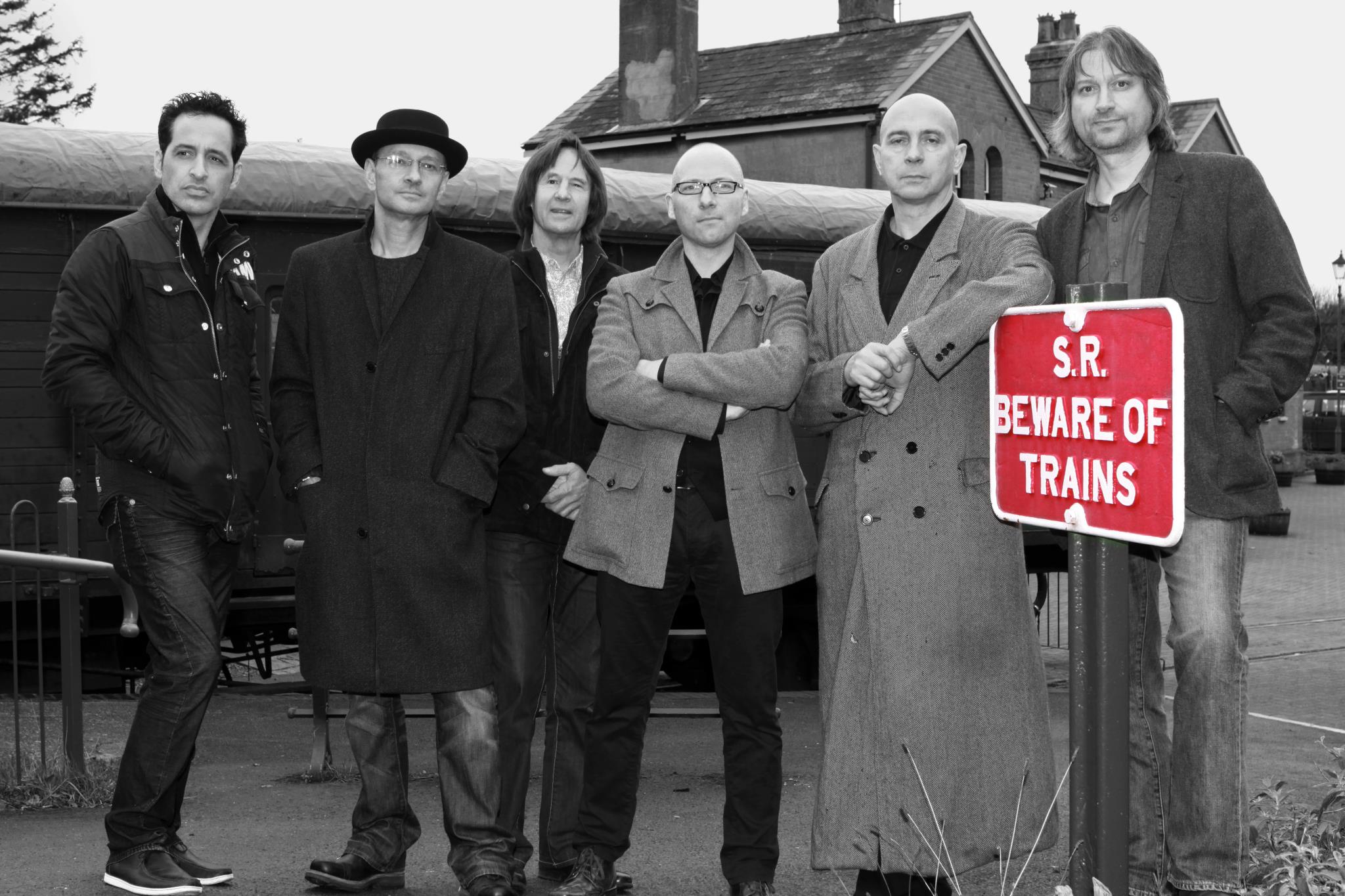
Nick, Andy, Dave, David, Danny, big red sign, Greg. Photo by Willem Klopper.
Great news today on Facebook from the station master himself, Greg Spawton of Big Big Train. Bassist and keyboardist Danny Manners has officially become a member of the band, joining Spawton, Andy Poole, David Longdon, Dave Gregory, and Nick D’Virgilio.
Spawton wrote:
We are pleased to announce that Danny Manners has joined Big Big Train as the band’s keyboard player. Danny made a significant contribution to English Electric Part One, playing keyboards and double bass and we are delighted that Danny has accepted our offer to join the band in time for the release of English Electric Part Two on March 4th. Danny’s past credits include Louis Philippe and Cathal Coughlan.
Manners’s training has been mostly in classical and jazz. He writes of himself at his website:
For those who have stumbled across me: I’m a double bassist, electric bassist, pianist, arranger and composer living in London, England. Starting with classical music as a child and teenager, I worked my way backwards through jazz and finally worked out how to play pop half-decently in my thirties. Along the way I’ve also been involved in improvised and “leftfield” musics. At the moment I’m lucky enough to be doing a little bit of all of these…
He also lists an impressive discography, having played extensively with Louis Phillippe, Louise Le May, Cathal Coughlan, Sandy Dillon, and Muse: http://www.dannymanners.co.uk/albums.html
I must admit, I’m (I–ed., Brad) thoroughly impressed with this addition. Over twenty years old, beginning with original members, Spawton and Poole, Big Big Train has never ceased to grow, take grand chances, and transform into what is arguably one of the greatest–if not THE greatest–rock band of our era. With their near collapse after the recording “Bard,” Spawton and Poole have developed the group tremendously with “Gathering Speed,” “The Difference Machine”, “The Underfall Yard”, and “Far Skies Deep Time”. Their 2012 release, “English Electric Part One”, has received rave reviews and has been labeled the single finest release of 2012 by a number of critics.
To this critic, “English Electric Part One” is not just the best of 2012, it’s the best rock release since Talk Talk’s 1988 magnum opus, “Spirit of Eden.” Before that, one would have to jump back to Yes’s “Close to the Edge” or Genesis’s “Selling England By the Pound” in the early 1970s or to Dave Brubeck’s “Time Out” to find comparable works of music in the last half century.
It should be noted as well that the engineer for Big Big Train, Rob Aubrey, is the Phill Brown of our era as well.
Finally, Manners has worked with David Longdon before, and–I assume–connected Big Big Train to the famous bassist and keyboardist.
The second part of English Electric will be released on March 4 of this year. American drummer, Nick D’Virgilio, a full-time member of the band, just finished recording the final drum parts for “English Electric Part Two.” Additionally, the band will be releasing a limited edition of the full “English Electric” in the fall and the re-imaging of previous tracks on “Station Masters” in 2014.
Well, the title isn’t exactly right. But, hey, the world’s best biographer of the 40th president of the United States likes us. That counts for something. In fact, it counts for a heck of a lot. Thanks, Steve Hayward!
I just yesterday stumbled across the obscure cultural fact that at the 2010 Rock and Roll Hall of Fame induction ceremony, Phish—one of those hippie-jam band successors to the Grateful Dead—opened the proceedings with a dead-on cover of one of the oldest and least accessible tunes ever done by Genesis: “Watcher of the Skies,” from Genesis’s 1972 album “Foxtrot.” The thing about “Watcher” is that it’s one of those prog tunes that takes a long time to get going, and once you’re finally under way. . . well, let’s just say it’s an acquired taste and leave it at that. (Though I’ll admit it is a taste I fully acquired in college in the late 1970s. Must have been all that second-hand smoke. . .)
To keep reading at Powerline (one of the most influential websites in the world. . . yeah, I’m not letting this one go easily), click here.
By way of introduction, I grew up in and around Southern Appalachia. I’m as conversant on Roscoe Holcomb, Flatt & Scruggs and the Stanley Brothers as Robert Fripp, Crack the Sky and Spock’s Beard. I grew up hearing pop, psychedelic and folk/country stirred together. When I was 8 years old Tommy James’ “Sweet Cherry Wine,” with its church organ, quasi-religious lyrics and Leslie speaker-distorted background vocals helped shape my standards for genre-bending music. It was fairly inevitable that I would fall in love with progressive rock. But I have a peculiar need to find harmony in disparate styles. That in part explains my choice for a first submission to Progarchy.
+++++++
The most memorable mental picture I have of early Genesis came from a set played on Belgian TV: Steve Hackett, with black beard and aviator spectacles, sitting at Peter Gabriel’s hand, ripping through the furious instrumental break of “The Musical Box” on his black Les Paul. After whipping the pick up the neck Hackett dropped his hands to his knees and sat like a classical musician at rest, his section of the piece done. I’d never seen anything like his demeanor in a rock band. Hackett could have just played with the London Philharmonic.
It’s easy to forget that Steve Hackett was not the first Genesis lead guitarist. A year earlier his “seat” was filled by Anthony Phillips, classmate of Peter Gabriel, Tony Banks and Mike Rutherford at Surrey’s exclusive Charterhouse School, a place where future gentlemen were groomed. Among many distinguished Old Cartusians was Ralph Vaughan Williams, collector of English folk songs and hymns who melded them into memorable classical pieces like Norfolk Rhapsody and the fantasias on “Greensleeves” and a Theme by Thomas Tallis. To listen to Phillips-era Genesis is to be reminded of Charterhouse manners and influence, which included things like mandatory chapel attendance and respect for the ancient traditions of England. The medieval, the rural, and the sacred surrounded the lads as they turned their attention to becoming pop song writers in 1967.
Mike Portnoy, in an interview with iDrum magazine, made an interesting remark about all the guys in the supergroup Flying Colors; namely, their running joke during the writing process:
We almost felt like the Village People! I’m the metal guy, Neil Morse the prog guy, Casey McPherson the pop guy, [Steve] Morse the country guy and Dave LaRue the funky guy!
I feel the same way about the supergroup team here at Progarchy. In addition to our shared loves, we also have our distinctive tastes. Me, I’m the metal guy; Brad Birzer is the prog guy; Carl Olson is the jazz guy; Kevin McCormick is the classical guy…
Two albums have been released in the past month, which have presented an interesting fork in the prog road, so far as I am concerned. They have a great deal in common in terms of where their roots lie and the musicians which appear collectively on both. And both may succeed in their own ways in bringing more listeners into the proverbial prog fold.
Genesis Revisited II
Genesis Revisited II is Steve Hackett’s continuing project to rearrange and revitalise some of the vast Genesis canon, a task he started 16 years ago with the first volume, Watcher of the Skies. As currently one of the busiest and most sought after prog artists in the business, this has been a huge undertaking for him. The cast of musicians he has picked this time reflects the crème de la crème of prog with his trusty inner circle of Nick Beggs, Lee Pomeroy, Roger King, Gary O’Toole, Amanda Lehmann, Rob Townsend, Phil Mulford along with special guests that include Steven Wilson, Francis Dunnery, Nik Kershaw, Mikael Åkerfeldt, Steve Rothery, Nad Sylvan, Jakko Jakszyk, Neal Morse and Roine Stolt plus John Wetton, Nick Magnus and his brother John Hackett who appeared on volume one.
Reinterpreting the much-loved classics of one of the seminal 70s prog bands is a sensitive business, even if you are one of those responsible for creating said classics in the first place. Tinker too much and you risk losing the essence of what made those classic songs so good; change too little and people will question the point of the exercise.
The former criticism was levelled at Steve Hackett in some quarters when he released the first of his Genesis retrospectives, back in 1998. Fourteen years on, he charts a safer and more successful course with this follow-up album, opting for a more subtle treatment of seventeen Genesis songs across the 2 hours 23 minutes of a double CD. He also find space to revisit four songs from his lengthy solo career.






 Progarchy