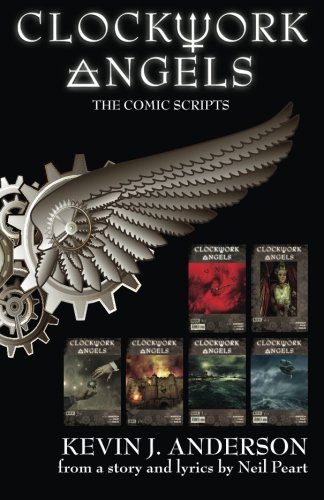
A review of Kevin J. Anderson, CLOCKWORK ANGELS: THE COMIC SCRIPTS (Monument, CO: Wordfire Press, 2014); from a story and lyrics by Neil Peart.
Birzer rating: 10/10.
From WordFire Press (December 2014).
Two things need to be stated before I even get into the heart of this review. Well, ok, let me put this in active form, before my students yell “foul!” I, Brad, need to state two things before getting into this review.
First, one could write a long and interesting article just about the convoluted and circuitous publishing history of CLOCKWORK ANGELS. And, why not? What a fascinating history. In the beginning, CLOCKWORK ANGELS was an album by Rush (remember, though, the first two songs came out almost two full years before the album itself).
Then, it was a best-selling novel by Kevin J. Anderson and Neil Peart.
Then, it was a huge worldwide rock concert tour, a live album, and a live concert DVD.
Then, it came out from BOOM! Studios in comic book form, illustrated by the extremely talented Nick Robles, over six issues. These six issues, of course, will be released in graphic-novel form in the spring (April 2015) with, I’m guessing, an intro or conclusion by Peart.
Now, however, CLOCKWORK ANGELS has come out from Anderson’s WordFire Press as THE COMIC SCRIPTS.
Soon, there will be a sequel, CLOCKWORK LIVES, which Anderson has only recently happily finished with the equally happy blessing of Neil Peart.
It’s possible the whole cycle might start over with the sequel.
And, if Rob Freedman is correct, CLOCKWORK ANGELS will probably grab the fancy of some Hollywood producer, direct, and acting talent, and it will be made into a major motion picture. If so—and, let’s pray this happens—the script is completely written, the scenes already storyboarded by Anderson, a true master of the art.
Second caveat. It’s no secret—at least to readers of progarchy—that I’ve been following the career of Neil Peart very closely since the spring of 1981. Since the age of 13, Peart has been as much a part of my life as has Ray Bradbury, J.R.R. Tolkien, Mark Twain, T.S. Eliot, and the list could go on.
Sci-fi demigod, Kevin J. Anderson.
Since some time in the early 1990s, however, I can also state the same about Kevin J. Anderson. Among modern science-fiction writers, the only other person I’ve followed as closely is J. Michael Straczynski. I’m absolutely fascinated by their writings as well as the trajectory of their careers. Each is a expert of his craft and an imaginative perfectionist. Each is also very much in-tune with his audience and the possibilities the internet presents. And, as probably well known, each has advanced the cause of progressive rock in a variety of ways. Straczynski had done so by promoting the career of Christopher Franke and Anderson by writing with Peart, producing the story and lyrics (along with his wife) for Roswell Six, and through a myriad of other ways. Each, also, fully embraces the comic and graphic novel worlds. Straczynski tends toward horror and the gnostic, and Anderson tends toward science fiction and the mythic, but, otherwise, the two have a great deal in common.
So, these two caveats stated, let’s get back to Anderson’s latest, THE COMIC SCRIPTS.
Even from a cursory examination of Peart’s song lyrics, the story of CLOCKWORK ANGELS seems a nicely updated version of 1978’s HEMISPHERES. There’s the side of order, and there’s the side of chaos. The hero, choosing not to embrace either extreme, finds a via media, making his own path and his own choices. He finds, in reality, that his choices are limited, however, but choice does exist. So, free will exists, but it does so only within certain bounds.
Anderson’s novel offers a wondrous exploration of Peart’s universe. Employing the literary devices of utopia and dystopia, Anderson, a sci-fi demigod, gives the story a much needed and beautifully executed Tolkien-esque and Chestertonian fairy-tale ethos and atmosphere. We discover why the Clockmaker craves surety and the Anarchist disorder. We also discover why Owen must reject both and become, for all intents and purposes, the everyman version of Cygnus.
Not limited to lyrics for twelve songs merely, Anderson explores, lulls, mulls, and lingers. With his deft hand, the world of Owen and the CLOCKWORK ANGELS becomes rich, full, and tangible. Though many have labeled this world as Steampunk—a label neither Anderson nor Peart would deny—it is much more than Steampunk as well. The pastoral quality of parts is truly pastoral and adds the Tolkienian fantastic to it all. Indeed, Anderson’s best writing—while always superb—truly shines when he is detailing the cultures that arise in distant and rural landscapes.
Equally important, though, is that Anderson is not only a great friend of Peart’s, he’s also a huge fan of Rush (and Hugh Syme). These loves show in almost every word and on every page of CLOCKWORK ANGELS. For those of us obsessed with Rush, Anderson ably rewards the reader, throwing into his novel (and the comics, and, thus, THE COMIC SCRIPTS) Easter eggs galore.
What surprises me most about THE COMIC SCRIPTS, however, is how utterly and brilliantly visual Anderson’s imagination is. Frankly, after having read much of his science fiction and some of his detective fiction, I really have no right to be surprised by any of this! Anderson is a genius at nearly every level, but he is especially excellent in and at creating a MYTHOS around, behind, and near every one of his novels. There’s a reason major international serials praised his own renditions of the XFILES as some of the best sci-fi of the 1990s. Sure, the XFILES was a great TV show. But, Anderson’s skill made the characters and the MYTHOS a thousand times better. I suppose my surprise at Anderson’s ability to visualize and imagine is, if anything, an indication of my own lack of imagination.
Looking at THE COMIC SCRIPTS, one readily sees that Anderson anticipated and then directed every single panel of the comics. He describes the emotions on the faces as well as the technology that will (certainly) jolt the reader into a sort of glee. Anderson presents every aspect of the CLOCKWORK world in all of its alchemical madness and glory.
By describing every thing visually, Anderson paints an interesting portrait of this world that could tease the Rush fan and the sci-fi/fantasy reader without end. Some day, lit crit folks will have a field day deconstructing all of this. For example, per both Peart’s and Anderson’s desires, the reader never actually sees the faces of the angels. This must be left to the individual mystery and imagination. Or, one sees that the symbol of the order-loving Clockmaker is a beehive and honeybee. The beehive looks suspiciously like the symbol of Utah, the Mormons, and the former State/Empire of Deseret. Is this intentional? I don’t know.
Or, how about the description of our hero, Owen? He is truly everyman—“He is non-ethnically specific,” Anderson explains. He “should have darker/olive skin, dark eyes, dark hair.” Anderson describes the cities of his world as Manhattan with a twist of old Berlin with a huge touch of the art deco. Could this be Gotham? Metropolis? Dark City? Of course.
Ok, but what surprises me most? That Hollywood hasn’t snatched up Anderson in a major way. Holy Moses, this guy can think, he can write, and he can imagine.
So, should you buy this latest offering from Anderson?
Do you like Rush? Yes.
Do you like science fiction? Yes.
Do you like intelligence and imagination in your fiction? Yes.
Do you like the visual arts? Yes.
For me, THE COMIC SCRIPTS is another brilliant exploration of the CLOCKWORK world. But, even if you’d never heard of Rush or even if you’ve never read the novel or the comics, this is still well worth owning. Anderson’s writing is so good, and his visual imagination is so fascinating, that THE COMIC SCRIPTS could easily (and does) stand on its own as a screenplay or as an actual stage play.
N.B. This post should be approached with caution. It is at least PG-13, if not NC17. Not for language, but for personal revelation and content. Additionally, I’ve written about one or two of these things before, especially about Peart as a big brother. Please don’t fear thinking—“hey, I’ve read this before.” But, even the few things I’ve mentioned before are here rewritten. Final note: for an exploration of Peart’s Stoicism, see Erik Heter’s excellent piece on the subject, here at progarchy.com.
Neil Peart, ca. 1987.
***
As I’ve mentioned before in these pages and elsewhere, few persons, thinkers, or artists have shaped my own view of the world as strongly as has Neil Peart, Canadian drummer, lyricist, writer, and all-around Renaissance man. I’ve never met him, but I’ve read all of his words and listened to all of his songs. I’ve been following this man since the spring of 1981 when two fellow inmates of seventh-grade detention explained to me the “awesomeness” of Rush. My compatriots, Troy and Brad (a different Brad), were right. Thank God I got caught for doing some thing bad that day. Whatever I did, my punishment (detention) led to a whole new world for me, one that would more than once save my life.
Having grown up in a family that cherished music of all types, I was already a fan of mixing classical, jazz, and rock. Rush’s music, as it turned out, did this as well as any band.
While the music captivated me, the lyrics set me free. I say this with no hyperbole. I really have no idea how I would have made it out of high school and through the dysfunctional (my step father is serving a 13-year term in prison, if this gives you an idea how nasty the home was) home life without Peart. I certainly loved my mom and two older brothers, but life, frankly, was hell.
I know that Peart feels very uncomfortable when his fan project themselves on him, or imagine him to be something he is not. At age 13, I knew absolutely nothing about the man as man, only as drummer and lyricist. Thus, even in 1981, I absorbed his lyrics, not directly his personality. Though, I’m sure many of Peart’s words reflect his personality as much as they reflect his intellect.
Rush gave me so much of what I needed in my teen years. At 13, I had completely rejected the notion of a benevolent God. He existed, I was fairly sure, but He was a puppet master of the worst sort, a manipulative, Machiavellian tyrant who found glee in abuse and exploitation. As a kid, I was bright and restless, and I resented all forms of authority, sometimes with violent intent. Still, as we all do, I needed something greater than myself, a thing to cherish and to hold, a thing to believe in.
I immersed myself in science fiction, fantasy, and rock music. Not a tv watcher in the least, I would put the headphones on, turns off the lights in my bedroom, lock the door, and immerse myself in the musical stories of Genesis, the Moody Blues, ELO, ELP, Alan Parsons, Yes, Jethro Tull, Pink Floyd, and, especially, Rush. I could leave the horrors of my house for roughly 44 minutes at a time.
Scratch, scratch, side one. Zip, turn. Scratch, scratch, side two.
Rock music was the sanctuary of my world. But, not just any rock. ZZ Top and REO Speedwagon might be fun when out on a drive, but I needed a work of art that demanded full immersion. I needed prog. I was not only safe in these rhythmic worlds, I was intellectually and spiritually alive, exploring innumerable realms. Pure, unadulterated escape. But, escape into a maze of wonders.
The first time I heard the lyrics (at age 13, the spring of 1981) to “Tom Sawyer,” I knew Rush was MY band. It seemed as though Peart was talking specifically to me, Bradley Joseph Birzer. That’s right. To 13-year old Brad in Hutchinson, Kansas. Peart was 15 years older than I, and he must have gone through the same things I had. Or so I thought. Again, I knew him only through his lyrics. But, did I ever cherish those lyrics. I lingered over each word, contemplated not just the ideas, but the very structures of lyrics as a whole.
Though his mind is not for rent
Don’t put him down as arrogant
His reserve a quiet defense
Riding out the day’s events
No, his mind is not for rent to any God or Government
Always hopeful, yet discontent [corrected from my original typos]
He knows changes aren’t permanent, but change is
Though I’ve never given any aspect of my life to the Government (nor do I have plans to do so), I long ago surrendered much of myself to the Second Person of the Most Blessed Trinity and to His Mother. While I’m no modern Tom Sawyer at age 47, I still find the above lyrics rather comforting. And, I do so in a way that is far beyond mere nostalgia.
Armed with Peart’s words and convictions, I could convince myself to walk to Liberty Junior High and, more importantly, to traverse its halls without thinking myself the most objectified piece of meat in the history of the world. Maybe, just maybe, I could transcend, sidestep, or walk directly through what was happening back at home. I could still walk with dignity through the groves of the academy, though my step father had done everything short of killing me back while in our house.
[N.B. This is the PG13 part of the essay] And, given all that was going on with my step father, the thought of killing myself crossed my mind many, many times in junior high and high school. I had become rather obsessed with the notion, and the idea of a righteous suicide, an escape from on purposeless life hanged tenebrous across my soul. After all, if I only existed to be exploited, to be a means to end, what purpose did life have.
What stopped me from ending it all? I’m still not sure, though such desires seemed to fade away rather quickly when I escaped our house on Virginia Court in Kansas and began college in northern Indiana. Not surprisingly, my first real friendship in college—one I cherish and hold to this day—came from a mutual interest in all things Rush. In fact, if anything, my friend (who also writes for this site) was an even bigger Rush fan than myself! I’d never met such a person.
Regardless, from age 13 to 18, I can say with absolute certainty that some good people, some good books, and some good music saved my life, more than once. Neil Peart’s words of integrity and individualism and intellectual curiosity stood at the front and center of that hope.
Perhaps even more importantly to me than Moving Pictures (“Tom Sawyer,” quoted above) were Peart’s lyrics for the next Rush album, Signals. On the opening track, a song about resisting conformity, Peart wrote:
Growing up, it all seemed so one-sided
Opinions all provided, the future predecided
Detached and subdivided in the mass production zone
No where is the dreamer or misfit so alone
There are those who sell their dreams for small desires
And lose their race to rats
Even at 14, I knew I would not be one who sold my dreams for small desires. I wanted to be a writer—in whatever field I found myself—and I would do what it took to make it through the horrible home years to see my books on the shelves of a libraries and a bookstores. Resist and renew. Renew and resist. Again, such allowed me to escape the abyss of self annihilation.
Indeed, outside of family members (though, in my imagination, I often think of Peart as one of my older brothers—you know; he was the brilliant one with the goofy but cool friends, the guys who did their own thing regardless of what anyone thought). From any objective standpoint, as I look back over almost five decades of life, I can claim that Peart would rank with St. Augustine, St. Francis, John Adams, T.S. Eliot, Willa Cather, Ray Bradbury, Russell Kirk, and J.R.R. Tolkien as those I would like to claim as having saved me and shaped me. If I actually live up to the example of any of these folks, however, is a different question . . .
I also like to say that Peart would have been a great big brother not just because he was his own person, but, most importantly, because he introduced me as well as an entire generation of North Americans (mostly males) to the ideas of Heraclitus, Plato, Aristotle, Sophocles, Cicero, Seneca, Petrarch, Erasmus, Voltaire, Adam Smith, Mark Twain, Ernest Hemingway, John Dos Passos, T.S. Eliot, J.R.R. Tolkien, and others.
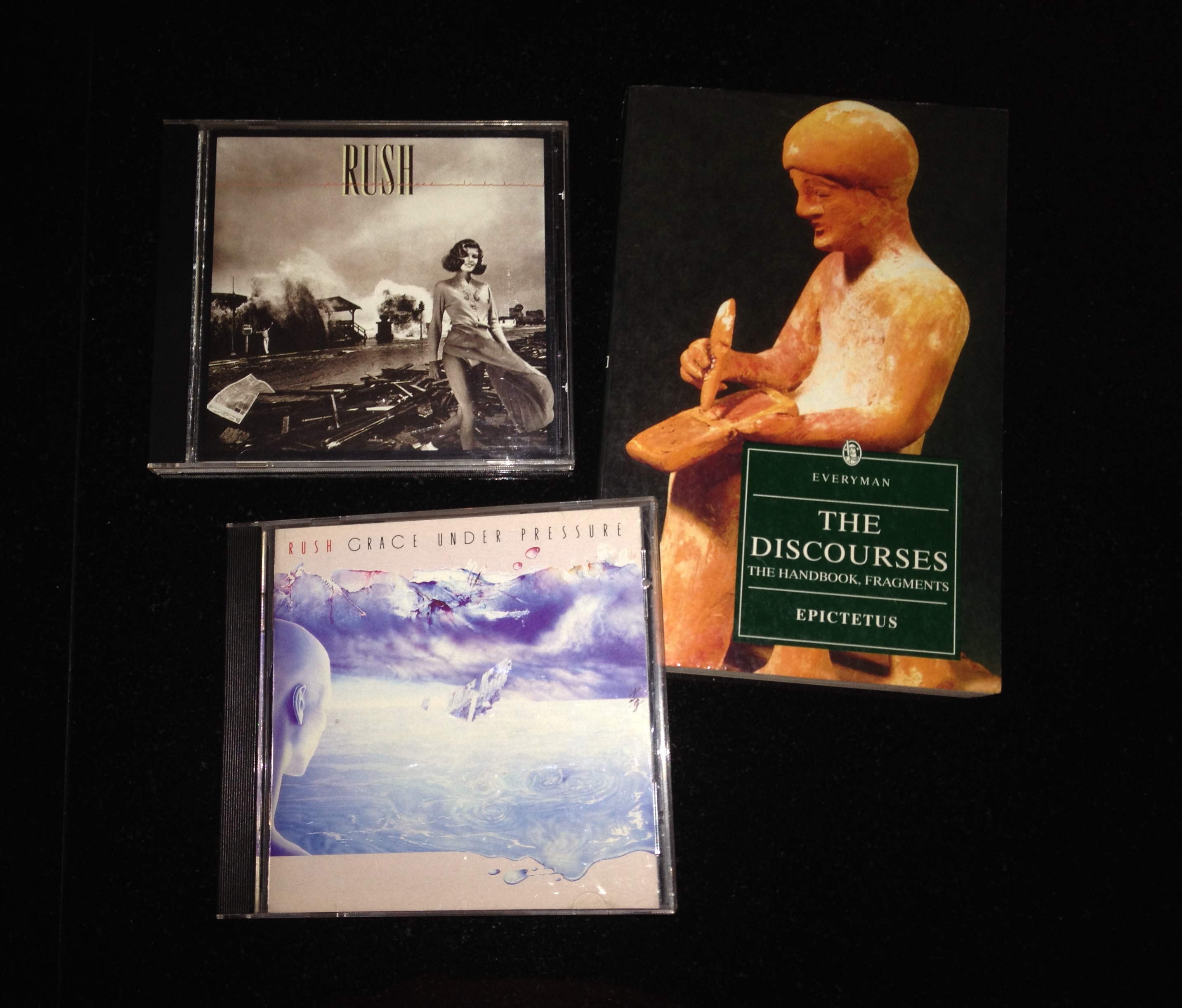
During my junior year of high school, I wrote an essay on the meaning of Huck Finn and Tom Sawyer, based on Peart’s interpretation. I earned some form of an A. In one of my core humanities courses, while at the University of Notre Dame, I wrote my major sophomore humanities term paper about the cultural criticisms of Neil Peart as found in his lyrics to the 1984 album, Grace Under Pressure. Again, I received an A.
I’m not alone in this love of Rush. The band is, of course, one of the highest selling rock acts of all time, and they are just now crossing the line into their fortieth anniversary. Arguably, no other band has had as loyal a following as had Rush. Thousands and thousands of men (and some women) faithfully attend sold-out concerts throughout North and South America to this day. This is especially true of North American men, ages 35 to 65. Now, as is obvious at concerts, an entirely new generation of Rush fans is emerging, the children of the original set.
Telling, critics have almost always despised Rush, seeing them as having betrayed the blues-based tradition of much of rock, exchanging it for a European (and directly African rather than African-American) tradition of long form, complexity, and bizarrely shifting time signatures. Such a direction and style became unbearable for the nasty writers of the largest music magazines. They have felt and expressed almost nothing but disdain for such an “intellectually-pretentious band,” especially a band that has openly challenged the conformist ideologues of the Left while embracing art and excellence in all of its forms. Elitist rags such as the horrid Rolling Stone and equally horrid NME have time and time again dismissed Rush as nothing but smug middle-class rightists.
That so many have hated them so powerfully has only added to my attraction to the band, especially those who came of age in 1980s, despising the conformist hippies who wanted to mould my generation in their deformed image. Rolling Stone and NME spoke for the oppressive leftist elite, and many of my generation happily made rude gestures toward their offices and their offal. I had no love of the ideologues of the right, either. But, they weren’t controlling the schools in the 1980s. Their leftist idiotic counterparts were in charge. They had no desire for excellence. They demanded conformity and mediocrity.
[The best visual representation of this widespread if ultimately ineffective student revolt in the 1980s can be found in “The Breakfast Club” by John Hughes (RIP).]
To make it even more real for me, the parents of Geddy Lee, the lead singer and bassist of Rush, had survived the Polish holocaust camps, and the parents of Alex Lifeson, the lead guitarist of the band, had escaped from the Yugoslavian gulag. Peart came from a Canadian farming community, his father an entrepreneur. No prima donnas were these men. They understood suffering, yet they chose to rise above it. And, of course, this makes the British music press even more reprehensible for labeling the members of Rush as rightest or fascist. Again, I offer the most dignified description for Rolling Stone and NME possible: “ideological fools and tools.”
At age 13, I stared and stared at this image. I loved the look of each of the guys. They couldn’t be more interesting to me.
Enter Rob Freedman
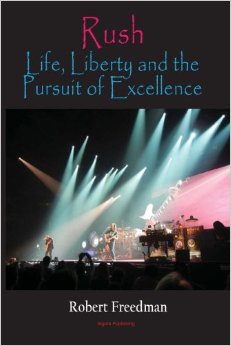
In his outstanding 2014 book, Rush: Life, Liberty, and the Pursuit of Happiness (Algora Press), author, philosopher, and media specialist Rob Freedman has attempted to explain not just Peart’s popularity among his multitude of fans—some of the most dedicated in the music world—but also the Canuck drummer’s actual set of ideas and explored beliefs in his books and lyrics. Not surprisingly, Freedman finds the Canadian a man deeply rooted in the western tradition, specifically in the traditions of western humanism and individualism.
As Freedman notes, one can find three themes in all of Peart’s lyrics: individualism; classical liberalism; and humanism. It’s worth observing that Freedman has formal training in academic philosophy, and this shows in his penetrating discussion of the music as well as the words of Rush.
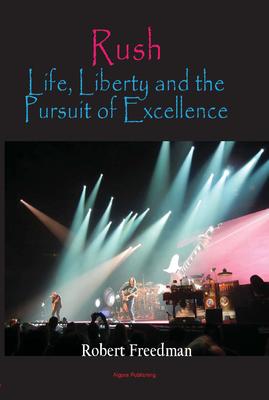
Cover of Rob Freedman, Rush: Life, Liberty, and the Pursuit of Excellence (2014). A must own.
Relying on interviews with the band, the music journalism (much of it bogus and elitist idiocy) of the last forty years, and actually serious works of Rush criticism, such as that done admirably by Steve Horwitz in Rush and Philosophy (Open Court, 2011), Freedman offers not so much a biography of the band, but rather a map of their intellectual influences and expressions. Freedman possesses a great wit in his writing, and the book—relatively short at 164 pages—flows and flows, time standing still until the reader reaches the end. For all intents and purposes, Freedman’s book serves as an intellectual thriller, a page turner.
As a lover of Rush, I have a few (very few) quibbles with Freedman’s take. Mostly, from my not so humble perspective, Freedman gives way too much space to such charlatans as Barry Miles of the English New Music Express who claimed Rush promoted neo-fascism in the late 1970s. Freedman, while disagreeing with Miles, bends over backwards defending Miles’s point of view, as it did carry immense weight in the 1970s and wounded the band deeply. From my perspective, there is no excuse for Miles. He maliciously manipulated and twisted the words of Peart—using his lyrics and a personal interview—which were as deeply anti-fascistic as one could possibly imagine (paeans to creativity and individualism) and caused unnecessary damage to the reputation of three men, two of whom who had parents who had survived the horrors of the twentieth-century ideologues, as noted above. Miles’s take on Rush is simply inexcusable and no amount of justification explains his wickedness and cthluthic insensibilities toward three great artists. Dante best understood where such “men” spent eternity.
Author Rob Freedman.
I also believe that Freedman underplays the role of Stoicism in his book. The venerable philosophy barely receives a mention. Yet, in almost every way, Peart is a full-blown Stoic. In his own life as well as his own actions, Peart has sought nothing but excellence as conformable to the eternal laws of nature. This is the Stoicism of the pagans, admittedly, and not of the Jews or Christians, but it is Stoicism nonetheless. Freedman rightly notes that Plato and, especially, Aristotle influenced Peart. But, so did Zeno, Virgil, Cicero, and Seneca. This comes across best in Peart’s lyrics for “Natural Science” (early Rush), “Prime Mover” (middle Rush), and in “The Way the Wind Blows” (recent Rush). In each of these songs, Peart presents a view of the world with resignation, recognizing that whatever his flaws, man perseveres. Erik Heter and I have each attempted to explore this aspect of Peart’s writings at progarchy. Heter has been quite successful at it.
As the risk of sounding cocky, I offer what I hope is high praise for Freedman. I wish I’d written this book.
Peart as Real Man
Neil Peart, ca. 2008.
In the late 1990s, Peart experienced immense tragedy. A horrible set of events ended the life of his daughter and, quickly after, his wife. Devastated, Peart got on his motorcycle (he’s an avid cyclist and motorcyclist) and rode throughout the entirety of North America for a year. It was his year in the desert, so to speak.
Then, in 2002, Rush re-emerged and released its rockingly powerful album, Vapor Trails. The men were the same men (kind of), but the band was not the same band. This twenty-first century Rush, for all intents and purposes, is Rush 2.0. This is a much more mature as well as a much more righteously angry and yet also playful Rush. This is a Rush that has nothing to prove except to themselves. The last albums—Vapor Trails (2002); Snakes and Arrows (2007); and Clockwork Angels (2012)—have not only been among the best in the huge Rush catalogue, but they are some of the best albums made in the last sixty years. They soar with confidence, and they promote what Rush has always done best: excellence, art, creativity, distrust of authority, and dignity of the human person.
Peart is not quite the hard-core libertarian of his youth. In his most recent book, Far and Near, he explains,
The great Western writer Edward Abbey’s suggestion was to catch them [illegal immigrants], give them guns and ammunition, and send them back to fix the things that made them leave. But Edward Abbey was a conservative pragmatist, and I am a bleeding-heart libertarian==who also happens to be fond of Latin Americans. The ‘libertarian’ in me thinks people should be able to go where they want to go, and the ‘bleeding heart’ doesn’t want them to suffer needlessly” [Far and Near, 58]
If he has lost any of his former political fervor, he’s lost none of his zest for life and for art. “My first principle of art is ‘Art is the telling of stories.’ What might be called the First Amendment is ‘Art must transcend its subject’.” [Far and Near, 88]
These twenty-first century albums speak to me at age 47 as much as the early albums spoke to me at age 13. I’ve grown up, and so has Rush. Interestingly, this doesn’t make their early albums seem childish, only less wise.
After my wife and I lost our own daughter, Cecilia Rose, I wrote a long letter to Neil Peart, telling him how much the events of his life—no matter how tragic—had shaped my own response to life. I included a copy of my biography of J.R.R. Tolkien. Mr. Peart sent me back an autographed postcard as thanks.
I framed it, and it will be, until the end of my days, one of my greatest possessions.
After all, Neil Peart has not just told me about the good life, creativity, and integrity, he has shown me through his successes and his tragedies—and thousands and thousands of others—that each life holds a purpose beyond our own limited understandings. As with all things, Peart takes what life has given and explodes it to the level of revelation.
Clockwork Angels by Neil Peart, Kevin J. Anderson, and Nick Robles (Six-issue comic series from Boom! Studios, 2013-2014).
A sample page from the comic series, Clockwork Angels. The reds and blues are brilliant, as are the emotions depicted. Art by Nick Robles.
By any reckoning, Clockwork Angels has done rather well. It is a prog-rock album, a concert, a live concert album and video, a novel, an audiobook, and now a six-book comic series from the relatively young publisher, Boom! Studios. Soon, I’m sure, Boom! will collect these six issues into a graphic novel, perhaps with a new introduction by Peart.
As the great Rob Freedman has argued at his website, Rush Vault, it could readily become a movie or a tv-series. Maybe even complete with action figures. No, I’m not exaggerating, and I’m not being sarcastic. Clockwork Angels has done very well, and I couldn’t be happier for Peart.
The novel, co-authored by Kevin J. Anderson and Neil Peart is, in and of itself, quite stunning. At essence, the story is little different than the one Peart told with Hemispheres. Chaos and order vie for power, with the individual—armed with integrity, intelligence, and creativity—making his own path. Yet, Peart and Anderson have made this story as fresh as fresh can be by adopting the form of a fairy-tale. It’s a rather Chestertonian and Tolkienian fairy tale at that. Peart even inserts himself (but, not by name) as the grandfather-narrator, well pleased with his children and grandchildren.
Adorned with color prints by Hugh Syme and printed on the highest quality of paper, the ECW novel is a wonderful thing to hold and behold.
At the time that Rush began to plan the tour for the album, Peart stated in no uncertain terms that certain aspects of the story could not be produced visually, as he hoped to keep them in the imagination. In particular, he was talking about the actual Clockwork Angels. Far better to leave them to the individual imagination than to the visual artists. Additionally, they needed to remain in an aura of mystery.
I must admit, when I first heard that the story would be produced in comic book form, I was apprehensive. I have nothing against comics and graphics novels. Indeed, I think the work of such giants as Frank Miller and Alan Moore probably inspired and certainly anticipated the iPads and other tablets we know all wield—a perfect blending of word and image. But, I wondered, wow could Peart’s desire be adhered to, when transferring the story to a visual medium. Would the art do justice to the story, or would it simply detract? I realize I’m in the minority in this view, but I firmly believe that Peter Jackson has come close to destroying the beauty and integrity of Tolkien’s world. Tolkien’s world is too strong to be destroyed by such technological mimicry, but still. . . I didn’t want Boom! to do the same thing to Peart’s work.
Now that all six issues have appeared, I can render judgment. The artist, Nick Robles, has done admirable work. True to the fairy-like intent of the story, Robles presents all of his images as something between a water-color painting and modern (think Jim Lee of DC) superhero art.
While Robles attempts to illustrate the Clockwork Angels, he does so in a way to minimize the destruction of imagination. Various lights and shadows, thankfully, obscure the more mysterious parts. Equally important, Robles not only draws the human face beautifully, rendering each with personality, light, and emotion, but his coloring makes some of the expressions jump off the page. His reds and blues are especially good. In other words, Robles really does augment the word with image, and I found myself appreciating this story in different ways than I had the original album and novel.
Robles and Boom! have done something I didn’t expect: they’ve made a brilliant story even better. Or least, they made me look at it in a very new way. What’s not to love? Gorgeous art; Peartian wisdom; and a story that mixes the best of Chesterton, Tolkien, and Ray Bradbury.
Freedman’s book on the meaning of Rush. I’m loving this book–BB
Rush’s lyrics over the decades put its point of view firmly in the great Western intellectual tradition of Aristotle, John Locke, and Adam Smith. So when you listen to the band’s 165 original compositions, you’re hearing the same ideas that animated Thomas Paine and Thomas Jefferson—only a lot louder.
Rush lyrics (penned almost entirely by Peart from their second album onward) cover a lot of ground. Individual songs meditate on the dreariness of the suburbs, the balance between heart and mind, the individual vs. the collective, intolerance, the perils of fame, nationalism, the tensions of art vs. commerce and so forth. When you step back a bit to take a wider view, themes that stretch across a number of songs or even albums begin to emerge. Among those that emerge over the course of Rush’s output are themes of Stoicism. So let me just proclaim that Neil Peart is a Stoic and that Stoicism is a significant component in his philosophical approach to life itself.
I should probably give a brief primer on Stoicism here, and will do so with a bit of trepidation, as there are several other contributors to this site whose knowledge of this school of thought and philosophy (or any philosophy) vastly exceeds my own.
The Stoic school of thought originated with Zeno of Citium, who began teaching it in Athens around 300 B.C. It was later adopted by the Romans, including the famous three listed above. A fundamental tenet of Stoicism is to live in agreement with nature, i.e. “the way things are.” Another one is to learn to distinguish between those things which are under one’s control and those things that are not – and to not worry about the latter. A exceptionally difficult goal to attain to be sure, but one well worth striving for. Contrary to popular opinion, Stoicism does not teach the suppression of emotions, but rather that emotions are instinctive reactions to events, while our judgments of the same can either arouse or cool those emotions. Balance is key.
So how does all this tie in with Rush lyrics? Let’s take a look.
After spending my first afternoon at the University of Colorado, I stopped by Time Warp Comics (http://www.time-warp.com). As it turns out, Neil Peart, Kevin J. Anderson, and Nick Robles have been producing a six-part comic book series of Clockwork Angels.
The first three issues are out, and I was even able to purchase a signed (by Anderson) copy of issue 1.
And, equally important, I found out that several of the guys working at Time Warp are proggers. They were also just–not surprisingly–fantastic guys (and a gal). So, a huge thanks to Clayton, Garrett, Michael, and Georgia!
What a store. I’ll certainly be stopping by again.
If you’re in Boulder, make sure you check out Time Warp.
Time Warp Comics, 3105 28th Street, Boulder, CO 80301.
Just today, our own progarchist and professional classicist and philosopher, Chris Morrissey, challenged us to name our top ten Rush albums. Not alphabetically, but actually in the order we love them.
So, I feel up to the challenge.
As I hope I’ve been clear in my writings here and elsewhere—I love Rush, and I have without interruption since I first heard MOVING PICTURES back when I was in detention in 7th grade! Yes, that was the spring of 1981, only a month after the album came out.
I can never offer enough thanks to my fellow junior high detainees, Brad and Troy, for introducing me to this band. At the time, they were shocked I knew everything about Genesis and nothing about Rush. Thank God for their evangelism.
Now, thirty-three years later, I would give much to call Neil Peart my older brother. That said, I can state unequivocally that in my own life, Peart’s lyrics have shaped me as much as any other great artist and thinker. Really, he’s up there with St. Augustine for me. As a Catholic boy (well, middle-aged, graying, Catholic man), this is saying a lot!
Of course, such a list is subjective, and I might be tempted to follow up tomorrow with a slightly different list. Regardless, here it is: as of June 30, 2014.
Grace Under Pressure. Coming out in 1984, this album has ever since defined the meaning of excellence and seriousness for me. I love the music, the flow, and, especially, the lyrics. Not only have the lyrics prompted innumerable great conversations with friends, but I proudly wrote my major liberal-arts core paper (sophomore year in college, 1987-1988) using nothing but the lyrics from this album. I argued that Neil Peart was a modern stoic, a philosopher of antiquity born in the modern world. I earned an A!
Moving Pictures (1981). I’m sure this isn’t controversial, except that most Rush fans would probably rate it number one. It means a great deal to me, and it has formed me—for better or worse—in my own understanding of integrity.
Clockwork Angels (2012). What a feast for the mind and the ears. The flow of the album is gorgeous as are the lyrics. Really, a great story—more of a fairy tale than anything else. The story is essentially the story of Hemispheres, but it’s told with much greater finesse. That it came at 38 years into their career is astounding, and it proves that the desire of each member of Rush to improve himself and his skills has not been a pipe dream. Highlight, the single most un-Rush like song, is “The Garden,” a statement of republican liberty and individualism. And, “Wish Them Well,” is the closest Rush will ever get to hippie/Beatle lyrics. Let the air drumming commence!
Power Windows (1985). As someone who loves both prog and New Wave, I heartily approve of Power Windows. Lifeson’s guitar has much more in common with The Fixx than it does with Rush’s output in the 1970s, but it demonstrates and reveals a real willingness to explore new areas of music. It’s fusion of New Wave and Prog was rivaled only by Yes’s Drama. And, the lyrics. . . sheesh. Neil is at his best.
Signals (1982). I know a lot of old-time Rush fans think little of this album, as they see it as a betrayal of the “true Rush.” But, schnikees has it meant a great deal to me. The lyrics, especially, have given me great comfort. Even this spring as I had make a major life decision, Peart’s words, “there are those who sell their dreams for small desires.” The entire first side is masterful musically as well. I don’t think side two is as strong, but it’s still quite good.
Caress of Steel (1975). Man, is this album wacky or what? And, in large part, I love it for being so weird. Musically, it’s unlike almost anything else out there—by Rush or anyone else. There’s as much acid folk on this album as there is hard rock and prog. But, really, By-tor? Snowdog? The Necromancer? I have no idea what Geddy, Alex, and Neil were thinking or smoking when they made this, but, wow, does it all work.
Vapor Trails (2002). This album is nothing if not a pure statement of life. “I’m alive,” Neil screams in every beat and every lyric of this album, especially after the horrific tragedies he suffered. And, he most certainly is a live. From the opening drums to the massive swirl of guitars and Geddy’s vocals throughout, this is a work of artistic brilliance, meaning, and drive. I never tire of this album.
Snakes and Arrows (2007). Again, this is part of Rush 2.0, the band that remade itself after Neil’s double tragedies. Everything in Snakes and Arrows is perfect. Again, the flow of the album just works brilliantly. And, the fusions and various styles are just fascinating. Neil’s lyrics are a bit angrier than usual, but still quite a effective.
A Farewell to Kings (1977). What’s not to love? The entire album reeks of integrity. Kevin McCormick, on this site, has explained in loving and intricate detail the musical importance of the album in ways I never good. But from the first notes of the guitar to the dire plight of Cygnus, I’m in!
2112 (1976). As Drew commented on Chris’s original challenge, 2112 is a tough one to rank because side one is so radically different from side two. I agree. But, side one is so incredible that it makes up for any flaws in the album. Who can’t just start head-banging when the Overture begins? Who doesn’t want to just hate the priests? And, who isn’t disheartened when the Solar Federation reassumes control. Sigh. . . sci-fi loveliness.
***
Long to longish progarchist posts on Rush Hold your Fire -Rush’s finest? by Tad Wert (*progarchy’s single most popular post ever)
Though I’m certainly no pacifist, and I rather love and owe allegiance to the American republic of the founding period, I can’t help but think of Peart’s lyrics when it comes to the beating of drums on Memorial Day weekend.
We see so many tribes overrun and undermined While their invaders dream of lands they’ve left behind Better people…better food…and better beer… Why move around the world when Eden was so near? The bosses get talking so tough And if that wasn’t evil enough We get the drunken and passionate pride Of the citizens along for the ride
They shoot without shame In the name of a piece of dirt For a change of accent Or the color of your shirt Better the pride that resides In a citizen of the world Than the pride that divides When a colorful rag is unfurled
Amen, Neil. It’s one thing to honor those who have given their very lives for us, it’s quite another to use those same sacrifices for nationalistic, egotistical, and nefarious agendas.









 Progarchy
