Hayward on Phish on Genesis on Progarchy

Well, the title isn’t exactly right.  But, hey, the world’s best biographer of the 40th president of the United States likes us.  That counts for something.  In fact, it counts for a heck of a lot.  Thanks, Steve Hayward!

I just yesterday stumbled across the obscure cultural fact that at the 2010 Rock and Roll Hall of Fame induction ceremony, Phish—one of those hippie-jam band successors to the Grateful Dead—opened the proceedings with a dead-on cover of one of the oldest and least accessible tunes ever done by Genesis: “Watcher of the Skies,” from Genesis’s 1972 album “Foxtrot.”   The thing about “Watcher” is that it’s one of those prog tunes that takes a long time to get going, and once you’re finally under way. . . well, let’s just say it’s an acquired taste and leave it at that.  (Though I’ll admit it is a taste I fully acquired in college in the late 1970s.  Must have been all that second-hand smoke. . .)

To keep reading at Powerline (one of the most influential websites in the world. . . yeah, I’m not letting this one go easily), click here.

Andy Tillison and Geoff Banks

4006205090_47d7dfd4e7If you’re free for the next 45 minutes, it’s definitely work checking into the Prog Dog Radio Show.

http://myradiostream.com/progdog

Geoff Banks is an excellent radio host, and Andy Tillison is an equally interesting guest.  Banks and Tillison are talking about the nature of progressive rock as well as engaging one another on a variety of topics.  On the nature of Prog: Geoff is arguing that prog is ”music that will stand the test of time.”  It is the classical music of our day.  Andy’s response: Progressive rock is “serious electric music.”

Andy, sounding very much like Owen Barfield or J.R.R. Tolkien of the Inklings stated that his brainchild, The Tangent, is much bigger than himself or a supergroup.  He hopes it will keep going long after he’s retired.

The chat room is especially interesting: Alison Henderson, Blake Carpenter (Minstrel’s Ghost), Sally Collyer, and Matt Stevens are all contributing.

A Progressive Rock Lexicon (or: How to Talk to a Prog Rocker)

In any field of endeavor, there is a certain language used.  One working in the legal field speaks of briefs, appeals, affidavits, and so on.  A football coach may speak of blocking schemes, blitzes, and pass routes.  And one who flies airplanes may speak of instrument flight rules, crosswind landings, air speed, and fuel mixture.


Alas, those that make and listen to music have their own language.  Of course, those of us involved with progressive rock, as listeners, musicians, producers, etc., usually look at the world a little bit differently.  As such, an alternate language has developed.


Thinking about this, I have come up with a list of a few terms to aid conversation between prog rockers, as well as to help those who would like to speak to us on our terms.  Of course, this list is by no means considered to be complete.  Fellow Progarchists and readers of this site, in the interest of smooth communications, you are not only welcome, but are encouraged to suggest additions.  So, without further adieu, and with tongue firmly planted in cheek, I present to you a brief glossary of progressive rock terms. 


Short song – a song under 10:00 minutes in length.


Unusual time signature – 4/4


Normal Time Signature – 7/4, 5/8, 7/8, etc.


Brick – a unit of measurement for determining thickness.


String Section – a group of musicians in an orchestra whose function it is to emulate a Mellotron.


Dancing – ??????


Pretentious (1) – a word used to describe the critics who accuse prog rockers of being pretentious.


Pretentious (2) – the lyrics from this guy:


Excess – ??????


Air Guitar – what rock fans play.


Air Keyboards – what progressive rock fans play.


Air Bass – Well, a lot of us play this too, especially those of us that are into Geddy Lee and Chris Squire.


Bass Guitar – a stringed instrument typically used in the melodic discourse of a progressive rock composition.  Occasionally used as part of the rhythm section.


Robert Moog – the greatest electrical engineer of all time.


Aaron Copland – a guy who used to write music for Emerson, Lake and Palmer.


Alberto Ginastera – See Copland, Aaron.


Female Prog Rocker – a woman that participates in progressive rock, either through listening or performing.  Most frequently found in Continental Europe, the U.K. and Scandinavian countries.  A North American variant of the species exists but is extremely rare.  Another related variant of the species is the prog rock spouse, defined as a wife dragged into the prog rock scene by an overzealous prog-rock loving husband. 


Consuming alcoholic beverages – rearranging your liver to the solid mental grace.


Seed drill – a tool for precisely positioning seeds in the soil, refined by a man who was preemptively named after the band Jethro Tull.


Composing – the art of multiple musicians in a band sitting around arguing for hours, sometimes very intensely, over whether the next bar is to be in F or F#.


Corporate Attorney – see video:


(it is rumored that they also did some prog rock in the 70’s)


Review: Cosmic Danger, “Universe at Large”

Cosmic Danger - Universe At Largeby Frank Urbaniak

I have listened to Cosmic Danger’s “Universe at Large” several times and I have had mixed reactions on each pass.  The music demonstrates hints of both early Yes and the Rabin /Sherwood years, Camel, Klaatu and Asia and is an interesting but somewhat frustrating listening experience.

There are nine tracks on Universe at Large logging in at about 50 minutes, with a mix of instrumental and vocal tracks.  There is little information online about the band or this album including lyrics or story line.  The quality of musicianship is excellent, but in both lyrics and music the album doesn’t flow well to these ears and the storyline escapes me.

First the good –these guys are exceptional musicians: the guitarist can rip like Howe during The Yes Album days, the drummer is tight, crisp, fast and well-mixed and the keys are always interesting.

The not so good-the name, the cover, the concept of the CD and the lyrics seem a bit too ‘space’ oriented, suitable as a soundtrack for Enders Game but less relevant than other progressive music being released today (BBT, Echolyn).  This isn’t cosmic as in Jon Anderson/Yes, but cosmic as in “we are journeying into space and won’t be back” but the story doesn’t seem very developed.  The bass seems a bit muted.

The mix is puzzling, with excellent drum/keys/guitars, but the heavy reverb and echo on the choruses and effects remind me of a late 80s release like Marc Jordan C. O. W or Yes’s Big Generator.

The first five tracks have vocals with big choruses, giving Universe at Large a strong AOR feel initially. “Champions” starts off the album with a heavy Argent sounding organ and a feel -good chorus suitable for the Olympics, although the words sound a bit hokey: “Champions give all they have, all along”.  “Freedom Flier” also begins with a nice organ riff (Tony Kaye style), and the vocals remind me of Flash/early Yes.  “Skydiving” sounds like a Moody Blues tune with strumming guitars and another heavily reverbed chorus and builds to a frantic conclusion where you can see how proficient these guys are as musicians. “Blue Sky”, the best track on the album, retains the Kim Bullard/Paul DeVilliers (Big Generator) feel with brassy keys and vocals reminiscent of Alan Parsons/Chris Squire.  An excellent guitar solo leads to a nice counterpoint vocal chant of “Blue Sky dawning, Red Sky at night.”

With “Bug in the Wire” the vocals are a bit clearer and ‘grittier’ , sounding a bit like Kevin Moore/Chromakey, with music by Klaatu.  At this point the album shifts to mainly instrumental focus, with “Endless Voyage” one of the most tasteful tracks on the album. “Moon Base Gamma” , the longest track on the album at 7 minutes, loses some of the momentum with some overdone synthesizer effects and cumbersome words about survival at Moon Base Gamma , with the repeating chorus of ‘where is home’ making this sound more like a space opera (think Intergalactic Touring Band).    “Five Year Mission” has a frantic bass/guitar riff and the powerful drumming again demonstrates the proficiency of the musicians.  “Moon Dusk” loses the momentum by concluding this ‘space’ journey with an overlong intro of heavy keyboard effects. Finally the band introduces some  tablas and percussion, but just when the track gets going it abruptly ends with a heavily reverbed chorus briefly chanting the theme from the opening track “Champions”.

In summary, these excellent musicians have produced an interesting but not very original release.  I am unclear as to the message and I am left with an ambivalent feeling about the full album.  While the instrumental tracks are interesting, I think the album would be better paced if some the instrumentals broke up the early vocal tracks to help build the ‘story’.   Certainly worth a listen and because of the obvious talent of the band, I look forward to future releases.

My rating: (out of 10):

Musicianship-8

Production-6.

Pacing-5.

Originality-5

Overall-6.

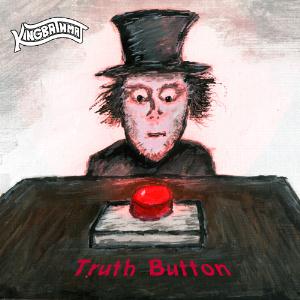
Truth Button by KingBathmat

Truth Button

Sometimes a band comes along that defies categorisation. KBm are such an animal. From the first listen the album aroused my curiosity and I strived in vain to ‘place’ it in my comfortable world of musical genres. That I failed to do so after repeated attempts is a testament to the diversity within Truth Button. As a result it’s taken me a long time to write this review (I’ve thought of little else for the last week!)

KBm are the brainchild of John Bassett, based in the UK. Truth Button is the band’s sixth album since 2003. I will be honest enough to say I had never heard of KBm before, so this was my first experience of their quite unique sound.

Truth Button has a loose concept and in the band’s words:

“…deals with an underlying theme of technophobia and social disconnection due to the ever-growing trivial use of modern technology”.

The frequent pressing of computer buttons has led to the creation of an illusory world but through the ‘Truth Button’ we can, if we wish, attempt to connect with the real world.

This theme is clearly referred to in some of the song titles and accompanying lyrics.

The mix of musical styles is eclectic and melded into an original sound. There’s a bit of Queen here and maybe Black Sabbath there and smatterings of indie and alternative rock (Queens of the Stone Age). At times the lead and bass guitar riffs are very grungy (Tool/Nirvana).  And they throw in a bit of Radiohead and Muse. The vocals however are generally light and punctuated with some nice harmonies.

Continue reading “Truth Button by KingBathmat”

Kevin McCormick’s Squall (1999)

kcmccKevin McCormick, Squall (1999).  To my mind, this is some of the best rock music ever written—but tempered with very serious classical sensibilities and lacking the over-the-top bombast present in even some the best of 1970s progressive rock.

If one had to label his music, it would most likely be a post-prog, post-rock, or, simply put post-Talk Talk.  In the current realm of music, one might think of a mixture of Matt Stevens, Gazpacho, and Nosound.

McCormick incorporates his profound poetry as lyrics.  Each word—and the way Kevin sings it—seems utterly filled with grace and conviction.  This is part two of a rock/post-rock trilogy (he’s currently working on number three).  And, it’s hard to listen to Squall without listening to its equally fine predecessor, With the Coming of Evening (1993).  Kevin really has it all: a great voice, the ability to write poetry as lyrics, and the training of a classical guitarist.

Before I write any more, let me admit my bias.  Kevin is one of my closest friends, and he has been since we first met in the fall of 1986 as freshman at the University of Notre Dame.  We still talk and correspond frequently.  Kevin is the godfather of my oldest son, and I of his second daughter.

We bonded immediately on matters of music back in 1986.

Kevin and his two brothers had a well-known Texas band in the mid 1980s, and Kevin formed the finest band at Notre Dame, St. Paul and the Martyrs, during our years there.  Toward the end of our senior year, St. Paul and the Martyrs opened for the-then unknown progressive jam band, Phish.

During our years in college, Kevin and I traveled throughout the U.S. and England together (making sure to visit Trident studios as well as EMI (hoping to catch a glimpse of Mark Hollis) while journeying through the mother land of prog and New Wave), co-produced a “Dark Side of the Moon” charity show, complete with an angsty-movie backing a full performance of the album by the Marytrs, talked music and lyrics until late into the nights, and even co-hosted a prog rock radio show on Friday nights.

Not surprisingly, one of my greatest memories of Kevin in college was listening to the entirety of Talk Talk’s Spirit of Eden in 1988.  We remained completely silent for a very long time after its completion, stunned by the immensity of its beauty.

Kevin is extremely talented in a number of ways.  Not only is he the father of our beautiful daughters, but he has won national poetry as well as classical guitar composition awards.  In addition to the two post-prog albums (With the Coming of Evening and Squall) already mentioned, Kevin has also released several albums of solo classical guitar as well as an album of Americana, all recorded on an 1840s Martin.

His music has been praised publicly by many (see, for example, his entry at Allmusic) and privately by such luminaries as Phill Brown and Greg Spawton.

As of this afternoon, Kevin has finished mixing a Christmas CD, recorded with his oldest daughter on vocals, to be released next Christmas season.  And, as mentioned above, he is currently working on the completion of his post-rock trilogy.

Here’s Kevin’s music at CD Baby:  http://www.cdbaby.com/Artist/KevinMcCormick

Here’s Kevin’s official site: http://www.kevin-mccormick.com/KM/index.html

I know we at Progarchy have offered lots and lots of suggestions for worthwhile purchases over the last three months.  But, as we begin this near year, I can state unequivocally that it’s worth supporting Kevin, especially as he prepares to record his new post-prog album.  I’ve only heard bits and pieces, but Kevin is a man of absolute integrity.  He is, like so many of us who either play prog or simply listen to prog, a perfectionist.  He also possesses one of the finest senses of beauty I’ve ever encountered in another.  So, while 2013 will probably NOT be the year of Kevin McCormick in the prog world, 2014 almost certainly will be.

Certainly, Kevin’s album should be one of the most anticipated releases of the next two years.  It’s worth beginning to anticipate today, January 1, 2013.


***


Some video links:

http://www.youtube.com/watch?v=umMMJ4B-D6k

http://www.youtube.com/watch?v=Kewac1nhue8

http://www.youtube.com/watch?v=fqsAcTs8KN0

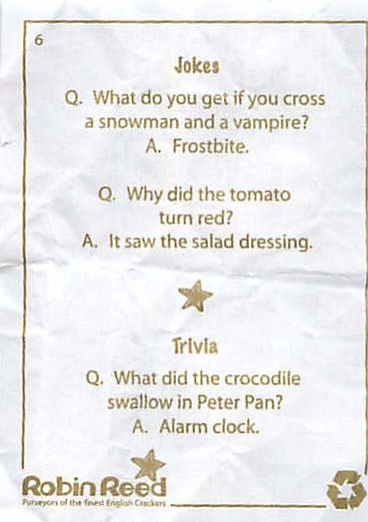
Frost*Bites

This was inside of a Christmas firecracker we popped last night.

frost bite

Excellent Jerry Lucky interview with John Galgano of the fabulous IZZ

index-banner
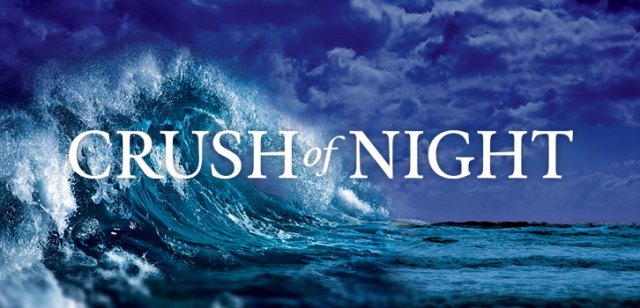
I’ve been slowly (way too slowly) getting up a review of IZZ’s latest album, CRUSH OF NIGHT.  From my perspective, it’s one of the best albums of this past year.

As I’ve been listening and prepping, I came across this excellent interview.

Jerry Lucky: Let’s start at the beginning. What’s the short-story as to how Izz came into being?

John Galgano: IZZ started when Tom was in College with Greg DiMiceli and through Greg met Brian Coralian and Paul Bremner. Being Tom’s brother, I was sort of already involved and working with the guys. We had originally gotten together to work on a piece called Deafening Silence that ended up being on the album My River Flows. Tom had written that piece of music and we all played on it for a few live shows. After that, we began writing material as a group and used that material for what became Sliver of a Sun.

JL: Who came up with the name? And what’s it all about?

JG: I’m a big fan of the New York Mets and at the time we started thinking about band names in the mid-90s, they had these three young pitchers who were supposed to be the next great pitchers for the Mets. One of the guys was Jason Isringhausen who was nicknamed “IZZY”. I loved this nickname and mentioned it to Tom and as we talked it over, we decided to drop the “Y” and just make it IZZ. It seemed to work well and we liked the way it sounded

To keep reading, please go here: http://www.jerrylucky.com/interviews_054.htm