The Spiritual Vision of Dimensionaut

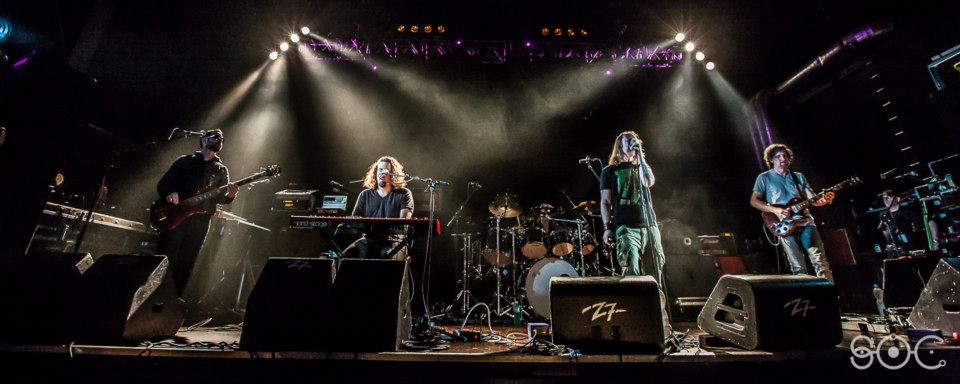
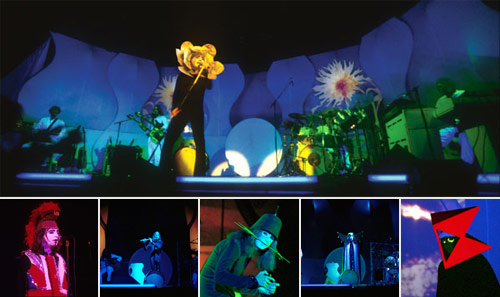
Sound of Contact LIVE at Z7 in Switzerland—Photo by Andy Wright

I have been contemplating the spiritual riches of Dimensionaut, the truly awesome prog masterpiece from Sound of Contact.

For me, the album does what prog does best, with that characteristically proggy ability to immerse the listener in a cosmic philosophical meditation.

To give another example: One of my absolutely favorite tracks from Big Big Train, “The Wide Open Sea,” does this sort of musical meditation stunningly well.

So, to encounter in Dimensionaut an album-length, equally successful exercise in that kind of philosophical and spiritual meditation, is a real thrill. And it’s an even more remarkable achievement if we consider that Dimensionaut is the equivalent of a vinyl double album.

Here is how I would slice it up for a deluxe vinyl gatefold edition:

SIDE 1:
01. Sound Of Contact (02:05)
02. Cosmic Distance Ladder (04:43)
03. Pale Blue Dot (04:44)
04. I Am Dimensionaut (06:25)

SIDE 2:
05. Not Coming Down (06:01)
06. Remote View (03:54)
07. Beyond Illumination (05:53)
[featuring Hannah Stobart]

SIDE 3:
08. Only Breathing Out (05:57)
09. Realm Of In-Organic Beings (02:52)
10. Closer To You (05:05)
11. Omega Point (06:30)

SIDE 4:
12. Möbius Slip (19:36)
I – In The Difference Engine
II – Perihelion Continuum
III – Salvation Found
IV – All Worlds All Times

If people approach Dimensionaut with an open mind, they will have to admit that this double album is an incredible achievement. Amazingly, it is prog that is accessible to everyone, and yet it does not shatter its integrity with any compromises.

All the negative reviews that I have read, and any reservations that I have heard expressed, stem simply from invidious comparisons, which are completely unfair.

Rather, if you clear your headspace of all preconceptions and genealogical obsessions, and just enter into the spirit of the music, the musical conclusion is inescapable:

With Dimensionaut, the Spirit ever lingers… undemanding contact in your happy solitude!

(I append below an interesting video in which Simon Collins and Dave Kerzner talk about the album’s story concept. They affirm that the musical journey explores not just dimensions of science fiction and romance, but most especially a serious spiritual dimension.)

You Can Do a Lot in a Lifetime, If You Don’t Burn Out Too Fast – Rush, April 23, 2013 at the Frank Erwin Center, Austin, Texas

ImageJust one week after a long-overdue induction into the Rock and Roll Hall of Fame, Rush opened the second leg of their ‘Clockwork Angels’ tour – and fortunately for myself and thousands of other Texans, they did it right here in Austin.

For long-time Rush fans, a Rush concert is more than just an event where we see musicians performing their catalog in a live setting.  For us, it is something that gets into us the way dye gets into a shirt and alters its color; something that affects each of us right down to the molecular level.  This show certainly did that for me, more for reasons I will get into below.

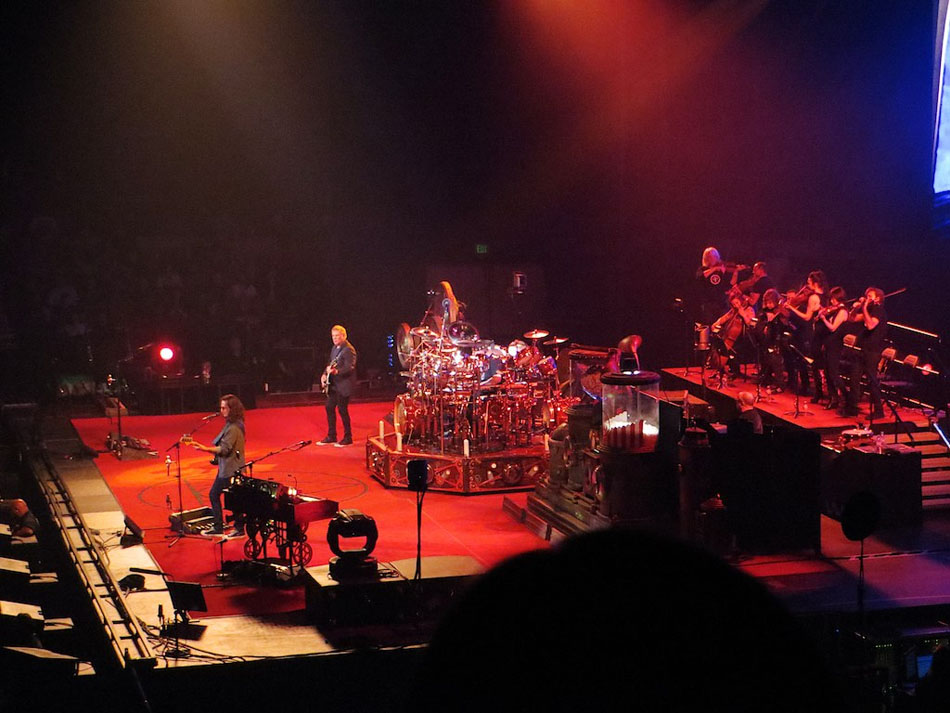
The steampunk aesthetic of the stage setup was spectacular.  It was refreshing to see a big visual presentation to accompany the music, which is a rare thing these days.  In contrast to the 70’s, when progressive rock was bigger and had more backing by the record companies, most contemporary prog shows are played in smaller venues without the type of visuals as were present in some of the gargantuan shows of that earlier time (think ‘Yes’ on the ‘Relayer’ tour).  Rush is the rare band from that era that can still play large venues with a corresponding stage set and light show that turns the presentation into more of an event than just a live music performance.

After a long break from the road, the band seemed rested, recharged, and ready to go.  Some of Rush’s typically humorous opening video greeted the audience when the lights went down, featuring the band’s trademarked slightly bizarre humor.  The concert proper then opened with a rousing version of ‘Subdivisions’, followed a number of 80’s works.  In the first set, they did three songs from ‘Power Windows’, including ‘The Big Money’, ‘Grand Designs’, and ‘Territories’, while also managing to squeeze in ‘Limelight’, ‘Force Ten’, and ‘The Analog Kid’.  After the latter tune, the band moved into the 90’s with ‘Bravado’ and ‘Where’s My Thing’ and then into the 00’s with ‘Far Cry’, which closed out the first set.

After a short break, the band returned to the stage, this time with eight additional musicians collectively known as ‘The Clockwork Angels String Ensemble’.  This tour has been the first in which Rush has brought extra musicians on stage, and they were used to good effect here.  The string ensemble filled in some spaces while enhancing others, remaining on stage throughout the performance of ‘Clockwork Angels’ and for several songs afterwards, including a blistering performance of ‘YYZ’, which is captured through a smartphone (not mine) here.

Beginning with another entertaining bizarro-humor video (with Neil, Alex, and Geddy playing dwarfs) the second half of the show kicked off with ‘Caravan’, and followed through with most of the songs from ‘Clockwork Angels’.  Regrettably missing from that list was ‘BU2B’ and ‘Wish Them Well’, the latter being a favorite of mine not only for the music but for the life lesson within the lyrics.  A guitar snafu during ‘The Anarchist’ was a minor hiccup that left Geddy alone without melodic accompaniment for a moment, but Alex and his guitar tech had the presence of mind to quickly swap out instruments.  The performance of ‘Clockwork Angels’ concluded with a spectacular performance of ‘The Garden’, the visuals of video working great with the music here.

After concluding ‘Clockwork Angels’, the band went back into the 80’s again, with ‘Manhattan Project’, a short drum solo, ‘Red Sector A’, and ‘YYZ’.  The string ensemble exited the stage and the band closed out the set with ‘The Spirit of Radio’.  The band returned for an encore including ‘Tom Sawyer’ and ‘2112’ (‘Overture’, ‘The Temples of Syrinx’, and ‘Grand Finale’) before calling it a night for good.

I don’t have much to critique for the show, but I do have to say that the soundman could have done a better job with the mix.  It was very bass-heavy, and this caused a bit of muffling of notes, particularly on a few of Alex’s guitar solos.  But overall, that wasn’t enough to dampen the experience, which was still overwhelmingly positive.

All in all, an outstanding show, played with the energy and intensity that belied their age.

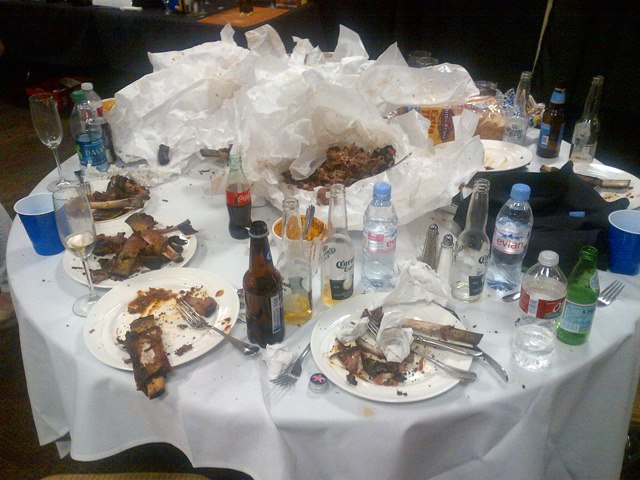
ImageAfterward, according to their Facebook page, Neil, Alex, and Geddy got in touch with their inner cavemen by devouring some Texas barbeque, as shown in the photo.  At this point of the review, you’ll have to excuse me while I go off on a tangent, but there is something in that photo that I think I need to address with the band members.  Geddy, Alex, Neil – I’m glad you enjoyed your barbeque during your most recent visit to the Republic of Texas.  The ribs and brisket are hard to beat.  However, I have to say I am a little disturbed in looking at some of the bottles on the table.  You three are Canadian boys, and therefore have Canadian genes – which means like other great Canadians, such as Bob and Doug McKenzie, you are drinkers of hearty beer.  Thus, seeing several bottles of Corona on the table gives me pause.  Corona is more or less a summertime beer – I could give you a pass on this if the gig was an outdoor gig during the sweltering months of July or August.  But last night was an unseasonably cool April night, and thus I just cannot understand the Corona.  Even more disturbing is what appears to be a bottle of Bud Light on the table.  Perhaps one of you reached for a water bottle and didn’t notice the difference?  Now, in fairness, toward the upper right corner, it does appear that some redemption is present, as I am about 90% confident that’s a bottle of Shiner Blonde.  I’ve compared the portion of the label I can see in the picture to an actual bottle of the same in my refrigerator, and the lack of a bar code on my bottle appears to be the only difference.  I’ll do more research of the label tomorrow night as I watch the NFL draft – just to be sure, you know.  Nevertheless, Shiner Blonde is a beer befitting of your Canadian DNA, guys, so I would recommend you use that to wash down your next Texas barbeque dinner.  Ok, tangent over.

This Rush concert was special in a way that says something both about Rush and their fans alike.  Not only was this my fifth Rush show, but it was the fifth different decade in which I had seen them.  Previously I had seen them in 1979 (Rupp Arena, Lexington, KY, Hemispheres tour), 1984 (Hampton Coliseum, Hampton VA, Grace Under Pressure tour), 1990 (Charlotte Coliseum, Charlotte, NC, Presto tour) and 2007 (Verizon Wireless Amphitheater, San Antonio, TX, Snakes and Arrows tour).  The 70’s, 80’s, 90’s, and 00’s. Now I can add the 10’s.  I’m comfortable in saying that I’m not alone among the Rush fan base, and in fact know there are fans that have seen many, many more shows than I have, and moreover, within the same five decades.  There are not many bands out there that one can say the same about.  There are even fewer (if any bands) that one can say that about while also saying that it was with the same lineup each time.  That’s a testimony to their longevity, as well as to the loyalty of the fans that have stuck with them all of these years.  As many of you will recognize, the title of this piece is drawn from the lyrics of ‘Marathon’ off of the ‘Power Windows’ album.  And those words, written by their philosopher-drummer nearly 30 years ago, appear to be even more true now than when that album was released.  Rush, despite some serious ups and downs, has persevered and continued to make great music far beyond the time when most bands lose their creative edge.  And fans like myself and countless others, we’ve lived our lives and had our own ups and downs for all of these years, and yet we kept coming back, keep buying the albums, and keep going to the concerts because we appreciate the excellence, the professionalism, the creativity, and the wisdom inherent in the lyrics. That neither Rush nor their fans have burned out, that both have shown the endurance to stick with one another throughout the decades only proves the wisdom of the lyrics from which this review draws its title.

Thanks, guys.  Not just for last night’s show. But for everything over all of these years.

Prog #35

rushcoverFEAT-237x300For those of us who don’t live in the UK, we have to wait a few extra days for our copies of PROG to arrive.  Mine arrives on the iPad, and I was thrilled to see so much good in the latest issue (out on iPad today).

Several Progarchist favorites are recognized and recognized well.

On Big Big Train’s English Electric 2:

For a band who have now been in existence for over 20 years to be creating albums as perfect as this is in itself utterly remarkable.  The fact that this is their second release of such a calibre within the space of a year can only reinforce the opinion that what we’re dealign with here is an act of rare, often indescribable brilliance.

I don’t see why the reviewer needed to bring up a Genesis reference and comparison twice.  Big Big Train is producing things so much beyond what Genesis did, though Genesis was, of course, brilliant in its own right.

But, Big Big Train is not Genesis Part II or Part III.  It’s Big Big Train.

Every time a review comes out of a new computer, the reviewer doesn’t keep bringing up the Commodore 64.  Why does a comparison to an early 70s band do anything for our understanding of a band performing perfectly beautifully in 2013, in and of its own right?  Ok, rant over.

On Cosmograf’s The Man Left in Space:

Armstrong has created a simply magnificent piece of work.

Amen.  And, a belated happy birthday to this genius, this Master of Chronometry and of the Platonic Spheres, Robin Armstrong.

Also in the issue: great stuff on Rush (even more, if you ordered the hardback edition of #35), on Todd Rundgren, and on RogerHodgson, and reviews of the latest from Sanguine Hum and Spock’s Beard.

To go to the official Prog site, click here.

Interact with RUSH live online today

RUSH.com

From WSJ.com: Today starting at 3:30 p.m. EST, Geddy Lee and Alex Lifeson of Rush will be answering fan questions LIVE.

Wind-blown Notes: Rush and Grace Under Pressure

graceunderpressure-cover-sMy favorite Rush album has been, at least going back to April 1984, Grace Under Pressure.  I realize that among Rush fans and among prog fans, this might serve as a contentious choice.  My praise of GUP is not in any way meant to denigrate any other Rush albums.  Frankly, I love them all.  Rush has offered us an outrageous wealth of blessings, and I won’t even pretend objectivity.

I love Rush.  I love Grace Under Pressure.

extrait_rush-grace-under-pressure-tour-1984_0

I still remember opening Grace Under Pressure for the first time.  Gently knifing the cellophane so as not to crease the cardboard, slowly pulling out the vinyl wrapped in a paper sleeve, the hues of gray, pink, blue, and granite and that egg caught in a vicegrip, the distinctive smell of a brand new album. . . . the crackle as the needle hit . . . .

I was sixteen.

From the opening wind-blown notes, sound effects, and men, I was hooked, completely.  I had loved Moving Pictures and Signals–each giving me great comfort personally, perhaps even saving my life during some pretty horrific junior high and early high school moments.

But this Grace Under Pressure.  This was something else.

If Moving Pictures and Signals taught me to be myself and pursue excellence, Grace Under Pressure taught me that once I knew myself, I had the high duty to go into the world and fight for what’s good and right, no matter the cost.  At sixteen, I desperately needed to believe that, and I thank God that Peart provided that lesson.  There are so many other lessons a young energetic boy could have picked up from the rather fragile culture of the time and the incredibly dysfunctional home in which I was raised.  With Grace Under Pressure, though, I was certainly ready to follow Peart into Hell and back for the right cause.  Peart certainly became one of the most foundational influences on my life, along with other authors I was reading at the time, such as Orwell and Bradbury.

Though I’m sure that Peart did not intend for the album to have any kind of overriding story such as the first sides of  2112 or Hemispheres had told, GUP holds together as a concept album brilliantly.

The opening calls to us: beware!  Wake up!  Shake off your slumbers!  The world is near its doom.

Or so it seems.

Geddy’s voice, strong with anxiety, begins: “An ill wind comes arising. . .”  In the pressures of chaos, Pearts suggests, we so easily see the world fall apart, ourselves not only caught in the maelstrom, but possibly aggravating it.  “Red Alert” ends with possibly the most desperate cry of the Old Testament: “Absalom, Absalom!”  Certainly, there is no hope merely in the self.  Again, so it seems.

The second song, gut wrenching to the extreme, deals with the loss of a person, his imprint is all that remains after bodily removed from this existence.  Yet, despite the topic, there is more hope in this song than in the first.  Despite loss, memory allows life to continue, to “feel the way you would.”  I had recently lost my maternal grandfather–the finest man  I ever knew–before first hearing this album.  His image will always be my “Afterimage.”

It seems, though, that more than one have died.  The third song takes us to the inside of a prison camp.  Whether a Holocaust camp or a Gulag, it’s unclear.  Frankly, it’s probably not important if the owners of the camp are Communists or Fascists.  Either way, those inside are most likely doomed.  Not only had I been reading lots of dystopian literature in 1984 (appropriate, I suppose, given the date), but I was reading everything I could find by and about Solzhenitzyn.  This made the Gulag even more real and more terrifying.

Just when the brooding might become unbearable, the three men of Rush seem to offer a Gothic, not quite hellish, smile as the fourth song, “The Enemy Within” begins.  Part One of “Fear,” the fourth track offers a psychological insight into the paranoia of a person.  Perhaps we should first look at our own problems before we place them whole cloth upon the world.

Pick needle up, turn album over, clean with dust sponge, and drop needle. . . .

Funk.  Sci-fi funk emerges after the needle has crackled and founds its groove.  A robot has escaped, perhaps yearning for or even having attained sentience.  I could never count how many hours of conversation these lyrics prompted, as Kevin McCormick and I discussed the nature of free will.  It’s the stuff of Philip K. Dick, the liberal arts, and the best of theology.

More bass funk for track six and a return to psychological introspection, “Kid Gloves.”  But, we move out quickly into the larger world again with the seventh track, “Red Lenses,” taking the listener back to the themes of paranoia.  When the man emerges for action, will he do so in reaction to the personal pain he has experienced, or will he do so with an objective truth set to enliven the common good?
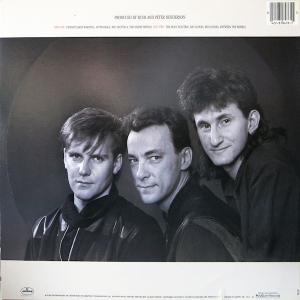
grace_under_pressure_0In the end, this is the choice for those who do not lose themselves to the cathode rays.  Is man fighting for what should be or he is reacting merely to what has happened, “to live between a rock and a hardplace.”

Unlike the previous albums which end with narrative certainty, Grace Under Pressure leaves the listener with more questions than it does answers, though tellingly it harkens to Hemingway and to T.S. Eliot.

Given the album as a whole, one might take this as Stoic resignation–merely accepting the flaws of the world.  “Can you spare another war?  Another waste land?”

Wheels can take you around

Wheels can cut you down. . . .

We’ve all got to try and fill the void.

But, this doesn’t fit Peart.  We all know whatever blows life has dealt Peart, he has stood back up, practiced twenty times harder, and read 20 more books.  That man does not go down for long.  And, neither should we.

In the spring of 1987, much to my surprise, one of my humanities professors allowed me to write on the ideas of Peart.  I can no longer find that essay (swallowed up and now painfully lonely on some primitive MacPlus harddrive or 3.5 floppy disk most likely rotting in a landfill in central Kansas), but it was the kind of writing and thinking that opened up whole new worlds to me.  My only quotes were from “Grace Under Pressure,” drawing a distinction between nature of the liberal arts and the loss of humanity through the mechanizing of the human person.  It dealt, understandably, with environmental and cultural degradation, the dangers of conformist thinking, and the brutal inhumanity of ideologies.  It was probably the smartest thing I’d written up to that point in my life, and even my professor liked it.

Of course, the ideas were all Peart’s, and I once again fondly imagined him as that really great older brother–the one who knows what an annoying pain I am, but who sees promise in me anyway, giving me just enough space to find my own way.

I’m forty five, and I still want Neil to be my older brother.

The Musical Biz

TheMusicalBox

Carlton Wilkinson reflects on the nature of music, arriving at a fundamental principle, which helps him think about the future of music:

Music is inherently live and therefore inherently local. The future of the music business is not in product sales, but in the service of that artist-listener relationship. Artists are thinking about tech. They’re embracing it and using it to reach their audiences directly.

He does this in “Pandora’s Box Is Open and the Music Biz Will Never Be the Same“, which develops a fascinating argument about how music is not a commodity:

It’s not a product that can be assembled in a production line or held in your hands. It’s something that comes naturally from every living person — some better than others — and can be enjoyed by every living person, for free as long as the musician is willing, with no other assistance needed.

The standard business model, perfected in the age of vinyl recordings, presented music as a tangible thing — a record — that a businessman could manufacture and sell like any other widget. But the music on those records is only a captured bit of the ephemeral, constantly changing musical experience.

A Bruce Springsteen song is never exactly the same two concerts in a row. A performance of Beethoven or Bach sounds different depending on who is playing, and were those composers themselves to play their most famous music for us, we would likely hear shocking differences from the versions we know — more radical than any modern interpreter would dare.

The experience of music is determined by its creators and by its listeners. By definition it is never completely recreated, but is created anew every time. It happens in the moment and will change in the next moment.

The traditional music business, built around the sale of fixed music recordings, handles manufacturing, packaging and distributing, middlemen selling something they didn’t make themselves, something never really theirs to begin with.

These days, though, tech is trashing that model, by fits and starts turning the business of music from a product-based market into something more like a social media service directly connecting artists and listeners.

Wilkinson earlier made his impassioned point that music is not a commodity in an insightful review of the music that Obama put on display for his second inaugural, “Obama’s Hit Parade“:

… I can overlook the lip-synching. What’s more disturbing, what I find harder to forgive, is the programming emphasis on pop music performers, including Beyonce and Kelly Clarkson, at the ceremony and elsewhere. …

The world of pop music has always revolved around money, the more the better. Money’s influence alters not just the way the music is presented, but the way it is created and the expectations of the creators and the audience. Success in this field is a dollar figure.

Classical and jazz don’t work that way. The musicians need to get paid, sure, and most aren’t above playing weddings or in some ways tailoring their music to suit their audience. Money pressures exist, but they don’t dominate the art form. Success here is rooted in technical accomplishment and in the musical experience itself.

When a classical artist verges on mass popularity, like Yo-Yo Ma, companies like Sony will maneuver themselves into a position to profit from it. But Ma didn’t get where he is by thinking about money — he got there by being a terrific cellist, and an inquisitive musician, constantly challenging himself, branching into new areas. His success was established long before big money entered the picture and continues largely because he is able to rely on his true artistic nature and ignore the role of money.

Pop musicians sometimes emulate that model, ignoring the financial rewards and following where talent and curiosity lead. Often they find themselves in a better place as a result, connecting more easily and honestly with audiences, developing a longer career trajectory.

They don’t let the money get in the way. …

Early in his first term, Obama made a commitment to present the U.S. cultural landscape in all its diversity. At that first inauguration, he shared the podium with Ma, Itzhak Perlman, Gabriela Montero and Anthony McGill playing a John Williams variation on the Shaker hymn “Simple Gifts.” He followed up on his promise by hosting workshops and concerts in various styles at the White House during the first year or two he was in office.

But at this year’s inaugural, that broader cultural perspective seems to have gone missing, narrowed to focus more fully on the most common commercial tendencies, music as a commodity.

Geddy Lee recently appeared on a TV sitcom in which the episode mocked Canadian culture as backwards, the fictional case in point being that its culture was transformed only much later by grunge. (In reality, of course, Rush’s prog metal had already allowed Canada to transform the musical world. Thus, Lee’s fake testimony on the sitcom imparts a delicious taste of irony to the self-deprecating joke being made at Canada’s expense.) Part of being able to get the joke was being able to comprehend the standard narrative that grunge changed the world of rock forever.

But Jason Notte, inspired by Wilkinson, debunks that standard narrative in “Nirvana’s ‘Nevermind’ and The Death of Guy Rock” by arguing that Nirvana in fact provided a negative example, by making clear only what rock cannot exclusively become—namely, grunge and grunge alone:

So where does Nirvana fit into all of this? Well, the familiar narrative says they did the world a big, huge favor by ridding it of hair bands and arena rock and making it safe for garage bands again. That’s not quite how it played out. The grunge and post-grunge era music world was filled with as much belabored growling, on-stage preening and aggro nonsense as ever, as evidenced by the lineup, fires and ensuing rioting and rapes that engulfed the ill-fated Woodstock ’99.

What Kurt Cobain and, later, Dave Grohl taught and most folks didn’t hear until Napster gave away much of the music and Woodstock ’99 made it very clear was that “rock” and, more importantly, pop music can’t be an exclusionary club filled with angry boys. …

Without making a concerted effort to do so, Cobain was being as inclusionary as he could within the confines of his genre. It’s something you hear echoes of in Jack White’s work and in his previous albums with the White Stripes and it’s something the Black Keys have reached for in their own blues-based fuzz rock and their collaborations with artists from various genres.

Inclusion is the common thread. …

That’s ultimately the key lesson from Nirvana and Smells Like Teen Spirit: It changed music and, more specifically, rock music by making “rock” sound nothing like Nirvana.

In other words, rock continues to progress. And it does so in its history by discovering innovative ways to facilitate inclusion and participation.

And that, arguably, is why progressive rock is the exemplary flower of the rock genre. Because, as is suggested by its lengthy songs and its display of musical virtuosity within the framework of group dynamics, it offers the greatest musical space for the flowering of inclusion and participation and a satisfying local experience.

Witness the relationship between the artists and the listeners of progressive rock. In our own time, Big Big Train is showing us how music, not as a commodity, but as a work of art that invites listeners to an immersive and unrepeatable experience, can bypass the music industry and allow rock to be what it is supposed to be according to its essence: namely, a musical experience of transcendence.

As Greg Spawton has observed:

In The Music’s All That Matters, Paul Stump makes some very interesting observations. Early on in the book, he correctly identifies that the main problem with progressive rock is its name (he calls it ‘the most self-consciously adjectival genre in all rock’). Another point that Paul Stump makes is about what unites the musicians of the genre. He says they have ‘a hankering after the transcendent’. I really like that phrase as it can take on a broader meaning than ‘progressive’. In Big Big Train, we combine our influences in a way, which is often original. But trying to do something different isn’t the be-all-and-end-all. What we are really trying to do is to make extraordinary music.

There’s only one way that prog rock can touch you.

And that is: in the present moment.

So why don’t you let it?

Now, now, now…

RUSH: A Farewell to Hemispheres, Part I

by Kevin McCormick

Rush appears to be a band without a retirement plan.  This past year saw the release of the highly acclaimed studio album Clockwork Angels, the subsequent world tour promoting the album and the fourth remastered re-release of the 35-year old classic album 2112.   With the re-release of that epic work and the renewed attention it has garnered, it is worth noting that the recording and the subsequent live shows were really, as the liner notes say, “The end of the beginning, a milestone to mark the close of chapter one in the annals of Rush.”

From Rushvault.
From Rushvault.

Neil Peart hardly could have known how accurate that statement would be.  Today the band is approaching its 40th year since its first full-length album.  Most artists of their age lucky enough to be still performing spend most of their time coasting on the tails of decades-old hits and playing as shadows of their former glory.  Rush seems to continually push itself into new territory creating an ever-changing sound yet with ever constant sensibility.  Something about Rush feels contemporary but remains rooted in the sound of three guys from Toronto four decades past.

Rock artists worked more quickly back then. By 1976, a banner year for Rush, the band had produced four studio albums.  Having resurrected themselves from the brink of extinction (or at least from being dropped by their label) with the inexplicable popularity of their futuristic totalitarian opera “2112,” the band toured extensively throughout the US and Canada.  Their “brief” stretch promoting the new album ran from February to August and included opening for Blue Oyster Cult and Aerosmith.  Somehow the band found time to put together a double-live album of those recent shows and, with but a week in-between, again headed out on the road from August and into the new year promoting that record, All the World’s a Stage. By the time they wrapped up in England in June of 1977, Rush had been touring for nearly two years without a lengthy break and receiving accolades not only for their recorded work but for the power, skill and intensity they brought to the stage.

Continue reading “RUSH: A Farewell to Hemispheres, Part I”

Hugh Howey Is A Gracious Man – A Brief Interview

Following my review earlier today of Hugh Howey’s Wool Omnibus, I sent him a note letting him know I had posted it (this was really his idea — he encourages his readers to review his books and get in touch with him, so I had no choice).  He sent me a nice note back, thanking me for the comparison of Wool to Ayn Rand’s Anthem and feeling honored to be, in my review, in the company of that book and Rush’s 2112.  I asked if I could post his response, and he said sure but that he’d also be happy to give a more structured response or answer a few questions.  So here are my “oh my god I have to come up with questions for Hugh Howey” questions and his thoughtful responses.  Hugh Howey is indeed a gracious man.

You’ve told me that you’re a fan of Ayn Rand’s Anthem and Rush.  Do you have a favorite Rush record? What are some other musical and literary favorites?
My favorite overall album is Moving Pictures, and I think that’s because of my age. My older brother got into their music, and I wanted to be as cool as he was. I remember hearing those drum solos go on forever and thinking to myself that these guys must not be interested in being on the radio at all, and that made them even cooler. In a way, I think Rush became commercial without trying to. And that appeals to me. Wool was written and published in a way that never should’ve led to commercial success.
 
Anthem is one of the grandaddies of post apocalyptic fiction. It gets left out of many discussions because of the controversial life and philosophy of its author, but I think art deserves to be critiqued independent of the artist. I didn’t think about the underground nature of Anthem until you mentioned it, but now I want to go back and read it again.
In the world of the Silo,information technology and mechanical technology play a huge role, and are described in very readable detail without killing the narrative.  Can you describe how you approached your description of these technologies in Wool?
I don’t enjoy science fiction when it gets bogged down in the details of how things work. The great thing about end-of-the-world stories is that the technology is often less advanced than what we have today. That allows the characters to stand in the foreground, which is what draws readers in. My approach is twofold, really: I respect the reader’s intelligence to figure things out as they go, rather than blast them with info dumps. And I don’t have characters marvel over aspects of their own worlds that really ought to be banal to them. Science fiction can do this sometimes: characters appear to be wowed over things that are everyday. That always feels jarring to me.
When you wrote the first novella, did you have an idea of how Wool 5 would end?
Not at all. It was just the one story. But when I set out to write Wool 2, I sketched out the entire saga, which includes the SHIFT and DUST books. I didn’t want to fall into the trap of Lost, where the creator has no idea what’s going on, and the reader/viewer can begin to sense this. I wanted to foreshadow events miles in advance. 
There are elements of wool that seem particularly well-suited for dramatic interpretation.  Are we going to see a movie of Wool?
I hope so! Ridley Scott and Steve Zaillian optioned the film rights. The screenplay is in the pipeline right now. I’d say the odds are 1 in 10 that a film gets made, which is pretty damn good by Hollywood standards! 
What are you currently writing, and how can we keep up with it?
I’m working on the end of the SHIFT series. After that, I’ll start the third and final act, DUST, which is where things really go to hell. My website is a good place to keep up with my writing. I even keep my word count updated, so you can see how far along I am in any draft. I try to think of the things I wish my favorite authors would do, and then I do them. Just makes sense to approach things that way.
 
Best,
Hugh