Rick Wakeman. Journey To The Centre Of The Earth. Newcastle City Hall. 24th April 2014
***
Journey To The Centre Of The Earth has been played live in the UK on three occasions. Once at Crystal Palace and twice at the Festival Hall London. It was here that the recording was made that went on to sell 15,000,000 copies. So tonight was the fourth time it had been played and the first time in it’s newly extended version due to Rick finding the old manuscript with the music that had been left off the original recording.
There was an air of expectancy from the mainly older looking crowd gathered to pay homage. The stage looked amazing with Ricks’ keyboard bank taking centre stage. The organ pipes at the back looked down on the seating for the orchestra and choir and a large chair was positioned for the narrator.
At 8.00pm prompt, Rick casually walked onto the stage dressed in a two piece suit. The audience responded and seemed to put him at ease. The was a Roland Piano set up at the front of stage and Rick went on to tell us who had influenced and encouraged him in the early days. These included Cat Stevens and David Bowie, so we got renditions of Morning Has Broken and Life on Mars. After forty minutes of humour and music, Rick left the stage and soon after the orchestra and choir started to filter on. Then the lights dimmed and on came Rick in white t shirt and trousers and the most magnificent silver sequin cape. Thus began our Journey.
The sound was crystal clear and the playing was impeccable. The strings and the brass shone through and the choir added an extra texture. They played the whole thing straight through. You could hear a pin drop during the quiet bits as the audience seemed transfixed. But as the build up to Hall of the Mountain King and the final closing notes approached the crowd were ready to jump to their feet to show their appreciation of such an outstanding piece of music.
Rick was overwhelmed by the support. I think he wasn’t too sure how the reaction was going to be, but he needn’t have been worried
For an encore they played some music from Return to the Centre of the Earth and then the final Hall section again, this time with rick out front duelling with the guitar player with Rick playing his over the shoulder synth guitar.
Another standing ovation then he was gone. A wonderful evening of nostalgia and superb music. If you are in two minds as to whether to get a ticket for the remaining shows… I say see it while you can. You won’t be disappointed.
[Dave is a great Englishman from Durham. He’s also a member of the progressive rock band, Salander. We’re very proud to have him write for progarchy–ed.]
Eric Clapton’s ‘Journeyman’ Album Feat. George Harrison, Chaka Khan, Daryl Hall, Robert Cray, Phil Collins and others Now Available On Hybrid SACD
“…one of the greatest rock/blues guitarists on the planet!”
Camarillo, CA – Much to the elation of Eric Clapton fans across the globe, Marshall Blonstein’s Audio Fidelity has released Clapton’s ‘Journeyman’ album as a limited numbered edition Hybrid SACD! Eric Clapton is a true legend. ‘Journeyman’ reached #16 on the Billboard album chart and became Clapton’s first solo studio album to go double platinum. Like any of his best albums, there is no grandstanding to be found on ‘Journeyman’…it’s simply a laid-back and thoroughly engaging display of his virtuosity. The album was heralded as a return to form for Clapton, much of it has an electronic sound, mostly influenced by the 1980s rock scene, but it also includes blues songs like “Before You Accuse Me,” “Running on Faith,” and “Hard Times.”
“At the center of it all is Clapton’s guitar work…stinging blues and soaring pop.”
There is an all-star assembly of guests: Dire Straits keyboardist Alan Clark, George Harrison, Chaka Khan, Daryl Hall, Robert Cray, Cecil and Linda Womack, Phil Collins and Gary Burton. Among the highlights are several cuts that feature slide-versus-slowhand guitar dueling with Cray. George Harrison is particularly impressive on his little masterpiece “Run So Far,” playing guitar and singing harmony vocals.
A couple of tracks rank among Clapton’s best from any decade.The strongest commercial single is “Bad Love,” which won the 1990 Best Male Rock Vocal Performance Grammy Award, and reached the No. 1 position on the Album Rock Chart. “Pretending” is a firm mid-tempo rocker that also reached the No. 1 position on the Album Rock Chart and and includes one of his most assured vocal performances ever.
Clapton sounds more convincing than he had since the early ’70s. Not only is his guitar playing muscular and forceful, his singing is soulful and gritty – he seems to have struck the perfect balance between the fiery blues of his youth with the pop flavorings of his later years.
CLASSIC ROCK magazine has announced its move to “TeamRock” away from Future.
As a part of the move, CLASSIC ROCK has also released a new iPad app. An email sent at 2:05 this afternoon even tried to detail exactly how the transition from the old to the new app should work.
I’ve now tried to transfer my subscription ten times. Nothing has worked. I’m about to give up. Has any one in the progarchy readership world had better luck? Needless to write, I’m a bit frustrated.
Classic Rock has now launched its all new iPad Edition – but that means you need to move to a new app.
It sounds like a hassle, but it will be worth it. The new iPad Edition has all new features, including video content, photo galleries, animated images, music player and loads of exclusive extra content. So you may need to download a new app, but you get more for it.
We know you have questions about this, so we’ve done our best to answer some of them below.
I’m a subscriber, what happens now?
We will obviously honour the rest of your subscription term within both the new app and the old app. When we update the old app your auto-renew will be turned off. We will still publish issues into the old app until April 2015, but these won’t be the new and improved editions.
To get the new and improved edition, you will need to:
Search for “Classic Rock Magazine” in the App Store;
Download the new app;
Sign into it using your Apple ID;
Once you’ve done that, create a username and password – this will verify your subscription;
Now you be entitled to download the new issue and every new issue for the duration of your subscription.
When your subscription comes to an end (we’ll send you an email to remind you), you will need to subscribe via the new app.
What about all of my back issues?
There will only be a year’s worth of back issues in the new app to start with and over time we may add in some more. In the meantime, you will have to keep the old magazine app in order to continue being able to view your back issues. However, if you delete the old app or update your device or operating system you will lose all issues in your library for good.
What if I have any other questions?
Our FAQs page has every question we could think that you might ask – just click here
One, two, three….okay hands down, there’s too many of you.
Rush fans united…
For the last thirty-five, or more years of loving progressive Rock music there was never a day I would have ever considered myself a fan of Rush.
No… please, keep hold of your rotten fruit and hear me out….
There was always something about them I couldn’t get my head around. I used to think it was Geddy Lee’s voice. The ear-shattering pitch he could achieve made seemingly domesticated house cats turn Feral.
Yet there was something undeniably attractive about some of the musical dexterity in the instrumental bits. The amazing power of the combined rhythm section of Lee and Peart was sometimes so complex it defied belief, but every now and then it just seemed too overblown, too heavy metal for a whimsical English Genesis fan like myself.
At various points over the years I continued to have a genuine dislike of what I heard at whatever moment I came across it. In the 1980’s it probably happened more so, because of their poppy-synth progression, and yet I’m told by the lifetime fans that this period also reflects some of their greatest moments too.
Even a couple of years back I had another listen and heard something from ‘Vapor Trails‘ and I didn’t like that much either. I was surprised at how heavy they sounded, but I know then that I was too set in my ways to open my eyes or ears and really listen objectively. I’m now told that the mix of the Vapor Trail’s album wasn’t very good either so I’m guessing that it didn’t help though.
It’s been a pattern all along.
My first real taste was when a school friend playing me side one of ‘2112‘ sometime in 1980. Like the cigarettes he also offered me to sample– I hated it. Yes, I know this sounds incredible to ‘you’–a fan of Rush. The many I have met over the years have rated this album as one of the best–a real epiphany moment–and beyond that they have been as fiercely loyal and devoted towards everything the band ever released, more so than probably any fan of any group I have known. At the time I heard ‘Temple of Syrinx‘, and as I have said earlier, Geddy Lee’s voice made my hair stand on end and not in a good way. Described as being similar to ‘A Munchkin giving a sermon’ by one particularly rude American critic, I could see my dislike for his vocal range and unique sound was shared by others.
And now is the time?
My parents always told me, I needed to try something I didn’t like at least once every year in case I changed my mind… It usually referred to some food that they knew one day I would like the taste of, when I was mature enough to appreciate it. Several years ago I gave up on this philosophy when I finally realised that there was no way in this lifetime, or the next, I would ever, ever like cottage cheese. It’s disgusting. It truly is the work of the devil.
‘Devil’s food’…..
So with Rush I honestly believed they were the cottage cheese of Progressive Rock. Not devils work, but as likable as the revolting, inedible lumpy stuff….with extra pineapple. I was convinced it would never happen, despite the regular gushing recommendations. When it comes to fans, you Rush types can really gush…however in recent years since I have become part of the social media revolution, I have found the voices harder and harder to ignore.
I even toyed with the idea now and then of going into the attic and looking for that dusty old copy of ‘A farewell to Kings.’ It’s been up there for many a year like a pair of crazy, multi-coloured socks that sit in the bottom of your sock drawer. An unwanted gift (that has been with me since 1986) which I would never enjoy even though I did once try…just a little.
One other item of Rush’s catalogue that I owned which I inadvertently bought was a shaped picture disk from 1982 –the single ‘New World Man’. I was a NUT for the space shuttle in the early eighties—and bought the single purely on the basis of the Columbia shuttle-shaped record. I never played it! I pinned the plastic sleeve to my bedroom wall with the record inside and it stayed there pretty much for the rest of the decade, even after I left home for college.
So fast forward to now and here I am… happy in the world of new Prog, minding my own business. There was no need to revisit the past when there was so many amazing bands to be enjoyed in the 21st century. Moreover where would I even start when it came to delving into the forty odd year history of a prolific band? It’s like signing up to do the New York Marathon having never run anywhere beyond a jog to the bus stop. Where do you start?
The niggling feeling that I was missing out on something just wouldn’t go away so I felt it was time to ask you, the fans and friends to help. Yet that was like asking all the salesmen at the sports shop which shoes I should buy to go running the marathon in. Everyone has a favourite and they all seem to be the best–the most definitive.
So one evening it all started with a series of questions which gave me the first album I needed to start with:
Facebook–‘There are a number of ‘different stages’ to Rush, depends on your listening tastes…’ me–Well I don’t know really. I’m not a big fan of eighties rock music. Facebook–‘Do you like keyboards, widdly prog, more guitar driven …’ me–Well I’m not a fan of metal and widdy is good. I like synth too as long as it’s not too over the top. Not really helping am I? Facebook–‘Moving Pictures’ – Go for it!’
So that was that. I jumped onto itunes and bought myself a Rush album… AND WOW! that’s all I can say.
Catch the mystery, catch the drift
Time to break my duck…
So the beginning was ‘Tom Sawyer‘. I realised straight away that this was a track of real familiarity. It’s impossible to go through thirty something years of Prog without coming across this song. It’s a classic tune that has obviously played in many a rock club in my youth and although I wasn’t paying attention I knew the song pretty well.
The first play was the opening of a door to my subconscious and lurking there was this music.
Immediately I can see why it is so loved by the fans. It’s not especially epic or technically challenging, and yet that’s its charm. It’s simple yet amazingly clever and radio friendly, (something Rush seem very capable off) and it was the right choice to start as it’s definitely an easy ride into a new world. Aside from the vocal at the lyric… ‘The River’ reaching some very high note, it was less high pitched than I expected, in fact it all seemed a lot less glass-shattering than I remembered…
I’m doing my best to avoid the obvious Ayn Rand elements to the song and yet the track hits you squarely on the chin in this regard. Using the Rand philosophy of man as the hero, (Tom in this case) the song plays to the central theme of a modern day individualist free to grow when only supported by a limited government, it’s all there in the song in black and white. It’s here at this point I wished I HAD listened to this track when I was younger. My middle-aged mind can’t help but pour over the meaning of songs and it’s not something I can switch off. If I had played this when I was twelve, I would have just enjoyed the way the words sounded instead of their message.
It’s the same going into the next track ‘Red Barchetta’, yet more Rand Pseudo-philosophy with an anti-government message. I’m sure when the ideas that went to form this song were presented, the belief was that we would now be living some Orwellian (1984) nightmare when the government had taken control–2112 as I understand it. Still aside from this, it’s a DAMN FINE catchy song and I find myself tapping my foot along to it.
It’s when we get to ‘YYZ’ that things really do start to sparkle for me, the tightness of the arrangements in those Morse code moments are mind-blowing, and that rhythm section I mentioned earlier shows its amazing strength. The rhythmically strummed guitar of Alex Lifeson is sublime and shows how much he is a versatile player–without doubt the one member who impresses me the most. My guitar tutor was always one who extolled his virtues particularly the flamenco-like way he would hit the strings, a kind of brush technique that raked the strings with a flick. Of course it’s one of many techniques he uses. Looking back, I think it was at those guitar lessons where I started to wonder if I should give Rush a chance.
With ‘Limelight‘ I get the subject more than most. The intensely private man that Peart is obviously is at odds with the success of the band. His own social awkwardness (is there a hint of ASD to him?) is the key to the song and that’s the level I am happy to leave it. The synths are good on this track too, they just seem to strike the right balance for me.
Something lost on me as the dazzling ‘The Camera eye’ opens is that this would have been the start of side two. As this is my Ipod it’s just track five instead. It has the feeling of a song that nicely starts a second side and this thought and inspiration by the artist is lost in the digital age. The song also impresses me and I feel the album is beginning to grow on me as it goes along. I like the Steinbeck quote and the viewpoint of the Camera eye as a stream of consciousness. It’s a tale of two cities and romantic in it’s delivery.
‘Witch hunt’ has the subtitle ‘Part III of Fear’. What is this about? a quick look on the internet reveals that this is part of a four part series that was released in reverse order. I realise at this point how confused my daughter Annika felt when she asked me about Star Wars. A–“But it’s part four daddy, we need to start with part one…” Me–“Sweetie, it’s supposed to start with part four and then it goes forwards to six before it goes backwards to one and then goes forwards again to three.”
How can ‘Witch Hunt‘ start with part III in 1981 and then progress to Part II in ‘Signals’ in 1982 before part I in ‘Grace Under Pressure’ in 1983.
Ouch my brain hurts. Am I supposed to listen to the three albums in reverse order to their release? Apparently the three songs were performed on the ‘Grace Under Pressure’ tour in the right order so maybe that’s the answer? Is there a live album of that tour? It’s a cynical song as it goes, the track really points to the choices we make based on fear that something bad is going to happen to us.
The last track on the album, ‘Vital Signs’ is a very different style from the rest of the album. I am told that this piece lays the ground work for the later albums such as ‘Grace’ and ‘Sub Divisions’. So maybe that’s where I need to go soon. It’s a lot more synth than the rest of the songs on Moving Pictures and I can see that Alex Lifeson has been relegated to a rhythm player more so. It’s a very short track and completes what feels like a short album, but 40 mins was typical for the time.
Touched for the very first time…
So there you have it. I popped my cherry!
In the space of a few tracks I have been set on a course towards understanding Rush and dare I say, I have liked what I have heard.
It’s just a little off-putting for me that Ayn Rand was the basis for some of the early work and I feel I will probably approach it at some point, but with caution. Rather refreshingly though, I see that Peart has recently tried to put some distance between him and the Rand right-wing ideologies. “I know where I fall politically. And I define it better now: I’m a libertarian, but a bleeding-heart libertarian.”
More clearly he says: “It’s enlightened self-interest. Free will.”
Whatever ‘enlightened self-interest’ is, I am guessing that Peart wants to shift slightly away from an ideology based entirely on self-interest with capitalist values that empower’s the individual at the expense of a healthy, government supported society as a whole.
I never really noticed before, but politically there was maybe a blockage towards me liking Rush because of my dislike for Rand and the fact that Peart was very much invested in it. As I said, I should have listened to it all much earlier–as a young teen, unaffected by theme and lyrics , instead feeling the pure energy and the power of the music and those iconic sleeve covers.
In short, I may never like everything they ever wrote, but there’s 40 years worth of music to have a go at so I should find something more to enjoy. It’s time for me to fast forward to the 21st century now and start on my second Rush album, ‘Snakes and Arrows’
I’ll be back to let you know…..
Other great reads on Progarchy…
A new review from Thaddeus Wert
Hold your Fire -Rush’s finest?
The first Rush album I bought was A Farewell To Kings – it was a cutout*, and I had heard they were a pretty good progressive rock trio. Geddy’s vocals turned me off initially, but Neil’s lyrics were very intriguing. The next album I acquired was Permanent Waves, because “Spirit of Radio” was all over the radio, and Geddy’s voice had mellowed a bit. That album remained in permanent rotation on my dorm room’s turntable for months, and I still listen to it often. Moving Pictures upped the ante even more, and Rush were becoming one of my all-time favorite bands. However, to my ears Signals was a letdown – the pervasive whoosh of synthesizers seemed to overwhelm Alex’s guitars, and the melodies weren’t as memorable as those in Moving Pictures. So I skipped Grace Under Pressure, convinced that Rush’s best days were behind them in the Permanent Waves/ Moving Pictures era. (In case you’re inclined to quit reading, in disgust at my ignorance of the greatness of Grace Under Pressure, I did eventually get it!)
In the mid-‘80s, I worked in record store, and we prided ourselves on listening to the cutting edge of everything new wave and postpunk: Cocteau Twins, The The, Simple Minds, The Smiths, R.E.M., The Cure, Talk Talk, etc. One day, our import buyer (who was the hippest employee in the store) was very excited, because it was the release date for Rush’s new album, Power Windows. I was surprised, to say the least, because Rush was not cool, like a 4AD band automatically was. But when he put it on the store’s sound system, and those glorious “Big Money” power chords poured out of the speakers, I was hooked. Rush was back! I played the cassette in my car constantly, and when the compact disc came out, I immediately got a copy. Power Windows was the first and only album of which I owned the cassette, the Lp, and the CD.
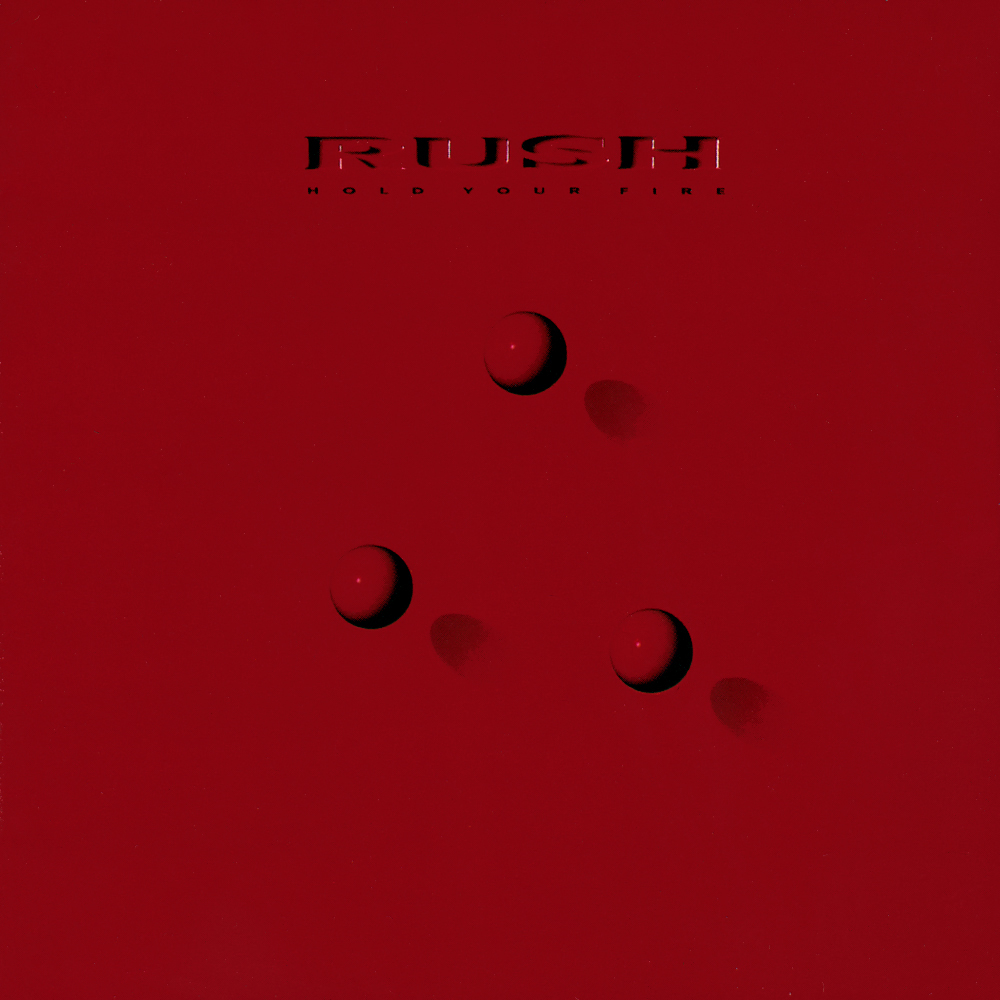
Which is my long-winded way of setting the stage for when I first encountered Hold Your Fire. The day before the official release date, I unpacked the box in which our store’s copies were packed, and gazed in admiration at the cover:
This was something unprecedented in Rush album cover art – instead of a meticulously detailed Hugh Syme painting containing visual puns, there were just three red spheres suspended over a red background. The obvious conclusion was that Alex, Geddy, and Neil were now reduced to the simplest, most perfect solid in geometry – polished and ready to bounce off of each other like billiard balls. Visually, at least, Hold Your Fire was sleek and minimalist. Peter Collins, who produced Power Windows, was back in the saddle, which boded well. I couldn’t wait to hear the music.
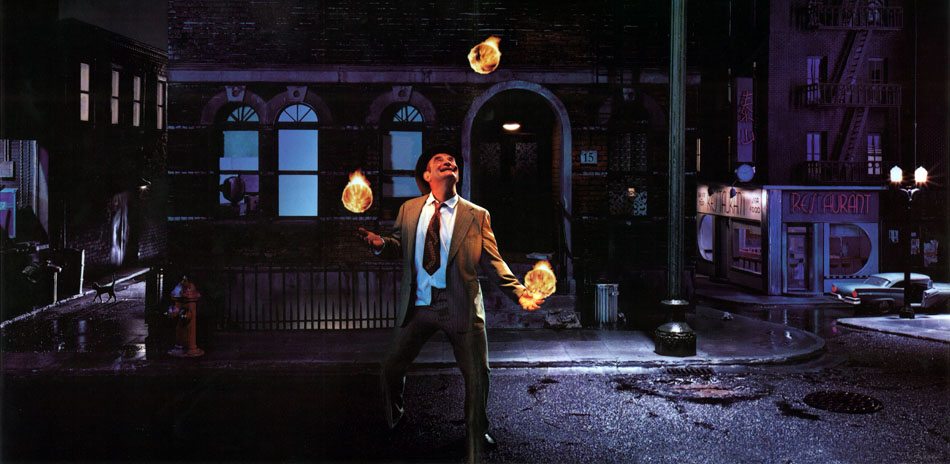
Inside the booklet, there was a spread that was more like what Rush fans expected: a man juggled three flaming balls (hold your fire, indeed), the building behind him vaguely resembled the façade in the Moving Pictures cover, in one of the windows you could make out the three vintage television sets from Power Windows, on the sidewalk stood the red fire hydrant from Signals, and the Chinese restaurant’s clock read 21:12 in military time (it turns out the restaurant’s sign reads Tai Shan, as well).
The first track, “Force Ten”, opens with a bone-rattling jackhammer and sampled choir, quickly followed by a straight-ahead drumbeat while the bassline leaps and bounds. Alex’s guitar is punk-like in its simplistic riffing – this is one of the most aggressive songs Rush has written up to this point in their career. Which makes the second track such a surprise. “Time Stand Still” features Aimee Mann, leader of the pop group ‘Til Tuesday, on vocals. Aimee Mann?? Once the shock of hearing someone besides Geddy sing on a Rush song, it’s clear this is actually a nicely constructed, interesting tune. Alex’s arpeggiated, brittle guitar sound is great in this context, and “Time Stand Still” stands the test of time as one of Rush’s most radio-friendly tunes. Neil’s wistful lyrics are very touching:
“Summer’s going fast- Nights growing colder Children growing up- Old friends growing older Experience slips away…”
“Open Secrets” is a bass/synthesizer dominated song with Alex providing some tasteful guitar filigrees as Geddy sings about how true communication is difficult between two people, due to their reluctance to be open and honest. As a matter of fact, the entire album’s theme is one of restraint. Where Power Windows was about power and the use of it, Hold Your Fire is about controlling that power – exercising restraint, in other words.
“Second Nature” begins with a nice keyboard riff, and slowly builds in intensity. Neil’s drums are excellent on this track, as he lends a touch of exotic rhythm to it. The song has a laconic pace to it, with lots of swirling synthesizer washes throughout.
Things definitely pick up in “Prime Mover”, which features some of Geddy’s finest bass work ever. In the same way New Order’s bassist Peter Hook often plays lead, Geddy carries this tune while Neil and Alex play over, under, and around him. This one of the strongest tracks on the album, and it benefits from a nice balance of keyboards vs. guitar/bass/drums.
“Lock and Key” was the first single off the album, and it’s a very good track. [Update: a Progarchy reader has informed me that “Force Ten” is actually the first single off of HYF. Thanks, Will!] Alex gets to rock out with some fat power chords and a fine solo, while Neil really shines on drums. This track will give your subwoofer a workout! The lyrics deal with how everyone keeps their “real” feelings under lock and key, in order to maintain civility:
“We don’t want to be victims On that we all agree So we lock up the killer instinct And throw away the key”
“Mission” contains the album title: “Hold your fire/Keep it burning bright/Hold the flame/’Til the flame ignites/A spirit with a vision/Is a dream with a mission.” Not one of my favorite tracks, but it is still an enjoyable listen.
“Turn the Page” is a whole ‘nother matter, though! This song is one of the best Alex, Geddy, and Neil have ever recorded. An unaccompanied bass riff starts things off, until Alex enters with some slashing guitar, and Neil lays down a rapid pulse. When the chorus begins, there is an atmosphere of time being suspended as Neil hits every other beat, then suddenly kicks it into overdrive with his patented bass pedal and cross-rhythmic work. After Alex’s solo, a stomach-churning bass synth explodes (at the 3:43 mark), and there is a mad dash to the end.
“Tai Shan” is an oddity – it has a too-obvious Asian influence musically, and the lyrics concern a fabled mountain in China where supposedly you are granted long life if you reach the top and raise your arms. It doesn’t exactly fit the tone of the rest of the album, though.
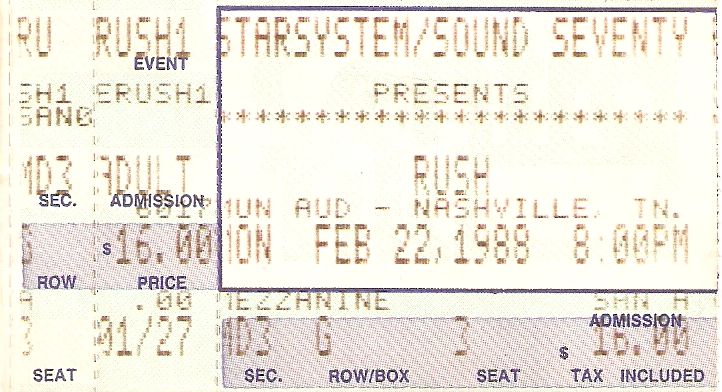
“High Water” closes things out on a relatively subdued note. A fitting conclusion to an album full of dynamic contrasts. By 1987, compact discs had become popular enough that Geddy, Alex, and Neil no longer felt constrained by vinyl’s time limitations. Hence, Hold Your Fire clocks in at a generous 50:30 minutes. It was followed by their third live album, A Show Of Hands. The DVD of that album is available as part of the Replay set, and it is an excellent summary of Rush’s “Synthesizer Period”. The Hold Your Fire tour was the first time I saw Rush live, so it holds a special place in my journey with Rush. After A Show Of Hands, Rush left their longtime label, Mercury, and signed to Atlantic. They eventually scaled back the keyboards, and returned to a more guitar-based sound. Hold Your Fire was the culmination of elements they had been developing since Signals, and they wisely stepped back from going down a synth-heavy pop/rock path.
Do I believe Hold Your Fire to be Rush’s finest album? No, I give that honor to Permanent Waves. However, I don’t think Hold Your Fire has ever gotten the respect it deserves. Rush plays relatively few songs from it on their tours, and it peaked at #13 on the charts when it was released. If listened to in conjunction with Power Windows, it completes what that album began. Enough time has passed to listen to it with fresh ears, and we can appreciate it for what it is: a successful attempt to craft a radio-friendly album filled with accessible songs. Sometimes you just have to have some fun!
* For our younger readers, a cutout was an Lp that the label deeply discounted because the title was overstocked. The label would cut a notch in the cover, and stores would sell it for 70% – 80% off the retail price.
“Turn The Page”, from A Show Of Hands:
[Ed. note–Tad’s is the first in a series of posts celebrating the fortieth anniversary of our beloved Rush]
Well, at least we know Neil is
thinking
about new lyrical ideas. He says in the
first part
of his two-part article on drum soloing for
Rhythm
magazine that last October, two months after the
Clockwork Angels
tour ended, he was driving up to the Drum Workshop outside Los Angeles to play around on some new shells the company had produced when some lyrics popped into his head. “I . . . laughed at myself for having a
lyrical
idea,” he says. “‘You’re not supposed to be doing that yet!’)”
Whatever the band ends up doing, it’ll have to wait until after its 41st anniversary your next year, which Alex has said will likely showcase some of Rush’s “rarer” songs.
In any case, Neil’s two-part article is a walk-through of how he composed his solos for the Clockwork Angels tour. Nick Raskulinecz wanted him to key his solo off the…
My good friend Steve Horwitz just sent me a link to this article from the American libertarian magazine, REASON. Enjoy.
In 1977, I bought my first Rush album. I was 13. The title of the disc was 2112, and the foldout jacket had a very cool and ominous red star on the cover. As soon as I got it home from the store, I carefully placed that vinyl record onto the felt-padded turntable of my parents’ old Motorola console stereo.
The moment I dropped that stylus, and that needle caught the groove, I became obsessed with Rush like only thirteen-year-old boys can get obsessed. I turned up the volume as loud as I thought I could get away with, and I rocked.
Arjan Lucassen has just released the following on Facebook:
Time has come to finally disclose my new project… it will be a collaboration between my favorite female singer Anneke van Giersbergen and me! Expect an epic concept double album, a combination of ‘classical meets metal’ and ‘acoustic folk’. More details later!
A progarchist take: God bless the Dutch. Yes!!!!!!!!!!!!!!!!!!!!!!!!!!!!!!!!!!!!!!
Andy Tillison continues to be brilliant. Homage to Tangerine Dream.
As Andy describes it:
Andy Tillison (Keyboards) and Luke Machin (Guitar) of THE TANGENT rehearse their Berlin School Electronica section of the Tangent’s set for the forthcoming European Mini Tour in May/June 2014. The tour features the two full progressive rock bands The Tangent and Karmakanic including members of Maschine, The Flower Kings and in London the band will be joined by Theo Travis, longtime associate of Tangent and currently the wind player with the Steven Wilson Band. All tour dates can be found at the Tangent website http://www.thetangent.org.
This piece was recorded by Andy in Yorkshire, England in one take and similarly by Luke Machin in Brighton, England using an internet link. The music is all live with no overdubs from either musician. There are two parallel 4 note sequencers running for the duration of the song in the same way as Tangerine Dream would have used analogue step sequencers. This piece features the (currently) new Roland FA-06 workstation which is responsible for all the keyboard sounds you hear (minus the ebow guitar patch and the Mellotrons) – regardless of which keyboard appears to be being played. The laptop computer in the video is creating these other sounds and the large desktop computer is only switched on because it happened to be switched on. It’s not doing anything. The arpeggios are generated by the FA-06.




 Progarchy