
soundstreamsunday #85: “Oil on Panel” by Wovenhand
 Like Robin Pecknold of Fleet Foxes — last week’s soundstreamsunday entry — David Eugene Edwards brings to American folk, rock, and country an utterly unique, instantly recognizable voice. Unlike Pecknold, Edwards toils in relative obscurity, which is a shame, as for the last 20 years he’s brought a wide-eyed intelligence to songs extending darker traditional themes, shimmering with christian imagery, to bracing goth soundscapes. While you could make favorable comparison of Edwards’ bands, Denver’s 16 Horsepower and Wovenhand, to Nick Cave’s Bad Seeds, the better starting point, should we need it, might be Cormac McCarthy’s Blood Meridian, or perhaps the old testament. Or Carravagio. With a voice both commanding and vulnerable, Edwards brings to his arrangements sonic chiaroscuro, breathing life, momentum, and dimension across acoustic and electric instrumentation tuned to his songs’ subjects. Compositionally, he is a painter looking, I think, for balance, perhaps reflecting his relationship with his faith.
“Oil on Panel” is from Wovenhand’s third album, 2004’s Consider the Birds. Referencing the act of painting, three of the deadly sins, Roma, and Yeshua, the song captures the direction Wovenhand was charting as it set out in the early aughts, into-the-christian mystic, highly refined, mannered, powerful. With a windy, buzzy ambience overlayed with piano and distant strings, the song blossoms into near-orchestral grandeur halfway through, Edwards telling a story heavy with images invoking less a narrative than a feeling, of being unmoored, freighted with guilt but defined by faith. If the edges bleed it is not without purpose. “I paint them roughly, I paint them in my sleep.”
soundstreamsunday presents one song or live set by an artist each week, and in theory wants to be an infinite linear mix tape where the songs relate and progress as a whole. For the complete playlist, go here: soundstreamsunday archive and playlist, or check related articles by clicking on”soundstreamsunday” in the tags section.
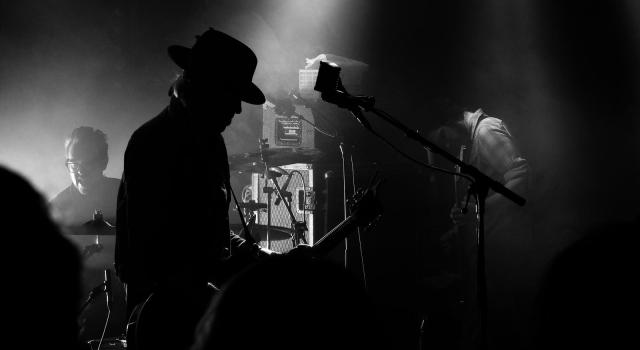
*Image of Wovenhand in concert by Colin Gentile, 2015.
Gandals Fist – Universal Wanderings revisited
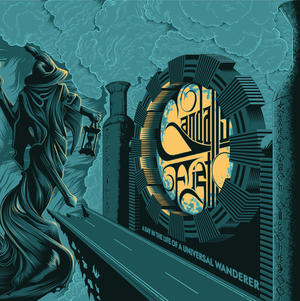
Well, not content with upping the ante last year with their triple disc magnum opus The Clockwork Fable (which to be honest is one of the finest albums ever made) and triumphantly headlining their own Fistival, the boys are giving us a bonus remastered Fisting with their remaster and re-tooling of their 2013 album A Day in the Life of a Universal Wanderer.
However, the Fist being the Fist never do things by half, so this see’s the album remastered, parts re-recorded, new linking narratives from Paddington’s Santa, Mark Benton (who also played a memorable part in The Clockwork Fable – oh, and Doctor Who) and the new track The Stowaway and the Fable, which according to the band, brings this release in line with the sonic template of 2014’s A Forest of Fey, and 2016’s a Clockwork Fable.
Now, for some artists chucking out a quick sneaky remaster of an album, scant years after it’s initial release could be seen as lazy, however having seen the care and attention the ‘Fist boys put into their work, this is more a case of taking that classic old car that’s been off the road for a year or two, putting in the hard yards and getting it race ready again.
The main difference between the original release (which I’ve not heard) and this new vision, is that since this was released drummer Stefan Hepe and bassist Chris Ewen were recruited to join the nucleus of the band Dean Marsh (guitars/keys/vocals) and Luke Severn (vocals/keys) and made their recorded debuts on the phenomenal A Forest of Fey (which was my first fisting).
It seems appropriate then to have the drum parts for Universal Wanderer re-recorded, with Stefan adding a his teutonic precision, giving it that mighty full Fist band sound that makes their latest releases so epic.
With Mark Benton providing linking narration, this pulls it right into the Fist family, and the mix of harder edged rock, full on epic space ballads, powerful epics, and tight coherent narrative this has all the hallmarks of a Fist classic.
Listening to the music here, and the plotting and way the songs lead the narrative, this could almost have been a dry run for The Clockwork Fable (and I have no doubt that somewhere in the fertile imagination of those Fist boys, this ties in somewhere with that and Forest of Fey).
They do like their harder edged sounds and epic tracks like the Nine Billion Names of God, and the new epic that has snuck it’s way here, or indeed like a pigeon found it’s way home ‘The Stowaway and the Endless Night, features some of their heavier sounds, impressive guitar riffing and a fab hard edge.
This subtle blend of light and dark works with tracks like Orphans of the Sky, and long term Fist associate Melissa Hollick provides superb vocals on here and forms part of that mighty Fist sound.
The concept here is around The Universal Wanderer a 26th Century mythical figure who has wandered the Universe since the dawn of time, I wonder if he’s ever bumped into someone similar who happens to fly round in a blue Police Box, I bet they have plenty of things to chat about at the Restaurant at the End of the Universe.
And having wandered the Universe the Fist have certainly got plenty of diverse musical sounds that they weave together to create a coherent whole, the wonderful Battle for Tannhauser Gate with William Stewarts violin duelling with the guitars, is a fab slice of folk rock prog, with another superb duet and pulls more strands of the story together.
In fact the album is as much as rich musical tapestry with the diverse genres and sounds, pulled together like a well made jumper, bringing the strands together to create a coherent whole, and one that is worth losing yourself in for an afternoon.
The closing The Wanderer Goes is the stitch that pulls those threads together, reprising the opening Nine Billion names of God, with a fantastically epic closing section, worthy of the name, bringing the album back full circle.
If you’ve never heard of Gandalfs Fist then it’s time you got fisted, and if you are familiar with them, and think you already have this album, according to the guys this is as different from the original as could be, reworked, retooled, remastered and reissued to give it a bigger place in the Universe.
Whatever you think of the bands name (and it has been described in certain quarters as a maarmite name, and I like it) Gandalfs Fist certainly are some of the most ambitious musicians when it comes for big concept albums and mighty sounds, and what is gratifying is that they have the musical chops and storytelling nous to pull it off with style and aplomb.
I look forward to where their fertile imagination plans on taking us next musically, whilst they ponder that in their secret Fist bunker where plots are plotted and albums are hatched, let us enjoy this story of a Universal wanderer and see where he takes us.
A day in the Life of a Universal Wanderer (Special Edition) is available now from
Kinetic Element, Live Fall 2017
Enjoy! Pure American prog.
Majesty and Decay
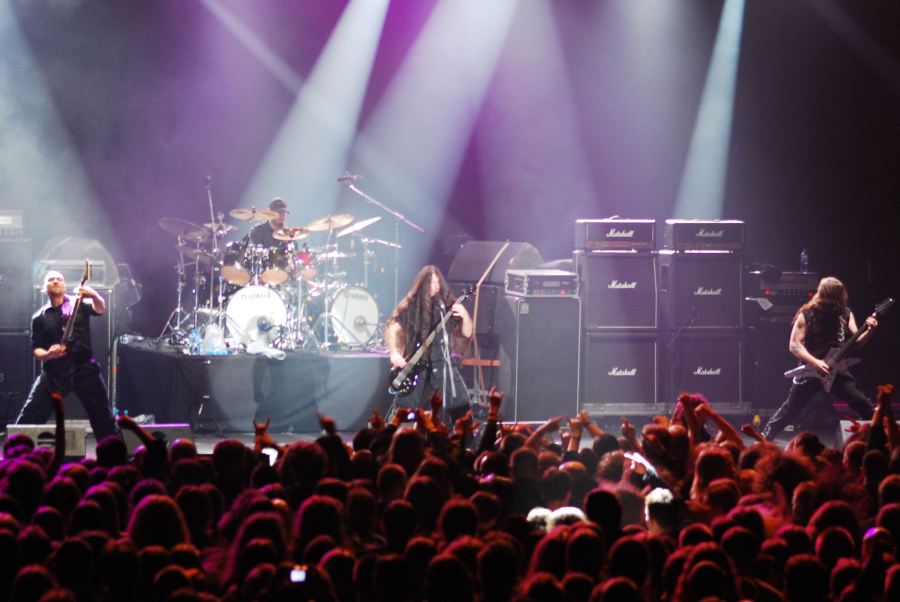
Study claims extreme music purges depression, in that case, Immolation should be among the most effective antidepressants. Emerging from the most fertile era in death metal, these New Yorkers effortlessly stood their own against Tampa and Stockholm scene’s invasion. A dose of bludgeoning drums, some excessively intricate guitar patterns, followed by sheer death metal growls – simply bulldozes depression and anything else in its path.
Immolation’s brand of dissonance is multifaceted; no other band rips your senses into such divergent paths. In other words, response to this imposing symphony can be – a still veneration, an accepting nod, or just violent moshing – depends solely on the listener’s filter. More crucially, this near deathly experience can be at times overwhelming – crossing those boundaries from being a mere antidepressant, and moving straight into the territory of ecstasy – illegal.
By commons: Lilly Mpl.wiki: Lilly Mreal name: Małgorzata Miłaszewska (Own work) [GFDL or CC BY 3.0], via Wikimedia Commons
Hometown homage: “I hate Winnipeg” @theweakerthans

Recent musings on commercial imperatives and hometown architecture:
“I hate Winnipeg,” sings the ironic refrain of the song One Great City! by Winnipeg indie band The Weakerthans.
In the last verse of the song, an “arcing wrecking ball” delivers the brutal sentiment on behalf of “our Golden Business Boy,” who “up above us all, leaning into sky,” tells a pious lie (“I love this town”) as he watches “the North End die.”
The lyrics refer to the statue gazing northward on the dome of the Manitoba Legislative Building. Popularly known as the Golden Boy, the “Eternal Youth” (his official name) surveys the architecture of Winnipeg.
In the poetic lyrics of The Weakerthans’ John K. Samson, the statue symbolizes the commercial imperatives of secular culture. Money and power rule the city, extracting profit from the weak.
The genius of the song consists in its many ironic contrasts between words and deeds. For example, money and power demolish the past, proclaiming love for “one great city” (on Winnipeg’s highway welcome signs) at the same time as they wreck it for further profit.
On the other hand, a humble artist writes a tune repeating, “I hate Winnipeg.” Yet with its wistful music and poignant storytelling, the song communicates his real love of home.
…
I feel how the example of sacred architecture, in the midst of a crude and rapacious secular culture, can instead cultivate for humans a real and lasting sense of home.
Without such beautiful architecture, utilitarian commercial interests will define the landscape of one’s hometown. The ugly skyline created by such cruel economic motivations contrasts ironically with real humans, whose nature will always seek to love the place where they live, just as The Weakerthans observe in their song:
And in the dollar store
The clerk is closing up
And counting loonies, trying not to say
I hate Winnipeg.


Bruford: Seems Like a Lifetime Ago, 1977-1980 — A Review
by Rick Krueger
I think it’s fair to say that this 8-disc set is going to be my reissue of the year. It’s pure delight from first to last, covering three brilliant studio albums, two distinct live sets (one previously unreleased) and a fascinating batch of rough-draft outtakes — all spearheaded by paradigmatic progressive rock drummer Bill Bruford.
Continue reading “Bruford: Seems Like a Lifetime Ago, 1977-1980 — A Review”
Jerry Ewing’s WONDROUS STORIES
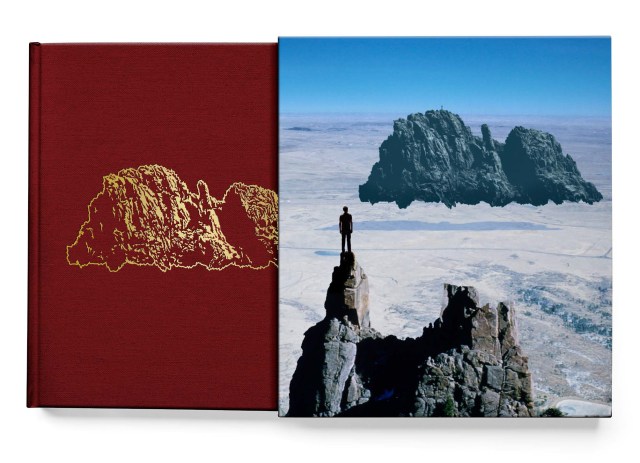
The price is a bit steep for those of us in North America, but Jerry Ewing’s latest book (out in December) looks quite gorgeous.
https://burningshed.com/jerry-ewing_wonderous-stories_book?filter_tag=jerry%20ewing
Concert Review: Dweezil Zappa (Zappa Plays Zappa) @ The Tower Theater, Fresno CA 05/03/17


Better late than never. I apologize for the delay in posting, but 2017 has been very eventful for me.
The first Frank Zappa song I ever head was “Don’t Eat The Yellow Snow.” I was attending college at the time and broadening my musical horizons. This introduction to the Zappa Universe was thanks to a certain infamous file sharing program. The first time I heard this bizarre, hysterical and musically acrobatic “song,” I think I stared at my computer screen and blinked, not knowing what the hell just happened. I dove into this music thanks to the likes of Steve Vai, Warren Cuccurullo and Dream Theater. And any song that begins with “Dreamed I was an Eskimo” had to be crazy special and deviously clever. It was, and it was merely a preview of the eccentric brilliance that was out there in the Zappa catalogue. Several purchases later and a couple chance encounters with Mike Keneally and Steve Vai (a Martin Guitar Clinic and NAMM appearance), I found myself itching to somehow experience Zappa’s music in a live setting. Behold, Zappa Plays Zappa is born, brainchild of Dweezil Zappa.
This leg of the tour was in part a celebration of the Freak Out! album and entitled “50 Years of Frank: Dweezil Zappa Plays Whatever the F@%k He Wants – The Cease and Desist Tour.” The name of the tour is a response to the trademark dispute that has occurred between Dweezil Zappa and the Zappa Family Trust (Ahmet Zappa/Executor). The trust ordered that Dweezil cease using the “Zappa Plays Zappa” moniker and to cease using images of his father, Frank Zappa, on all merchandizing. The details of this dispute can be found elsewhere and it’s a very sad read. Frank Zappa passed away in 1993 and left a mountain of a musical legacy behind. He was regarded as a genius, an avant-garde innovator that was never afraid to break the rules. He was also one hell of a guitar player. Dweezil Zappa has carried on this legacy by presenting the music of Frank Zappa at his live shows. It is only fitting that Dweezil, an accomplished guitarist in his own right, honor that heritage and with stellar musicians, many of whom were part of incarnations of Frank’s touring bands. For this touring cycle, the group would present selections including songs from Freak Out!, the debut album by The Mothers of Invention, Frank Zappa’s first rock combo.
The Freak Out! tracks are the wackiest, and yet some of the most brilliant music pieces you’ll ever experience. It didn’t sound like anything that was around at the time and still doesn’t sound like anything that’s out now. It’s freaky, complex, intricate, fun, jazzy, zany, it grooves, it boogies, it rocks, it sways, and it’s just one giant amalgamation of bizarre sound and eccentric brilliance. The vocals dart from spoken word narration, to lounge singing, to doo-wop, to soulful crooning, and on and on and on. It’s madness. But there’s something amazingly entertaining and musical about it. Only a certain breed of power musicians can pull off this crazy, impossible to play music with heart AND expert precision. The current line-up is no exception. They’re like musical super heroes. The Zappa musicians have always been untouchable players and unusual characters: Odd, weird, funky, freaky, cool, but above all…freaking geniuses. And at the core of this line up is a mellow and low-key guitarist in jeans and a black V-neck, armed with a gentle smile and a Gibson SG. There’s a calmness and serenity to Dweezil when he’s onstage, it’s spellbinding watching him, seeing him lay down his parts with nurturing care, then seeing how he glances over at his bandmates with equal parts pride and a quiet joy.


Zappa Plays Zappa is no stranger to Fresno. Fortunately for us, the group has performed in this area once or twice previously. Kudos to the group and booking agents for not forsaking our little neck of the woods. From the moment the group came onstage we knew we were in for an unmatched experience, variety and virtuosity. From the netherworldly bounce of “Transylvania Boogie,” to the vocal hilarity and madness of “It Can’t Happen Here,” the soulful “How Could I Be Such a Fool?” to the creepy waltz of “Who Are the Brain Police?,” it was an insanely wild roller coaster ride. During a pause, many in the audience began shouting song titles. Someone shouted “Watermelon!” Dweezil with a playful smirk said something like “Requests? You’ know what we’re gonna do?…We’re gonna stick to the fucking setlist, that’s what we’re gonna do,” and with a smile he and the group powered on. David Luther on lead vocals, guitar, keys, and bary sax, was an eerily perfect match for this group. That deep voice is a striking resemblance to Ike Willis, Napoleon Murphy Brock and Frank Zappa’s vocal style. “It Can’t Happen Here” is a great example of that zany vocal delivery. “What Will This Evening Bring Me This Morning?” saw vocalists Cian Coey and Scheila Gonzalez harmonize and sing the hell out of that song. It was an exercise in power soul. The set had transitioned from Freak Out! era tracks to 200 Motels. And then the band reduced itself to a power trio, with Dweezil, Ryan Brown and Kurt Morgan ripping into a bitchin’ version of “Apostrophe,” the title track of the same album. You could feel and hear the great Jim Gordon and Jack Bruce in their playing. Bassist, Kurt Morgan, was awesome to watch. His facial expressions, nonverbals, mannerisms, his movements onstage. The way he curled his lips and bobbed his head when he locked into a tight, thunderous groove. And damn, no one, I mean NO ONE can rock cargo shorts and orange socks like that man. Throughout the concert, Kurt was playing insane bass parts, singing backgrounds, AND having an incredibly euphoric time while doing it. You could see the musical joy on that man’s face. And the way he played that bass during “Apostrophe,” I’m amazed those strings didn’t fuse onto the fretboard with all the kinetic energy and heat going on. About drumming power-house Ryan Brown, wow, everyone in this group has a legacy of big shoes to fill. The drummers in all the Zappa groups have always had the distinction of being an “it” guy, drummer’s drummers. One has to continue a legacy built upon and including Jimmy Carl Black, Ansley Dunbar, Vinnie Colaiuta, Terry Bozzio, Ed Mann, Chester Thompson, Chad Wackerman and Joe Travers. Bottom line, the drummer had better be a bad ass drummer. Ryan was able to easily channel the spirits of all the Zappa alums that came before him, and laid down a kicking groove while keeping all the intricacies and nuances needed to pull off those complex parts. And then there’s the striking Scheila Gonzalez, who can’t be a real person.She has to be some kind of musical virtuoso android fem-bot sent from the future. She’s an accomplished, award winning multi-instrumentalist, able to play flute, sax, keys, and sing like her life depended on it. She possesses a powerful voice, husky and throaty, and it gels well with Cian Coey’s raspy yet soulful diva vocals. Main keyboard player and violinist Chris Norton brought it all together, gluing the group together and anchoring it with complex leads and great background singing as well. KILLER line-up. At one point during the set, Dweezil made reference to these songs, the bizarre qualities of the music and how it all must have freaked out parents in the 60s. Dweezil expressed “This isn’t music from the past, it’s music from the future. We just haven’t caught up with it yet.” The group continued to faithfully execute pieces like “Inca Roads,” “Zomby Woof,” “Doreen/You Are What You Is,” “Keep It Greasy,” “Packard Goose,” and of course the lovely and tender closer to Joe’s Garage (and my biggest reason for attending this concert), “Watermelon in Easter Hay.” It gently murmurs its way into the world, delicate and dreamy, with a guitar tone that borders between space rock and surf rock (think of Santo and Johnny’s “Sleepwalk”). I have this deeply sentimental connection to that song. When I think of that melody, I think of my young kids, and snapshots of the joy and color of their growing up comes to mind, I’m not sure why. The song is regarded by many, including Dweezil, as Frank Zappa’s greatest guitar solo. There are several videos showing a composed yet emotional Dweezil Zappa, performing that song with great care and reverence as tears roll down his face. I think this Fresno gig had him just as nostalgic. Side note: Duran Duran performed a version of this song during a 1994 New York City concert, with Warren Cuccurullo on guitar (a Zappa alumnus, kind of young, kind of wow). The show continued with encores and the final closer, “Muffin Man.” This was an insanely great concert, performed by master musicians. It deepened my appreciation for Zappa’s brand of weird but devastatingly awesome music. I’m so fortunate I was able to see these guys close to home. If you have even the slightest inclination to go see this group, please do, you won’t regret it. Just watch out where the huskies go.


BARRY WEINBERG Launches “Beyond the Astral Sky” Single

South Florida based musician and songwriter Barry Weinberg is set to launch his Prog Rock influenced album Samsarana in January 2018, but the musician is today announcing the imminent release of the first single.
The single, “Beyond the Astral Sky,” is an anthem, gorgeous track with soaring vocals. The song is the first in the series of singles taken from Samsarana, a release that sees the musician exploring through a number of styles evolving around Prog Rock.
About “Beyond the Astral Sky” Weinberg says: “This song is very personal to me and actually one of the first songs I had ever written for the album. For years, this was purely a classical guitar piece with lyrics that I would play on my acoustic, but as I started to record it, I started experimenting with electric leads over the acoustic phrases and vocals and it evolved into what it is today.”
Lyrically “Beyond the Astral Sky” is about hope in the face of despair. As Weinberg explains:
“It’s about that experience when you look around yourself, your life and the world you’re in, and get overwhelmed by the chaos, destruction, darkness, confusion, stress, hardship… and yet, in that moment of utter despair, you can look up at a star or into a child’s eyes, and although surrounded by darkness, you can begin envisioning a different world, a different life, a different future that’s inspiring, joyful, empowering. This is how we make change in our lives. This is how we make change in the world. Acknowledging and owning the darkest parts of ourselves and our lives that we hate and shifting our attention to a new intention, our ideal, our vision. It’s the light dot in the center of the dark part of the Taoist yin/yang symbol. This is where I was at when I wrote this song and this where the main ‘character’ is at in the story of ‘Samsarana.’”
For more info visit Barry Weinberg’s official website.
Other links:
 Progarchy
