Avenged Sevenfold Cover “Wish You Were Here”

This is a pretty remarkable cover of Pink Floyd’s “Wish You Were Here.” I presume Avenged Sevenfold chose to do this as a tribute to their late drummer, Jimmy “The Rev” Sullivan. It seems the band move ever closer to progressive rock – Prog magazine even did a spread on them earlier this year.

Hunted

Black Sabbath, Iron Maiden and the remaining doom metal bells and whistles are obvious. But, Khemmis goes further, and shapes a melody built on mystical and sorrowful passages. Every aspect, including the distressing vocals is tailored to accentuate these very qualities.

Doom metal is a constrained and a well explored area populated with numerous Scandinavian and North American greats. In the past 30-40 years, they have managed to excavate all the darkest corners in this genre. But, Khemmis, quite confidently introduce sharp magical qualities to these stagnant waters. With an equally engaging Artwork, Hunted makes a compelling case for a brand new variant of old school doom.

By Benjamin Hutcherson (Own work) [CC BY-SA 4.0], via Wikimedia Commons

Unforgettable Vinyl Gatefold Moments @rushtheband

Moments you will never forget… listening to Rush, A Farewell to Kings, for the first time.

What’s The Buzz About General Fuzz?

As I’ve gotten older, I find myself enjoying instrumental/ambient/space music more and more. These chaotic and ever-accelerating times lend themselves to a musical genre that encourages reflection and relaxation.

In earlier posts, I brought to our faithful readers’ attention the wonderful music of Kevin Keller and CFCF. In this one, I want to showcase another outstanding artist working in the “Downtempo” realm of music: General Fuzz. The musical brainchild of composer James Kirsch, General Fuzz has released 7 albums, and you can download them all for free (yes, FREE. He explains the motives behind his generosity here) at his website. I started at the beginning with 2002’s eponymous General Fuzz album, and I’m slowly working my way through to his latest, 2014’s Oughta See. The problem is, every album is such a beautiful gem of contemplative melodies that I can’t leave one for the next. However, if your curiosity is piqued and don’t know where to start, let me suggest checking out Kirsch’s 2008 masterpiece, Soulful Filling. Here’s my favorite track from that collection:

Kirsch’s music is carefully constructed to seduce the listener with perfectly arranged musical miniatures that avoid being saccharine. In other words, I was immediately attracted to his music, I have listened to it repeatedly, and I have yet to tire of it. I keep finding new and delightful details in each hearing. Here’s how he explains it in his own words:

Unless your music is simple and poppy, or incredibly accessible, most people won’t be able to make sense of it on first listen, and consequently not return for a second listen. I can not approach my own music with fresh ears – I’m intimate with every second of it. It’s great to have someone who’s not a huge music fan listen to my music before I release it to gauge how most people will receive it. It has previously helped shape the ordering of  tracks on an album. Accessible music will always be more popular than complex music.

I’ve learned that it often takes many listens for people to start really enjoying my music. My favorite story is of a co-worker who’s cd player broke with my cd in it, so they had to listen to it all day on repeat. The next day he told me never to stop writing music.

James Kirsch is attempting something courageous in these days of a collapsing music industry: he is producing extraordinary music and giving it away – trusting that those who “get it” and enjoy it will respond with donations. I hope his experiment is successful – we need more composers of his caliber thriving in today’s music scene.

soundstreamsunday #85: “Oil on Panel” by Wovenhand

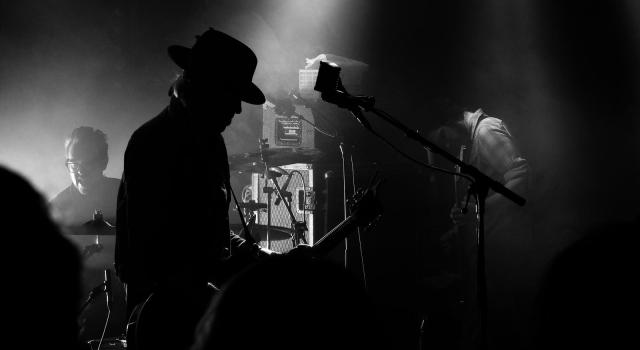
wovenhandconcertLike Robin Pecknold of Fleet Foxes — last week’s soundstreamsunday entry — David Eugene Edwards brings to American folk, rock, and country an utterly unique, instantly recognizable voice.  Unlike Pecknold, Edwards toils in relative obscurity, which is a shame, as for the last 20 years he’s brought a wide-eyed intelligence to songs extending darker traditional themes, shimmering with christian imagery, to bracing goth soundscapes.  While you could make favorable comparison of Edwards’ bands, Denver’s 16 Horsepower and Wovenhand, to Nick Cave’s Bad Seeds, the better starting point, should we need it, might be Cormac McCarthy’s Blood Meridian, or perhaps the old testament.  Or Carravagio.  With a voice both commanding and vulnerable, Edwards brings to his arrangements sonic chiaroscuro, breathing life, momentum, and dimension across acoustic and electric instrumentation tuned to his songs’ subjects.  Compositionally, he is a painter looking, I think, for balance, perhaps reflecting his relationship with his faith.

“Oil on Panel” is from Wovenhand’s third album, 2004’s Consider the Birds.  Referencing the act of painting, three of the deadly sins, Roma, and Yeshua, the song captures the direction Wovenhand was charting as it set out in the early aughts, into-the-christian mystic, highly refined, mannered, powerful.  With a windy, buzzy ambience overlayed with piano and distant strings, the song blossoms into near-orchestral grandeur halfway through, Edwards telling a story heavy with images invoking less a narrative than a feeling, of being unmoored, freighted with guilt but defined by faith.  If the edges bleed it is not without purpose.  “I paint them roughly, I paint them in my sleep.”

soundstreamsunday presents one song or live set by an artist each week, and in theory wants to be an infinite linear mix tape where the songs relate and progress as a whole. For the complete playlist, go here: soundstreamsunday archive and playlist, or check related articles by clicking on”soundstreamsunday” in the tags section.

*Image of Wovenhand in concert by Colin Gentile, 2015.

Gandals Fist – Universal Wanderings revisited

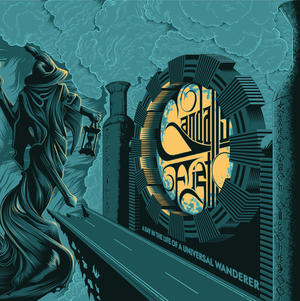
frontcover-wanderer-reissue

Well, not content with upping the ante last year with their triple disc magnum opus The Clockwork Fable (which to be honest is one of the finest albums ever made) and triumphantly headlining their own Fistival, the boys are giving us a bonus remastered Fisting with their remaster and re-tooling of their 2013 album A Day in the Life of a Universal Wanderer.

However, the Fist being the Fist never do things by half, so this see’s the album remastered, parts re-recorded, new linking narratives from Paddington’s Santa, Mark Benton (who also played a memorable part in The Clockwork Fable – oh, and Doctor Who) and the new track The Stowaway and the Fable, which according to the band, brings this release in line with the sonic template of 2014’s A Forest of Fey, and 2016’s a Clockwork Fable.

Now, for some artists chucking out a quick sneaky remaster of an album, scant years after it’s initial release could be seen as lazy, however having seen the care and attention the ‘Fist boys put into their work, this is more a case of taking that classic old car that’s been off the road for a year or two, putting in the hard yards and getting it race ready again.

The main difference between the original release (which I’ve not heard) and this new vision, is that since this was released drummer Stefan Hepe and bassist Chris Ewen were recruited to join the nucleus of the band Dean Marsh (guitars/keys/vocals) and Luke Severn (vocals/keys) and made their recorded debuts on the phenomenal A Forest of Fey (which was my first fisting).

It seems appropriate then to have the drum parts for Universal Wanderer re-recorded, with Stefan adding a his teutonic precision, giving it that mighty full Fist band sound that makes their latest releases so epic.

With Mark Benton providing linking narration, this pulls it right into the Fist family, and the mix of harder edged rock, full on epic space ballads, powerful epics, and tight coherent narrative this has all the hallmarks of a Fist classic.

Listening to the music here, and the plotting and way the songs lead the narrative, this could almost have been a dry run for The Clockwork Fable (and I have no doubt that somewhere in the fertile imagination of those Fist boys, this ties in somewhere with that and Forest of Fey).

They do like their harder edged sounds and epic tracks like the Nine Billion Names of God, and the new epic that has snuck it’s way here, or indeed like a pigeon found it’s way home ‘The Stowaway and the Endless Night, features some of their heavier sounds, impressive guitar riffing and a fab hard edge.

This subtle blend of light and dark works with tracks like Orphans of the Sky, and long term Fist associate Melissa Hollick provides superb vocals on here and forms part of that mighty Fist sound.

The concept here is around The Universal Wanderer a 26th Century mythical figure who has wandered the Universe since the dawn of time, I wonder if he’s ever bumped into someone similar who happens to fly round in a blue Police Box, I bet they have plenty of things to chat about at the Restaurant at the End of the Universe.

And having wandered the Universe the Fist have certainly got plenty of diverse musical sounds that they weave together to create a coherent whole, the wonderful Battle for Tannhauser Gate with William Stewarts violin duelling with the guitars, is a fab slice of folk rock prog, with another superb duet and pulls more strands of the story together.

In fact the album is as much as rich musical tapestry with the diverse genres and sounds, pulled together like a well made jumper, bringing the strands together to create a coherent whole, and one that is worth losing yourself in for an afternoon.

The closing The Wanderer Goes is the stitch that pulls those threads together, reprising the opening Nine Billion names of God, with a fantastically epic closing section, worthy of the name, bringing the album back full circle.

If you’ve never heard of Gandalfs Fist then it’s time you got fisted, and if you are familiar with them, and think you already have this album, according to the guys this is as different from the original as could be, reworked, retooled, remastered and reissued to give it a bigger place in the Universe.

Whatever you think of the bands name (and it has been described in certain quarters as a maarmite name, and  I like it) Gandalfs Fist certainly are some of the most ambitious musicians when it comes for big concept albums and mighty sounds, and what is gratifying is that they have the musical chops and storytelling nous to pull it off with style and aplomb.

I look forward to where their fertile imagination plans on taking us next musically, whilst they ponder that in their secret Fist bunker where plots are plotted and albums are hatched, let us enjoy this story of a Universal wanderer and see where he takes us.

A day in the Life of a Universal Wanderer (Special Edition) is available now from

https://www.gandalfsfist.com/store

Majesty and Decay

Study claims extreme music purges depression, in that case, Immolation should be among the most effective antidepressants. Emerging from the most fertile era in death metal, these New Yorkers effortlessly stood their own against Tampa and Stockholm scene’s invasion. A dose of bludgeoning drums, some excessively intricate guitar patterns, followed by sheer death metal growls – simply bulldozes depression and anything else in its path.

Immolation’s brand of dissonance is multifaceted; no other band rips your senses into such divergent paths. In other words, response to this imposing symphony can be – a still veneration, an accepting nod, or just violent moshing – depends solely on the listener’s filter. More crucially, this near deathly experience can be at times overwhelming – crossing those boundaries from being a mere antidepressant, and moving straight into the territory of ecstasy – illegal.

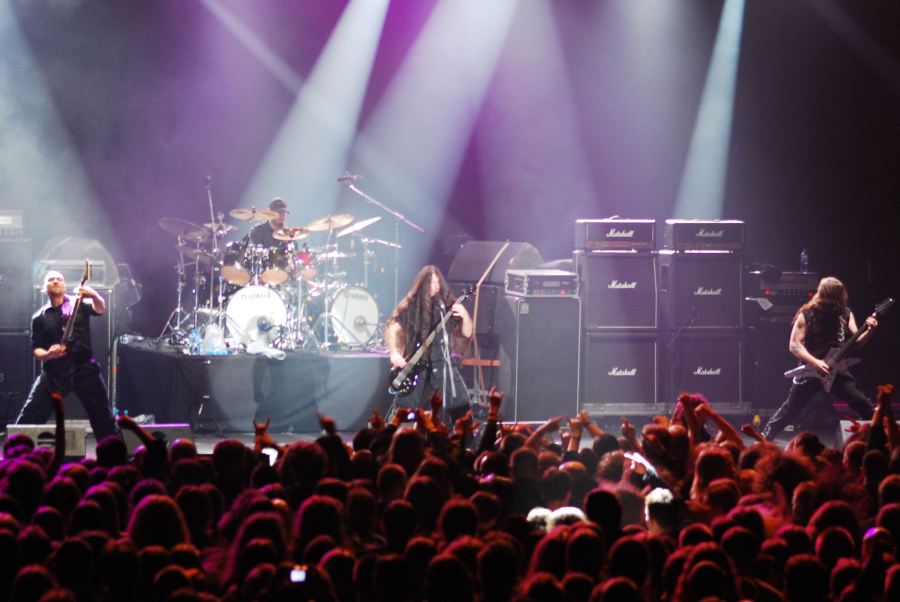
By commons: Lilly Mpl.wiki: Lilly Mreal name: Małgorzata Miłaszewska (Own work) [GFDL or CC BY 3.0], via Wikimedia Commons

Hometown homage: “I hate Winnipeg” @theweakerthans

Recent musings on commercial imperatives and hometown architecture:

“I hate Winnipeg,” sings the ironic refrain of the song One Great City! by Winnipeg indie band The Weakerthans.

In the last verse of the song, an “arcing wrecking ball” delivers the brutal sentiment on behalf of “our Golden Business Boy,” who “up above us all, leaning into sky,” tells a pious lie (“I love this town”) as he watches “the North End die.”

The lyrics refer to the statue gazing northward on the dome of the Manitoba Legislative Building. Popularly known as the Golden Boy, the “Eternal Youth” (his official name) surveys the architecture of Winnipeg.

In the poetic lyrics of The Weakerthans’ John K. Samson, the statue symbolizes the commercial imperatives of secular culture. Money and power rule the city, extracting profit from the weak.

The genius of the song consists in its many ironic contrasts between words and deeds. For example, money and power demolish the past, proclaiming love for “one great city” (on Winnipeg’s highway welcome signs) at the same time as they wreck it for further profit.

On the other hand, a humble artist writes a tune repeating, “I hate Winnipeg.” Yet with its wistful music and poignant storytelling, the song communicates his real love of home.

I feel how the example of sacred architecture, in the midst of a crude and rapacious secular culture, can instead cultivate for humans a real and lasting sense of home.

Without such beautiful architecture, utilitarian commercial interests will define the landscape of one’s hometown. The ugly skyline created by such cruel economic motivations contrasts ironically with real humans, whose nature will always seek to love the place where they live, just as The Weakerthans observe in their song:

And in the dollar store
The clerk is closing up
And counting loonies, trying not to say
I hate Winnipeg.