EEv2 Impressions

by Nick “Dr. Nick” Efford

If I’m honest, I was harbouring a secret wish for something rather different in tone from EE1: darker and more edgy, perhaps. Clearly, we don’t have that here – but it would be churlish to feel disappointment at getting more of the same, given the sublime nature of EE1. And there’s no doubt that Big Big Train have once again served up some wonderful music for us.

bbt ee2East Coast Racer is a suitably epic album opener that doesn’t quite gel for me yet. There are several parts to it that I really like but I’m struggling to find the thread linking them all together. It is growing on me with repeated listens but is giving up its secrets slowly!


No such issues with Swan Hunter, which is much simpler and more direct. The affection and nostalgia infusing this track makes it a natural companion piece to EE1’s Uncle Jack.  The obvious lyrical connection is that both Uncle Jack and Swan Hunter concern members of Dave Longdon’s family, but if you put to one side the lightness of the former and the more stately cadence of the latter then there are also some interesting melodic parallels to be found.  I’m not sure if this is deliberate or not, but it added something to the music for me.  All in all, a very pleasant piece, although not as memorable as the tracks that follow.

Worked Out is, I think, where this album truly sparks into life. The opening motif is pure pop and sounds like something Mike & The Mechanics might play, with Dave Longdon’s voice uncannily matching the timbre of Paul Carrack’s in places.  Then it switches into ‘prog wig-out’ mode, first with a flute-filled passage that would make Jethro Tull proud, then with a driving closing section featuring some brief but very welcome synth soloing. Absolutely splendid stuff.

Continue reading “EEv2 Impressions”

Pete Blum’s Open Letter to BBT

by Pete Blum

Dear BBT,

BBT EE2It feels as though it wants to be a “love letter” of a sort.  But it isn’t really there yet.  It’s not intensely passionate; it’s not yet full of those deep and personal codes that arise from having spent time as lovers or as the closest of friends.  It’s more like a very early and tentative venture, saying that I’ve been seeing and hearing you, I’ve been watching you and feeling the growth of some kind of friendship, but I wonder if it is (or could be) more.  I’m afraid, too.  Afraid of how you might respond, or even more afraid that you will not respond.  Afraid that if any blood flows into my words, you might miss it and find flattery alone, perhaps sprinkled with a spur here, a barb there, if that’s how you take some of it.  Do I dare ask for your patience when you don’t really know me?

Anyway, this is mainly about our third time “alone together,” as I truly tested that “together”:  It seems to have “tested positive” as the medical folk say.  I can’t refrain from this reaching out, from this speaking (though with a computer keyboard that may not be quite as clumsy as a voice).  It may be selfish on my part.  But isn’t it true that everything may be such, for all of us?

The Underfall Yard was where we first met, right after our mutual friend BB (no T) pointed you out to me with undisguised awe.  I heard, I believe, that at which his awe was aimed, or that which called to it.  Then the first installment of English Electric seemed to confirm it, in concert with some reaching back to earlier efforts.  You seemed so familiar, but also to move so easily and sensually beyond the familiar.  I was brought to an emotional dead halt by “A Boy in Darkness.”  I must confess, it had my attention locked in its cold embrace for days, haunting every other element of my everydayness.  I wrote a brief note about that before.

Continue reading “Pete Blum’s Open Letter to BBT”

So it Begins. . . Big Big Train, English Electric Vol. 2

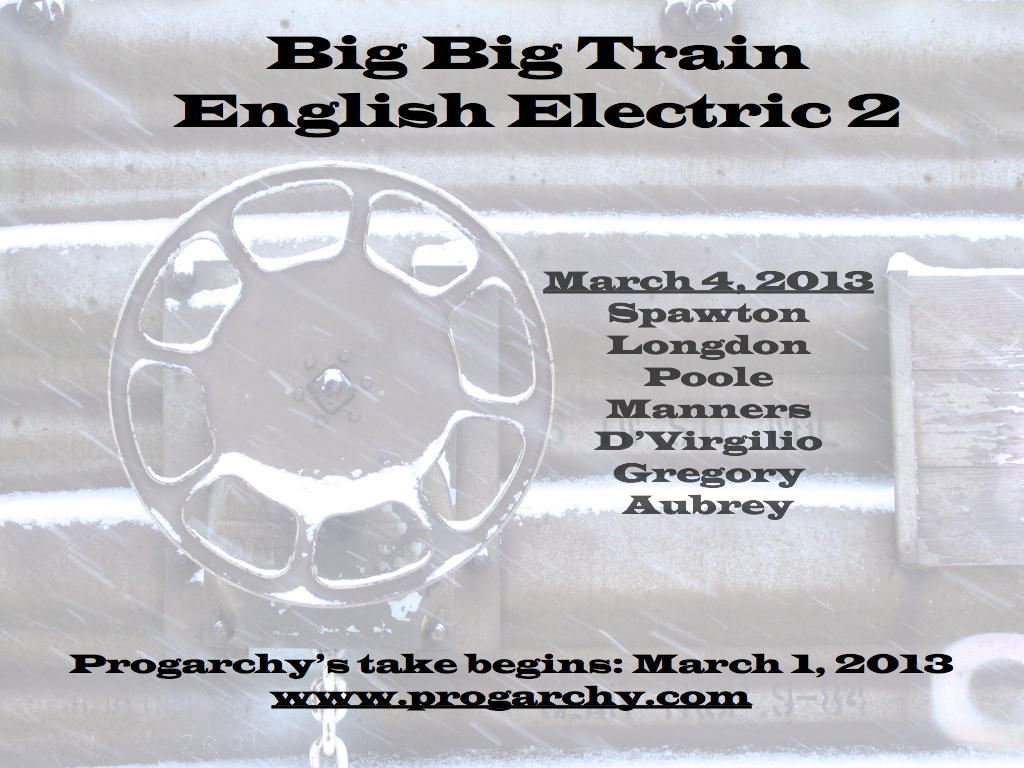
[And so it begins. . . the reviews of the latest release from Big Big Train, English Electric Vol. 2.  You can pre-order now, as the official release date is March 4, 2013.  BBT is already shipping.  Our Progarchists will be reviewing the new release intensively and extensively between today and March 4, 2013.  Indeed, let us declare the four days of BBT an official holiday of leisure, truth, and beauty in our little Republic of Progarchy–Brad, ed.]

***

ee2“English Electric Pt 2 – Pictures at an Exhibition”

by Alison Henderson

I like to think that listening to English Electric Pt 2 is like visiting a rather exclusive sonic picture exhibition.  You walk into the gallery and you are instantly surrounded by seven exquisite works of art, each with its own character, telling a different story, but somehow all inextricably linked. As the album begins to play, you are drawn to each of them individually, especially the detail and care that has been taken into bringing them to life and you are filled with admiration for their creators, and with awe for the effect they have on you.

East Coast Racer is a tour de force of the collection, big and certainly epic enough to cover a whole wall because of the detail and precision that has gone into its making.  At its centre, you see this legendary steam locomotive the Mallard taking shape through Danny Manners’ intricate piano lines that start and end the piece, introducing us to its sleek lines and curves, before it bursts out of the canvas at breakneck speed, David Longdon’s voice soulfully expressing the pride and passion felt by the men who crafted and engineered this beautiful mechanical masterpiece. Ever changing, ever evolving, this work shifts up and down the gears several times, the attention to detail paid through the painstaking instrumentation, adding texture to the Turneresque picture evolving in the music.

Continue reading “So it Begins. . . Big Big Train, English Electric Vol. 2”

Let the Reviews Begin! Tomorrow Begins Four Days re: Big Big Train’s latest, English Electric II

bbt ee2 roundtable 2.002

Brian Watson Exhibition: “The Lives of Brian”

373107_348071475308894_22985215_nDPRP.net prog reviewer extraordinaire, Brian Watson, will be exhibiting his art this Saturday, March 2, 2013, beginning at 10am.

The exhibition will be at The Old Grammar School Gallery in Otley (England).  If you live in the area, please support our friend and inspiration, Brian!

Record in a Bag

Hollerado’s new single is free from iTunes this week.

You’ll want to buy the whole album (Deluxe Version) of these upper-echelon Canuck indie rockers.

But be sure to download their previous bag of awesome tunes for free from their Web site: Record in a Bag.

O Canada!

Interact with RUSH live online today

RUSH.com

From WSJ.com: Today starting at 3:30 p.m. EST, Geddy Lee and Alex Lifeson of Rush will be answering fan questions LIVE.

Steven Wilson – The Raven That Refused To Sing (And Other Stories)

Steven Wilson’s journey as a solo artist from debut Insurgentes to his new release The Raven That Refused To Sing (And Other Stories) has been a fascinating one.  That first album has dark introspection and desolate beauty in equal measure.  Follow-up Grace For Drowning is a different beast, with more shades of light and dark to it and with a more expansive and organic feel. Raven puts that work into context as a transitional piece, for here Wilson’s vision seems, at last, to be fully realised.

The influences that shaped Grace – the improvisational aspects of jazz, and Wilson’s involvement in remixing King Crimson’s early work – are once again evident, but this release can boast greater coherence than Grace, due in part to its unifying ‘ghost stories’ theme. It also benefits from a rather different approach to production. Wilson is settled and comfortable enough with this group of musicians to gamble on live recording in preference to meticulous overdubbing, emulating the methods used on those 1970s prog masterpieces that he has been remixing so successfully. The gamble has paid off and the music frequently builds to a thrilling intensity as the players feed off of each other.  Having the legendary Alan Parsons at the controls is the icing on the cake, guaranteeing a recording of superb quality.

Luminol kicks off proceedings in a suitably explosive manner, with frenetic bass and percussion plus vocal harmonies that call to mind Tempus Fugit from the 1980 Yes album Drama. The pace and energy are high in the early and closing stages of this twelve-minute piece, with all players getting the chance to show what they can do, but it is perhaps Adam Holzman’s piano during the quieter middle section that impresses most.

The album really pivots around the twin epics of The Holy Drinker and The Watchmaker. Both are as good as anything Wilson has ever done. Drinker is moody, powerful and intense, the perfect showcase for the staggering virtuosity of the musicians that he has assembled as his band. Theo Travis particularly shines here. Watchmaker is more delicate in tone and really quite beautiful for the opening four minutes before opening out into some spectacular interplay between Guthrie Govan’s guitar and Travis’ saxophone. Piano, vocals and bass all take their turn at the front of the sound stage before a closing section laden with heavy power chords.

There are nods to Wilson’s other projects. Drive Home feels almost like a Porcupine Tree song before it expands into a closing section with a stunning Guthrie Govan guitar solo that quite simply takes the breath away.  The title track is sparse, mysterious and moving; it probably wouldn’t look out of place on Wilson’s recent Storm Corrosion collaboration with Opeth’s Mikael Åkerfeldt.

Verdict? Steven Wilson’s best work to date.

Gazpacho news

2008_gazpacho_6Gazpacho, one of my all-time favorite bands, posted this (below) today at FACEBOOK.  I assume they won’t mind me reposting it here at Progarchy–Brad, ed.

*****


Hi there and greeting from us lazybones. It has been a special year with happy and sad events as life thunders on. We can definitely confirm that we havent been.

However, being who we are, it has been very difficult to suspend the need to make more of our particular brand of music. Last album Mog was written in a frenzied weekend session where most of the original demos were kept and polished over the year it took to make the final album.

This time we set our standards much higher and as the months have gone by we have written about an hours worth of music which will be whittled down and added to over the year. We have committed to a concept album in the true meaning of the word and where our last four albums have been intended as films without pictures the new one feels a lot more like a novel. A novel written by a confused and crazy man but still a novel!

The ideas we are toying with are based around the concept of evil and its different shapes and incarnations. The malevolent force that mankind has dressed up as the will of God or the misdeeds of demons depending on the circumstance. Is it possible to catch the feel and the impact of this in music? Well we think so, and the demos are dark but strangely engaging.

Its still early days and as soon as we have a release date we’ll keep you posted.

Wish us luck!

Love
Gazpacho

Virtual liner notes for English Electric—Part 1

bigbigtrain

As a companion piece to my “liner notes” post on English Electric—Part 2, here is a compilation of some virtual “liner notes” that expand a bit more upon the ones that are already available at Big Big Train’s album page for English Electric—Part 1:

1. The First Rebreather is “the true story of a man called Alexander Lambert who dived heroically into the flooded Severn Tunnel in 1880. The navvies who built the tunnel and who were hard-drinking fearless chaps were terrified that the river would break in and drown them all. However, when the tunnel flooded, the water was found to be fresh rather than tidal. The navvies had, in fact, struck an immense underwater spring which flowed through a fault in the rock (they called it The Great Spring). Conventional diving equipment was used to try to close an iron door in the tunnel to hold the water back. The equipment failed due to the air-hose continually being snagged.
The tunnel engineer had heard of a man called Henry Fleuss who had developed an experimental diving apparatus called a Rebreather (in effect, it was the first aqua-lung.) Fleuss was persuaded to make an attempt on the tunnel but was so frightened that he turned back and said he would not return to the darkness ‘for £10,000 or more.’ The equipment was handed over to Diver Lambert who carried out a number of dives which involved swimming 1000ft up the flooded tunnel in complete darkness. Lambert, The First Rebreather, confronts his fear in the tunnel whilst the workmen await his return.
‘The first rebreather’ is a strange phrase which sounds almost super-heroic which, indeed, Lambert was.  So, I decided that, for the purposes of the song, The First Rebreather would be seen as a sort of superhuman creature come to save the navvies from the Great Spring.
Lambert would, of course, have looked very odd in his diving gear and, to the superstitious men, I’ve imagined that he would have looked like a Mummer (also known as a Souler). Mummers’ plays generally feature a character who brings back to life a dead person, so that fitted quite nicely as Lambert tries to bring air back to the lungs of the tunnel.
In the song, The Great Spring has also become a character. I remember being frightened as a child by the story of Beowulf swimming into the mere to slay the beast and again, I’ve used that imagery. In Beowulf, his men waited by the water for him to return. He returned ‘at the ninth hour’. The closing vocal section of the lyrics is about the workmen waiting for Lambert to swim back to the surface. As The First Rebreather is also a direct follow-up to Winchester Diver, I have also worked in some references to The Divine Comedy.” [GS]

2. Uncle Jack is about David Longdon’s uncle, John Henry Herring, who was a collier who “worked in the pits around the Heanor (Derbyshire:UK) area. He spent so much time beneath the ground that he truly valued his time on the surface. Jack would walk his dog (Peg) and would take notice of all that was happening around him in the natural world. The changing of the seasons, birdsong, woodland wildlife and the ‘bustle in your hedgerow.’” [DL]

3. Winchester From St Giles’ Hill is about the mutual influence of geography and history; namely, “the development of the city with its place in the landscape.” Greg Spawton explains: “Winchester is a beautiful and historic city in the south of England. St Giles’ Hill lies to the east of the city and forms part of the western edge of the South Downs. From the top of the hill you can see all of Winchester, and the song is an historical view of the development of the city and of (as Peter Ackroyd calls it) the ‘long song’ of England.
Winchester stands at a number of crossroads in time and provides a narrative of British and English history in miniature. There was a prehistoric settlement at Oram’s Arbour, then it became a Roman town and afterwards, a Saxon capital and stronghold. The Normans built a castle and a massive cathedral. It became a centre of learning with the opening of Winchester College and, in Victorian times, the railways came and with them the modern age.” [GS]

4. Judas Unrepentant is about Tom Keating, “an art restorer who eventually turned to art forgery after failing to break into the art market. He was on a personal crusade to destabalise the art world by forging works to fool the experts. He deliberately planted clues in the works that would reveal them as forgeries. He also cunningly managed to falsify provenances for his forgeries.” [DL]

5. Summoned By Bells is about memories from Greg Spawton’s mother “who grew up in a working class area of Leicester called Highfields.” After a family trip to revisit the area, Greg was inspired to write the song by this episode: “As we drove away, we stopped to let a young girl cross the road. If we had been able to stand in that spot 70 years before, that little girl could have been my mum on her way down to Spinney Hill park. With this image in my mind, more clear to me than the changes in Highfields, was the golden thread of continuity running down from the past.” [GS]

6. Upton Heath is “a moment of calm amidst the frantic, flamboyant and epic moments elsewhere. Some Big Big Train songs can be lengthy, dynamic and intense, Upton Heath is none of these things, it is uplifting, relaxed and has its own sense of peace.” Note that “Upton Heath is a place in Dorset, UK and Greg has chosen this title because it is one of his favourite places to go walking.” [DL]

7. A Boy in Darkness is about the children and young people employed in the colleries who “were expected to work down the mines in hard conditions once they had left school”, as well as all “children who suffer at the hand of those to whom they are entrusted.” David Longdon says the song’s message is: “Don’t be afraid to shine bright light into dark corners.” [DL]

8. Hedgerow picks up where Uncle Jack left off, with “a collier’s love of nature, seasons and hedgerows”. David Longdon explains: “It is about my Uncle Jack once again only this time it focusses on the contrast between his life on the earth’s surface and his working life below. The song has an anthemic feel to it as it develops. It includes great musical contributions from Rachel Hall who adds layered violin. Backing vocalists Lily Adams and Violet Adams reprise their nursery rhyme-like list of the sort of things that you would expect to find in a British hedgerow, previously featured in Uncle Jack (track two).” [DL]