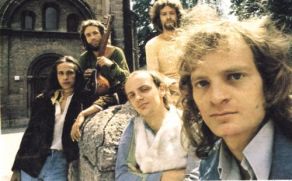
Prog Dog 6 with Geoff Banks

Dear Progarchists, fabulous dj (despite what he says about himself!) and prog master, Geoff Banks, has a weekly radio-internet show called the Prog Dog show.  I’ve thoroughly enjoyed his program over the last several weeks.  For those of us in EST, it begins at 2pm.

http://myradiostream.com/progdog

His own description of today’s show: “Join me for 2 hrs of scintillating music courtesy of IQ, The Plastic People Of The Universe, Thomas Dolby, Siddhartha, PFM, Public Image, Hatfield and The North, Hawkwind, FPOA, Pink Floyd, Sigur Ros and much much more.”

At the same website as the stream, you can also join in the chat room, upper right corner of the screen.  Banks and followers are as witty as they are knowledgable.  Enjoy!

Mini-review: Fumbling Toward Sarah

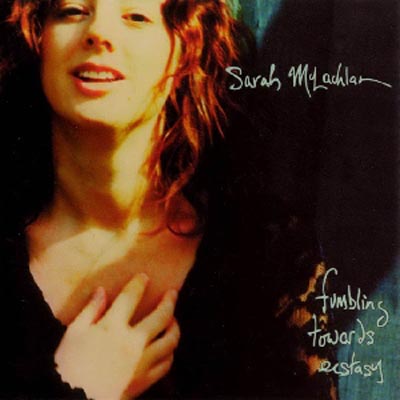
Sarah McLachlan, Fumbling Towards Ecstasy (1993).  I can’t explain why this album means so much to me, but it does.  I love McLachlan’s voice and her very effective use of hammond organ as well as her Talk Talk-esque atmospherics.

While the album as a whole has a very pop feel, especially after the much more experimental and minimalist first two albums (Touch and Solace), it still holds together brilliantly.  Even 19 years later.

The second half of Fumbling Toward Ecstasy is especially powerful.  In particular, the best songs are the searching “Ice,” the driving “Hold On,” and the whimsical “Ice Cream.”  Really, when one puts the song writing together with the production, one can only reasonably cry “genius.”  Then, if you add “Fear” to this, there’s really nothing to do but drop one’s jaw.  “Fear” is, simply put, one of the finest songs ever written.  Every aspect of it is perfection defined.  Words, meaning, arrangement, production.  I might go so far as to argue this is the single best “pop” song ever written–and, yes, I’m not forgetting the Beatles.  The Beatles never captured this depth of meaning or intent.

Wind in time rapes the flower on the vine/Nothing yields to shelter

And, importantly, Fumbling lacks the nasty anti-religious cant of her middle work (I’m not a purist about this, by any means, as Rush is one of my favorite bands; I can only take in your face skepticism a little more than I can take in your face evangelicalism).  Her followup albums, especially Surfacing and Afterglow, are not only are weak lyrically, they’re weak musically, ranging into pure sap at times.  “Angel” embodies the worst of McLachlan, though I’m sure she made an absolute mint on it.

Her latest album, Laws of Illusion, while not nearly as sappy or poppish as her middle work, is also not as interesting as her earliest work.  Frankly, I hope McLachlan follows other serious pop artists such as Natalie Merchant, going into the more artistic realm rather than the more commercial.  I assume she no longer needs the money to be commercial?   Her voice could fit so perfectly in more experimental venues.

When I worked at the Organization of American Historians in graduate school, we would play all three of the first cds as we played Quake on the network (after business hours, of course).  What a contrast.  Yet, it worked.  That, or we were all a little schizophrenic.  Ok, let’s take this line of reasoning no further.

Believe it or not, I’ve seen McLachlan as many times in concert as I’ve seen Rush.  Each performance is a delight.  Indeed, she’s as good as anyone I’ve ever seen live.  She completely throws herself into every performance.  I very hope she will do the same with her forthcoming album.

Succinct Reviews of Seven Sterling (Non-Prog) CDs

I live with several people and many things: my wife, our three children, a dog, two cats, five chickens, numerous fish, a dated wardrobe, and countless delusions. Among those delusions is an unwarranted—irrational!—belief that I will write long, detailed reviews of every album I deem worthy of such. Reality smirks at such excessive dreams, but I continue to harbor them. Still, I sometimes relent to reality, with gritted teeth and a fleeting snarl. So, what follows are short reviews of seven recently released albums (mostly downloads, actually) that share two qualities: they are not prog, and they are excellent. I should note that although the main focus of Progarchy.com  (which I conceived and Brad birthed—ooh, that sounds a bit, uh, strange) is obviously prog, it is open to all forms of good music. Genre is of far lesser importance than quality. That said, let’s push “Play”.

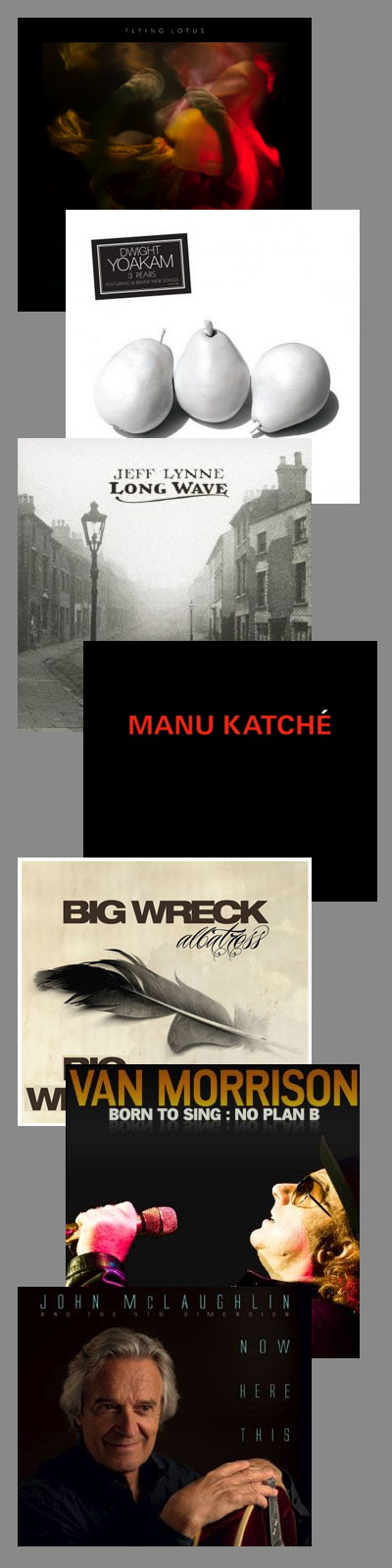
• “Until The Quiet Comes” by Flying Lotus. This is my sort of electronica: richly detailed, sumptuous, quirky, edged with darkness, possessing a jazzy flair, and endlessly inventive. The jazzy element has a genealogy, as Steven Ellison (who is Flying Lotus) is the great-nephew of Alice Coltrane, wife of the late, legendary ‘Trane. Includes a track, “Electric Candyman”, with a certain Thom Yorke. A near perfect late night album, this rewards repeated listens.

• “3 Pears” by Dwight Yoakam. His music has always been lean and his lyrics dry, but the new twist is subtle: a warmth in both content and sound. An example of the first is “Waterfall”, which is playful, with a wry and wistful sense of joy. The second comes through in Yoakam’s superb vocals, set in arrangements that are fat-free and feature just the right amount of twang and reverb, with tasty touches of organ and piano. The man is a superior songwriter and this set is further proof that country music can be twangy and contemporary without being shallow and trendy.

• “Long Wave” by Jeff Lynne. A part of me was prepared to dislike this because it is a covers album and is quite short (barely 28 minutes). Yes, this is a rather nostalgic homage to songs Lynne grew up on (standouts include “She” and “Beyond the Sea”), but the wizard of ELO brings such an obvious love to the project, I was won over. It doesn’t hurt that it is impeccably sung, played and produced, with lush Lynne-harmonies and ELO-like arrangements that are all about the songs. Besides, if there is one thing Lynne’s music has always had, it was a sense of nostalgic melancholy and romantic regret. Short, bittersweet, and stellar.

• “Manu Katché” by Manu Katché. Who hasn’t this phenomenal drummer played with? Notable names include Peter Gabriel, Sting, Jeff Beck, Tears for Fears, Tori Amos, and about a billion others. This is Katché’s fourth disc for ECM, and each has been fabulous; this newest release is notable for its propulsive approach. As one reviewer noted (I’ve lost the link), this is perhaps the funkiest ECM album ever, the sort of playful, soulful jazz album that gives an assured nod to modern sounds (read: synths and loops), but is rooted in acoustic bliss, with plenty of warm horns and shimmering organ. Recommended for anyone who loves great jazz and anyone who needs an entry point for modern jazz that is equally brainy and passionate.

• “Albatross” by Big Wreck. I was oblivious to this fine group (a “neo-prog hard-rock outfit” according to AllMusic.com) until I stumbled upon this new release on emusic.com. Singer Ian Thornley brings Chris Cornell to mind with his powerful, expressive vocals, but is hardly a clone, nor does he try to be. Three successive songs—”Wolves”, “Albatross”, and “Glass Room”—are worth the price of admission. “Wolves” (see YouTube video), especially, is a dynamite track, a perfect four-minute modern rock song, with top-notch playing and subtle melody. One of my favorite releases of 2012.

• “Born to Sing: No Plan B” by Van Morrison. No need for a Plan B for the Belfast Cowboy because he is the supreme Celtic synthesist, so soaked in jazz, blues, roots, and early rock, he can sing about grass growing and it is magical (and, in that regard, reminds me of G.K. Chesterton). This jazz-oriented album, on the Blue Note label, is arguably his best in a decade; he sounds refreshed, focused, and even happy. The horn arrangements are special and the songs are leisurely without ever wandering, mellow without ever dragging. The real revelation here are Morrison’s horn-like vocals, which are strong, elastic, and restless. Great album by one of my favorite musicians.

• “Now Here This” by John McLaughlin and The 4th Dimension. Some fans of McLaughlin’s legendary projects from the 1960s and ’70s aren’t too taken with his recent albums, which often feature guitar-synth and other modern devices. But while this album is occasionally frenetic and has a very modern (and crisp) sound, the adjective that keeps coming to mind is “soulful.” This comes through more obviously when things slow down, as on the lovely “Wonderfall”. The guitar solos are technically brilliant of course, but also have passionate, hungry logic that cannot be denied. This is music for the mind and the soul, which is about the highest praise I can give it. Fantastic effort from the legendary axe man.

Sola Music!

Dear Progarchy friends,

Thanks so much for being so willing to give this new site a chance.  I’m amazed and thrilled at the response we’ve gotten.  Indeed, your response has been far better than Carl, Chris, or I had originally hoped.  And, we can have big dreams!  So, again, thank you profoundly.

Each of the members and writers share only three things in common: we’re all human beings; we really like each other; and we love music.

That said, we each hold a lot of different ideas (naturally) regarding politics, religion, etc.  And, some of us are quite active writing about things besides music–the type of things (especially religion and politics!) that can divide rather than unite.

One of the most important reasons Carl, Chris, and I started Progarchy was for the very reason that we wanted to talk about music free of politics, etc., and take a break from our ordinary (or bizarre, depending upon your point of view) political and religious criticism and analysis.

Please know that THIS site will be free of politics.

Additionally, and most importantly, we have an active Facebook page here.  I’m still figuring out how to work it correctly.  But, we’d be honored [for our British friends, please make that “honoUred”] if you “like” us there and join in the conversation there as well as here.

Thanks again for everything.  Here’s to Progarchy!  Yours, Brad, Carl, and Chris (eds)

Popol Vuh is Heavy

ImageWhat makes a heavy record? What is heavy music?

I still haven’t put my finger entirely on it.  There are landmarks to go by.  I think of the giant leap forward in production that Led Zeppelin achieved, where the drums and bass, really for the first time, were up front and PRESENT in a rock album, as Jimmy Page successfully married technology to sonic texture (it is amazing to think that a mere year and a half separated Zeppelin’s first from Sergeant Pepper’s Lonely Hearts Club Band, in so many ways a touchstone for “produced” music, art rock, and progressive rock, but still quite thin sounding).  Black Sabbath’s first, and then Paranoid, followed closely on the heels of Zep’s initial efforts, with Butler/Iommi/Ward’s dark conjurations so perfectly in tune with Geezer Butler’s lyrical mood and Ozzy’s keening wail.  Then there’s the heaviness of message or melody or harmony, the lay-it-on-you trips of musical philosophy, that can blow down the walls even with the simplest of acoustic setups.  I’ve never heard a punk-like shriek equal to Uncle Dave Macon’s banjo and voice records of the 1920s, or Charley Patton’s husky growl as it disappeared into the scratchy grooves of a worn Paramount 78.  You want heavy? Patton’s heavy.  Heaviosity is just what it is…I couldn’t tell you WHAT, but I know it when I hear it.

Successful progressive rock by definition is heavy music, as it seeks to differentiate itself from less self-consciously achieving music.  Like any artful endeavor, it can utterly fail in the attempt, by stating the familiar without stretching towards the unknown.  For instance, use of atonal or dissonant structures can only work as a dynamic shift between pieces (whether those pieces are albums or songs are parts within songs), in search of the sublime. As a repetitive reflex such devices are no more meaningful than a beautiful melody iterated too many times.  Even music that relies heavily on drones can only do so because of the periodic resolutions or tonal completions.

Heavy music is the sound we hear made sacrosanct, often unknowably but assuredly.

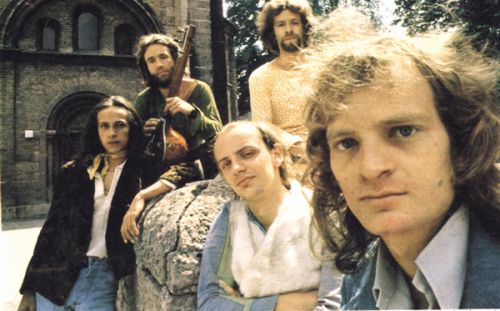
I came to Popol Vuh later than I should have, years, decades, after I’d tuned into instrumental, meditative music (in the form of classical and jazz music).  I was surprised when I did hear them that devotional music could be so obvious and compelling, and so far removed from the treacly mission-speak of Christian rock and its earnest minions.  I’d heard of the band for a long time, I couldn’t say how long, and knew they were vaguely associated with new age music in the same way that Tangerine Dream were.  That they were German may have sealed the deal to my overly threatened ears:  nope, not going there.  When I finally did listen, into my 30s by then, it was a revelation.  A true classic, 1972’s Hosianna Mantra, dominated my stereo on Sunday mornings for a number of months, and still periodically does, guiding me through a non-denominational liturgy of the soul.  Florian Fricke, Popol Vuh’s guiding genius and pianist, guitarist Connie Veit, and vocalist Djong Yun provide music to a common mass that knows no religious boundary.  I’d like you to hear this, in the title track, Hosianna-Mantra:

http://www.youtube.com/watch?v=Kf8PWspETtc&feature=youtu.be

Veit’s gliss guitar provides a fluid compliment to Fricke’s piano, with the oboe and Djong Yun’s vocal floating as one above clouds of melodic invention.  Intentional or not on the part of the musicians — and I believe it was, as Fricke had apparently experienced, not long before making this record, a rather intense religious conversion, part of which was abandoning his previous forays into electronic space music (equally wonderful, by the way) — it achieves a transcending spiritual glimmer, and is the single most compelling and inspiring expression of faith I have experienced in music.  This is heavy music that is full of light, illuminating a path that Fricke and his collaborators in Popol Vuh would continue to follow for a number of years with an astounding level of success, whether in the music they created for Werner Herzog’s films in the 70s or on their own records.

While Hosianna Mantra is often pointed to as Popol Vuh’s greatest achievement, it was a transitional record, heralding a string of albums where Connie Veit eventually left the group and Danny Fichelscher, a drummer and guitarist for Amon Duul II, joined, greatly influencing Popol Vuh’s sound.  Fichelscher’s rock chording, accomplished solo-ing, and pounding drums gave sonic muscle to Fricke’s explorations, darkening the clouds.  This is heard to greatest effect on the album Letzte Tage Letzte Nachte (Last Days, Last Nights), which at 30 minutes is one of the shortest progressive rock albums I can think of, and also is one of the heaviest records in my collection.  There’s an eastern non-blues, metallic, marching sturm-und-drang that Fichelscher brought from Amon Duul II, and combined with Fricke’s melodic sensibilities this creates an atmosphere of shadow as well as light, broadening the reflective palette, retaining the beauty while at times adding an edge of dread.  The first track, Der Grosse Krieger (The Great Warrior), inhabits this space, setting the tone for the rest of the album:

http://youtu.be/gdh-IhnhQd4

As on Hosianna Mantra, Djong Yun has a strong influence on Letzte Tage Letzte Nachte, but here it’s a harder rock turn, with her voice often joined to that of Renate Knaup, another Amon Duul II stalwart.  Where on Hosianna Mantra, “Kyrie” was churchlike, solemn in its beauty, here “Kyrie” becomes a Hindu chant, with an almost Allman Brothers-like instrumental outro.  The acoustic “Haram Dei Raram Dei Haram Dei Ra” continues the eastern om, leading into “Dort ist der Weg” (There is the Way), another dense electrical rock foray.  The album concludes with the title track, a duet between Yun and Knaup, its fingerpicked arpeggios, reverberation, and repeated line, “When love is calling you, turn around and follow,” suggesting the more meditative work of U2.

http://youtu.be/KpPPElUV9Hg

Popol Vuh is heavy, and Popol Vuh is no more.  Florian Fricke died in 2001, leaving a large and varied catalog of music behind him.  Never content to stay in one place musically too long, and shunning the commercial potential his music certainly could have had in the New Age market had he done so, Fricke shared with many other “krautrock” pioneers a deep concern that music remain art, that it achieve a transcendence beyond simply making music or a day’s pay.  He once said “Popol Vuh is a Mass for the heart” — his is a music well-described.

Blake McQueen and the Integrity of the Art

I was–rather admittedly and with no small amount of giddiness–excited to a see a full-page spotlight on new British prog act, Coralspin, in the latest issue of PROG (Issue 31).

The last paragraph of the article confirms everything I’ve come to believe about the band since I first had the opportunity to hear their first cd back in May.

Although their rebellious streak is moderate compared to Keith Emerson’s Hammond organ murder, Coralspin’s determination to write for themselves has produced a sonic experience just as distinctive.  It seems this prog malarkey isn’t as easy as you’d think.  ‘I thought, “it can’t be that hard”–it’s actually a lot harder than I thought!’  McQueen surmises wisely.  ‘We do our own music, play what we want and don’t have anyone telling us what to do.’

Amen, Blake.

My favorite prog track of the week: “Chuta Chani”

Every few days or so I go to the ProgArchives.com site and check out new material and reviews. The most recent visit was rewarded with the discovery of the Italian neo-prog band, Profusion, who recently released their second album, “RewoToweR”. The band’s site offers this description:

There are many languages ​​that lead the climb: rock, metal, fusion, pop, acoustic-tango. Each floor is a different dimension from the previous, but never isolated. Just as you can look at the title letters in both directions, the tower is also an ascent and descent together, until it gets to be a maze. The “RewoToweR” building is not like a “Babel of different languages” but the attempt to speak, through experimentation, a new and modern language.

Yes, that’s a bit cutesy and a tad hyperbolic, but the music is quite good, even outstanding, with assured playing, tasteful arrangements, and hook-heavy songwriting that is at turns playful, ambitious, mythical, and, on occasion, a little corny (see “Treasure Island”, a song about pirating).

The song “Chuta Chani” is a perfect example of what the band has to offer. Melodic violin solo intro? Check. Crunchy, tasty riff? Yep. Great bass line? Of course. Guitar with a hint of Middle Eastern spice? Indeed. Clean, strong semi-exotic vocals? In spades. Catchy bridge and chorus? Oh yeah. Breakneck keyboard solo with classical motifs? And how! Short chorale section to conclude? Why not? The singer, Luca Latini (described on the ProgArchives.com page as a “pop-soul singer”) has personality to spare. Normally, I’m not too taken with English lyrics sung with a strong accent, but Latini makes it work (at least for me) because he has fabulous tone and range, and he does inject so much enthusiasm and energy into the proceedings. And, despite the accent, he reminds me quite often of the criminally underrated Ted Leonard of Enchant (and other projects), which is high praise. Here is the band’s video for “Chuta Chani”:

Prog Magazine 31 (iPad) Now Available

Sadly, for North American prog fans, it’s really, really difficult to get ahold of the excellent British magazine, Prog.  When I do find copies in some of the larger bookstores, the issues are always several months behind.  One good solution for those of us not living in the U.K. or Europe is to get the iPad version.  It comes out when the magazine is released, and the content (everything but the CD) is complete.

The new issue (31) came out yesterday, and it’s excellent.

https://itunes.apple.com/gb/app/id453737964?mt=8&affId=1621074&ign-mpt=uo%3D6

Mini-review: The Cure, “Disintegration”

Two years ago, an issue of WIRED hit me hard.  Page 55 especially intrigued me. “What’s wired this month” featured the following: “The Cure:Disintegration, deluxe addition — everyone has a favorite Cure album, but anyone who says Disintegration isn’t the best should have their black eyeliner confiscated. The 21st anniversary of this goth-pop classic from godfather of gloom Robert Smith is being celebrated in style. The three-disc set includes rare tracks and a live Wembley Arena recording from 1989.”

21 years? Simply astounding to me at the time I read this.  Now, two years later, I’m still astounded.  We’re coming up on the 25th anniversary of the album.

I have owned and listened to Disintegration for roughly half of my life. It came out right before the Berlin Wall fell (no connection, as far as I know; though, the title of the album is telling), the summer between my junior and senior years at Notre Dame. What had come before—Japanese WhispersHead on the Door, etc.—was really good, and I had played each frequently on my turntable. But this 1989 album—Disintegration—ranks up there with Security, Hounds of LoveSpirit of EdenThe Color of SpringThe Flat Earth, Heaven Up Here, and Ocean Rain as one of the best albums of the 1980s. This wasn’t typical rock, “music with an attitude,” but music as art. It still is.

When pushed on this, I have argued Disintegration is one of my top 15 non-classical albums of all time. Though the older I get, the less taken I am with such rankings, even my own.  But Disintegration?   Is there a flaw in the album?  Nearly every note is perfectly placed, and the music holds together beautifully from the opening track, “Plainsong,” to the strange finale, “Untitled.” Lyrical intensity, driving bass, timeless keyboard work, and even some periodic optimism, ala Eliot, fashion, predominates on the album.  The Cure’s great flaw is their attempt (commercially lucrative, to be sure) to write bouncy pop songs.  While songs such as “Friday, I’m in Love,” are fun, they have absolutely no staying power.  If I never hear any of these pop songs again, I will not be sad.

But, “Disintegration” avoids all attempts at commercialism.  It succeeds brilliantly.

There are some truly weird songs on the album, such as “Lullaby.”  Taken in isolation, “Lullaby,” would not be special.  But, in the context of the album, it is stunning.

Many people, especially those older than I am, tend to think of Robert Smith only in terms of nihilism and drugs. These things about Smith are undoubtedly true.

But, frankly, I find much of his work haunting and inspiring. I would much rather spend time listening to Smith’s 1981 Gothic anthem, “Faith,” then any song/hymn I know of by either Dan Shutte or Marty Haugen, modern Catholic drivel. Raised Roman Catholic himself, Smith — no matter how drug-induced his music and lyrics are — possesses a rare sense of the contemplative and even, dare I write it, the liturgical. Thankfully, his music never gets political, but it is always intellectually, spiritually, and emotionally stimulating.

Though the Cure achievesthe creation of some profound moments on their following albums, about 1/2 of Wish (1992), Bloodflowers (2000), and The Cure (2004), Smith and co. never quite reached the level that they established with Disintegration.

1989’s Disintegration serves as the adagio of the Cure trilogy: beginning in 1982 and ending in 2004. To me, the album only has one serious flaw — the few seconds of silence between each song.

Rainbow re-release

Got a really nice email and press release today from James Parrish.  Thanks much, James

*****

LONG AWAITED DELUXE REISSUES OF RAINBOW SET FOR RELEASE THIS NOVEMBER

Rainbow are set to release Deluxe Reissues of On Stage and Long Live Rock N’ Roll this November.

Rainbow, lead by the guitarist, Ritchie Blackmore, became synonymous with some of the most well regarded and popular charting Rock songs of the seventies and eighties. From ‘Stargazer’ and ‘Man On A Silver Mountain’ to ‘All Night Long’, ‘Long Live Rock And Roll’ and ‘Since You Been Gone’, each year in the decade of Rainbow was marked by some of the best songs and performances captured both on record and in concert.

Passing through the band were some of the best the genre had to offer. Vocalists Ronnie James Dio and Graham Bonnet, bass player and producer Roger Glover and drummer Cozy Powell, each brought their individual talent to the table to record some of Rock’s best loved hard rock on those albums and singles.

On Stage is a live album originally released in 1977. The album was recorded live over several German and Japanese dates in late 1976 during the Rising world tour. Producer Martin Birch spliced many of the tracks together from different dates. The recording features the customary introduction to a Rainbow show – the classic quote from The Wizard of Oz,”Toto: I have a feeling we’re not in Kansas anymore. We must be over the rainbow!” with the last word repeated as an echo, then the actual band plays a musical phrase from the song ‘Somewhere over the Rainbow’ before breaking into ‘Kill the King’.

Long Live Rock ‘n’ Roll is the third studio album released in 1978. This was Rainbow’s last album to feature Ronnie James Dio on vocals.


Disc 1

Over The Rainbow

Kill The King

Medley: Man On The Silver Mountain

Blues

Starstruck

Catch The Rainbow

Mistreated

Sixteenth Century Greensleeves

Still I’m Sad


Disc 2 (bonus tracks) – Live Osaka 9/12/1976

Kill The King

Mistreated

Sixteenth Century Greensleeves

Catch The Rainbow

Medley: Man On The Silver Mountain

Stargazer

Still I’m Sad

Do You Close Your Eyes


(Previously unreleased)

Long Live Rock N’ Roll

Disc 1

Long Live Rock ‘n’ Roll

Lady Of The Lake

LA Connection

Gates Of Babylon

Kill The King

The Shed (subtle)

Sensitive To Light

Rainbow Eyes


Disc 2 Rough Mix’s 02/07/1977:

Lady Of The Lake

Sensitive To Light

LA Connection

Kill The King

The Shed (subtle)

Long Live Rock N Roll

Kill The King


Shepperton Studio Rehearsals:

Long Live Rock ‘n’ Roll

Rainbow Eyes Don


Don Kirschner Show with Alt Vocals:

Long Live Rock ‘n’ Roll

Kill The King

Long Live Rock ‘n’ Roll

LA Connection

Gates Of Babylon


For more information please contact James Parrish at Prescription PR at james@prescriptionpr.co.uk