The Textures of Nosound–Never an Afterthought

afterthoughts640Review: Afterthoughts (2013; Kscope Records).  It can be ordered here.

Listening to a Nosound album (original, live, or compilation–they come in every variety and always possess the very essence of quality itself) is so much more than a moment or an event.  It’s an immersion into something immeasurably deep and wide and beautiful.   It’s a mystery.  It’s liturgy.  It’s possibilities.  It is eternity.

Looking over the reviews of the first three studio albums–Sol29 (2005), Lightdark (2008), and A Sense of Loss (2009)–a few words appear repeatedly and unmistakably.  Ethereal, intelligent, contemplative, flowing, organic, psychedelic, spacey (as in Pink Floyd space rock), progressive, artful, ambient, flowing, melodic, painted, cinematic.

If one had to label the music of Nosound, it might be something like: neo-classical, Hollis-esque, Shoe-gaze prog.  Certainly, the spirit of Mark Hollis lingers over the music of Nosound, but, as with most bands loved and admired by Progarchy, Nosound is its own band, and the sound it creates is its own.

Some have labeled the music of Nosound minimalist, but this is simply false.  While it might have the feel of Philip Glass at times, Nosound is about a wall of sounds as well as about the absence of sounds.  Just as Arvo Part uses amplifiers when necessary to make the music he needs, so does Nosound.  If a synthesizer is called for, a synthesizer is used.  But, if a real stringed instrument is appropriate, the stringed instrument is used.  Everything has its place, and every thing supports every other thing.

Afterthoughts (2013; Kscope)

In less than a week, Kscope will be releasing the fourth studio album from Nosound, Afterthoughts.  When it was first announced, I ordered the three cd-version immediately.  Very graciously, Nosound sent us a promo-advanced copy of Afterthoughts.  I’m not sure how many times I’ve listened to it over the past week and a half.  It is every bit as captivating as the first three albums, and I have thoroughly enjoyed and appreciated and been made better by my immersion in this latest work.  It is a glory, to be sure.

It is certainly Nosound, but it is Nosound plus.

The nine songs of the album are: In My Fears, I Miss the Ground, Two Monkeys, The Anger Song, Encounter, She, Whatever You Are, Paralysed, and Afterthought.

As always, the album ebbs and flows.  Though I grew up on the treeless and waterless plains of Kansas, I imagine the music best represents the ebb and flow of the tide.  Just as with the ocean, one must imagine creatures populating the water well beyond anything we know, and we must imagine the edge of the world just over the horizon.  When reaching it though, one does not fall into nothingness but into everythingness, life itself.

The words flow as beautifully and as meaningfully as the music itself, and the lyrics only take one further into this sacramental reality.  The listener feels the joys, the anguish, and the incomprehensibilities experienced by the lead singer, Giancarlo Erra.

While every song presents and exists in its own form of majesty, the album especially reaches its highest highs in the second half.  From the longings of Encounter (the fifth track), Afterthoughts climbs to ever greater heights, reaching eternity sometime in the middle of the eighth track, Paralysed.

Giancarlo Erra

The mastermind behind the band, Roman Giancarlo Erra, is as intelligent and as talented as he is kind.  An artist in the purest sense, Erra writes for himself, but he never forgets his audience.  Yet, unlike so many in the larger rock and pop world, Erra keeps that sense of traditional relationship between artist and patron (his fans and those who purchase his CDs).  He never–in any way, shape, or form–dumbs down his art, but he remains responsive to his audience, incorporating them joyfully in his own art.

As the greatest of Anglo-American poets, T.S. Eliot, explained at the very end of World War I:

And he is not likely to know what is to to be done unless he lives in what is not merely the present, but the present moment of the past, unless he is conscious, not of what is dead, but of what is already living.

Though 94 years early, Eliot must have been writing about Erra.  Certainly, we can consider Eliot’s voice prophetic.  Erra embraces the moment while never forsaking what he has inherited.  Indeed, Erra willfully and lovingly embraces the past in the present, and the present in the future.  As with Eliot in the greatest work of art of the twentieth century, The Four Quartets, Erra stands in the middle of his art and looks outward.  He observes the world from within the miracle.

Unlike so many those pretentious artists of the last century who often stood aloof from all of those around them, Erra, again, invites all listeners into this world of majesty.  They might not accept his invitation, but the invitation remains, nonetheless.

As I would with Greg Spawton, Matt Stevens, and Robin Armstrong, I would give much to sit down and have a drink with Giancarlo.  It wouldn’t matter if we had a coffee, a beer, or a glass of red wine–the conversation, I assume, would be spectacular and meaningful.  We’d certainly talk about music, but, if I’m judging Erra correctly, we’d talk about everything under the sun and, perhaps, beyond.

Probably, Erra’s work will be remembered someday more as an early 21st century equivalent of Arvo Part and Henryk Gorecki rather than it will be with, say, Marillion or  Oceansize (both bands I love).

Regardless, the work of Nosound is a must-own for any person celebrating this current return of prog music or any real lover of any kind of music.  And, not just Afterhoughts, but every studio album by Nosound.  You can also go beyond the studio albums as well.  Happily, Erra never stops releasing EPs and other assorted good things.  At the Pier, Clouds, The World is Outside, and The Northern Religion of things are well worth owning as well.

And, perhaps most interesting of all is the mixing of Nosound and No-man in what is arguably the finest name ever for a band, Memories of Machines.  Erra’s music has its own place within the current revival of prog, and it’s as important as the music of Big Big Train, Gazpacho, Matt Stevens, The Reasoning, Neal Morse, and a number of other acts Progarchy cherishes.

Thank you, Nosound.  You ably capture the essence of the music of the spheres, and we living in this vale of tears can do nothing but smile and appreciatively wait for more glimpses of all that is eternal.
You Can Do a Lot in a Lifetime, If You Don’t Burn Out Too Fast – Rush, April 23, 2013 at the Frank Erwin Center, Austin, Texas

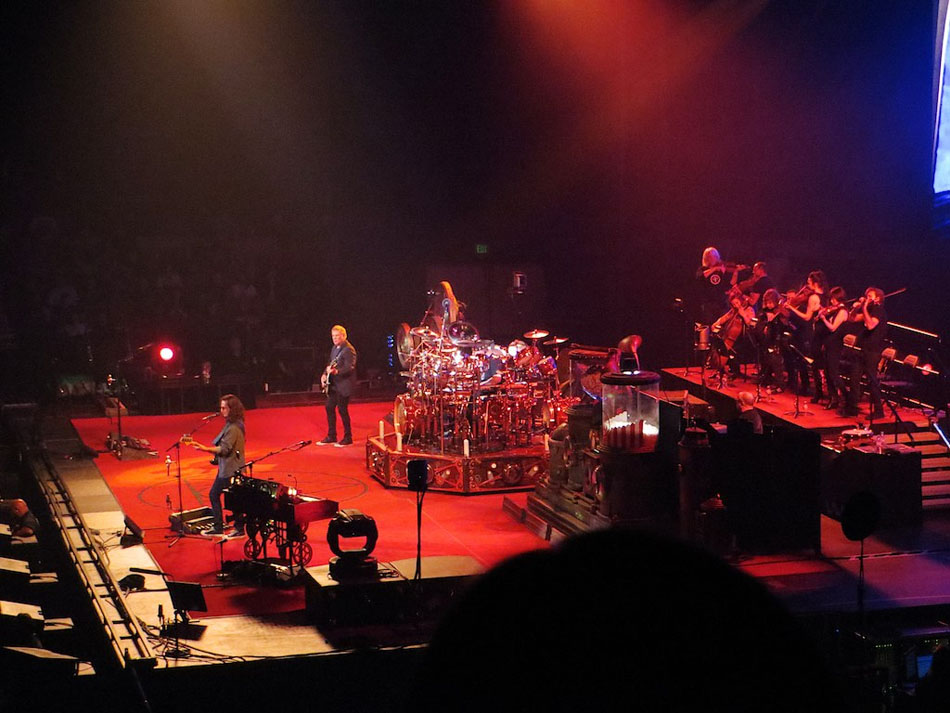
ImageJust one week after a long-overdue induction into the Rock and Roll Hall of Fame, Rush opened the second leg of their ‘Clockwork Angels’ tour – and fortunately for myself and thousands of other Texans, they did it right here in Austin.

For long-time Rush fans, a Rush concert is more than just an event where we see musicians performing their catalog in a live setting.  For us, it is something that gets into us the way dye gets into a shirt and alters its color; something that affects each of us right down to the molecular level.  This show certainly did that for me, more for reasons I will get into below.

The steampunk aesthetic of the stage setup was spectacular.  It was refreshing to see a big visual presentation to accompany the music, which is a rare thing these days.  In contrast to the 70’s, when progressive rock was bigger and had more backing by the record companies, most contemporary prog shows are played in smaller venues without the type of visuals as were present in some of the gargantuan shows of that earlier time (think ‘Yes’ on the ‘Relayer’ tour).  Rush is the rare band from that era that can still play large venues with a corresponding stage set and light show that turns the presentation into more of an event than just a live music performance.

After a long break from the road, the band seemed rested, recharged, and ready to go.  Some of Rush’s typically humorous opening video greeted the audience when the lights went down, featuring the band’s trademarked slightly bizarre humor.  The concert proper then opened with a rousing version of ‘Subdivisions’, followed a number of 80’s works.  In the first set, they did three songs from ‘Power Windows’, including ‘The Big Money’, ‘Grand Designs’, and ‘Territories’, while also managing to squeeze in ‘Limelight’, ‘Force Ten’, and ‘The Analog Kid’.  After the latter tune, the band moved into the 90’s with ‘Bravado’ and ‘Where’s My Thing’ and then into the 00’s with ‘Far Cry’, which closed out the first set.

After a short break, the band returned to the stage, this time with eight additional musicians collectively known as ‘The Clockwork Angels String Ensemble’.  This tour has been the first in which Rush has brought extra musicians on stage, and they were used to good effect here.  The string ensemble filled in some spaces while enhancing others, remaining on stage throughout the performance of ‘Clockwork Angels’ and for several songs afterwards, including a blistering performance of ‘YYZ’, which is captured through a smartphone (not mine) here.

Beginning with another entertaining bizarro-humor video (with Neil, Alex, and Geddy playing dwarfs) the second half of the show kicked off with ‘Caravan’, and followed through with most of the songs from ‘Clockwork Angels’.  Regrettably missing from that list was ‘BU2B’ and ‘Wish Them Well’, the latter being a favorite of mine not only for the music but for the life lesson within the lyrics.  A guitar snafu during ‘The Anarchist’ was a minor hiccup that left Geddy alone without melodic accompaniment for a moment, but Alex and his guitar tech had the presence of mind to quickly swap out instruments.  The performance of ‘Clockwork Angels’ concluded with a spectacular performance of ‘The Garden’, the visuals of video working great with the music here.

After concluding ‘Clockwork Angels’, the band went back into the 80’s again, with ‘Manhattan Project’, a short drum solo, ‘Red Sector A’, and ‘YYZ’.  The string ensemble exited the stage and the band closed out the set with ‘The Spirit of Radio’.  The band returned for an encore including ‘Tom Sawyer’ and ‘2112’ (‘Overture’, ‘The Temples of Syrinx’, and ‘Grand Finale’) before calling it a night for good.

I don’t have much to critique for the show, but I do have to say that the soundman could have done a better job with the mix.  It was very bass-heavy, and this caused a bit of muffling of notes, particularly on a few of Alex’s guitar solos.  But overall, that wasn’t enough to dampen the experience, which was still overwhelmingly positive.

All in all, an outstanding show, played with the energy and intensity that belied their age.

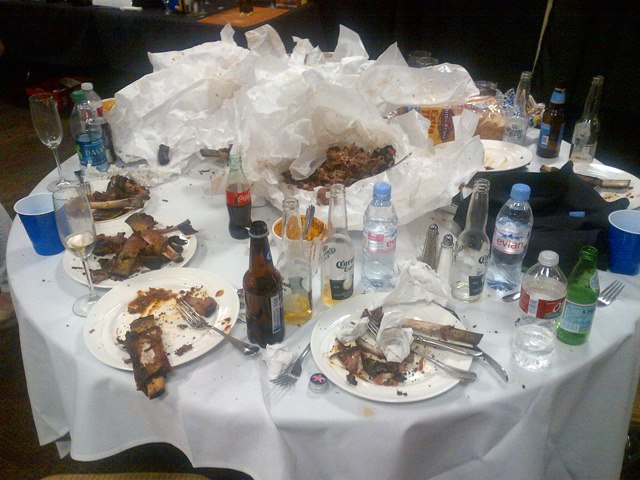
ImageAfterward, according to their Facebook page, Neil, Alex, and Geddy got in touch with their inner cavemen by devouring some Texas barbeque, as shown in the photo.  At this point of the review, you’ll have to excuse me while I go off on a tangent, but there is something in that photo that I think I need to address with the band members.  Geddy, Alex, Neil – I’m glad you enjoyed your barbeque during your most recent visit to the Republic of Texas.  The ribs and brisket are hard to beat.  However, I have to say I am a little disturbed in looking at some of the bottles on the table.  You three are Canadian boys, and therefore have Canadian genes – which means like other great Canadians, such as Bob and Doug McKenzie, you are drinkers of hearty beer.  Thus, seeing several bottles of Corona on the table gives me pause.  Corona is more or less a summertime beer – I could give you a pass on this if the gig was an outdoor gig during the sweltering months of July or August.  But last night was an unseasonably cool April night, and thus I just cannot understand the Corona.  Even more disturbing is what appears to be a bottle of Bud Light on the table.  Perhaps one of you reached for a water bottle and didn’t notice the difference?  Now, in fairness, toward the upper right corner, it does appear that some redemption is present, as I am about 90% confident that’s a bottle of Shiner Blonde.  I’ve compared the portion of the label I can see in the picture to an actual bottle of the same in my refrigerator, and the lack of a bar code on my bottle appears to be the only difference.  I’ll do more research of the label tomorrow night as I watch the NFL draft – just to be sure, you know.  Nevertheless, Shiner Blonde is a beer befitting of your Canadian DNA, guys, so I would recommend you use that to wash down your next Texas barbeque dinner.  Ok, tangent over.

This Rush concert was special in a way that says something both about Rush and their fans alike.  Not only was this my fifth Rush show, but it was the fifth different decade in which I had seen them.  Previously I had seen them in 1979 (Rupp Arena, Lexington, KY, Hemispheres tour), 1984 (Hampton Coliseum, Hampton VA, Grace Under Pressure tour), 1990 (Charlotte Coliseum, Charlotte, NC, Presto tour) and 2007 (Verizon Wireless Amphitheater, San Antonio, TX, Snakes and Arrows tour).  The 70’s, 80’s, 90’s, and 00’s. Now I can add the 10’s.  I’m comfortable in saying that I’m not alone among the Rush fan base, and in fact know there are fans that have seen many, many more shows than I have, and moreover, within the same five decades.  There are not many bands out there that one can say the same about.  There are even fewer (if any bands) that one can say that about while also saying that it was with the same lineup each time.  That’s a testimony to their longevity, as well as to the loyalty of the fans that have stuck with them all of these years.  As many of you will recognize, the title of this piece is drawn from the lyrics of ‘Marathon’ off of the ‘Power Windows’ album.  And those words, written by their philosopher-drummer nearly 30 years ago, appear to be even more true now than when that album was released.  Rush, despite some serious ups and downs, has persevered and continued to make great music far beyond the time when most bands lose their creative edge.  And fans like myself and countless others, we’ve lived our lives and had our own ups and downs for all of these years, and yet we kept coming back, keep buying the albums, and keep going to the concerts because we appreciate the excellence, the professionalism, the creativity, and the wisdom inherent in the lyrics. That neither Rush nor their fans have burned out, that both have shown the endurance to stick with one another throughout the decades only proves the wisdom of the lyrics from which this review draws its title.

Thanks, guys.  Not just for last night’s show. But for everything over all of these years.

3RDegree and John Galgano Show

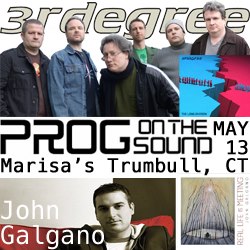
concert 3d degree galganoThis was just posted on Facebook, and I’m now thinking it might be worth a car trip to Connecticut!

3RDegree is pleased to announce John Galgano (and Izz Lite) will be opening up the show on May 13th at Marisa’s Ristorante in Trumbull, CT as part of the PROG ON THE SOUND concert series. John is a driving force behind Izz who have been a fantastic generator of great prog rock albums since the late 90’s and John’s solo album REAL LIFE IS MEETING is a highlight of 2012. Sharing the stage with him has been something 3RDegree has wanted to do for a while.

From my perspective, each made one of the best albums of 2012.  Sadly, neither has received enough attention.  May this be rectified in 2013!

Prog #35

rushcoverFEAT-237x300For those of us who don’t live in the UK, we have to wait a few extra days for our copies of PROG to arrive.  Mine arrives on the iPad, and I was thrilled to see so much good in the latest issue (out on iPad today).

Several Progarchist favorites are recognized and recognized well.

On Big Big Train’s English Electric 2:

For a band who have now been in existence for over 20 years to be creating albums as perfect as this is in itself utterly remarkable.  The fact that this is their second release of such a calibre within the space of a year can only reinforce the opinion that what we’re dealign with here is an act of rare, often indescribable brilliance.

I don’t see why the reviewer needed to bring up a Genesis reference and comparison twice.  Big Big Train is producing things so much beyond what Genesis did, though Genesis was, of course, brilliant in its own right.

But, Big Big Train is not Genesis Part II or Part III.  It’s Big Big Train.

Every time a review comes out of a new computer, the reviewer doesn’t keep bringing up the Commodore 64.  Why does a comparison to an early 70s band do anything for our understanding of a band performing perfectly beautifully in 2013, in and of its own right?  Ok, rant over.

On Cosmograf’s The Man Left in Space:

Armstrong has created a simply magnificent piece of work.

Amen.  And, a belated happy birthday to this genius, this Master of Chronometry and of the Platonic Spheres, Robin Armstrong.

Also in the issue: great stuff on Rush (even more, if you ordered the hardback edition of #35), on Todd Rundgren, and on RogerHodgson, and reviews of the latest from Sanguine Hum and Spock’s Beard.

To go to the official Prog site, click here.

Poor Richard’s Inconsequential Idea

Heaven knows I admire Richard M. Weaver.ideas

The great Southern scholar and philosopher hails from my neck of the woods.  He grew up in Weaverville, NC, just up the road from my mother’s people in Leicester.  His Southern Essays is a book I hold almost as closely as the Bible; it reminds me of who I am and where I come from.  It introduced me (before Russell Kirk) to my early American political hero, that colorful, bull-whip cracking intransigent, John Randolph of Roanoke, with his special blend of “social bond individualism.”  Weaver shaped my understanding and thinking in ways that will ever remain with me.

His most famous book is Ideas Have Consequences, a tour de force in traditional conservative thought and social commentary.   Weaver saw the rejection of universals as the harbinger of a disordered mind and disordered society.   Symptomatic, in his view, were certain elements of pop culture, notably jazz music.  On this score, just as Randolph broke with Jefferson, I have to break with the great intellect.

Edward Feser wrote a fantastic 2010 blog post that took Weaver’s ideas on jazz to task.

Weaver and I agree that it was a catastrophe to abandon realism about universals, to deny that things – including, most importantly, human beings – have essences which define an objective standard of goodness for them. But realism comes in different forms, and the different forms have different moral, theological, cultural, and political implications.

Feser draws a distinction between Platonic and Aristotelian philosophies and finds Weaver defaulting to a Manichean view of music.

[Weaver] tells us that jazz is a mark of modern civilization’s “barbarism,” “disintegration,” and “primitivism.” Why? His reasons seem to boil down to four: First, jazz evinces “a rage to divest itself of anything that suggests structure or confinement” and an eschewal of “form or ritual”; second, its celebration of the soloist’s virtuosity is a mark of “egotism” or “individualization”; third, its appeal lies in “titillation” and its themes are often “sexual or farcical,” appealing to the “lower” rather than “higher centers,” so that it fails to raise us to “our metaphysical dream”; fourth, it is “the music of equality.” Obviously, what he says about jazz applies also to other elements of modern pop culture.

Let’s consider Weaver’s concerns in order. First, it is, of course, by now a commonplace that to accuse jazz of formlessness or lack of structure is the height of superficiality. From swing to bop to modal jazz to fusion to acid jazz, it does not take much listening to discern the order underlying even the freest improvisation. Even free jazz has structure, though as I indicated in my previous post, it is so abstract that it can (in my view, anyway) only ever be of purely intellectual rather than aesthetic interest. It is hard not to see in Weaver’s criticism the Platonist’s impatience with the messiness and complexity of the real world, a desire for all form or order to be simple and evident enough to be accessible from the armchair. As the Aristotelian realizes…to know the essences of things we actually have to get our hands dirty and investigate them empirically, in all their rich detail. If the structure of jazz is complex and unobvious, it is in that respect only mimicking the world of our experience.

To which I say, “amen.”  Certainly this applies to progressive music as well.  Perhaps none combined fusion elements better than a band that came up in Weaver’s back yard, the Dixie Dregs.  Begun as a lab project at the University of Miami’s Frost School of Music, the Dregs engaged one another in complex musical conversations that exemplified a flair and swagger secured in its own kind of social bond individualism.

At least I have to believe the audacious John Randolph would have celebrated the Dixie Dregs, even if Richard Weaver would have been freaked out.

So here’s to ideas and their consequences — to getting our hands dirty —  from the appropriately titled Dregs of the Earth.

Marillion news

Marillion Clock

MARILLION SET NEW WORLD RECORD AT UK CONVENTION

Ayelsbury, Buckinghamshire (April 16, 2013) – Crowd-funding pioneers Marillion have broken the record for World’s Fastest DVD Release by recording their live performance on the evening of Friday, April 12 and officially releasing the final product 10 hours and 31 minutes post-show at 7:03am!  The release is a live recording of their opening night of the UK Marillion Weekend in Wolverhampton!  Production teams “Toward Infinity” and Abbey Road’s “Live Here Now” pulled an all-nighter editing and producing the release, Clock’s Already Ticking, for a 2 DVD/3 CD souvenir package made available at the venue that morning.

Fans from across the globe can purchase the set at www.marillion.com.

Wolverhampton marks the finale of the three Marillion Weekend conventions scheduled this spring in three different countries, with more than 6500 fans in attendance!  The seventh biannual Marillion Weekend is the most unique music experience, wherein fans have an opportunity to not only see their favorite act perform different sets, three nights in a row, but also become immersed in the Marillion culture and history with various activities.  Please visit the following link for the official trailer: http://www.youtube.com/watch?v=kRoHD2OEDR4.

Marillion Weekend activities included “Swap the Band” – fans submissions earn a spot to perform with the band, the “Marillion Museum” – boasting limited edition items, stage wear and various items from the band’s history, fan Futbol match, Marillion Pub Quiz, charity 10K Run, and more.  There were also Merchandise Shops stocked with signature items only available at the events…thousands of items sold at each convention!  Additionally the nominated charity for 2013 was the Hoping Foundation.  There were various fundraisers over the course of the Holland weekend including charity raffle of a special book for all attendees to sign, that will include handwritten lyrics by h and signatures and photos of the band.  For more information on Hoping, please visit http://www.hopingfoundation.org/

Continue reading “Marillion news”

Schnikees: The Reasoned Thief!

frontpage_newlogoI guess I’m a little behind on prog news.  This was announced a few weeks ago–The Reasoning will be working with Bruce Soord of The Pineapple Thief on the next album.  Wonderful news.

For the first time we’ll be bringing in an outside producer, too: we’re honoured to welcome the wonderful Bruce Soord on board. The band are full of excitement and enthusiasm right now about getting firmly stuck into this new piece of work.

For the full article at PROG, go here–http://www.progrockmag.com/news/bruce-soord-to-produce-the-reasoning/

What a solid collaboration–one for the ages.

Nosound, “Afterthoughts”–a must own (brief)

afterthoughts640After posting a brief note this weekend re: the forthcoming album from Nosound, “Afterthoughts,” Giancarlo Erra himself (!) contacted me.  What a gracious man he is.

Thanks to his good graces, I have now had a chance to listen to a preview/promo of the new album several times.  In fact, I’m on at least my sixth time.  And, I’ve the had the chance to listen to it on at least three different types of devices.

“Afterthoughts” is stunning.  I–and perhaps a few other progarchists as well–will review this fully.  But, if you’re looking for something to preorder, make sure this is it.  Fantastic, melancholic yet uplifting, intense, organic, deep, imaginative–everything you expect from Nosound and then some.  A 2013 must-own.

To preorder (and YOU SHOULD!), click here.


***

Also, in doing a brief bit of research on Nosound, I came upon this insightful interview from Prognaut:

http://prognaut.com/interviews/giancarlo-erra-nosound.html

The Mysterious Driving Majesty of Jeff Hamel and Majestic

Review: Majestic’s “V.O.Z.” (Majestic Records, 2013; two disks–”Voyage of Zosimos”).  Produced by Jeff Hamel, with two full-time members of the band: Hamel (guitars and keyboards) and Mike Kosacek (drums, percussion).  Additionally, there are four vocalists: David Cagle, Tara Morgan, Chris Hodges, and Celine Derval.

majestic voz

From the moment I received a physical promo copy of Majestic’s latest CD in the mail, I was intrigued.  Two disks, a concept, and with cover art equally enticing as well as disturbing (a wraith/priest/mystic/monk? holding its own eyeballs).

And, who is Zosimos?  My first thought was of the Eastern Orthodox priest and saint, Father Zossima, from Brothers Karamazov.  But,  then there’s also the early Christian heretic, Zosimos of Panopolis.  A wonderful set of options–orthodoxy or heresy?  When I wrote to Hamel, asking about all of this, he responded, it’s most closely related to Greek tragedy.

Well, that means it could still be about the Orthodox or the Gnostic!  But, this is totally fine.  I’m happy to leave it a mystery.  The lyrics carry as much a sense of artistry as do the composition and production of the album as a whole.  Clearly, the lyrics involve a journey, and that journey, as all good ones do, involves wonder, tragedy, and joy.   Disk two, even proggier than disk one, seems a series of vignettes–perhaps the visions of Zosimov.

No matter how many times I listen to this CD, I find it enthralling.  While certainly “prog rock,” VOZ has unusual sounds, atmospheres, and mysteries around every corner and at ever turn of this stunning album.  If Jeff Hamel is half as interesting in real life as he is in the studio, an astounding person he must be.  Indeed, though listed as producer and primary song writer, he is, for all intents and purpose, a director and an orchestrator.  Truly, every aspect of this release is a work of art.

I’m not always a huge fan of comparing one person’s art to those of others, but if I had to, I would ask the reader of the review to imagine Edgar Allen Poe or Washington Irving as lyricist, Tangerine Dream as creator of atmospheres and atmospherics, and Rush for song writing hooks.  And, if someone forced me into comparing Hamel’s work to a modern-day Progger, I would certainly think of him as the North American equivalent of Arjen Lucassen.

According to Majestic’s website, this album took two years to write, record, and produce.  I’m not surprised in the least.  VOZ has perfectionist written all over it.  And, thank the good Lord!  Who wants half-hearted art?  Certainly, no Progarchist.

Official website for the band and the label: www.majesticsongs.com, its physical offices located in Minnesota.  It’s a wonderful website–with lots of musical treasures and much to explore.

This will certainly not be my last Majestic CD.  I’m more than eager to explore Hamel’s back catalogue.  I give VOZ my highest recommendation.

And, on a personal note–Jeff, thank you.  Thank you for not dumbing down or commercializing your art.  Don’t get me wrong, I hope your music makes you a wealthy man.  But, I hope this happens through what you’ve shown already to be immense integrity.  Yours, Brad (ed.)