Prog Magazine 31 (iPad) Now Available

Sadly, for North American prog fans, it’s really, really difficult to get ahold of the excellent British magazine, Prog.  When I do find copies in some of the larger bookstores, the issues are always several months behind.  One good solution for those of us not living in the U.K. or Europe is to get the iPad version.  It comes out when the magazine is released, and the content (everything but the CD) is complete.

The new issue (31) came out yesterday, and it’s excellent.

https://itunes.apple.com/gb/app/id453737964?mt=8&affId=1621074&ign-mpt=uo%3D6

Approaching Olympus: Ave, Aryeon!

What would happen if Led Zeppelin and Queen joined forces to write not just a soundtrack but a full-fledged movie with a story told in the grand tradition of Ray Bradbury’s Farenheit 451, Aldous Huxley’s Brave New World, George Orwell’s 1984, or, the best of all, Walter Miller’s Canticle of Leibowitz?  Maybe Vernor Vinge might contribute as well.  Or, what if all five authors came together to produce one absolutely huge science-fiction story dealing with life, death, amusement, boredom, hypocrisy, statism, ideology, eco-destruction, godlessness, and every other issue that really matters but which we more often than not find convenient to ignore?

And, what might happen if you found Ridley Scott or Chris Nolan or Alex Proyas to direct?

Maybe you could throw some elements of The Island or Dark City or Equilibrium or Brazil into the film?  The serious issues raised by the first, the film noir of the second, the violent intensity of the third, and the dark humor of the fourth.

And, maybe you might be able to get the man who made replicants feel so very, very real to lead this surreal dark descent into an ideological and inhumane dystopia (it’s worth remembering that when Plato used the Greek word, “utopia,” he chose the word because it meant “no where”)?

And, what if instead of Led Zeppelin and Queen you found a man who could not only write compelling space operas but who also had the courage to state some really uncomfortable truths about the post-modern world and where we might, as a species, be headed?  And. . . who could also sing well and seemingly play very well every instrument known to the rock world?

And not just well, but really, really, really well?

If you could bring all of these disparate things together, you might find at the center of this eccentric collection one of the most interesting and original science-fiction story tellers of our day, a perfectionist by the name of Arjen Anthony Lucassen.  Or, as he playfully puts it in the liner notes: “Recorded, produced, mixed and mastered by Arjen ‘I’m not a control freak’ Lucassen at the Electric Castle.”  Oh, I like this man, and I’ve never had the grand privilege of meeting him.

And, you might find that all of his previous work–with the prog operas of Ayreon, the theatric romance of Ambeon, the prog metal of Star One, and the driving Goth prog of Guilt Machine–led to this most recent story, “Lost in the New Real.”

Lucassen has created a prog and science-fiction masterpiece with this brand new release.  Every thing is perfect–the story, the lyrics, the narration (by Rutger Hauer, of Blade Runner fame), and even the CD booklet.  Every thing.  Perfect.

And, what an over-the-top bombast of thought–all connected, all meaningful–a trip through so many emotions and realizations.  A blast, to be sure.

In his video promo for the album, Lucassen states the “Lost in New Real” is a culmination of every thing he’s done before in terms of musical styles: a mixture of psychedelic, of prog, of power pop, and of metal.  But, the story is so compelling and immersive and the types of music so appropriate to each respective part of the story, all feels like one centric whole, no matter the style changes.

With Hauer’s narration and Lucassen’s flawless delivery, I happily journeyed down this rabbit hole.

The story revolves around a Mr. L, revived in the future and guided by an omnipresent “hardheaded shrink” (Rutger Hauer) to help this man of the past adjust to the future.

The future, known as “The New Real,” hasn’t worked out too well.  For one thing, their history is totally off: Ronald Reagan won numerous Oscars; the Rolling Stones never touched drugs; and Madonna was actually a virgin.

At some point in the not so distant past of this future, Yellowstone blew, spewing toxic fumes around the world.  Now all that remains of western North America is, presumably, a plaque to commemorate “Yellowstone Memorial Day,” the day that the human race finally learned that Mother Nature ultimately always trumps technology.

The e-police (a wonderful play on Cheap Trick’s famous song of yesteryear) watch over every thing and privacy is a thing long forgotten.  Humans live to 164 and find life incredibly boring.  Thankfully, though, Dr. Slumber will happily euthanize you into the next world, complete with pretty nurses and bouncy Beatle-like music.

Most interestingly, though, the government has instituted a “Parental Procreation” policy, and parents must submit official forms to the state for approval to bring children into the world.  (I can guarantee the reader that should Mr. Lucassen’s vision ever become reality, your current reviewer and his family would be in serious trouble.)

In the end, Mr. L cannot determine if he’s human anymore or if he has become mechanized beyond recognition.  “I’m alive . . . But in a dream.  Am I only. . .a machine?”  Whatever Mr. L’s fate, the story ends with his despair.  Even the narrator seems to have given up after giving a bit of a tricksterish chuckle.

Ok, so let’s bring in not just Bradbury, Huxley, and Orwell (who appears in the story–he “was hot!”) but also every important critic of modernity, postmodernity, and extreme glorification of technology: from Romano Guardini to Russell Kirk to Marshall McLuhan.  All of this can be found in this magical mystery tour through the whirligig of our post-modern abyss.

But, it’s not over.  Disk Two (yes, Lucassen seems constitutionally incapable of doing any thing only partially) is full of really interesting covers (Pink Floyd (an absolutely stunning metal cover of “Welcome to the Machine”), Led Zeppelin, Alan Parsons, and Frank Zappa) as well as glorious original tunes–vignettes, if you will–of the world of the “New Real.”  After exploring the essential questions of our humanity on Disk One, Lucassen asks the larger existential questions respecting the universe.  The most intriguing question he asks (“Our Imperfect Race” and “So Is There No God?”): would it be better for aliens to exist or not?  Wouldn’t it actually be the more horrible of the two possibilities if all of existence and life and purpose really did rest on us–and us alone–in the entirety of existence, time, and space?

As I stated earlier, this two-disk affair is one seamless, intelligent, and mischievous blast of sound and ideas.  As many times as I’ve listened to it already, I can’t stop smiling.  Every line, every transition just makes me thankful such a thing as this exists.

I’ve enjoyed every thing Lucassen has done over the past fifteen years, though he’s often much heavier in his music than I would have thought I would have liked–I being a Big Big Train, Talk Talk, Genesis, Marillion, Tin Spirits, Gazpacho, Matt Stevens kind of guy.  (Still, I’m a huge Rush, The Reasoning, Riverside, and Oceansize fan–so maybe there’s more heaviness in my tastes than I often think).

But, I like every thing Lucassen has accomplished, and I’m certainly not alone.  There’s a strong following behind Lucassen, and, I assume, it will grow only much wider and much deeper with this latest album.  He is a man willing to take any number of chances, and, thus far, the deities of prog have been faithful to him.

With “Lost in the New Real,” Lucassen approaches as closely to Olympus as the gods will allow.  Ave!


[A slightly different version of this appeared on my personal blog this past summer–ed.]

Tales of the Edge

by Alison Henderson

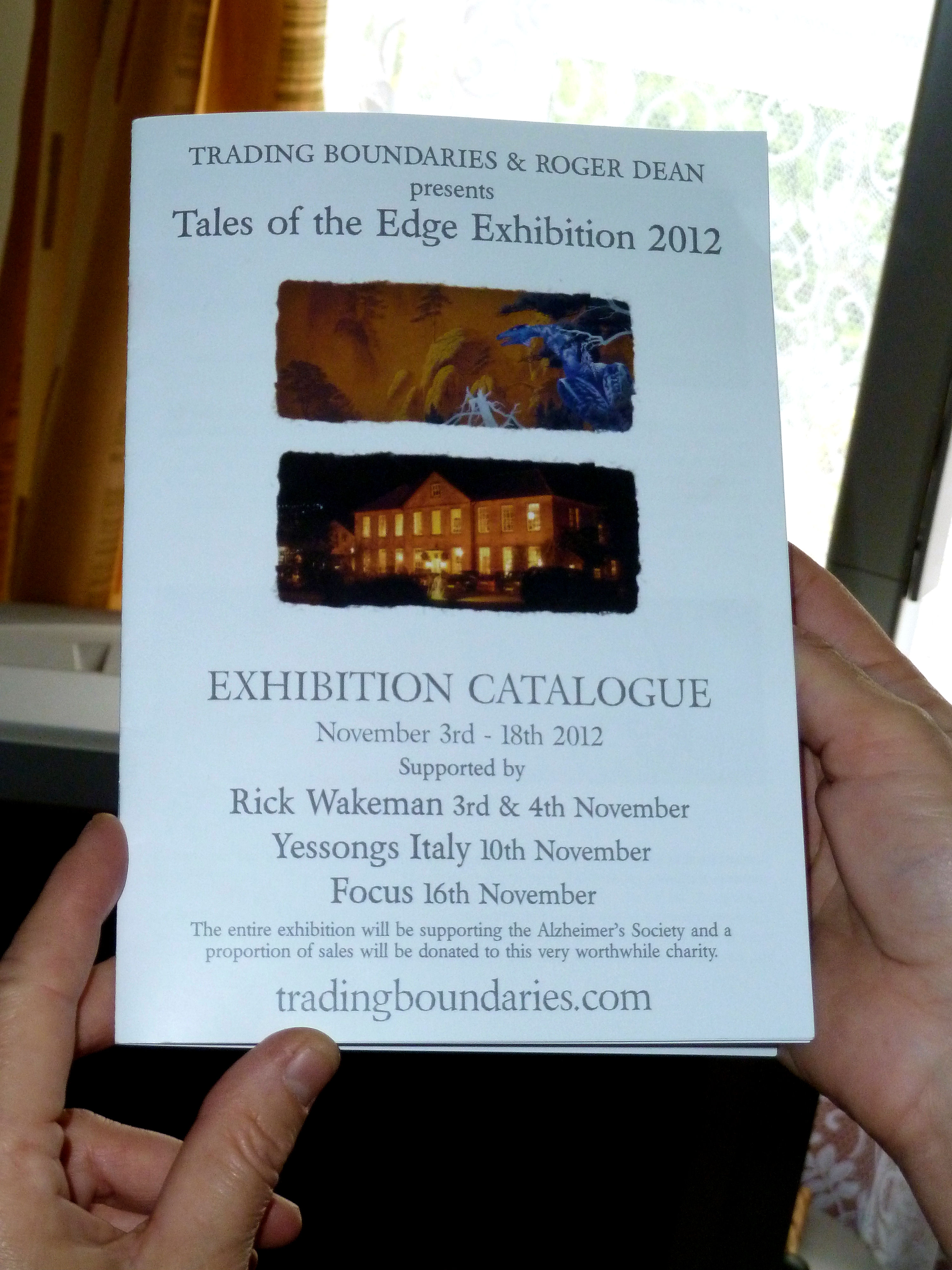
Tucked away along the endless leafy lanes of south east England lies a little prog oasis not many people know about. The elegant Grade II Listed façade of the period home of Trading Boundaries in deepest East Sussex gives away no clues that it is currently the location of an exhibition of probably the most famous prog artist in the world who has been joined in the celebrations this weekend by a special “old friend” of his.

The name Roger Dean is synonymous with the iconic album covers of chiefly Yes, but also other great prog rock bands such as Asia, Uriah Heep, Greenslade and now the legendary Dutch band, Focus.

Yet Dean considers himself to be nothing more than a landscape artist. That is some diminution of his role in creating the entire backdrop for a generation of prog rock lovers and perhaps being a huge influence on a very successful contemporary film but that is another story.

Living close by in the Ashdown Forest area of East Sussex, this is the third time Roger has exhibited his vast collection of work at Trading Boundaries.  And here in this shopping emporium among imported Indian wooden cabinets and wardrobes, soft furnishings and desirable trinkets are currently hung some of the most iconic examples of his work.

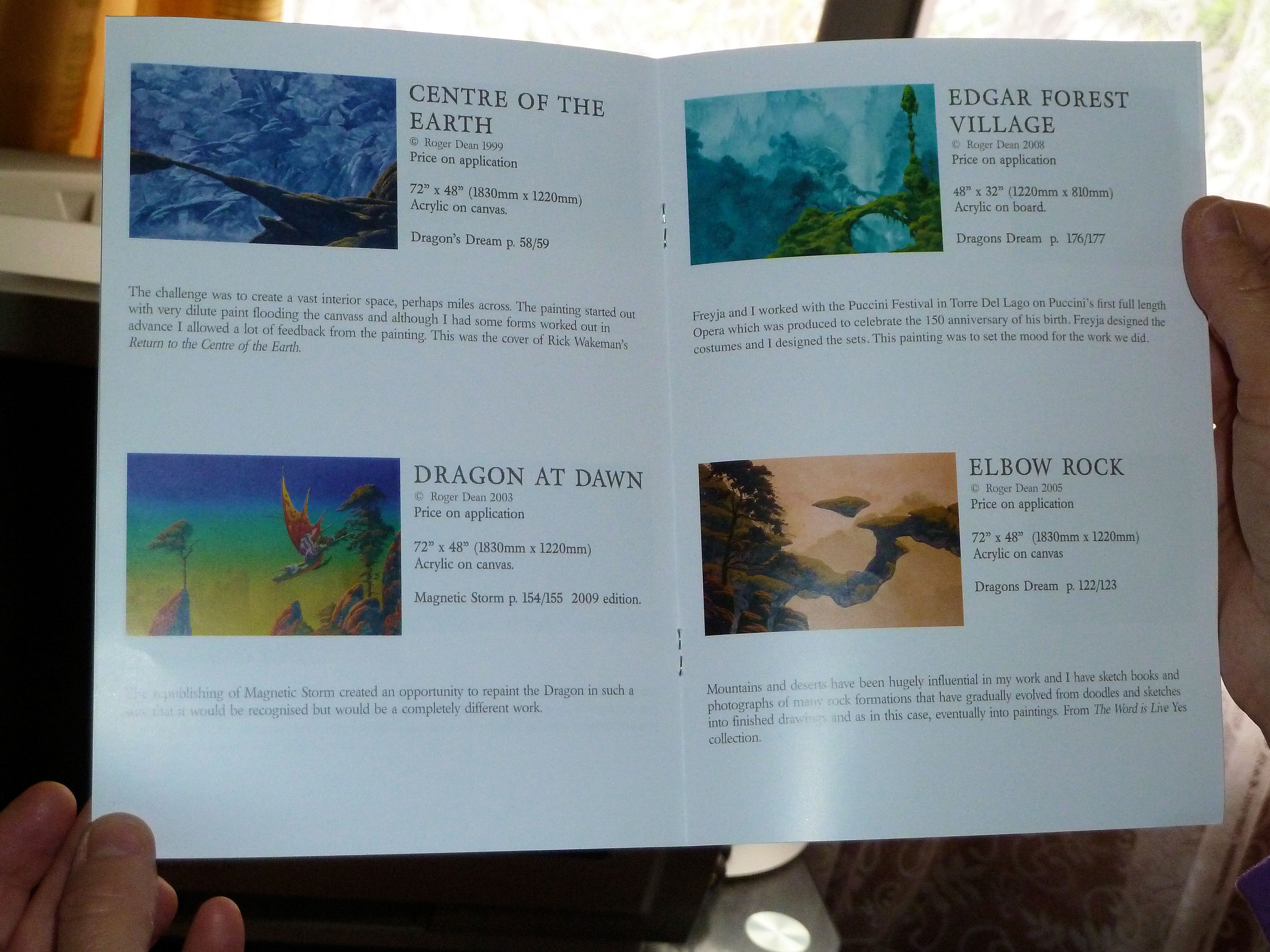
So around every corner currently, there is another Roger Dean masterpiece to lose yourself in ranging from the huge swirling blue inner landscape he developed for Rick Wakeman’s Return to the Centre of the Earth to the intensely intricate design for Asia’s Alpha which the artist explains brought out his inherent skills as a draughtsman.

There are also the suites of logos for Yes, including the more recent dragonfly designs, and for Asia, both of which demonstrate how important it is for a band to have its own identifiable branding especially when so beautifully conceived and crafted by Dean.

Of all the works, it is the cover of Tales From Topographic  Oceans which still draws the eye the most. That whole universe captured in one panorama throws up so many visual questions. Is it all meant to be beneath the sea – hence fish – or how can it be when there is a waterfall running through it – and what about the distant pyramid and the blueness of the heavens above? Like the contents of the album, the image is a mystery, a conundrum and above all else, a journey.

Oh yes, and did I mention earlier on that an old friend joined him? That would have been one and only Mr Wakeman who has supported him both evenings this weekend in Trading Boundaries’ intimate and atmospheric Elephant Cafė, (Carl Palmer, John Wetton and Steve Hackett have also played there recently), to reflect and reminisce on the past as well as contributing  three musical interludes.

Well, the stories and laughs flowed thick and fast, most of them worthy of a separate post once I have deciphered the shorthand hieroglyphics  I took down at speed in virtual darkness, so allow me some time to translate and share them with you some other time.

However, I can tell you this. Despite christening it Toby’s Graphic Go-Kart, Rick rates TFTO is his favourite Yes album cover whereas the artist has gone for Relayer which he said looks as though it has been painted “with dirty water”.

Also, the first time Roger showed the band an example of his work to use, Rick was admiring it and said how nice it was until the artist told him he was holding it upside down.

What came over loud and clear however was the tremendous mutual admiration and respect between the pair throughout this impromptu chat, conducted on a couple of easy chairs with the emporium’s dog occasionally wandering onto the stage and stealing the show.

And yes, Rick played – though only just when he was presented with the resident “school” piano, which in his own inimitable way, made it sound like a Steinway.

To a backdrop of even more of Roger Dean’s incomparable works, Rick played “And You And I” using some of the original chord sequences. Well, need I tell you how absolutely sublime it sounded and still as hypnotic as the version which we all now have in our collections. Then he just made us all melt with The Meeting, that gorgeous prog hymn from Anderson Bruford Wakeman and Howe (ABWH). Rick explained he and Jon had been at George Martin’s studio in Monserrat before the volcanic eruption where they recorded the album. Both liked the idea of trying to create instant music so the melody line was what they came up with and the very first take was what appeared on the album. He made it all sound so simple, of course.

Finally, to end on a more light-hearted note, he decided to play The Nursery Rhyme Concerto using the style of the great composers such as Mozart for Baa Baa Black Sheep and Ravel’s Hickory Dickory Dock.  British readers will be particularly interested to learn that Twinkle Twinkle Little Star was performed in the style of Dawson, Les Dawson. Note to American readers, Google Les Dawson piano – you’ll get the general idea!

Well, that was certainly an evening you never imagined would happen. And it does not end there either.  As part of the exhibition events, both top tribute band Yessongs Italy and also Focus will be playing live there in the next three weeks. What a wonderful way to celebrate a man who drew on his own unique imagination to inspire ours and also that of the music which shaped our lives.

For more information, go to: http://online.tradingboundaries.com/rdex2012


Threnodic Introspections in Neverland: The Reasoning

Call me a total nerd (and it would be true, for better or worse), but I experience a thrill every time I meet a new word.  Hello new word, I’m Brad.  Well, ok, I’m generally not quite this formal, especially with vocabulary.

With The Reasoning’s newest masterpiece, Adventures in Neverland, I had to look up the word, “Threnody.”  A funeral dirge.  For the previous EP, And Another Thing, I had to look up “Apophenia.”  A false perception of patterns.

Nice.

From the first moments I can remember listening to Progressive Rock, I have always appreciated not only the intelligence and creativity espoused by the artists themselves, but I’ve also loved the ways in which prog artists demand a certain intelligence and creativity on the part of the listener.

If I’m going to spend any where from thirty minutes to 120 minutes listening to something, I want full immersion.

Every The Reasoning album is a full immersion into the wonderful and meaningful ream of art–by design and certainly without apology.  “Here we are,” Matt, Rachel, and the gang seem to be proclaiming.  “We’ve given you everything we have, and we very much hope you enjoy it as well.  Regardless, we’re having a blast.”

And enjoy it I do, Matt and Rachel.  Every album, every song, every time.

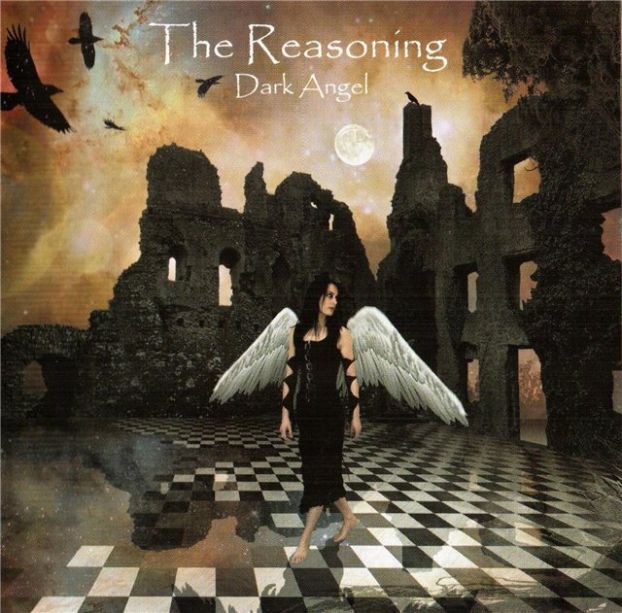
I first encountered their music in 2008 with the release of their second album, Dark Angel.  No mediocre band would give themselves such a lofty name, I correctly assumed.  I was equally intrigued by the title and cover of that album.

The cover itself is worth describing (and I’ll paste a picture of it here, I hope–please wordpress, please!).  A gorgeous, leather-clad, barefooted, winged woman walks across black and white tile (my first thought is a chessboard) in the ruins of a castle or cathedral, with a full moon and ravens above her.  A few planets hover in the background, as does a small glimpse of a renaissance village, and the floor decays as the angel moves forward, away from the village.

Since that moment four years ago, I’ve purchased everything The Reasoning has recorded in the studio, including their haunting cover of Duran Duran’s best song, “The Chauffeur.”

The first album, Awakening, appeared in 2006.  Dark Angel came out in 2008, and the Duran Duran cover in 2009.  In 2010, The Reasoning released Adverse Camber.  This year, The Reasoning released the EP, And Another Thing, in the spring, and Adventures in Neverland just about a month ago.  These guys are unstoppable.  And, we’re all the better for it.

The newest album, Adventures in Neverland, lives up to every one of my very high expectations.  From the opening moment–guitar, keyboards, and a countdown–until the last note, Adventures in Neverland drives and rocks.  It is a truly great album.  Superb in every way.

As it does move, it moves almost relentlessly, driving the listener toward the Apocalypse.  Most of the music has been written by the bassist, Matt Cohen, and the lyrics have been penned by his wife, Rachel Cohen.

He’s clearly a perfectionist, one of the best bassists in rock, and a man driven.  Rachel’s clearly a brilliant and poetic wordsmith, possessed of a voice equal to her imagination.  I could listen to her sing me into the gates of heaven itself.

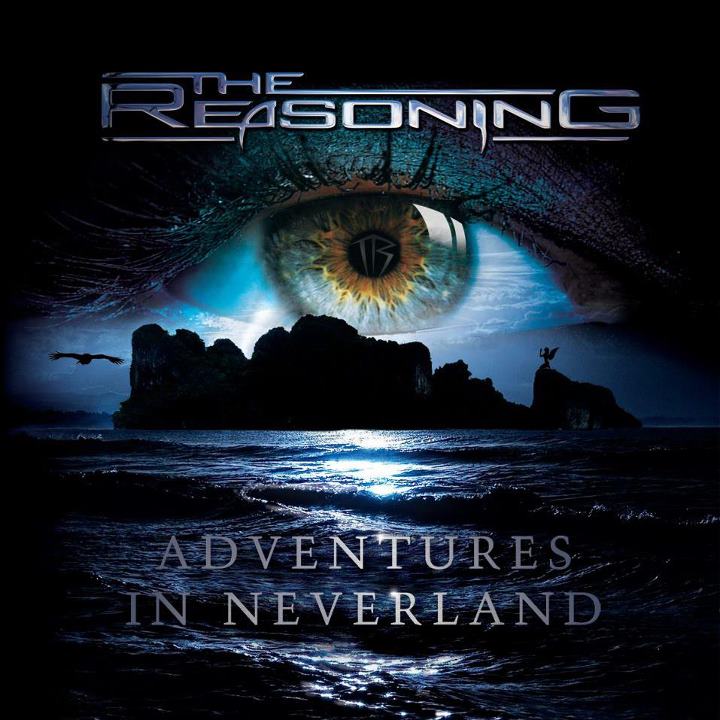
As with other The Reasoning releases, the cover of the new CD is inviting, if a bit ominous.  It appears, visually, to be a sequel to Dark Angel.  Rather than seeing the angel cross the ruins from inside of the ruins, the viewer sees the ruins (most likely) from a great distance, with birds still hovering but an omniscient eye overseeing it all, including what appears to be the Dark Angel atop the ruins themselves.  Fading at each end, the title: “Adventures in Neverland” hangs at the bottom.

Every song on Adventures in Neverland is a gem:

1. HYPERDRIVE

2. THE OMEGA POINT

3. THE GLASS HALF

4. STOP THE CLOCK

5. OTHERWORLD

6. END OF DAYS

7. NO FRIEND OF MINE

8. THRENODY

9. FOREST OF HANDS AND TEETH

10. ADVENTURES IN NEVERLAND

If you’re happy with this new wave of progressive rock (Brian Watson of DPRP fame called it the “third wave”), you’ll be especially happy with The Reasoning.  For me, they’re an intimate part of the revival.  They’re leading, and they’re leading very well.

Every reader of Progarchy should support The Reasoning.  Here’s the official website (click here).

As a sidenote, I have also followed Matt Cohen (@thereasoning) on Twitter and Facebook for quite some time.  The guy is absolutely hilarious, down to earth, and extremely talented.  He also calls things as he sees them.  In other words, he’s not just a great artist, he’s a real person.

Join Neal Morse’s Inner Circle for Free right now.

Excellent news from Radiant Record’s Chris Thompson.  Join the Inner Circle for free and get the new Inner Circle release, Neal’s take on Flying Colors.

Click here!

Happy Halloween (Santa vs. Frankinstein from Radiant Records)

Thank you Neal Morse and Radiant Records for some great music and some visual levity.

Frankincense

New Cosmograf, 62 days away

ImageVery exciting news.  Robin Armstrong (fountainhead of COSMOGRAF) has just updated his website site with a countdown clock for the new album.  62 days and counting.   Order early and often–I promise it will be far more exciting than the outcome of the American presidential elections.
http://www.cosmograf.com/countdown-to-launch/

First Ever Progarchy Competition begins NOW

Image
Photo courtesy of Cracked.com.

I’m happy to announce our first ever Progarchy competition.  The prizes: cds of Rush, “Clockwork Angels”; Big Big Train, “English Electric Part One”; and The Reasoning, “Adventures in Neverland.”

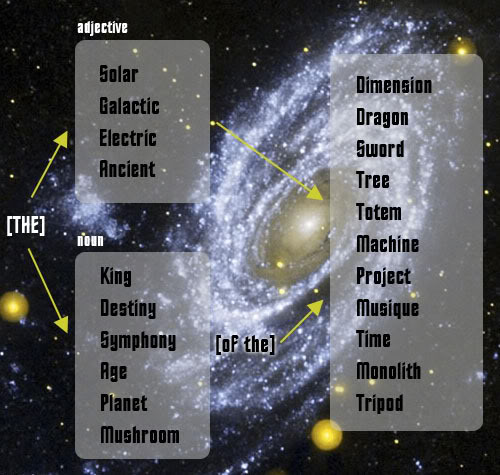
The contest (brain child of my friend, Seth James): 1) come up with the best name for a prog band.  2) come up with the most absurd name for a prog band.  Do not use names of actual bands (past or present).  These must be original.  No need to distinguish, however, which is best and which is absurd.  

The judges will be the Progarchists, and we will announce the winner on the Ides of December.

So, to enter, just comment below–name of the band and a way to get ahold of you.  Competition ends on December 8, 2012.

Nick D’Virgilio News

Thanks to Prog for posting this:

http://www.progrockmag.com/news/nick-dvirgilio-not-giving-up-on-spocks-beard-reunion/

A Prog Awakening (Part 1)

I suppose it is inevitable that kids encounter music first through the filter of parents’ or siblings’ tastes. That was certainly true in my case. In the early 70s, the meagre set of records owned by my mum and stepdad was my only window onto the world of music. I remember several LPs by Elton John and Rod Stewart, the odd one or two by The Beatles and The Stones, also The Carpenters, John Denver, Mama Cass…

At some point, I began to assert my musical independence and sought out new sounds. At that time in the UK, the main channels for hearing new ‘popular music’ were Radio 1 and the TV show Top Of The Pops. Like most kids, I listened to ‘The Charts’ and had little awareness of anything else. Glam rock and disco had no appeal, but then punk and ‘New Wave’ came on the scene. Like many young people of that era, I found the energy and non-conformist attitude of these new genres incredibly exciting. For the first time in my life, I starting buying my own music: 7″ singles by The Clash, Buzzcocks, The Stranglers, Siouxsie & The Banshees…

Yet the signs were there that I would soon move on to other things. In amongst all that punk were singles by rock acts such as The Who, Queen and Nazareth. Further clues were to be found in my fascination with three albums from my stepdad’s otherwise middle-of-the-road collection. The first of these was a cassette of Pink Floyd’s seminal Dark Side Of The Moon. I forget when I first heard this, but it was before I started buying singles: probably 1975, certainly no later than 1976. I used to sit in the corner of the living room with headphones on, bewitched by the stereo sound effects as much as the epic qualities of the music. I hadn’t realised just how well-crafted music could be until that point.

The second of these intriguing albums was a Focus ‘greatest hits’ compilation – one of Polydor’s ‘Rock Flashback’ series. The cover was awful – fluorescent yellow with the band name spray-painted in green above a skewed, oddly-tinted band photo – but the music more than made up for that. There was so much to enjoy here: Jan Akkerman’s incredibly fluid and inventive guitar playing, Thijs van Leer’s unhinged, operatic performance on Hocus Pocus… In its own way, this was every bit as exciting as the punk that would very soon inspire me to start buying records. Focus remain a favourite of mine to this day, and Sylvia would almost certainly feature as one of my ‘Desert Island Discs’.

And the third of these influential albums? None other than Tangerine Dream’s Atem, completely unlike anything else in my stepdad’s collection. I suspect he saw it going cheap somewhere and bought it on the strength of the artwork. I doubt that he liked what he heard! He played the track Wahn for me, probably in the expectation that I would be shocked by its weirdness. I certainly found it challenging, but it was also strangely compelling. It was a tentative start to what would eventually become an infatuation with TD’s 1970s and 1980s material.

The transition period for me can be roughly dated as late 1978 to early 1979. Before that period, I was a chart-listening, single-buying slave to musical fashion who occasionally managed to reach beyond such superficiality and touch something deeper and more meaningful in music; after that period, I considered myself a serious music fan – album-focused, interested in seeking out new music for its own sake rather than its popularity, ready for the transcendent experiences of witnessing my favourite bands performing live.

That daunting leap from punk to prog was made via the convenient stepping stone of hard rock, principally in the form of Led Zeppelin and Deep Purple. The first rock album I owned was, in fact, Zeppelin’s The Song Remains The Same – a present from Christmas 1978, I think. I no longer recall the precise chronology of my musical discoveries, but I still remember all of the vinyl LPs that were added to my burgeoning collection over that period from Christmas ’78 to my fourteenth birthday in July ’79: the first post-Hackett Genesis album, And Then There Were Three; Pink Floyd’s Wish You Were Here; Paris by Supertramp; Mike Oldfield’s Exposed; and 2112 by Rush. The latter, in particular, had a profound effect on me. I think Side 1 of 2112 was probably my first encounter with a true prog epic. Rush have been one of my favourite bands ever since.

Coming up in Part 2: My own musical ‘Cambrian explosion’ of 1979-1981, and my first gigs…