Grateful for my beloved wife, son, daughter-in-law, grandchildren and siblings. Also a lover of theology, music, history, philosophy, classic novels, science fiction, fantasy and Looney Tunes.
In case you hadn’t noticed, the last quarter of 2018 has put paid to any perceived drought of new releases & reissues. Capsule reviews of what I’ve been listening to since the first of this month follow the jump; albums are reviewed in descending order on my Personal Proggyness Perception (PPP) scale, scored from 0 to 10.
As announced on — appropriately enough — October 31, Pink Floyd drummer Nick Mason will bring his new band Saucerful of Secrets (or, in an example of Mason’s typically dry wit, “Not The Australian Roger Waters”) to North America in the spring of 2019. The tour will mark Mason’s first live shows in the Western Hemisphere since Floyd’s Division Bell extravanganza prowled the continent’s football stadiums back in 1994.
With the blessing of both Roger Waters and David Gilmour in his back pocket, Mason is focusing on pre-Dark Side of the Moon Floyd; setlists for SoS’ shows have included tracks from Piper at the Gates of Dawn, A Saucerful of Secrets, Atom Heart Mother, More, Meddle and Obscured by Clouds, along with early Floyd singles and B-sides. In Mason’s words, “With the help of some like-minded friends, I have embarked on a voyage of discovery of the music that was the launchpad of Pink Floyd and my working life. It seems too early to retire, and I missed the interaction with other musicians.”
Debuting with four small London gigs this past May, Saucerful of Secrets completed a European theater tour in September. The North American tour will be similar in scope, with Mason and his cohorts (Blockheads guitarist Lee Harris, Spandau Ballet guitarist/vocalist Gary Kemp, post-Roger Waters Floyd bassist Guy Pratt and Transit Kings keyboardist Dom Beken) bringing their show to 2500-3500 seat venues.
Presales for the first block of shows have already begun, with public sales starting on Monday, November 5. Tour dates are listed below; more info is available at Ticketmaster.
March 12, 2019 – Vancouver, BC @ Queen Elizabeth Theatre
March 13 – Seattle, WA @ The Paramount
March 15 – San Francisco, CA @ The Masonic
March 16 – Los Angeles, CA @ The Wiltern
March 19 – Phoenix, AZ @ Comerica Theatre
March 21 – Denver, CO @ Paramount Theatre
March 24 – Dallas, TX @ The Pavilion at Toyota Music Factory
March 25 – Houston, TX @ Jones Hall for the Performing Arts
March 27 – Miami Beach, FL @ Fillmore Miami Beach at the Jackie Gleason Theater
March 29 – Atlanta, GA @ Tabernacle
March 31 – St. Louis, MO @ Stifel Theatre
April 1 – Milwaukee, WI @ The Riverside Theater
April 3 – Minneapolis, MN @ Orpheum Theatre
April 4 – Chicago, IL @ The Chicago Theatre
April 5 – Indianapolis, IN @ The Old National Centre
April 7 – Columbus, OH @ Palace Theatre
April 8 – Akron, OH @ Akron Civic Theatre
April 9 -Detroit, MI @ The Fillmore Detroit
April 11 – Buffalo, NY @ Shea’s Performing Arts Center
April 12 – Wallingford, CT @ Oakdale Theatre
April 13 – Boston, MA @ Orpheum Theatre
April 15 – Montreal, QC @ Place des Arts
April 16 – Toronto, ON @ Sony Centre for the Performing Arts
April 18 – New York, NY @ Beacon Theatre
April 22 – Washington, DC @ DAR Constitution Hall
(And yes, having experienced The Division Bell-era Floyd in concert at the late unlamented Pontiac Silverdome — the only rock show I’ve ever attended where, even at full volume, I was able to go without earplugs for the entire night — I grabbed a ticket for the Chicago stop today.)
If you want a generous sample of what Nick Mason’s Saucerful of Secrets has to offer, check out their recent Copenhagen show:
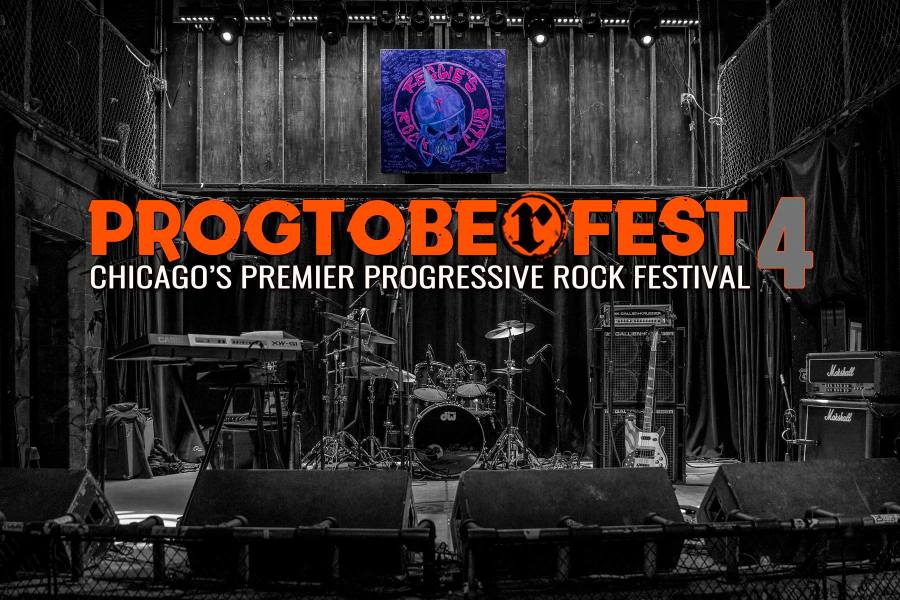
As I exited the CTA Green Line on a crisp, clear Chicago Sunday, Reggie’s Rock Club and Music Joint beckoned with the promise of Progtoberfest’s final day: twelve hours of sixteen bands on two stages. Constantly unfolding delight or endless endurance test? Only one way to find out.
(Notes for after the jump: links are provided to bands’ online presence — website, Facebook or Bandcamp pages — wherever possible. An asterisk [*] by a band’s name means I bought one or more of their CDs at the event; A cross [+] means the band didn’t have CDs for sale — but their music is now on my want list. Here we go …)
Due to the delights and demands of daily life, my second annual visit to Chicago’s Progtoberfest couldn’t be as extensive as last year’s threedayblowout. Originally, I was only going to take in Sunday, in order to experience Soft Machine’s 50th anniversary tour of the USA. But an unexpected schedule opening let me check out the Saturday night action at Reggie’s Rock Club on the Windy (and Sleety) City’s south side.
One of the reasons I added Saturday night to my itinerary was the return of North Carolina’s ABACAB – The Music of Genesis. This ambitious tribute band charmed Progtoberfest 3 with a complete run-through of 1977’s live Genesis album, Seconds Out. This year, the brief was even more demanding: celebrating Genesis’ 50th anniversary by counting back down the years a la Rush’s R40 tour.
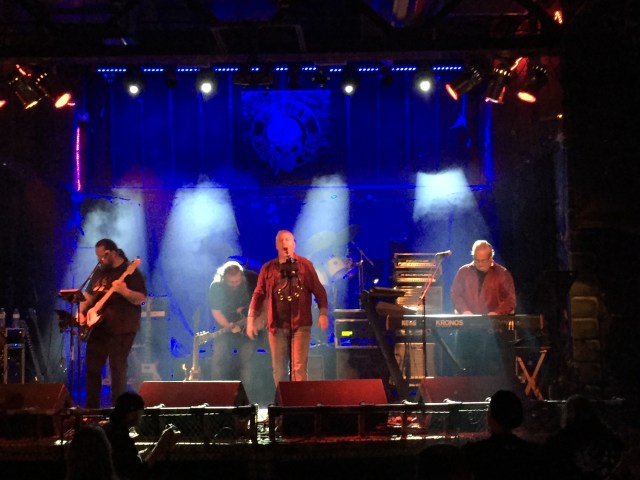
Given their time constraints, ABACAB opted to start with the 1981 Genesis track that gave them their name, then go back, back, back … Jaws dropped throughout the audience as they scaled the challenging heights of And Then There Were Three’s “Burning Rope,” Wind and Wuthering’s “Eleventh Earl of Mar” and the title track from A Trick of the Tail, never originally performed onstage. These choices all had special meanings for me: not only did I play “ABACAB” with my Alma College band The Run-Outs (shout out to Gadz, Jenny, Beef and the late great Joel Kimball), but “Burning Rope” and “Earl of Mar” were highlights of Genesis’ set when I saw them in 1978 at my first rock concert (also my first date)!
And the upward climb continued — Nick D’Virgilio (among his numerous credits, drummer on the final Genesis album Calling All Stations) hopped onstage, taking command to sing “In the Cage” from The Lamb Lies Down on Broadway with flair and power:
From that point on, ABACAB had the audience completely in their grasp, cruising through highlights of the Peter Gabriel years in high style, then finishing with “In the Beginning” from the 1968 schoolboy album From Genesis to Revelation. Singer Pete Lents, bassist/guitarist Cliff Stankiewicz, new guitarist James Nelson, keys man Patrick Raymaker and drummer Matthew Hedrick played with brio and precision throughout, and got an enthusiastic standing ovation for their sterling effort.
Another cool thing about Progtoberfest: how organizer Kevin Pollack draws on the incredibly talented musicians based in Chicago, including many who’ve played crucial roles in the development of jazz, rock and prog. Dinosaur Exhibit was a shining example of that talent on display — a seasoned “where are they now” octet featuring members of area bands The Flock, Aura and The Mauds; the prime draw was violinist Jerry Goodman, best known for his founding stint with John McLaughlin’s Mahavishnu Orchestra.
Given Goodman’s pedigree and track record, I’m not sure the Rock Club crowd (including members of Soft Machine leaning back against the soundboard) were ready for the horn-powered blue-eyed soul that kicked off Dinosaur Exhibit’s set. It was driving, vivid stuff , as vocalist Ben Cothran testified with the best and Goodman fiddled up a storm — but you could almost see the “is this really prog?” thought balloons forming over the audience’s heads. The rest of the set (pioneering Goodman fusion originals like “Brick Chicken”, an admirably psychedelic take on “I Am the Walrus” and a viciously swinging “Theme from ‘Perry Mason'” finale) were more in that expected wheelhouse, though, and DE ultimately got the extended applause they deserved.
Which left Neal Morse as the evening’s closer, climbing onstage for a solo set on vocals, acoustic guitar, keyboard, percussion and looping software. As always, Morse was engaging and impressive, using his sonic arsenal to present songs from his new Life and Times, along with impressive takes on solo material (the multi-layered overture/finale sequence from ?), tunes by Transatlantic (“Stranger in Your Soul,” an impromptu “We All Need Some Light”) and Spock’s Beard (“Thoughts Pt. I & II,” done entirely with vocal loops).
Morse’s improvisatory opener “Songs of Freedom,” incorporating riffs from both Black Sabbath and Yes, established a loose, fun tone for the set — best encapsulated when he brought “Selfie in the Square” to a shuddering halt, then spent 10 minutes pulling tunes by Coldplay, Donovan and The Beatles out of his head, all because he couldn’t help singing the word “yellow” with an British accent! This wasn’t the high-energy, goal-directed path of concept albums like Testimony and The Similitude of a Dream; it was a relaxed, meandering vibe, in keeping with the smaller crowd, the quieter sound palette and the lateness of the hour. It was delightful to catch Morse off his guard and having more sheer fun than usual, with every bit of his heartfelt lyricism and musical brilliance still there for us to enjoy. (After I left to catch the train, Nick D’Virgilio hopped back onstage to harmonize with Neal on Spock’s Beard standards “The Doorway” and “Wind at My Back.”)
The other great part of my Progtoberfest sojourn was catching up with fellow fans I connected with last year from West Michigan, Kentucky, St. Louis, Wisconsin and beyond. More about that next time, as well as covering the lineup for Day 3 — sixteen bands on two stages in twelve hours. Stay tuned …
Jazz shouldn’t have any mandates. Jazz is not supposed to be something that’s required to sound like jazz. For me, the word ‘jazz’ means, ‘I dare you.’
Wayne Shorter, the last saxophonist standing from jazz’s golden age, its great lateral thinker both as player and composer, tossed off that quote in 2013 when he turned 80. For his 85th birthday, Shorter has tripled down: his latest project Emanon breaches multiple boundaries, stretching out not just beyond jazz, but beyond music itself.
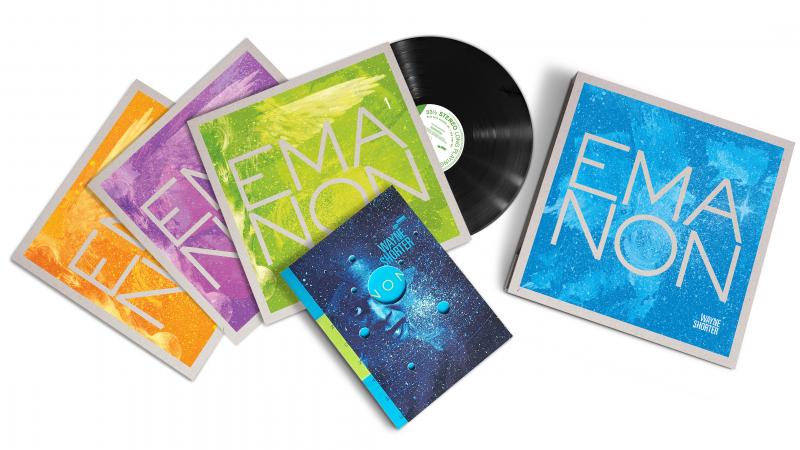
Emanon (“no name” spelled backwards, referencing both a Dizzy Gillespie tune and Ralph Ellison’s Invisible Man) is a marvelously ambitious sprawl, Shorter’s stab at a work of total art. Containing a 2013 suite of his music re-imagined for jazz quartet and chamber orchestra, a double album of his quartet’s 2016 live date in London, and a graphic novel in collaboration with screenwriter Monica Sly and comic/children’s book artist Randy DuBurke, it’s meant to be heard and seen as a whole. Also touched — it’s not available digitally, only in CD (Standard) or CD/LP (Deluxe) box sets. Or as Shorter puts it, “The packaging is intentionally designed to reveal its dormant possibilities as it travels between alternative realities of the multiverse.” Sounds kinda progressive to me …
MC50 at 20 Monroe Live, Grand Rapids, Michigan, September 22, 2018.
Brothers and sisters, I wanna see a sea of hands out there … I want everybody to kick up some noise, I wanna hear some revolution … Brothers and sisters, the time has come for each and every one of you to decide whether you are going to be the problem or you are going to be the solution! You must choose, brothers, you must choose. It takes five seconds, five seconds of decision, five seconds to realize your purpose here on the planet. It takes five seconds to realize that its time to move, it’s time to get down with it. Brothers, it’s time to testify. And I want to know – are you ready to testify? Are you ready!! I give you a testimonial. THE MC5!!
As Brother J.C. Crawford’s ghostly, prerecorded invocation echoed in our ears, Wayne Kramer welcomed his audience (including me, my older brother, and my friends from high school and college) with a giant grin, a wicked riff from his Stars and Stripes Stratocaster, and the unmistakable, hyped-up grind of “Ramblin Rose.” Surfing a bone-shaking wave of sound, Kramer joyously belted out a raucous vocal, reeling off exhilarating solo licks on the Strat between verses. Almost 50 years after Detroit’s original punks recorded their live debut album Kick Out the Jams, the evening already promised to live up to the MC5’s formidable legend.
“Kick Out the Jams” itself quickly followed, with Zen Guerrilla’s Marcus Durant taking over on vocals, channeling MC5 singer Rob Tyner’s throaty, soulful delivery, stoking us up to dance and shout along. On this and “Come Together”, Kramer locked in with Soundgarden’s Kim Thayil for a meaty twin guitar punch a la Fred “Sonic” Smith; meanwhile, Faith No More bassist Billy Gould and Fugazi drummer Brendan Canty laid down deep irresistible grooves, vibrating human bodies and rattling the concrete floor. This was hard rock honed to a keen point — recklessly idealistic, the barbaric yawp of youth refined by decades of hard knocks, dearly bought wisdom, revived dedication to craft and killer instinct. Plus the obvious determination to give the crowd a good time.
What new music, live albums, and reissues (deluxe and otherwise) are heading our way between now and Black Friday? Check out the exhaustive (and possibly exhausting) sampling of promised progressive goodies — along with a few other personal priorities — below. Pre-order links are for CDs or combo packages; vinyl editions are frequently available from the same website.
September 21:
Marillion, Happiness is Cologne and Popular Music. Limited edition live reissues from Racket Records and earMusic. Pre-order at Amazon or other online retailers.
Nosound, Allow Yourself. Pre-order from Burning Shed.
September 28:
Blackfield, Open Mind (The Best of Blackfield). Pre-order from Burning Shed.
Dave Stewart and Barbara Gaskin, Star Clocks. Pre-order from Burning Shed.
October 5:
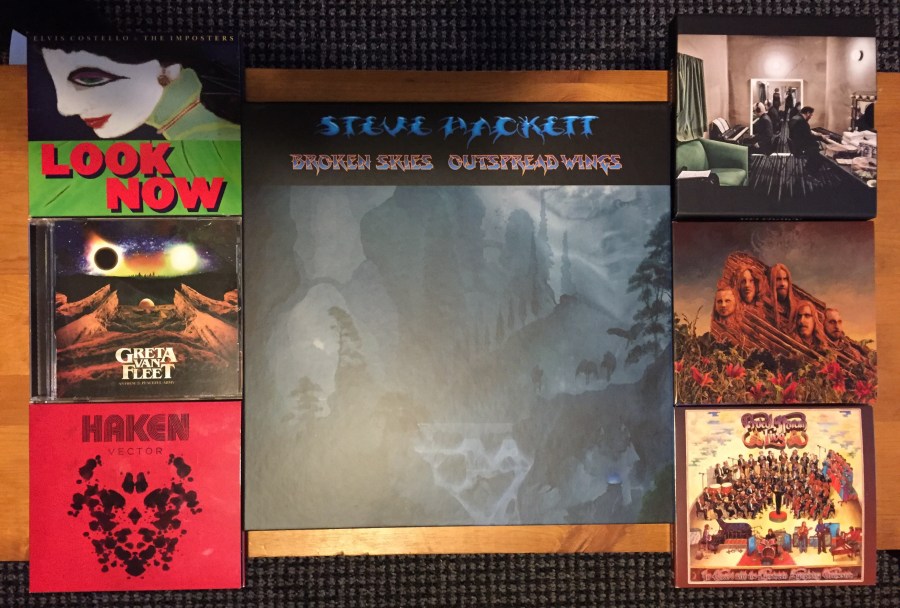
Steve Hackett, Broken Skies – Outspread Wings (1984-2006). Esoteric Recordings reissue box set (6 CDs + 2 DVDs). Pre-order autographed copies from Hackettsongs.
King Crimson, Meltdown: Live in Mexico. 3 CDs + 1 BluRay. Pre-order from Burning Shed.
October 12:
Glass Hammer, Chronomonaut. Pre-order autographed copies or the deluxe bundle from Glass Hammer’s webstore. Pre-order deadline: October 11.
Sanguine Hum, Now We Have Power. Pre-order from Bandcamp.
October 19:
Greta Van Fleet, Anthem of the Peaceful Army. The first full-length album from Frankenmuth, Michigan’s young Zepheads. Pre-order at GvF’s webstore.
iamthemorning, Ocean Sounds. Live in the studio; audio/video bundle. Pre-order at Burning Shed.
In Continuum, Acceleration Theory. With Dave Kerzner and an all-star line-up. Pre-order bundles from Bandcamp.Pre-order deadline for special bundles: September 30.
Frank Sinatra, Only the Lonely: 60th Anniversary Edition. Yes, really. The greatest concept album of the pre-rock era, with Sinatra and arranger Nelson Riddle at their most gorgeous and devastating. “Make it one for my baby … and one more for the road.” More info at Super Deluxe Edition.
October 26:
Anathema, Internal Landscapes. The best of the band’s Kscope albums. Pre-order from Burning Shed.
Procol Harum, Live In Concert with the Edmonton Symphony Orchestra. Esoteric Recordings reissue with bonus tracks. Pre-order from Burning Shed.
November 2:
Opeth, Garden of the Titans: Live at Red Rocks Amphitheatre. Various audio & video formats/bundles available. Pre-order from Burning Shed.
Steven Wilson, Home Invasion: In Concert at the Royal Albert Hall. Various audio & video formats/bundles available. Pre-order from Burning Shed.
November 9:
Jethro Tull, This Was — The 50th Anniversary Edition. Steven Wilson remix included, on 3 CDs + DVD. Pre-order from Burning Shed.
Rikard Sjöblom’s Gungfly, Friendship. Pre-order from Rikard’s webstore.
November 16:
Marillion, Brave Live and Live in Glasgow. Limited edition live reissues from Racket Records and earMusic. Pre-order at Amazon or other online retailers.
It’s been a busy week at the mailbox and on the doorstep. With a clear day off, I decided to listen to all the new music I’ve received since Monday. Capsule reviews follow the jump; albums are reviewed in their descending order on my freshly made up Personal Proggyness Perception (PPP) scale, scored from 0 to 10.
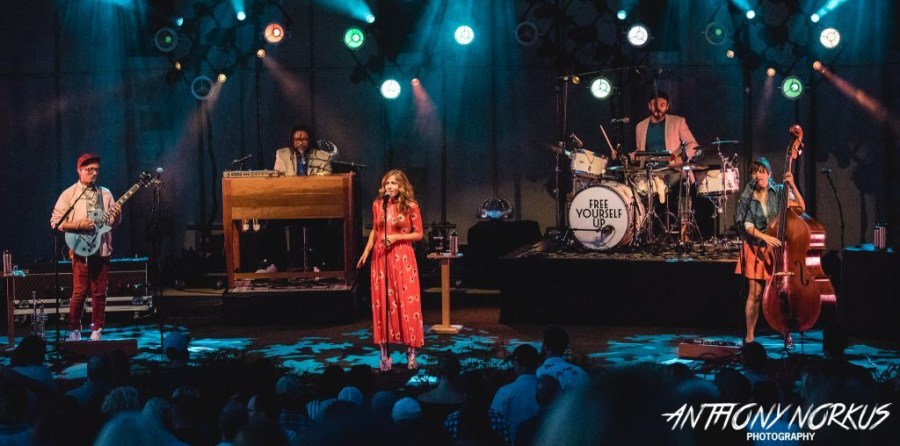
Lake Street Dive at Frederik Meijer Gardens Amphitheater, Grand Rapids, Michigan, August 30, 2018.
Boston-founded, Brooklyn-based pop’n’soul band Lake Street Dive has swiftly become a quintessential Meijer Gardens act — debuting in 2015, returning every year since, regularly selling out shows even though their ticket prices have doubled in just four years. (The quintessential Meijer Gardens act? Undoubtedly Lyle Lovett, who’s appeared during 13 of the Amphitheater’s 16 seasons.)
In that time span vocalist Rachael Price, guitarist/trumpeter Mike “McDuck” Olson, stand-up bassist Bridget Kearney and drummer Mike Calabrese have seasoned their initial Motown-meets-Beatles stylings with funk and disco flavors, signed with quirky Warner Music imprint Nonesuch, added keyboardist Akie Bermiss as a full member, and scored a top 10 album, 2018’s Free Yourself Up. With 2,000 fans spanning the generations in attendance, this show was set to be a celebration — by both players and audience — of the band coming into its own.
From my point of view, they delivered; the night felt like the most fun of the three Lake Street Dive shows I’ve heard. The simple choice of having Calabrese’s drum kit face the audience (instead of toward stage right) seemed to open a more direct connection between the group and the crowd. And with four albums to choose from, the setlist felt like it flowed better, with more variety in the moods and grooves, consistent forward motion, and a gathering momentum.
Throughout the night, Bermiss’ pads, rhythms and synth licks gave Olson leave to be looser on guitar and play more solo trumpet, and Calabrese’s drumming was splashier and more extroverted. Playing to their respective strengths, Kearney held down the bottom end with solidity and style, while Price cooed, cajoled, tempted and triumphed, delivering alternately sassy and lovelorn reports from the front lines of 21st-century romance. Multi-part harmonies were spot on throughout the night, with Bermiss contributing a winning lead vocal on a typically oddball cover, Shania Twain’s “You’re Still the One.” Other eccentric ideas like a triptych of songs about the same loser (“Bobby Tanqueray/Spectacular Failure/Doesn’t Even Matter Now”) and the microsuite “Seventeen” came off without a hitch, too. By the encore, as Price soared on the driving “Dude” then simmered through the lounge jazz take on the Jackson 5’s “I Want You Back” that brought Lake Street Dive to prominence, I was convinced — this had been a great evening. And the audience response seemed to bear that out.
Except for one thing: my friend from college — who’d first brought Lake Street Dive to my attention, who consistently raves about their abilities, who’s attended all their Meijer Gardens shows with me, whose musical opinions I deeply respect — wasn’t convinced. And he had fair points to make. For one thing, the live sound was substantially louder and boomier than on previous visits — I realized that, on the uptempo tunes, I’d been compensating by listening through the low end fuzz and haze to hear the harmony vocals or Kearney’s detailed bass work. In addition, the thicker, chunkier sound of the Dive’s quintet formation just didn’t work for him; while acknowledging Bermiss’ ability and musicianship, he strongly prefers the open space and freer interplay of the original quartet. And both of us agree that the band’s writing could use a shot in the arm — all the onstage energy pumped life into the new tunes, but on disc both the Nonesuch albums (Side Pony and Free Yourself Up) run out of steam before they run out of songs.
So while I enjoyed the evening, this show also served another purpose — illustrating that “in matters of taste, there can be no dispute” — de gustibus non est disputandum, for any Latin majors. Both of us had strong opinions of the show — and the cool thing was that we could talk through them without feeling like we had to convince the other to abandon his point of view. Probably good for me to remember the next time one of those classic online prog-rock discussions (“Was Genesis any good after Peter Gabriel and Steve Hackett left? Did Trevor Rabin ruin Yes? Was Signals where Rush jumped the shark?”*) break out.
And, since “in matters of taste, there can be no dispute,” I do think that both my friend and I would encourage you to check out Lake Street Dive —- on record and live — for yourself. You can also check out another local review of the show, with an extensive photo gallery, here. The setlist:
Baby, Don’t Leave Me Alone with My Thoughts
You Are Free
I Don’t Care About You
Red Light Kisses
Mistakes
Bobby Tanqueray
Spectacular Failure
Doesn’t Even Matter Now
Hello? Goodbye!
Hang On
I Can Change
You’re Still the One
Call Off Your Dogs
Seventeen
Shame, Shame, Shame
Musta Been Something
Bad Self Portraits
Good Kisser
You Go Down Smooth
Dude
I Want You Back
— Rick Krueger
*- For the record, my answers are: yes; no; and absolutely not.
Toto at Frederik Meijer Gardens Amphitheatre, Grand Rapids Michigan, August 24, 2018.
Toto’s sold out my local outdoor shed twice in the past three years. Last time through, they stacked the deck, playing plenty of hits and radio favorites. This year, with the anniversary compilation 40 Trips Around the Sun to flog, they took more chances with a deep-cut setlist, a semi-acoustic storytellers interlude, and extended displays of their fearsome chops. Riding a fresh wave of Internet love, they could do no wrong for the hyped-up crowd.
And the same held true for me; I’ve always had a soft spot in my heart (and possibly my critical faculties) for Toto. A posse of Los Angeles studio aces melding Steely Dan’s shuffles, Boz Scaggs’ blue-eyed soul, crunchy proto-Van Halen guitar and proggy synthesizer fanfares, with the mission statement (from founding drummer Jeff Porcaro in Rolling Stone) “craft is content”? No wonder rock critics hated their guts, especially when when they got triple platinum sales out of the box. Their goal was to make sleek, catchy pop with a touch of musical ambition, get on radio and move records — not bare their souls, change the world, or even necessarily write sensible lyrics. There’s an odd, appealing purity to that aim, no matter how calculated the strategy.
Top 40 radio courts a different sound these days, but Toto still has a knack for the killer hook; kicking off, new songs “Alone” and “Spanish Sea” were every bit as engaging as the singalong version of “Hold the Line” and Toto IV’s “Lovers of the Night” that they framed. Following spirited takes of tracks from forgotten-stepchild albums like Tambu and Turn Back, the band lit the fuse on Kingdom of Desire’s funky instrumental “Jake to the Bone;” guest keyboardist Dominique “Xavier” Talpin (subbing for founder David Paich) and guitarist Steve Lukather stoked their lengthly solos to the boiling point, while synth whiz Steve Porcaro and the rhythm section (Shem von Schroeck on bass, Shannon Forest on drums, Lenny Castro on percussion) simmered underneath. Building on the momentum, “Rosanna” was a foregone, happily welcomed conclusion to the first half, with singer Joseph Williams (the John Williams’ son! Really!) and sax man Warren Ham helping bring the crowd to their feet.
The storytellers interlude — with everyone sitting on stools and Lukather playing acoustic guitar — had its charms, even though the six selections (including Porcaro’s “Human Nature” from Michael Jackson’s Thriller) were truncated to keep things moving. Ramping up again, the band dove deeper into their catalog, holding the audience’s attention even through obscurities like the Dune soundtrack’s impressive “Desert Theme”. But in the end, past was all prologue; the moment Lukather shouted, “Are you ready for that song?” and Castro and Forrest launched the polyrhythms of “Africa,” Meijer Gardens went joyously, deliriously nuts. It was gonna take a lot to drag 2,000 fans away from that moment; they were all in — dancing, singing along, clapping during Castro’s exhilarating solo, chanting back and forth vocals with Williams, responding with a full-throated standing ovation. Hard to beat an extended moment of pop ecstasy like that — even if you’re frightened of this thing that you’ve become.
One quick and grungy cover of Weezer’s “Hash Pipe” later (sadly, without Rivers Cuomo or “Weird Al” Yankovic in sight), Toto was done, the crowd went home happy, and my streak of satisfying showsin 2018 was unbroken. Check out another review of the show, with an extensive photo gallery, here.




 Given their time constraints, ABACAB opted to start with the 1981 Genesis track that gave them their name, then go back, back, back … Jaws dropped throughout the audience as they scaled the challenging heights of And Then There Were Three’s “Burning Rope,” Wind and Wuthering’s “Eleventh Earl of Mar” and the title track from A Trick of the Tail, never originally performed onstage. These choices all had special meanings for me: not only did I play “ABACAB” with my Alma College band The Run-Outs (shout out to Gadz, Jenny, Beef and the late great Joel Kimball), but “Burning Rope” and “Earl of Mar” were highlights of Genesis’ set when I saw them in 1978 at my first rock concert (also my first date)!
 From that point on, ABACAB had the audience completely in their grasp, cruising through highlights of the Peter Gabriel years in high style, then finishing with “In the Beginning” from the 1968 schoolboy album From Genesis to Revelation. Singer Pete Lents, bassist/guitarist Cliff Stankiewicz, new guitarist James Nelson, keys man Patrick Raymaker and drummer Matthew Hedrick played with brio and precision throughout, and got an enthusiastic standing ovation for their sterling effort.
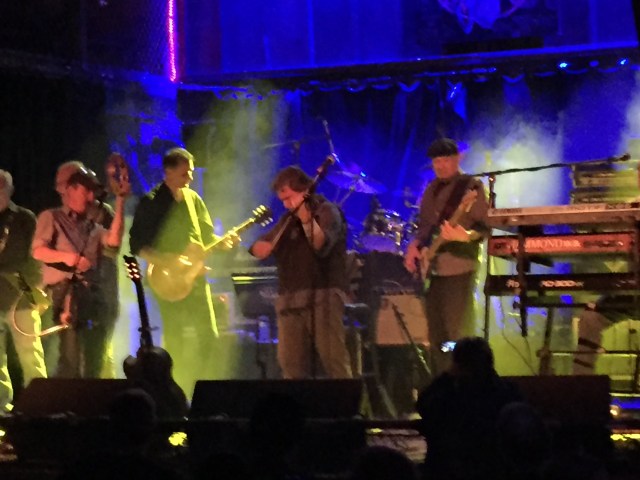 Given Goodman’s pedigree and track record, I’m not sure the Rock Club crowd (including members of Soft Machine leaning back against the soundboard) were ready for the horn-powered blue-eyed soul that kicked off Dinosaur Exhibit’s set. It was driving, vivid stuff , as vocalist Ben Cothran testified with the best and Goodman fiddled up a storm — but you could almost see the “is this really prog?” thought balloons forming over the audience’s heads. The rest of the set (pioneering Goodman fusion originals like “Brick Chicken”, an admirably psychedelic take on “I Am the Walrus” and a viciously swinging “Theme from ‘Perry Mason'” finale) were more in that expected wheelhouse, though, and DE ultimately got the extended applause they deserved.