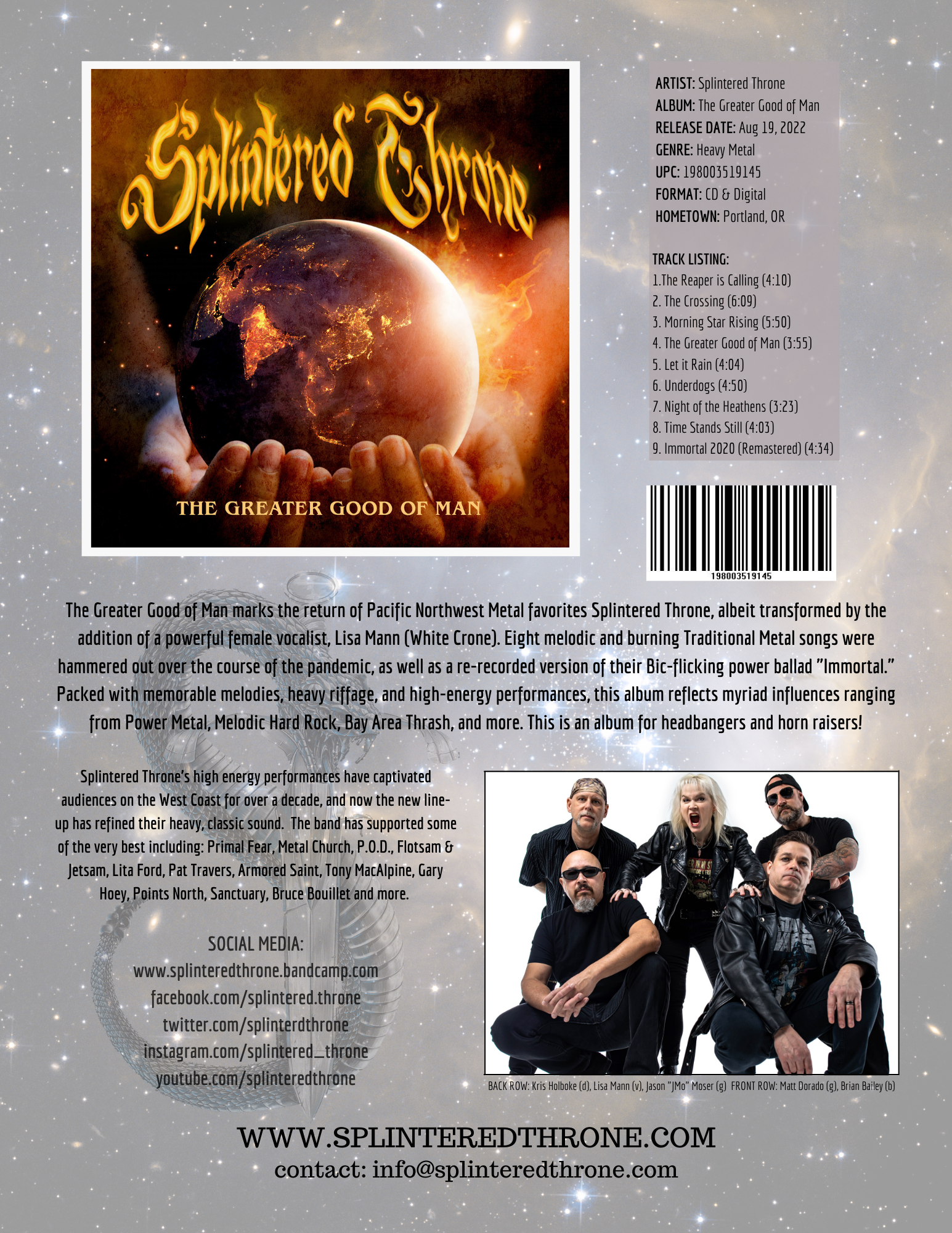
Rawr! Get ready for Splintered Throne’s new incarnation with vocalist Lisa Mann, whose solo album The Poisoner (recorded under her alias White Crone) was chosen here at Progarchy as one of the ten best albums of 2020.
Splintered Throne’s new single is coming this Friday, May 27, in advance of the whole album’s release on August 19. Check below for the full track list.
Keep an eye on https://splinteredthrone.bandcamp.com/ for this Friday, indeed, but you can also right now order CD copies there of Splintered Crone’s 2018 metal masterpiece, Redline. Don’t be misled by its first three tracks, which are relatively traditional; the album unfolds with undeniable prog sensibilities with a veritable cascade of standout tracks like “Nature’s Design,” “Fog of War,” and “Inside Looking Out,” and then finally crescendoes into the absolutely epic “Take It to the Grave.”
It’s going to be great to hear what Lisa Mann’s Dio-like charisma will bring to the band. Compare her own prog chops on tracks like “Interment,” “Edge of Gone,” and “18 Rabbit” from her sledgehammer showcase The Poisoner. The new Throne disc seems likely to achieve the greater good of metal, thanks to her exciting new vibe.
Lobate Scarp, You Have It All (Indiegogo/Bandcamp) ★★★★★ A+ 10/10
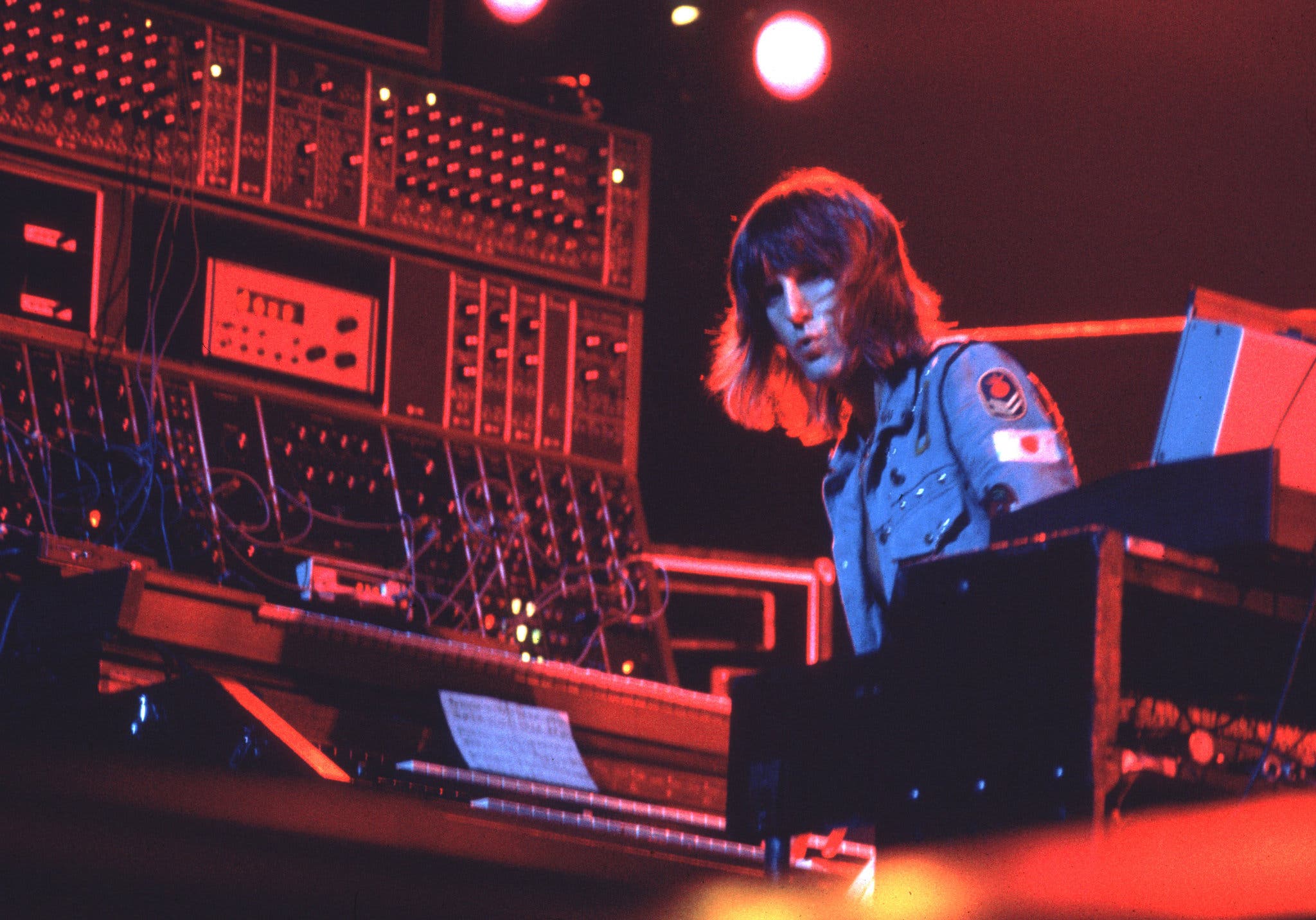
What kind of band would you get if you combined Keith Emerson on keyboards, Steve Hackett on guitar, Chris Squire on bass, Neil Peart on drums, and Robby Steinhardt on violin? That’s the best way I can try and communicate to you what the sound of Lobate Scarp is like. But don’t get me wrong; I don’t mean to suggest that Lobate Scarp is simply a pastiche of familiar sounds from ELP, Genesis, Yes, Rush, and Kansas. Not at all. What I mean is that the sound of Lobate Scarp is like some impossible dream come true.
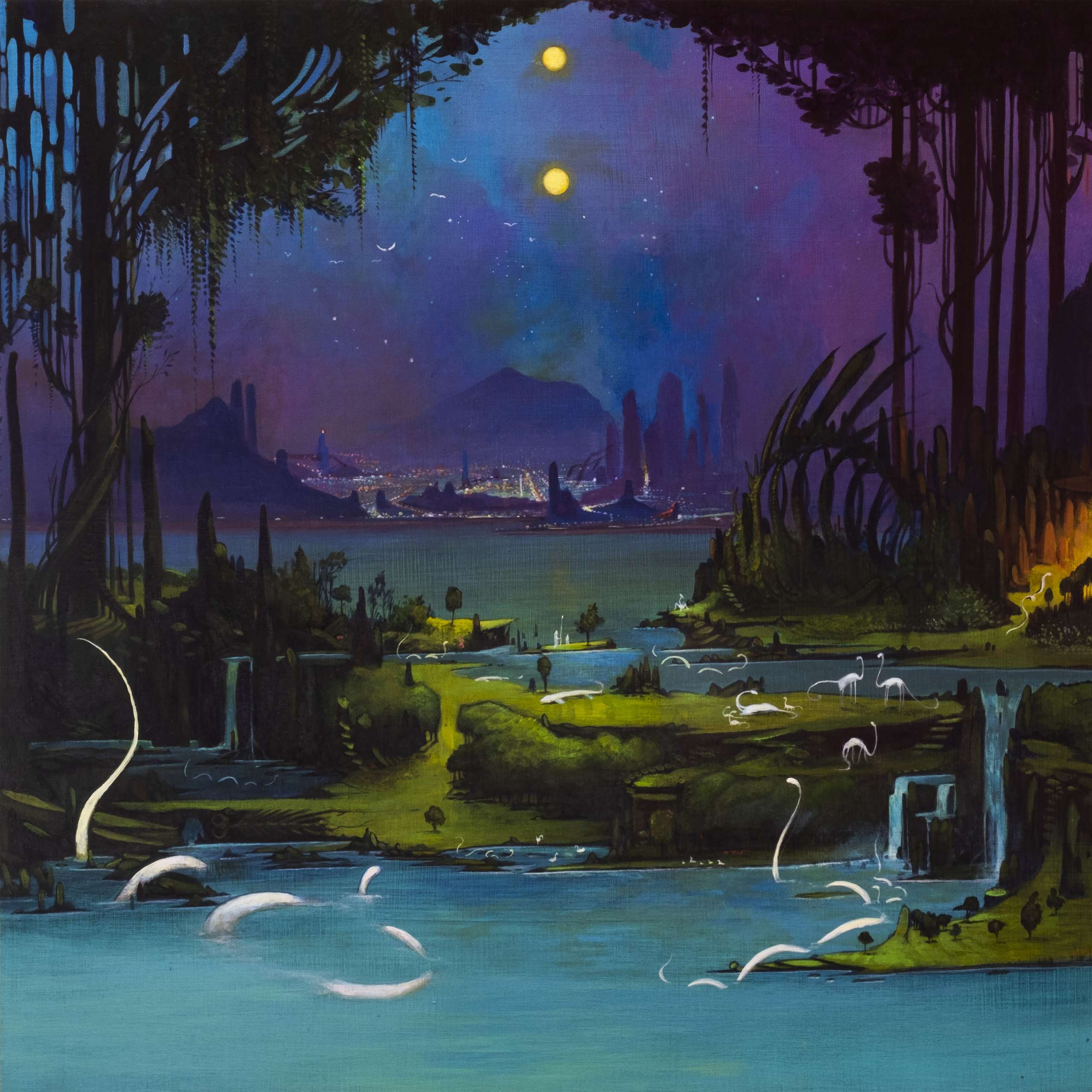
As if it burst forth from the dream world of their cover art, Lobate Scarp does indeed have their very own unique sound. That’s the wondrous fact now firmly established by You Have It All, their second full-length album. It is a truly magnificent achievement. It instantly secures You Have It All a permanent place in the celestial upper echelon where my all-time favorite records rotate in eternal bliss.
Back in 2012, Lobate Scarp’s first CD, Time and Space, contained exquisite intimations of greatness. I am forever grateful to Adam Sears himself for boldly going where no band had gone before and introducing his work to me. I was simply floored. This band was offering something new: yes, their own sound; and who cares about fashion, we always want bravely epic prog with unlimited daring. Helmed by Adam’s visionary hand, that courageous debut album also hinted at a future greatness, because right away there was debate about the merits of the CD on this site. That’s a small clue a band just may be very special.
That kind of debate does not happen for a band that is a mere copycat nostalgia act trying to replay the glories of the era of the birth of prog. No, a band with their own sound, and doing something new and interesting, will inevitably provoke different and polarizing responses. First, Progarchy published a negative assessment, and then a positive assessment. Finally, I tried to break the deadlock at Progarchy, by myself declaring the album one of the very best albums of the year.
Over the years, I was delighted to learn of the band being quietly at work, with an occasional burst of beautiful light in 2016 and 2019. And now the patient work of a decade has come to fruition. You Have It All is an apt title for an album of such staggering ambition that actually and successfully attains all the moonshots it takes.
The first thing that has to be said about this record is just how good it sounds. It is absolutely one of the best sounding audio experiences of my life. Steven Leavitt and Rich Mouser and Michael Bernard have all done amazing work with this CD and created an audio paradise. The production and engineering investment of talent that has been lovingly poured into this record is indisputable in every note. Every penny that was crowdfunded has been spent to dazzling effect.
The startlingly immediate surround-sound of the drum kit on every track is a marvel to behold, whether it is special guest drummer Eric Moore (of Suicidal Tendencies, and Infectious Grooves) on the two epic tracks “You Have It All” (14:31) and “Flowing Through the Change” (17:25), or Jimmy Keegan (of Spock’s Beard, and Pattern Seeking Animals) or Mike Gerbrandt on the other tracks. And the various guitar tones will have you doing double takes… who is that? Is Steve Hackett on this album, or what??? And Adam Sears can be likened to Keith Emerson for his uncompromising pursuit of sound for the sake of glorious sound.
Usually, Lobate Scarp is Adam Sears (vocals/ keys), Andy Catt (bass), Peter Matuchniak (guitar), Evan Michael Hart (drums), and Christina Burbano-Jeffrey (violin), as when they performed most recently at RoSFest in April in Sarasota, Florida. But the impressive parade of studio musicians appearing on the CD recording is a testament to Lobate Scarp’s unrelenting pursuit of excellence by any means necessary. I have the impression that they will record and re-record, and collaborate and re-collaborate, again and again, in any permutation and combination of talents, regular or extraordinary, as they pursue the perfect sound and the perfect record. And gosh darn it, their diligence of a decade has paid off mightily with this release.
You Have It All has the effect of a typical Yes album on me, in that it unfailingly elevates my spirit and transforms my mood for the better just by listening. This is no small musical miracle. Yes is a band prized as rare on this earth for just that reason. Operating in that same prog tradition of making intimate contact with the listener, Lobate Scarp uses their magic power to do what only the rarest of musicians have the power to do.
As far as I can discern the story tying the album together, it goes something like this. The hero of the story is Everyman, so let’s call him Adam, since that is what the word Adam means. Adam is jamming with his prog band on “Conduit,” the opening instrumental track, with his band endlessly practicing in pursuit of perfection. But people think Prog Adam is crazy for loving to spend his precious time practicing prog music like this. This instrumental: It’s so long! Over five minutes long and there aren’t even any lyrics yet! The people are criticizing Prog Adam for his super-proggy instrumental. So, he replies in track two, telling them there is “Nothing Wrong” with his life. He’s doing what he wants to do. But just telling the haters to stop it is not enough. Prog Adam therefore goes in search of spiritual sustenance, looking for a spiritual “Life-Line” on the next track, as sustenance for his prog, and finding it. With this spiritual enlightenment attained, Prog Adam goes back to his band, and then they communicate the spiritual enlightenment by expressing its lesson in the epic track, “You Have It All.” Jon Davison even makes a guest appearance on this track, making a cameo as the voice of the universe that teaches Prog Adam what he needed to learn, so that he is then able to communicate it with the epic musical power of “You Have It All” (14:31). End of Part One.
Part Two begins with “Beautiful Light,” with Prog Adam viewing the universe on a daily basis through the mystical lens he learned about in Part One. But then, with “Test Tube Universe,” Prog Adam, either back in his day job as a scientist, or simply by making an analogy on the basis of considering a scientist in his lab, considers the thought that maybe the universe is just like an experiment that, although beautiful and supportive to us (see Part One’s lesson), does not really matter to its creator. But then in “Flowing Through the Change” (17:25), Prog Adam makes spiritual contact with the transcendent creative force behind the universe and taps into its deepest essence: namely, love. This final spiritual awakening to the fullness of love is foreshadowed with “In the Night I” and “In the Night II” which are threaded between the earlier tracks on the album, since “In the Night III” is the second movement within “Flowing Through the Change,” wherein Prog Adam sees the face of God, and thereby finds his way to the path of love.
If all this sounds a bit woo to you, what can I say except that, I’m probably making this all up, or else, if you listen to the music, it will make you into a believer in prog and love and light, and so on. The radiant power of the music on this album magically transforms whatever it comes into contact with. Unless your heart is made of stone. Or, maybe even then, too; that’s how good this music is.
So, what are you waiting for, Bandcamp Friday? It’s already here! You Have It All has everything you need.
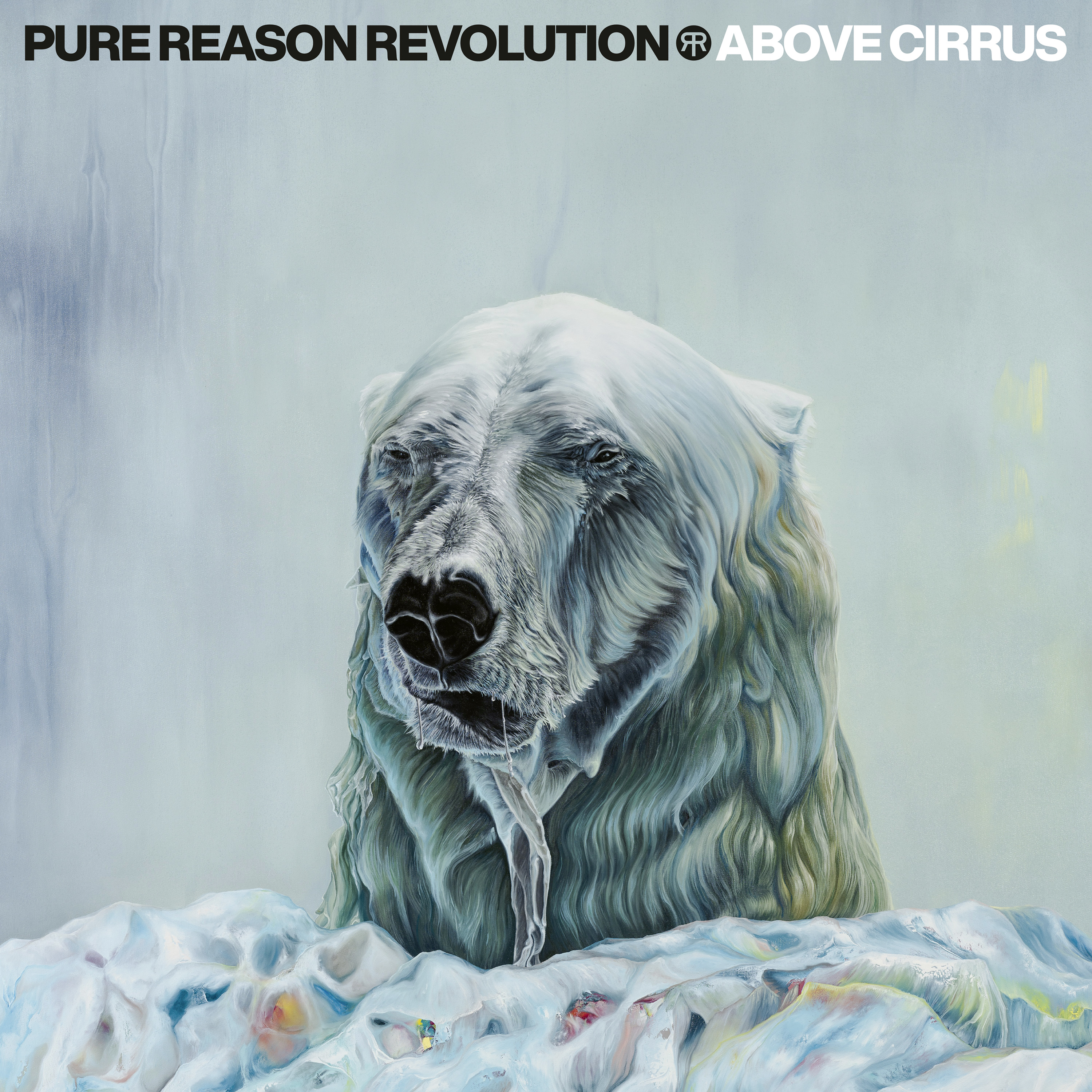
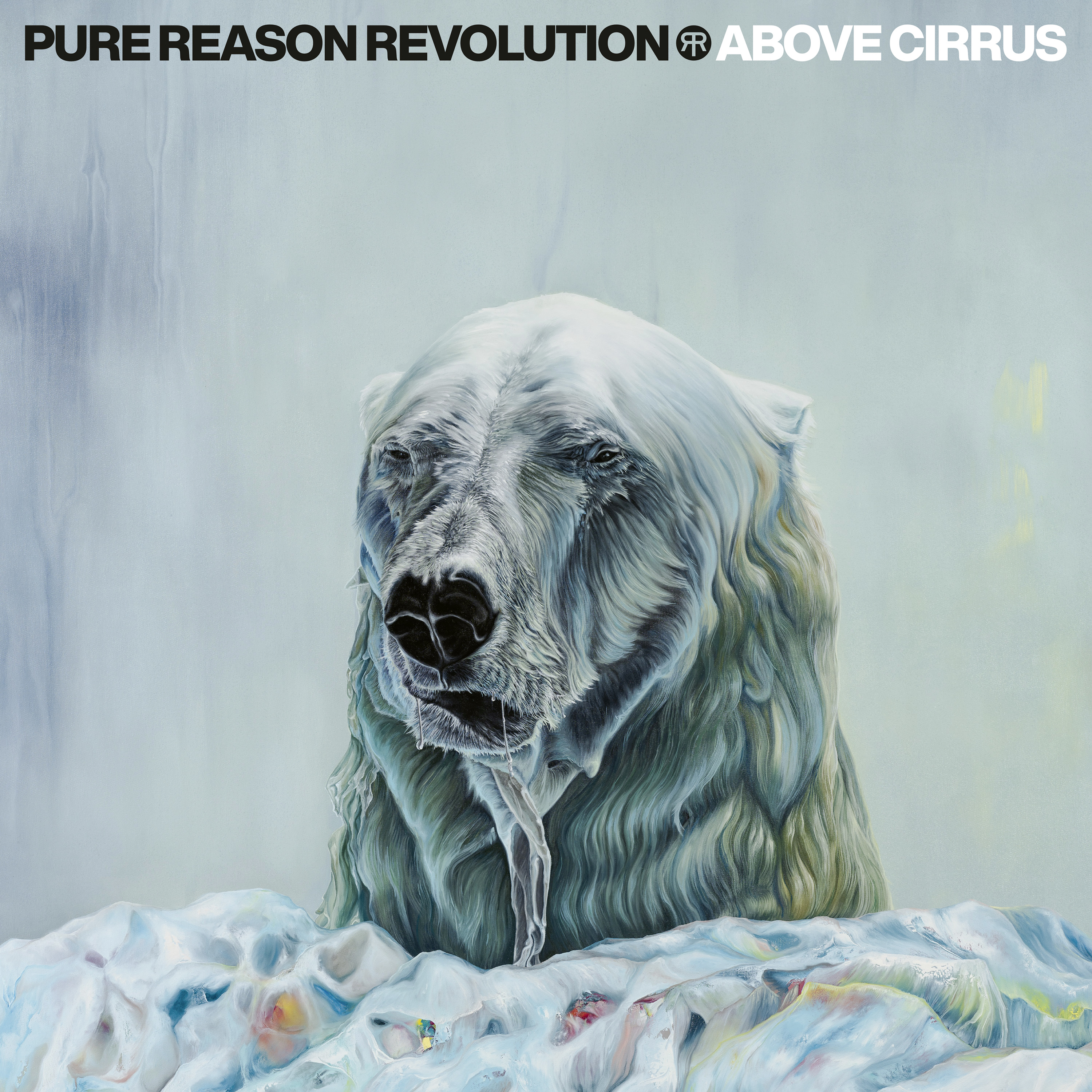
Pure Reason Revolution, Above Cirrus(Inside Out Music) ★★★★★ A+ 10/10
This brilliant new release draws upon all the best features of Pure Reason Revolution’s back catalogue. But it also reveals PRR developing now into a heavier band, with cascades of sound that can suddenly rock the listener at unpredictable junctures.
I have listened to no other record this year more times than I have this one. Its beauty and complexity continues to unfold after repeated spins. My considered assessment is that this album lays claim to being PRR’s best work yet.
Those are bold words to commit to print, because Pure Reason Revolution burst upon the scene with a stunning debut LP in 2006, The Dark Third, foreshadowed only by their 2005 EP, Cautionary Tales for the Brave. The Dark Third earned them so many accolades, and was such an unexpected prog rock masterpiece, that it has been almost impossible for reviewers to avoid invidious comparison of their later work with that glorious debut.
For example, many listeners were baffled by the emphasis on dance grooves and electronica synth sounds on 2009’s Amor Vincit Omnia and 2010’s Hammer and Anvil. But those paying closer attention would have realized that PRR cannot be easily pegged as a conventional prog band, ready to unproblematically adopt a nostalgic label like “the new Pink Floyd.” That has always been a lazy inference, based solely on the David Gilmour-esque guitar of “Aeropause,” the opening track of The Dark Third. Rather, it is “Golden Clothes,” the last track on the 2 CD edition of The Dark Third (which unites disparate tracks from the UK and US editions), that contains the seeds for PRR’s later adventures, especially on their next two albums. The fact is, there is no genre that PRR works within other than: “no limits”; and so “prog” is simply the easiest way to try and categorize a band so creative that they consistently defy nominal categorization. They continually change musical shape, and not just from album to album, but typically within any given song.
Above Cirrus feels like the second half of a double album experience that began with PRR’s recent reunion on 2020’s Eupnea. On this new disc, the otherworldly harmonic duo of Chloe Alper and Jon Courtney consolidate their best musical insights and experiences from Eupnea. Hence, Greg Jong, also on guitars and vocals, is now a full PRR member again, which had not been the case ever since after The Dark Third had been recorded and just before it was released. Perhaps it was Greg’s stellar contributions to Eupnea that led to the realization that there was something in the debut LP’s ternary chemistry that was still untapped. Adding a fourth element, Geoff Dugmore contributed drums to Eupnea and, now here once again, his thunderous impact is heard to thrilling effect all through Above Cirrus. Consider, for example, how he seems to singlehandedly guide his bandmates on a trip from dance to metal in “Phantoms.” The only thing present on Eupnea that is not augmented further on Above Cirrus is Chloe’s complete metamorphosis into the new Kate Bush. Like the queen herself, Chloe too is capable of slaying at a distance with the emotional power of her unmatched phrasing. But on Above Cirrus she selflessly recedes into the harmonic structures, with no full blown leads or duets. Yet she still occasionally unveils her lone voice, on songs like “Cruel Deliverance,” with sparing turns of phrase that pierce the soul.
The theme of Eupnea (literally, “breathe well”) seemed to be “life,” and the theme of Above Cirrus seems to be “afterlife,” in the sense that the music this time around explores the theme of re-birth; that is, of what kind of positivity and regeneration can still come forth after encounters with evil and darkness. The impressionistic lyrics of PRR are so poetic and arresting, they add yet one more uncanny effect to be savored upon repeated listens and contemplations of the band’s work. On Above Cirrus, “Our Prism” and “New Kind of Evil” each allude to coping with the shadows of the pandemic, and “Phantoms” confronts lies, disinformation, and malice. “Cruel Deliverance” invokes death, failed escape, emotional wounds, and deception. Most epically, “Scream Sideways” is ten minutes of astonishing, visceral, haunting explorations of conflict, grief, and love. “Dead Butterfly” exquisitely contemplates violence and the fragility of life, while “Lucid” kaleidoscopically depicts lovers fighting their way through to reconciliation. Each of these songs connects powerfully with the listener on a deep emotional level. They generously repay the patient auditor with delicate and graceful bursts of radiance and consolation.
Looking back at The Dark Third 2 CD edition, that debut was really an era of a double album’s worth of material, adding up to an hour and half in total (if you also include “Sound of Free” from The Intention Craft EP). The theme was twofold: dreams and reality, and the moveable boundary between the two.
Further, PRR’s next two albums may together be considered to form a double album: Amor Vincit Omnia focuses on the theme of “love,” and Hammer and Anvil on the theme of “war.” Each disc complements the other; in themselves, they each contain carefully intricate musical tapestries. I am continually amazed that songs like “Victorious Cupid” or “Les Malheurs” or “Never Divide” or “Blitzkrieg” are not more widely recognized as the works of pure genius that they are, equal to or surpassing anything on The Dark Third. But such is the conundrum of being a devoted listener of PRR. Part of the pleasure lies in one’s expectations being repeatedly confounded and subverted by this endlessly clever and imaginative band. Only the joy and ecstasy of the music is itself the reward. Any reviewer’s words that come afterwards may serve only as mere nods to others, like us, who have also found their way to this incomparable band.
Eupnea and Above Cirrus, as I have already opined, take the shape of two halves of one whole, and not without precedent, at least if my above remarks also strike other listeners as true. Eupnea, with its theme of “life,” seems to possess a gentler prog idiom than Above Cirrus‘s fearless exploration of “afterlife,” namely, the life still possible after darkness and death. This new PRR disc may be too challenging for some in that it is scarcely comprehensible on first listen. But perhaps in that way it mindfully rises to embody its theme.
Jon, we are told, asked Greg, who knew all the cloud names: Well, what’s above cirrus? Nothing’s above cirrus, replied Greg. Well, if the only thing after life can be life, then this dazzling music is a fitting celebration of the miracle of life’s regenerative powers. For music is already beyond life. In this way, too, for PRR — with Eupnea and Above Cirrus now indisputably proof of a PRR back from the dead — music is their afterlife. And they take us right to the heart of the miracle.
Reviewed by C.S. Morrissey for Progarchy.com
For further immersion into PRR, click to Progarchy’s interviews with Jon Courtney here and here.
Jon Courtney of Pure Reason Revolution spoke with Progarchy.com today about Pure Reason Revolution’s new album Above Cirrus, which will be released next month.
Listen to “Phantoms,” or “New Kind of Evil,” or click on the audio file above to listen to what Jon Courtney had to say about these tracks, and all the others on the album, during today’s Progarchy interview.
Pink Floyd has long been a powerful artistic voice against fascism. One of their most unforgettable studies of how fascism lurks within the human heart is their unforgettable rock opera The Wall. A cinematic recap of the essentials:
Now Pink Floyd stands in solidarity with Ukraine against today’s incarnation of fascist genocide:
Arjen does it again on the third sci-fi metal outing of his supergroup starship known as Star One. ★★★★★
If you like prog metal, and if you like sci-fi movies and TV, then this is another fantastic disc from Star One. Arjen Anthony Lucassen is once again in the captain’s chair, steering the starship for this new mission into the galaxy of sci-fi shows about time travel.
Each track assembles a mighty away team to explore the thematic terrain of sci-fi artworks both famous and obscure. The key personnel on the bridge are Arjen on guitar and bass and Ed Warby on drums, starring roles like those of our beloved Kick and Spock. Erik van Ittersum on Solina Strings and Joost van den Broek (of After Forever) on Hammond are akin to mission support from Bones and Scotty. Here’s the breakdown of the away teams track-by-track:
Track 01, “Fate of Man” (05:29), is inspired by The Terminator. The magnificent maiden Brittney Slayes (of Unleash the Archers) delivers a killer vocal performance. The peerless Michael Romeo (of Symphony X) adorns the track with a scintillating guitar solo. CD2 of the package includes the same tracks as CD1, but with different vocalists: for this track, that’s Marcela Bovio (of Elfonia, The Gentle Storm, Stream of Passion, and MaYaN). Slayes is a tough act to follow, but Bovio shows she’s as spectacular as a supernova on her turn.
Track 02, “28 Days (Till the End of Time)” (07:20), is inspired by Donnie Darko. Russell Allen (of Symphony X) sings lead and keeps the disc feeling like a Symphony X album. John Jaycee Cuijpers (of Praying Mantis) does vocals on CD2. Timo Somers (of Delain) steals the show with a sweet guitar solo.
Track 03, “Prescient” (06:34), is inspired by Primer. Ross Jennings (of Haken) supplies his truly unique vocals, along with Michael Mills (of Toehder), for a very satisfying combo. Will Shaw (of Heir Apparent) handles it on CD2. I watched Primer a long time ago and, unlike the familiar references on the first two tracks, I had to look it up to remind myself of the plot: “Friends and fledgling entrepreneurs invent a device in their garage which reduces the apparent mass of any object placed inside it, but they discover that it has some highly unexpected capabilities – ones that could enable them to do and to have seemingly anything they want. Taking advantage of this unique opportunity is the first challenge they face. Dealing with the consequences is the next.”
Track 04, “Back from the Past” (04:50), is inspired by Back to the Future, and it’s a real hoot. Jeff Scott Soto does the spirited vocals and Ron Bumblefoot Thal (of Sons of Apollo, Guns ’n’ Roses) the mind-bending guitar solo. John Jaycee Cuijpers (of Praying Mantis) does vocals on CD2.
Track 05, “Revel in Time” (04:37), is inspired by Bill and Ted’s Excellent Adventure, and is the most whimsical of all the tracks. Arjen is having lots of fun with this whole project, so it seems right to make this the title track. Also, the “revel” is a nice pun on “travel”, since “travel in time” is the unifying album theme. Brandon Yeagley (of Crobot) does vocals and Adrian Vandenberg (of Vandenberg, Whitesnake) the raucous guitar solos. John Jaycee Cuijpers (of Praying Mantis) does vocals on CD2.
Track 06, “The Year of ’41” (06:20), is inspired by the movie The Final Countdown. I guess this song is okay, and the movie has receded in my memory. Joe Lynn Turner (of Deep Purple, Rainbow) does vocals and the amazing guitarist Joel Hoekstra (of Whitesnake, Cher, TSO) does really fine work on the soloing. Jens Johansson (of Rainbow, Yngwie, Stratovarius) does the synthesizer solo, but on CD2 it’s Alessandro Del Vecchio on both vocals and the synthesizer solo. I had to recall the plot: “During routine manoeuvres near Hawaii in 1980, the aircraft-carrier USS Nimitz is caught in a strange vortex-like storm, throwing the ship back in time to 1941—mere hours before the Japanese attack on Pearl Harbor.” Fine, that’s great, but I think I’d prefer to hear the song by Europe that has the same title.
Track 07, “Bridge of Life” (05:13), is inspired by the movie Frequency. The inimitable Damian Wilson (of Threshold, Headspace, Landmarq) contributes memorable vocals, and I feel sorry for Wilmer Waarbroek on CD2 who has to be compared to the great Damian. I had to remind myself of the plot here also: “When a rare phenomenon gives police officer John Sullivan the chance to speak to his father, 30 years in the past, he takes the opportunity to prevent his dad’s tragic death. After his actions inadvertently give rise to a series of brutal murders he and his father must find a way to fix the consequences of altering time.”
Track 08, “Today is Yesterday” (05:46), is inspired by the movie Groundhog Day. Dan Swanö (of Nightingale, Second Sky, Edge Of Sanity) hams it up on vocals. At first, I thought the vocal performance was as ridiculous as the umlaut on the last vowel of his name. But after more listens, I warmed up to it. The track has nice thoughts about the classic Bill Murray flick. Lisa Bella Donna contributes Moog synth, and Marcel Singor (of Kayak) the appropriately obnoxious guitar solo. Arjen Lucassen himself (of Ayreon, The Gentle Storm, Stream of Passion, Ambeon, Guilt Machine, in case you forgot) does all guitars, bass, keyboards, and even the vocals on CD2. You can listen to this track every February 2nd: “A narcissistic TV weatherman, along with his attractive-but-distant producer, and his mawkish cameraman, is sent to report on Groundhog Day in the small town of Punxsutawney, where he finds himself repeating the same day over and over.”
Track 09, “A Hand on the Clock” (05:51), is inspired by the movie Source Code. The brilliant Floor Jansen (of Nightwish, After Forever) is stellar on vocals here, and it’s hard to believe someone of her talent is buried on track nine. Then again, I can understand wanting to lead with Brittney’s star turn on track one, and the rationale here seems to be Arjen saving his favorites for last, placing Jansen in the antepenultimate position, so that the excitement and anticipation builds as we listen to the CD and eagerly await her turn. Joost does a Hammond solo to add extra zip. Floor’s sister Irene contributes backing vocals but also the vocals on CD2 together with Marcela Bovio. I’ve only watched this movie once, back when it was first out: “When decorated soldier Captain Colter Stevens wakes up in the body of an unknown man, he discovers he’s part of a mission to find the bomber of a Chicago commuter train.” Pretty decent, but it’s Floor’s singing that I would return to again and again.
Track 10, “Beyond the Edge of it All” (04:52), is inspired by the British sci-fi/horror TV series Sapphire and Steel, which I did not know about until listening to this CD. John Jaycee Cuijpers (of Praying Mantis) does good vocals, and I think Arjen does the guitar solo here as part of the “best for later” logic of the album tracking. He must be a big fan of the show, because after looking it up and watching it, now I am too. I can’t believe I had never seen it before, because it is absolutely classic, and I am grateful to Arjen for bringing it to my attention through this album. Mike Andersson (of Tungsten, Star One) does vocals on CD2. Perhaps listeners will want to have a two-week film festival of all the movies Arjen has made this album about. That’s a great idea, and I welcome you to it. My own festival ended up being a Sapphire and Steel marathon:
“Sapphire & Steel is a British television science-fiction fantasy series starring David McCallum as Steel and Joanna Lumley as Sapphire. Produced by ATV, it ran from 1979 to 1982 on the ITV network. The series was created by Peter J. Hammond who conceived the programme under the working title The Time Menders, after a stay in an allegedly haunted castle. Hammond also wrote all the stories except for the fifth, which was co-written by Don Houghton and Anthony Read. In 2004, Sapphire and Steel returned in a series of audio dramas starring David Warner and Susannah Harker.”
Track 11, “Lost Children of the Universe” (09:46), is inspired by the movie Interstellar. That movie is one of my top-ten favorites, so I approve of the “best for last” implication here. Roy Khan (of Kamelot) does vocals here, and the Hellscore Choir also shows up near the end for an unexpected twist. Steve Vai delivers an Academy Award-worthy guitar solo.
Surprisingly, Tony Martin (of Black Sabbath) is placed on CD2 instead, but I think Arjen faced an impossible choice here, because Khan’s dramatic delivery is just so darn good. I think Ray Gillen was a better singer for Sabbath than Tony Martin was, but alas Tony is better known.
Marcela and Irene contribute truly stellar interstellar backing vocals, as on so many other places on the album: they really deserve a lot of credit as the (perhaps unsung) background singing heroes that they are here on this disc.
Note: Arjen released this track as an advance single, with a mix of vocals from both Roy and Tony. So, if you are true fan and total collector like me, you will want all three versions of the song.
Thanks you Arjen and crew for another thrilling journey. I am grateful for hours and hours of so much enjoyment with this virtuous circle of sci-fi movies and songs. Rock on at warp speed!
Crown Lands had quite the year. First, these Rush superfans paid tribute with “Context—Fearless Part 1”, and its B-side “Right Way Back”, back in March.
In May, they offered live versions of the same, recorded as jaw-dropping proof that they were not merely wizards in the studio, but also a dynamic live duo, the likes which we have not seen before.
Then, they unleashed the killer single “White Buffalo” (in 7/8 time, no less) and the 13-minute epic “The Oracle” back in July.
The creativity kept on coming, as September saw the addition of “Inner Light” and “The Witching Hour (Electric Witch)” to the previous two tracks on the stunning White Buffalo EP.
Crown Lands has beautiful vinyl editions of everything, but you can also get the latter four songs on a nifty White Buffalo CD.
The year ended with a grand-slam live performance of all their new 2021 music, plus select gems from earlier years, on Odyssey Vol. 1, which you can also view online.
“I almost wish we were butterflies and lived but three Summer days. Three such days with you, I could fill with more delight than 50 common years could ever contain”~ John Keats
I am not sure where to begin or what to write. Or even if I should write at all. But the out-pouring of grief has been profound and deeply moving. So I wanted to say something.
To put pay to the rumours, speculation, inaccurate reporting and perhaps to help some of you with your own questions and sense of loss, I can tell you that David had a traumatic fall at our cottage during the early hours of Friday morning. I am not going to share everything which took place. Those intimate details are just for band members, David’s beautiful girls, his Mum and me. But I will tell you that David left this life being held in my arms on Saturday 20th November. I told him how much I loved him, that he was safe and that it was time to take the next step on his great adventure. To be with him during his very last moments is the greatest tragedy and greatest privilege of my life.
I waited all my life for David. He filled up my heart. He was inspirational, thoughtful, kind, generous, gentle, loving and funny. Goodness me, was he funny. We would laugh and laugh every day. He was the best of all men.
He leaves an enormous legacy behind. Not only in terms of his creative output but also the many lives he has touched, the friends he has made and the strong unshakeable brotherhood he shared with Danny, Dave G, Rikard, NDV and of course his dearest Greg.
I know David will always be right by my side. But if I ever feel I need that extra connection, I can always reach for the music. And so can you. Because even though he told us that we will find him in the hedgerow, let me tell you a secret : it’s not true. He’s in the music. That is where you will find him.
Good bye my beautiful boy – until we meet again one day.
Big big BBT surprise: 4-track EP of 4songs fromWelcome to the Planet
WOW!
A big big surprise from Big Big Train today, as suddenly they have released four tracks from their surprise forthcoming album (Jan 28, 2022), Welcome to the Planet.
You can now immediately enjoy four tracks in advance: viz., tracks 1, 2, 3, and 6 from the forthcoming 9-track LP.
I also noticed that Apple Music immediately applied the purchase as a credit to the future purchase (or pre-order) of the forthcoming album. Very nice!
The tracks are excellent. Enjoy, my friends.
Prog on, BBT! Thanks for the early early Xmas gift.









 Progarchy