From WSJ.com: Today starting at 3:30 p.m. EST, Geddy Lee and Alex Lifeson of Rush will be answering fan questions LIVE.

From WSJ.com: Today starting at 3:30 p.m. EST, Geddy Lee and Alex Lifeson of Rush will be answering fan questions LIVE.
Steven Wilson’s journey as a solo artist from debut Insurgentes to his new release The Raven That Refused To Sing (And Other Stories) has been a fascinating one. That first album has dark introspection and desolate beauty in equal measure. Follow-up Grace For Drowning is a different beast, with more shades of light and dark to it and with a more expansive and organic feel. Raven puts that work into context as a transitional piece, for here Wilson’s vision seems, at last, to be fully realised.
The influences that shaped Grace – the improvisational aspects of jazz, and Wilson’s involvement in remixing King Crimson’s early work – are once again evident, but this release can boast greater coherence than Grace, due in part to its unifying ‘ghost stories’ theme. It also benefits from a rather different approach to production. Wilson is settled and comfortable enough with this group of musicians to gamble on live recording in preference to meticulous overdubbing, emulating the methods used on those 1970s prog masterpieces that he has been remixing so successfully. The gamble has paid off and the music frequently builds to a thrilling intensity as the players feed off of each other. Having the legendary Alan Parsons at the controls is the icing on the cake, guaranteeing a recording of superb quality.
Luminol kicks off proceedings in a suitably explosive manner, with frenetic bass and percussion plus vocal harmonies that call to mind Tempus Fugit from the 1980 Yes album Drama. The pace and energy are high in the early and closing stages of this twelve-minute piece, with all players getting the chance to show what they can do, but it is perhaps Adam Holzman’s piano during the quieter middle section that impresses most.
The album really pivots around the twin epics of The Holy Drinker and The Watchmaker. Both are as good as anything Wilson has ever done. Drinker is moody, powerful and intense, the perfect showcase for the staggering virtuosity of the musicians that he has assembled as his band. Theo Travis particularly shines here. Watchmaker is more delicate in tone and really quite beautiful for the opening four minutes before opening out into some spectacular interplay between Guthrie Govan’s guitar and Travis’ saxophone. Piano, vocals and bass all take their turn at the front of the sound stage before a closing section laden with heavy power chords.
There are nods to Wilson’s other projects. Drive Home feels almost like a Porcupine Tree song before it expands into a closing section with a stunning Guthrie Govan guitar solo that quite simply takes the breath away. The title track is sparse, mysterious and moving; it probably wouldn’t look out of place on Wilson’s recent Storm Corrosion collaboration with Opeth’s Mikael Åkerfeldt.
Verdict? Steven Wilson’s best work to date.
Gazpacho, one of my all-time favorite bands, posted this (below) today at FACEBOOK. I assume they won’t mind me reposting it here at Progarchy–Brad, ed.
*****
Hi there and greeting from us lazybones. It has been a special year with happy and sad events as life thunders on. We can definitely confirm that we havent been.
However, being who we are, it has been very difficult to suspend the need to make more of our particular brand of music. Last album Mog was written in a frenzied weekend session where most of the original demos were kept and polished over the year it took to make the final album.
This time we set our standards much higher and as the months have gone by we have written about an hours worth of music which will be whittled down and added to over the year. We have committed to a concept album in the true meaning of the word and where our last four albums have been intended as films without pictures the new one feels a lot more like a novel. A novel written by a confused and crazy man but still a novel!
The ideas we are toying with are based around the concept of evil and its different shapes and incarnations. The malevolent force that mankind has dressed up as the will of God or the misdeeds of demons depending on the circumstance. Is it possible to catch the feel and the impact of this in music? Well we think so, and the demos are dark but strangely engaging.
Its still early days and as soon as we have a release date we’ll keep you posted.
Wish us luck!
Love
Gazpacho
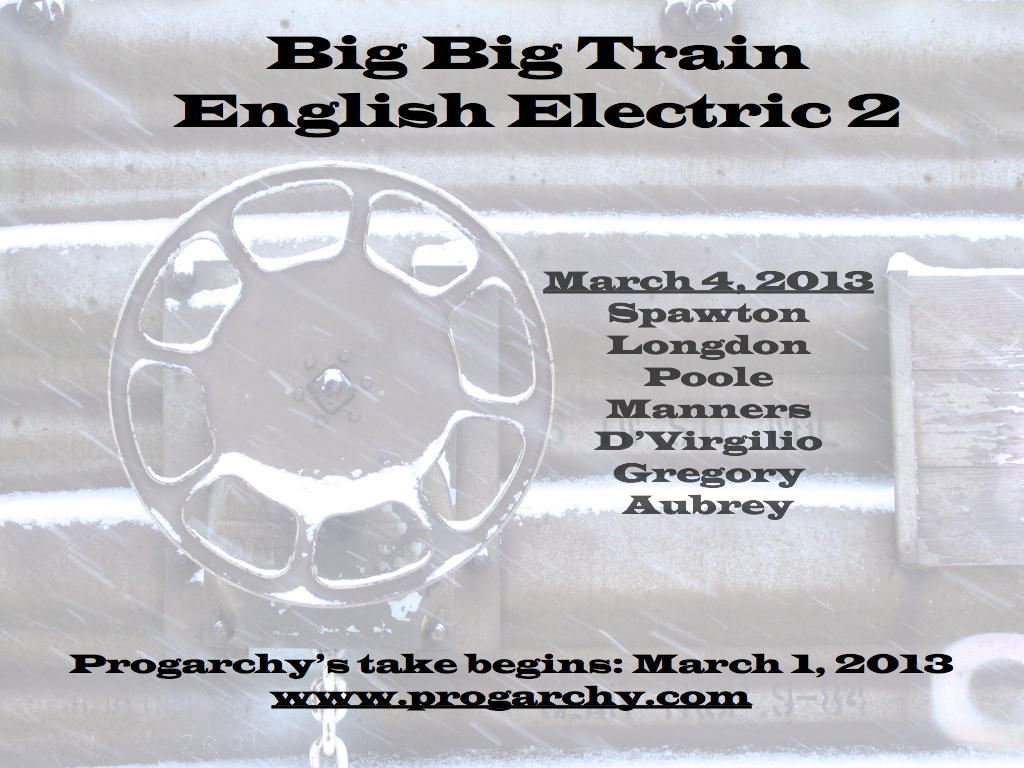
As a companion piece to my “liner notes” post on English Electric—Part 2, here is a compilation of some virtual “liner notes” that expand a bit more upon the ones that are already available at Big Big Train’s album page for English Electric—Part 1:
1. The First Rebreather is “the true story of a man called Alexander Lambert who dived heroically into the flooded Severn Tunnel in 1880. The navvies who built the tunnel and who were hard-drinking fearless chaps were terrified that the river would break in and drown them all. However, when the tunnel flooded, the water was found to be fresh rather than tidal. The navvies had, in fact, struck an immense underwater spring which flowed through a fault in the rock (they called it The Great Spring). Conventional diving equipment was used to try to close an iron door in the tunnel to hold the water back. The equipment failed due to the air-hose continually being snagged.
The tunnel engineer had heard of a man called Henry Fleuss who had developed an experimental diving apparatus called a Rebreather (in effect, it was the first aqua-lung.) Fleuss was persuaded to make an attempt on the tunnel but was so frightened that he turned back and said he would not return to the darkness ‘for £10,000 or more.’ The equipment was handed over to Diver Lambert who carried out a number of dives which involved swimming 1000ft up the flooded tunnel in complete darkness. Lambert, The First Rebreather, confronts his fear in the tunnel whilst the workmen await his return.
‘The first rebreather’ is a strange phrase which sounds almost super-heroic which, indeed, Lambert was. So, I decided that, for the purposes of the song, The First Rebreather would be seen as a sort of superhuman creature come to save the navvies from the Great Spring.
Lambert would, of course, have looked very odd in his diving gear and, to the superstitious men, I’ve imagined that he would have looked like a Mummer (also known as a Souler). Mummers’ plays generally feature a character who brings back to life a dead person, so that fitted quite nicely as Lambert tries to bring air back to the lungs of the tunnel.
In the song, The Great Spring has also become a character. I remember being frightened as a child by the story of Beowulf swimming into the mere to slay the beast and again, I’ve used that imagery. In Beowulf, his men waited by the water for him to return. He returned ‘at the ninth hour’. The closing vocal section of the lyrics is about the workmen waiting for Lambert to swim back to the surface. As The First Rebreather is also a direct follow-up to Winchester Diver, I have also worked in some references to The Divine Comedy.” [GS]
2. Uncle Jack is about David Longdon’s uncle, John Henry Herring, who was a collier who “worked in the pits around the Heanor (Derbyshire:UK) area. He spent so much time beneath the ground that he truly valued his time on the surface. Jack would walk his dog (Peg) and would take notice of all that was happening around him in the natural world. The changing of the seasons, birdsong, woodland wildlife and the ‘bustle in your hedgerow.’” [DL]
3. Winchester From St Giles’ Hill is about the mutual influence of geography and history; namely, “the development of the city with its place in the landscape.” Greg Spawton explains: “Winchester is a beautiful and historic city in the south of England. St Giles’ Hill lies to the east of the city and forms part of the western edge of the South Downs. From the top of the hill you can see all of Winchester, and the song is an historical view of the development of the city and of (as Peter Ackroyd calls it) the ‘long song’ of England.
Winchester stands at a number of crossroads in time and provides a narrative of British and English history in miniature. There was a prehistoric settlement at Oram’s Arbour, then it became a Roman town and afterwards, a Saxon capital and stronghold. The Normans built a castle and a massive cathedral. It became a centre of learning with the opening of Winchester College and, in Victorian times, the railways came and with them the modern age.” [GS]
4. Judas Unrepentant is about Tom Keating, “an art restorer who eventually turned to art forgery after failing to break into the art market. He was on a personal crusade to destabalise the art world by forging works to fool the experts. He deliberately planted clues in the works that would reveal them as forgeries. He also cunningly managed to falsify provenances for his forgeries.” [DL]
5. Summoned By Bells is about memories from Greg Spawton’s mother “who grew up in a working class area of Leicester called Highfields.” After a family trip to revisit the area, Greg was inspired to write the song by this episode: “As we drove away, we stopped to let a young girl cross the road. If we had been able to stand in that spot 70 years before, that little girl could have been my mum on her way down to Spinney Hill park. With this image in my mind, more clear to me than the changes in Highfields, was the golden thread of continuity running down from the past.” [GS]
6. Upton Heath is “a moment of calm amidst the frantic, flamboyant and epic moments elsewhere. Some Big Big Train songs can be lengthy, dynamic and intense, Upton Heath is none of these things, it is uplifting, relaxed and has its own sense of peace.” Note that “Upton Heath is a place in Dorset, UK and Greg has chosen this title because it is one of his favourite places to go walking.” [DL]
7. A Boy in Darkness is about the children and young people employed in the colleries who “were expected to work down the mines in hard conditions once they had left school”, as well as all “children who suffer at the hand of those to whom they are entrusted.” David Longdon says the song’s message is: “Don’t be afraid to shine bright light into dark corners.” [DL]
8. Hedgerow picks up where Uncle Jack left off, with “a collier’s love of nature, seasons and hedgerows”. David Longdon explains: “It is about my Uncle Jack once again only this time it focusses on the contrast between his life on the earth’s surface and his working life below. The song has an anthemic feel to it as it develops. It includes great musical contributions from Rachel Hall who adds layered violin. Backing vocalists Lily Adams and Violet Adams reprise their nursery rhyme-like list of the sort of things that you would expect to find in a British hedgerow, previously featured in Uncle Jack (track two).” [DL]
Big Big Train is keeping the art of the album alive. We may not buy gatefold vinyl anymore, but in conjunction with our CDs or digital downloads, we can nevertheless read blog posts which function to create a set of virtual “liner notes.”
To aid you with your forthcoming enjoyment of the masterpiece that is English Electric—Part 2, here is a compilation of the virtual “liner notes” that Greg Spawton [GS] and David Longdon [DL] have made available on their blogs. And for the last three songs, I also quote from the recent Progarchy interview with the band:
English Electric—Part 2
1. East Coast Racer is about how “75 years ago, on 3rd July 1938, a streamlined locomotive called Mallard set the world speed record for steam trains, travelling at 126mph on a straight, downhill stretch of the East Coast Mainline.” Greg Spawton observes that “it wasn’t so much Mallard but the people who designed, made, fired and drove her that interested me. And it is their tale we tell over the 15 minutes or so of East Coast Racer.
It is a story with a wonderful list of main characters; designer Sir Nigel Gresley, his assistant Oliver Bulleid, fireman Tommy Bray and driver Joe Duddington. Alongside those with starring roles was a community of engineers and railwaymen who all played a part in the making of a legend.
But, in the end, we come back to Mallard.
Émile Zola said: ‘Somewhere in the course of manufacture, a hammer blow or a deft mechanic’s hand imparts to a locomotive a soul of its own’.
In this short sentence, Zola puts his finger on the connection between the maker and the machine. Mallard has outlived its creators but in it, this company of men and the work they carried out, lives on.” [GS]
2. Swan Hunter is “a song about the inevitable changing world and how these changes impact directly upon local communities.” Inspired by a letter from BBT artist Jim Trainer to Greg Spawton, the song is an evocation of the men in Jim’s family, many of whom shared the same name; the song thus imaginatively “centres around a main character. Let’s call him Jim. Jim is now an old man and he is reflecting back on his life as a shipbuilder who worked at Swan Hunter in the Neptune Yard. Imagine Jim, sitting by his fireside and recounting tales to his son about how it all once was and how much life has changed. Jim accepts the impermanence of material things and the inevitable passing of time.” [DL]
3. Worked Out is about “the mining industry of the Midlands (which featured as a setting in Uncle Jack, Hedgerow and A Boy in Darkness on Part One).
It is difficult to contemplate the immense scale of coal mining in Britain before its relatively recent decline. In the 1920s, there were more than a million coal-miners and the number was still at around 700,000 into the 1950s. By 1994, there were just 20,000 coal-miners.
The loss of so many mines was a disaster for communities which relied on the industry for work. Some have recovered but others still suffer very low levels of employment with all of the problems that lack of work brings.
Worked Out tells the story of a community from a mine which lasted longer than most. The colliery was called Birch Coppice and mined the Warwickshire coalfield until 1987. In the end, the colliery was closed because of a faultline in the coalface rather than for political or economic reasons.” Greg Spawton reflects on the changing landscape, as nature reclaims the sites and greens over the hills, covering up what lies beneath: “Underneath the ground are the remains from over 150 years of mining. … The same type of story can be found in the landscape all over Britain as the physical remnants of the gigantic undertaking that was the Industrial Revolution are lost. Worked Out is a song about the miners of Birch Coppice but it could be about any of the mining communities which have seen the closure of the pits and the loss of a way of life.” [GS]
4. Leopards is a love story “about two people who had gone their separate ways after the end of their relationship. Years pass until one day, by chance, the pair meet again. Their mutual feelings are rekindled and they carefully begin to rebuild their relationship. Inevitably, they both have their insecurities, their baggage and fears.
On the eve of her birthday, he presents her with a small ornate jewellery box which when opened, contains a beautiful Cartier Panther brooch. The jewelled body of the beast sparkles in the light. It must have cost a fortune. She pins the bejewelled feline to the lapel of her dress and as she stands to admire it in the large mirror above the mantlepiece, he drapes her shawl around her shoulders. He gently kisses the nape of her neck as he does so. It may be the champagne or the high emotion of the moment but she finds herself lost for a while in her reverie.
‘Happy birthday darling’ he whispers.
But she is troubled by her rekindled love towards her former lover. Back then she loved him dearly and afterwards she then had to learn to live without him. She remembers her terrible sorrow and it has taken time and courage to learn to trust and to give again.
Her dilemma is this:- He tells her that he was a fool to leave her. He says that not one single day had passed since they parted without him thinking of her and regretting his selfish act. He also says that he has changed but the question she asks herself is this:- Are we really able to change?
On one hand, if she does not surrender herself, she will never know what could be. On the other, will her fear of being hurt all over again outweigh her overwhelming desire to love him and be loved by him? …
The leopard metaphor within the title concerns itself of course with the old proverbial question ‘can a leopard change its spots?’” [DL]
5. “Keeper of Abbeys is about a chap I met at a ruined abbey in the north of England. This man worked from dawn until dusk every day, tending to the stones. I got to know him a little bit but used my imagination to join up the missing parts of his story.” “A few years back we visited the North Yorkshire Moors. We stayed for a few days at an English Heritage cottage within the grounds of an abbey at Rievaulx.” [GS]
6. “The Permanent Way is the pivotal track where we try to bring everything together.” The title phrase “is a Victorian expression which means the finished track and bed of a railway. … On The Permanent Way, which is the penultimate track on the album, we have brought together the stories of the individuals and communities working on and under the land who, along with inescapable geological forces, helped to forge the British landscape. … Where people have helped to shape the landscape it is at the hands of ordinary folk that this has been done. Sometimes this has been at the behest of powerful land-owners and at other times it has been due to the vision of those far-sighted men-of-iron. But in the end it all comes down to ordinary men and women, in communities past and present, working on the land.” [GS]
7. “Curator of Butterflies is inspired by a woman called Blanca Huertas who is the Curator Lepidoptera at the Natural History Museum. I read an article about her where she said the study of butterflies can allow so many tales to be told. The song is about how narrow the line is between life and death. I was very anxious about it sounding trite and so I wove a character into it to make it a story and tempt me away from spouting platitudes.” Life and death: “The song is about the fine line between those two extremes. As I grow older I become more aware of my mortality and the mortality of my family and friends. The knowledge that we hold about our mortality means that life can be a beautiful burden.” [GS]
My favorite Rush album has been, at least going back to April 1984, Grace Under Pressure. I realize that among Rush fans and among prog fans, this might serve as a contentious choice. My praise of GUP is not in any way meant to denigrate any other Rush albums. Frankly, I love them all. Rush has offered us an outrageous wealth of blessings, and I won’t even pretend objectivity.
I love Rush. I love Grace Under Pressure.
I still remember opening Grace Under Pressure for the first time. Gently knifing the cellophane so as not to crease the cardboard, slowly pulling out the vinyl wrapped in a paper sleeve, the hues of gray, pink, blue, and granite and that egg caught in a vicegrip, the distinctive smell of a brand new album. . . . the crackle as the needle hit . . . .
I was sixteen.
From the opening wind-blown notes, sound effects, and men, I was hooked, completely. I had loved Moving Pictures and Signals–each giving me great comfort personally, perhaps even saving my life during some pretty horrific junior high and early high school moments.
But this Grace Under Pressure. This was something else.
If Moving Pictures and Signals taught me to be myself and pursue excellence, Grace Under Pressure taught me that once I knew myself, I had the high duty to go into the world and fight for what’s good and right, no matter the cost. At sixteen, I desperately needed to believe that, and I thank God that Peart provided that lesson. There are so many other lessons a young energetic boy could have picked up from the rather fragile culture of the time and the incredibly dysfunctional home in which I was raised. With Grace Under Pressure, though, I was certainly ready to follow Peart into Hell and back for the right cause. Peart certainly became one of the most foundational influences on my life, along with other authors I was reading at the time, such as Orwell and Bradbury.
Though I’m sure that Peart did not intend for the album to have any kind of overriding story such as the first sides of 2112 or Hemispheres had told, GUP holds together as a concept album brilliantly.
The opening calls to us: beware! Wake up! Shake off your slumbers! The world is near its doom.
Or so it seems.
Geddy’s voice, strong with anxiety, begins: “An ill wind comes arising. . .” In the pressures of chaos, Pearts suggests, we so easily see the world fall apart, ourselves not only caught in the maelstrom, but possibly aggravating it. “Red Alert” ends with possibly the most desperate cry of the Old Testament: “Absalom, Absalom!” Certainly, there is no hope merely in the self. Again, so it seems.
The second song, gut wrenching to the extreme, deals with the loss of a person, his imprint is all that remains after bodily removed from this existence. Yet, despite the topic, there is more hope in this song than in the first. Despite loss, memory allows life to continue, to “feel the way you would.” I had recently lost my maternal grandfather–the finest man I ever knew–before first hearing this album. His image will always be my “Afterimage.”
It seems, though, that more than one have died. The third song takes us to the inside of a prison camp. Whether a Holocaust camp or a Gulag, it’s unclear. Frankly, it’s probably not important if the owners of the camp are Communists or Fascists. Either way, those inside are most likely doomed. Not only had I been reading lots of dystopian literature in 1984 (appropriate, I suppose, given the date), but I was reading everything I could find by and about Solzhenitzyn. This made the Gulag even more real and more terrifying.
Just when the brooding might become unbearable, the three men of Rush seem to offer a Gothic, not quite hellish, smile as the fourth song, “The Enemy Within” begins. Part One of “Fear,” the fourth track offers a psychological insight into the paranoia of a person. Perhaps we should first look at our own problems before we place them whole cloth upon the world.
Pick needle up, turn album over, clean with dust sponge, and drop needle. . . .
Funk. Sci-fi funk emerges after the needle has crackled and founds its groove. A robot has escaped, perhaps yearning for or even having attained sentience. I could never count how many hours of conversation these lyrics prompted, as Kevin McCormick and I discussed the nature of free will. It’s the stuff of Philip K. Dick, the liberal arts, and the best of theology.
More bass funk for track six and a return to psychological introspection, “Kid Gloves.” But, we move out quickly into the larger world again with the seventh track, “Red Lenses,” taking the listener back to the themes of paranoia. When the man emerges for action, will he do so in reaction to the personal pain he has experienced, or will he do so with an objective truth set to enliven the common good?
In the end, this is the choice for those who do not lose themselves to the cathode rays. Is man fighting for what should be or he is reacting merely to what has happened, “to live between a rock and a hardplace.”
Unlike the previous albums which end with narrative certainty, Grace Under Pressure leaves the listener with more questions than it does answers, though tellingly it harkens to Hemingway and to T.S. Eliot.
Given the album as a whole, one might take this as Stoic resignation–merely accepting the flaws of the world. “Can you spare another war? Another waste land?”
Wheels can take you around
Wheels can cut you down. . . .
We’ve all got to try and fill the void.
But, this doesn’t fit Peart. We all know whatever blows life has dealt Peart, he has stood back up, practiced twenty times harder, and read 20 more books. That man does not go down for long. And, neither should we.
In the spring of 1987, much to my surprise, one of my humanities professors allowed me to write on the ideas of Peart. I can no longer find that essay (swallowed up and now painfully lonely on some primitive MacPlus harddrive or 3.5 floppy disk most likely rotting in a landfill in central Kansas), but it was the kind of writing and thinking that opened up whole new worlds to me. My only quotes were from “Grace Under Pressure,” drawing a distinction between nature of the liberal arts and the loss of humanity through the mechanizing of the human person. It dealt, understandably, with environmental and cultural degradation, the dangers of conformist thinking, and the brutal inhumanity of ideologies. It was probably the smartest thing I’d written up to that point in my life, and even my professor liked it.
Of course, the ideas were all Peart’s, and I once again fondly imagined him as that really great older brother–the one who knows what an annoying pain I am, but who sees promise in me anyway, giving me just enough space to find my own way.
I’m forty five, and I still want Neil to be my older brother.
All those discoveries, all those revelations. The heady seventies seemed, to this newly addicted progger, a time when music was becoming something very important, and something very Other than whatever it had been before. It was as though my listening knew a simple filing system reflected in the arrangement of bins in the store where I bought most of my records. Classical, Jazz, and something like “Pop/Rock,” where the prog seemed mostly to fall back then. January of 1973 had not yet been shaken by Oldfield’s Tubular Bells (coming later that same year), which would bash against the sides of the existing bins even more forcefully.

But then there was Wakeman’s The Six Wives of Henry VIII. The historical record now seems to show that marketers and critics often didn’t have much of a clue what to make of it. I remember the first time I saw it at the store, displayed prominently among “recently released” titles. I thought of myself as being hooked on almost anything that involved synthesizers, and being very much under the spell of Fragile, I bought it without hesitation. I knew that Henry VIII had been a King, but not much more than that.
I remember listening multiple times, and being convinced that I liked what I was hearing. In retrospect, however, I think it was a fairly long time before I had anything that would qualify as an understanding of what I was hearing. The continuities with Yes were palpable enough to confirm my favor immediately, but I know that I first heard them as something like isolated moments. It was as though I had to wait between them, and I didn’t notice for a while how impatient and superficial was that waiting. I also didn’t notice until later how momentous an impression was growing within me of that music through which I initially “waited.”
Keyboards! KEYBOARDS!!
I cradled the album cover so reverently in my lap, poring over that center picture of Rick looking so cool and so totally at home in that nest of keyboards. I’m quite sure that I had looked at it more times than I could count before I really noticed one day that there, so dominant in that nest, was the keyboard of a grand piano, the most-emphatically-NOT-a-synthesizer presence once I had really perceived it there. Indeed, it may not have been until after a few spins of Tubular Bells (with that very British voice, announcing: “Grand Piano!”) that I went back and really saw it.
I now see my belated noticing of the grand piano as a sort of marker for my beginning to notice just how rich was the instrumentation, how complex and layered were ALL of those keyboards, and how they were layered with ALL of the other instruments.
I’ve already alluded here a number of times to the “between” character of what we were then calling “progressive.” It was with Six Wives, its completely unapologetic thematic immersion in the grandeur and tradition of British monarchy, and its continuity with Fragile‘s explicit embrace of “classical,” that I really began to find my feet in what became a lifelong love of what anthropologist Clifford Geertz called “blurred genres.”
Yeah, I was just as taken with Journey to the Centre of the Earth when it came out in 1974. But now I would say that Six Wives has held up much better with the passage of time. Compared to Journey, it seems not to have aged. In fact, if anything sounds a bit dated now, it’s those synthesizer moments that first stood out to me, for which I found myself “waded” at first.
Wakeman’s output has been huge, and I’ll confess to not having heard ALL of it. But it’s difficult for me to imagine him ever really topping this masterpiece. When I saw Wakeman live with Yes in 2004, and they played that wonderful acoustic “shuffle” version of “Roundabout,” I felt like I was back in Henry’s court.
Make sure to download David “Amazing Wilf” Elliott’s latest podcast, an interview with Master of Time and Chronometers, Robin Armstrong. An excellent insight into the making of a truly stunning work of art, The Man Left in Space.
http://www.thedividingline.com/podcasts/european-perspective/
It’s an episode that I will probably revisit.
Hot on the heels of his Live Momentum Tour, Neal Morse has released a 5-disc set (3 CDs, 2 DVDs) that is a worthy alternative for those of us who didn’t get a chance to see this band live. You always get your money’s worth when Neal is involved, and this release is no exception. The DVDs (available in Blu-ray, as well) and CDs document the entire 3-hour set, and what a performance it is!
Recorded and filmed in HD on October 11, 2012, at the Highline Ballroom in New York City, Neal and the band turn in an incredibly tight, high-energy set for an enthusiastic audience. Neal’s long-time collaborators Mike Portnoy (drums) and Randy George (bass) are joined by Bill Hubauer (keyboards, violin, sax, vocals), Eric Gillette (guitar, keyboards, vocals), and Adson Sodré (guitar & vocals).
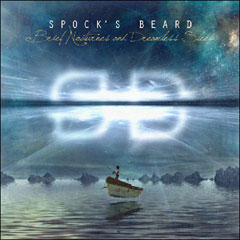
I’ve been a fan of Neal Morse since his days in Spock’s Beard – keeping up with Transatlantic and his solo efforts. He is an amazingly prolific songwriter, but of late his work seemed to be suffering from a “sameness”. Then came last year’s Flying Colors and Momentum albums, where it was clear something lit a roaring fire to his creativity. Momentum is his finest solo work since the Question Mark album.
In the liner notes to this release, Neal mentions that he found Hubauer, Gillette, and Sodré through YouTube auditions, so I before I popped in the first DVD, I was a little apprehensive regarding their ability to keep up with Morse, Portnoy, and George. My fears were completely unfounded, as Adson lays down a jaw-dropping guitar solo in the opening song, “Momentum” (you can see the performance of the song in the promo video below). Eric Gillette shines on guitar, vocals, and keyboards throughout the entire show, and Hubauer adds wonderful depth with his keyboard pyrotechnics and fine violin and sax work.
Basically, what Neal put together is a three-keyboard/three-guitar front lineup that is incredibly versatile. Add in their ability to execute complicated vocal harmonies on songs like “Thoughts Part 5”, and this is one of the best live outfits I’ve ever seen. Mike Portnoy is the hardest working drummer in showbiz, and he is obviously having a blast propelling this group through epic after epic. The avuncular Randy George is the anchor on stage, nimbly laying down rock-solid yet melodic basslines, while eschewing the spotlight.
Neal himself is, of course, the center of attention as he moves back and forth between keyboards and guitar, conducting the band (and the audience) from one emotional peak to another. It’s clear he’s delighted with the tight rapport between himself and the band. They are able to shift from a delicate flamenco-style acoustic interlude to crushing hard rock in the blink of an eye and make it look easy.
The set includes four major epics. “Testimony Suite” clocks in at 21 minutes, and it includes highlights from Morse’s 2003 album, Testimony. Neal is upfront and open about his Christian faith, and it is a genuinely emotional moment for him as he sings this account of his conversion. “The Conflict (From Sola Scriptura)” is 27 minutes long. Initially, I was put off by Sola Scriptura, but this performance illuminated aspects of it that I hadn’t heard before. It’s a beautiful piece. “Question Mark Suite”, at 21 minutes, is an outstanding distillation of Neal’s exploration of the symbolism behind the Exodus and the Hebrew Tabernacle. After a change of pace with the relatively brief “Fly High” (I would have preferred something like “Absolute Beginner” here; “Fly High” isn’t that strong a song, IMO), Neal and the band wrap up the show with the 33 minute magnum opus “World Without End” from Momentum. It’s an incredible performance that outdoes the original, and leaves the audience yelling for more.
The band fulfills that request with a three-song encore: “Crazy Horses” (yes, the Osmonds oldie!) sung by Mike Portnoy while Neal takes over the drums; “Sing It High” (which features every member taking a solo turn), and finally, “King Jesus”. As the exhausted musicians leave the stage, you can clearly hear a member of the audience call out, “Neal! Neal! Thank You!”
The second DVD disc includes an hour-plus tour documentary. Beginning with rehearsals in Tennessee, we follow the band from their first show in Nashville on October 2, 2012 (which, to my eternal regret, I had to miss) to their last in Chicago on October 12. In the space of ten days, they perform shows in Nashville, Jacksonville, Mexico City, Los Angeles, Seattle, Denver, New York City, and Chicago, all the while practicing and continually refining their parts. It’s a marathon run at a sprinter’s pace. There is video footage of every performance, and much of it is quite good. One definitely gets an appreciation for how much hard work and how many hours it takes to make a live performance look easy. As Mike Portnoy says, “This band kicks ass! I mean, the second gig – it’s tight; a really tight second gig.” Neal himself describes them as “A band on fire”. I can’t disagree.
You can order this CD/DVD set direct from Radiant Records.
Here’s the promo video for “Momentum”:
Remember Leah? There’s a great new interview with her over at Louder Than Hell.
Here’s a sample, from which you can get an idea of what she’s currently up to:
LTH: What can your fans expect from your shows? What aspect of your band brings in crowds?
In the future, fans can expect to see more records from me, and special projects. I’m very experimental, so you may see medieval Christmas songs, or electronica, or symphony orchestras. Nothing is off the table with me. I do hope to tour in the future, and I know it will be an amazing show, though I can’t promise any dates at this time.
LTH: Chemistry within a band very is important. When the band originally formed, what was it about playing with the other musicians that made you the most impressed? What is it about the chemistry between the members that makes the band unique?
In my particular music career, the songs came first, and the players came after. Most of the musicians on my record were people I brought in specifically for my project. And because I’ve mainly been a recording artist, not a performing artist, I haven’t had a solid band line-up. As of now, I am putting together my band for special performances. In the future I’d love to have a solid, long-term band that will collaborate with writing and create a whole new sound together. In any band, chemistry is important. It’s amazing how you can connect with players musically, but you might not connect with them in other areas of life. That’s what I love about music: it brings down barriers and brings people together.
LTH: Thank you for taking the time to speak with us about your music. Do you have a special event like a concert or tour coming up that you’d like to discuss? What’s next for the band?
What’s next for me is developing my live show, writing and recording more albums, hopefully doing some music videos, and a little side project I have with Eric Peterson from Testament and Dragonlord! I’m very excited about that project and am looking forward to beginning our writing sessions for that very soon!