Caveat Emptor: Future Media Publications

One of the last things I want to spend time on (mine or yours) is writing about things I don’t like on Progarchy.  Simply put, there’s too much good in music to waste on trash.  And, not surprisingly, I’m generally not very good at criticizing anyway.

But be warned, the packaged magazine now available in the U.S. at Barnes & Noble’s entitled “The Cure and the Story of the Alternative 80s” is a complete waste of printing materials.

I came across it this past weekend while in Grand Rapids, and I was quite taken with the title.  Coming from Future Media (makers of the excellent PROG) and complete with 15 track cd, I’d assumed this would be good.  It’s not.  The cd has absolutely nothing from The Cure, and the magazine devotes only five pages of text (out of a total of 130 pages) to The Cure.  None of the information is new to any one who has even the slightest interest in The Cure.

I’d assumed Future Media packaged and sealed their publications to keep the magazines and the cds in good form.  As it turns out, Future Media seals the magazines to present its products in a false fashion.

So, take my advice, and avoid this magazine like the plague.  A complete and total waste of $15.

Rant over.

A Beginner’s Guide to Big Big Train

Dear Progarchists,

My apologies for the absence of posts yesterday, November 15.  I’m in the middle of round two of grading freshmen papers and midterms, and life overtook me this week.

It’s late Friday afternoon as I type this in Michigan, but I still have one more academic event today.  At six (in about 2 hours), I’m giving a lecture on The Killing Fields, the sublime 1984 movie about the holocaust in Cambodia, 1975-1978.  As I think about watching that movie for the first time, I get chills.  What horrors humanity creates for itself.  But, that’s a different topic.

As the sun streams into my office window, I’m in the mood for much more pleasant things.

In particular, I’m thinking about the majesty and wonder that is Big Big Train.  I saw a Twitter post two days ago from a friend who expressed shock at the intensity and greatness of BBT.  In a way, I’m incredibly jealous those who have yet to experience BBT for the first time.  So, for those who have not had the grand pleasure that is listening to BBT, here’s a guide.

And, just so I make myself as clear as possible: the new BBT album, EEP1, is the equal in greatness of Talk Talk’s 1988 “Spirit of Eden” and Genesis’s 1973, “Selling England By the Pound.”  This is, without question, a must own for any lover of music, progressive or otherwise.

As many times as I’ve heard it, there are several tracks that still make me what to blaze a path toward social justice and there are several that just make me smile, for the opening note to the last.

But, certainly, nothing on this album is frivolous.   Each track is fraught with meaning.

***

On September 3, 2012, Big Big Train released its latest best studio album, English Electric Part One.  It is a thing of truth, beauty, and goodness in every way.  Part Two arrives in March.  From what I’ve seen on the web and through brief correspondence, it looks as though Part Two will be every bit as intense and glorious as Part One.

Thank to the good will of webeditors, Winston Elliott, Josh Mercer, and Carl Olson (the last, being a full fledged citizen of Progarchy), I’ve had the joy of writing about BBT a number of times..  Last summer, the band released an epic single dealing with the life of St. Edith.  To see this, click here.  http://www.catholicvote.org/discuss/index.php?p=19315

If you’re new to the genre of progressive rock, which its fans rightly consider every bit as good if not better than the best of jazz (equal in musicianship, but superior in inventiveness and, of course, lyrics, since jazz is generally without vocals), I’ve tried to explain and defend the genre to specialized audiences here: http://www.nationalreview.com/articles/299126/different-kind-progressive-bradley-j-birzer

And, here: http://www.ignatiusinsight.com/features2011/bbirzer_progrock_may2011.asp

On my personal blog, Stormfields (www.bradleybirzer.com), I’ve had the great pleasure of writing about some of my favorite bands: Big Big Train, Matt Stevens and his The Fierce and the Dead, Talk Talk, the Cure, Rush, The Reasoning, Arjen Lucassen, Tin Spirits, and XTC.

At my main professional site, TIC (founded by Winston Elliott, the main editor and brain behind it), I’ve also had the good fortune of writing extensively about Big Big Train:http://www.imaginativeconservative.org/search/label/Greg%20Spawton

While I couldn’t even come close to calculating how many words I’ve employed in writing about progressive rock over the years, the same would be even more true regarding my favorite, Big Big Train.

The latest BBT release, English Electric Part One, is not only BBT at its best, it is art at its absolute best.  Best described as pastoral, Georgian, and bucolic, the new album is also eccentric (without ever losing its center), intense, brooding, meandering, reflective, joyous, and deeply vernal.  This is something new, as BBT has traditionally explored the more autumnal aspects of life.

It’s also simply hard not to love these guys on a personal level.  I started corresponding with Greg Spawton several years ago, and he responded immediately and with what I quickly discovered was his characteristic wit and kindness.  After all, who was I–just some goofy guy from the U.S. who happened to fall over myself explaining why I loved BBT.  I once wrote something similar to Neal Peart.  I got a nice postcard back two years later.  But, from Greg, a friendship emerged.  Now, my kids even color pictures for him and ask how my “English rock star friend” is doing.  I have found that all of the members of this band are similar in this regard, and it’s very, very clear by their art that they love one another in a way only brothers can.  Indeed, they face the world not as individual artists, each pulsating with radical individuality, but as a band, ready to leaven all that is good in the world.

A quick look at the wide-ranging debates on the BBT FB page shows how many wonderful and meaningful folks gravitate toward this band and remain to talk some more!  Some of these people have also become good friends, though I’ve yet to meet a single one, face to face.

Greg Spawton and Andy Poole formed the band in the early 1990s, and they’ve since added some of the absolute finest musicians of our day: American drummer Nick D’Virgilio (rivaled in drumming only by Neal Peart of Rush and Mike Portnoy, formerly of Dream Theater), guitarist Dave Gregory (formerly of XTC and currently of Tin Spirits) and flautist and singer, David Longdon, a music professor and folklore and folk music expert.  Augmented by a professional team, in particular engineer and producer, Rob Aubrey, BBT makes music that reflects not only the woes, sufferings, and glories of this world, but without timidity, of the next world.  Imagine the three parts of The Divine Comedy come to life, and you’ll get a sense of what BBT is doing.

Spawton and Longdon, the two main writers of the lyrics, are clearly well read and articulate.  Listening to a 2-hour interview with David “Wilf” Elliott (no relation to the famous Texan cultural critic, Winston Elliott) this past weekend reminded me once again how excellent true conversation among friends and professionals can be.  I would give much for our loud talk show (Mike Church excepted, as always) and TV show hosts in this country to take notice of what educated and purposeful English gentlemen can do.  To here the interview, go here: http://www.theeuropeanperspective.com/?p=1764.  I would not be surprised if these five would’ve been welcomed in the Thursday evening discussion in the 1930s in C.S. Lewis’s rooms at Oxford.

It’s also worth calling Rob Aubrey, who engineered the album, a sixth member of the band.  Aubrey is the Phill Brown of our generation.

To conclude this late Friday afternoon piece, let me encourage you to purchase a cd from Big Big Train. http://www.bigbigtrain.com/ This is a band that not only pursues, as mentioned above, the Good, the True, and Beautiful, but they are entrepreneurs, each trying to make his way in this rather fallen world.  For over twenty years, they have chosen not to pursue the commercial path of pop culture sensations and corporate conformity.  Every writer for and reader of Progarchy knows too well that the once successful system of patronage is long gone.  We must be willing to support culture and art where it emerges.  I promise you, the music of Spawton, Longdon, and Co. will not disappoint, and the band is well worth supporting.

If you’re still not convinced, try one of their many songs for free here: http://www.bigbigtrain.com/main/listen

They’ve certainly changed my life and only for the better.

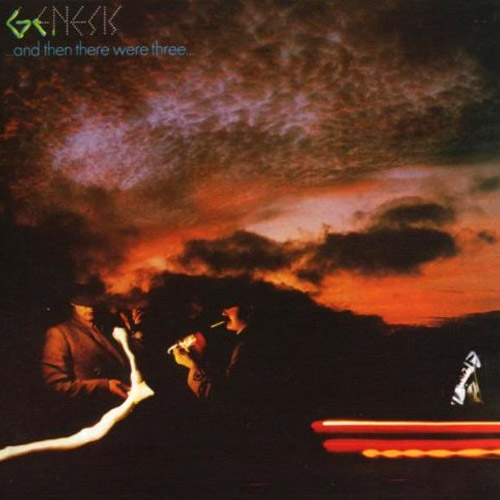
Underrated Albums Corner – Genesis, …And Then There Were Three

The top ten reasons to listen again to
…And Then There Were Three (1978):

10. Tony Banks’ keyboard work

9. Phil Collins’ drumming

8. Mike Rutherford’s bass work

7. The TEXTURE of the production

6. The rest of the songs are much more interesting than “Follow You Follow Me”

5. The strange but fascinating premises of most of the songs

4. Phil Collins singing about an American cowboy.

3. The TEXTURE of the production

2. How astonishingly well these guys do musically, even without Steve Hackett

1. The TEXTURE of the production!

A Potpourri of Pineapple Treats

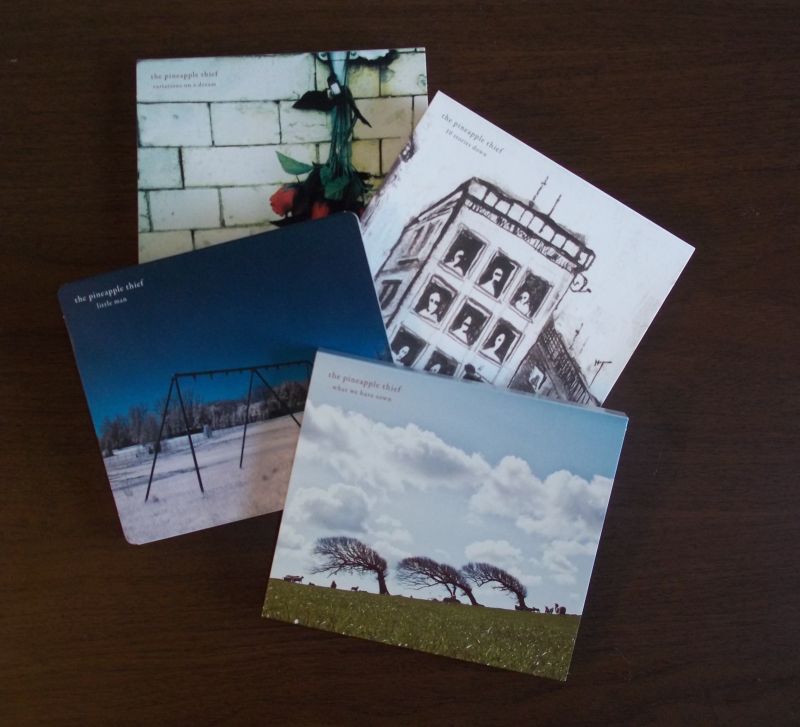
Kscope Music has been reissuing The Pineapple Thief’s albums beginning with their third, Variations on a Dream. With the recent release of their sixth, What We Have Sown, a wonderful back catalog is now available to those of us who missed them the first time around.

I happen to love Bruce Soord’s music, but there might be a “sameness” to it that can be frustrating to some prog fans. Soord’s compositional technique is very minimalist (in the same sense Philip Glass, Steve Reich, and Arvo Part are minimalist). For example, the song “Vapour Trails”, from Variations on a Dream, is nine minutes long, and the entire lyrics consist of

we’re flying too low/we’re flying too low/and trying to go far/but finding it hard/we’ve got your vapour trails to follow/you home/we’ve got your vapour trails to follow/we’re flying too fast/we’re flying too fast/and finding it won’t last/but something will pass…/we’ve got your vapour trails to follow/you home

As the words are repeated over and over, they become part of the overall sound of the song, and small variations in the melody have a much greater impact. It takes patience to listen to a typical Pineapple Thief song, but it is definitely rewarding. Every song creates a sense of time being suspended, as endless permutations of the basic melody are worked out. Perhaps Soord is the Bach of prog, and his songs are fugues!

If you’ve never heard anything by The Pineapple Thief, a good place to start is the two-disc compilation, 3000 Days. Variations on a Dream (probably my favorite, with the amazing mini-suite “Part Zero”)  is Pineapple Thief at their most Radiohead-like. 10 Stories Down is more acoustic and lighter in feel.  Little Man is a heartbreakingly beautiful account of Soord’s loss of a child at birth.

What We Have Sown was initially released as a quickly-recorded farewell work for the Cyclops label just before The Pineapple Thief began its relationship with Kscope. Recorded in 8 days, it is a wonderful collection that features one of Soord’s finest songs, the 27-minute “What Have We Sown?” as well as the sinuous, Middle Eastern-flavored “Well, I Think That’s What You Said”. Kscope has tacked on two bonus tracks, making it an even better package than the original.

As a matter of fact, Kscope has done an excellent job with all four reissues. They come in attractive slipcases, and all have updated artwork. Variations on a Dream and 10 Stories Down each include a bonus disc of music that was originally given away in limited editions.

The Pineapple Thief represent a more contemplative side of prog, and based upon their latest release, All The Wars, they are still exploring new and exciting musical territory.

Yes, A Floydian Rush to Jazz!

I’ve been buried with real work and real reality, but I do have grand designs for review posts of the new Soundgarden CD, “King Animal”, which released today, and Stephen Lambe’s book, Citizens of Hope and Glory: The Story of Progressive Rock, which I’ve almost completed reading (very short review: 4.5 stars out of 5, recommended). In the meantime, in my unrelenting quest to show the many wonderful connections between prog and jazz, here are three covers of prog classics, performed by the trio, Bad Plus (band site).

For those who aren’t familiar with Bad Plus, the trio—Reid Anderson, Ethan Iverson and David King—has made its name by being, in two word, distinctive and controversial. Part of their distinct (and controversial, to some) approach has been to cover tunes that aren’t a part of the usual jazz canon. For example, have you heard many true jazz covers of ABBA’s “Knowing Me, Knowing You”, Heart’s “Barracuda” (with singer, Wendy Lewis), or Black Sabbath’s “Iron Man”? No, I didn’t think so. And those covers, in my opinion, are excellent; they not only get your attention but they reveal aspects and possibilities in the original songs that weren’t obvious before. And it is done with a winning mixture of intensity, fabulous interplay, respect for the material, sly humor, and some “out there” moments. The Guardian puts it well when it describes the trio in this way: “If the Coen Brothers put together a jazz trio, perhaps it would be like this, the comic and the dramatic rolled together.”

And how about the fact the trio titled its 2007 album, “Prog”? Fabulous! Here, then, are Bad Plus covers of Rush’s “Tom Sawyer”, Pink Floyd’s “Comfortably Numb”, and Yes’s “Long Distance Runaround”:

Sins of the Father

Ok, readers, I have a confession to make.  I have been indoctrinating my two-and-a-half year old son into prog fandom.  In fact, on my iPhone, I have a playlist for this very purpose.  The playlist has the oh-so subtle title of “Subversive Indoctrination to Prog”.  When I give my son his nightly bath, music from this playlist is usually playing in the background.  In fact, sometimes I even time his bath using music from this playlist.  Tonight’s bath was rather long – one Underfall Yard and a Firth of Fifth, to be precise.

Am I doing the right thing?  I wonder.  This could end up causing my son to never be able to sit at the ‘cool kids’ lunch table.  And then there is the problem of the odd time signatures being imprinted into his impressionable little brain.  Will it affect his ability to dance – and could this in turn affect his ability to find a mate later on in life?  Will he be trying (awkwardly) to dance to 7/4 time while a potential girlfriend is gracefully moving to 4/4 time?

On the other hand, as a concerned parent, how can I not do something like this?  Should he really be turned loose in the wasteland of pop music of the present and the future as it continues its descent?  Should some future Lady GaGa, some future Jay-Z, or some future Justin Bieber be allowed to shave points off of his IQ (if you’ll pardon the neo-prog pun).  And living here in Texas, I could be faced with a prog parent’s worst nightmare – that he will spend his 21st birthday line dancing in a bar that exclusively plays country music.  The horror … the horror.

In the end, I think I must continue.  It’s a parent’s job to guide their offspring, is it not?

Son, if you are reading this someday in the future, I apologize for short-circuiting your dancing ability and whatever distress that may cause you in the dating game.  May I suggest you search for a mate that doesn’t like dancing, as I found with your mother?  Please know though, my son, I did this with the best of intentions, trying to keep you from polluting your musical taste with “music” created by record company executives catering to the lowest common denominator in pursuit of the highest possible profit.  Art should be more than that.  As Neal Peart once wrote (and you will know him soon), “glittering prizes and endless compromises shatter the illusion of integrity.”   As your father, I’m going to do my best to keep your integrity intact.

Love,

Dad

🙂

Neal Morse/A Proggy Christmas

Review of Neal Morse/Prog World Orchestra, A Very Proggy Christmas (Radiant Records, November 20, 2012)

Every Thanksgiving night, we watch “Home Alone,” knowing perfectly well how successful Kevin’s antics will be.  This little ritual of laughs inaugurates the annual Christmas season for the Birzers.

From that showing of Home Alone until the arrival of the Three Wise Men on Epiphany, we celebrate the season of Christmas rather vigorously in our house.  Though we don’t put up the tree until the 24th of December, we certainly let the house ring with festive music–operatic, pop, classical, jazz, and rock.  Indeed, such music plays almost the entire season.

I must admit, I’m a big fan of Christmas albums.  There’s something about such familiar and comforting music being reworked in some kind of new fashion that almost always hits me in particular but probably predictable ways.

I am always especially impressed with artists who rework these Christmas classics, knowing that their songs will be judged by enduring and relatively rigorous standings.  In particular, I especially enjoy the Christmas music of George Winston, Vince Garibaldi, Sixpence None the Richer, Sarah McLachlan, and Loreena McKennitt.

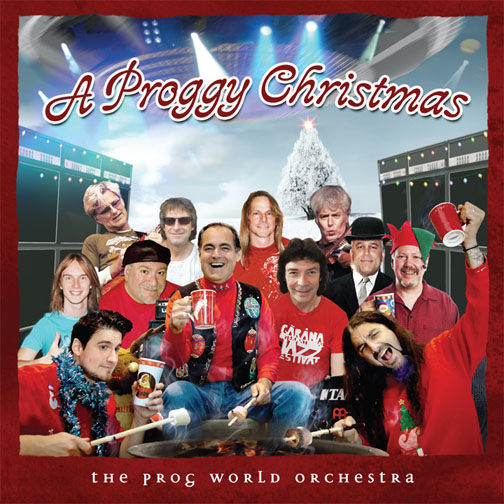
This year, joining this impressive list is Neal Morse’s Christmas band, “Prog World Orchestra.”  Arriving on November 20 (Tuesday, a week from tomorrow) from one of the finest record labels around (Radiant), “A Proggy Christmas” offers a wonderful take on a number of holiday classics.  Not surprisingly–as this comes from the mind of Mr. Progressive himself–the production is rigorous, the music is serious but tinged with Morse’s humor, and a number of pleasant surprises await the listener.

The name of the group, “Prog World Orchestra,” is appropriate.  All of the members of Transatlantic (Portnoy, Trewavas, and Stolt), Steve Hackett, Steve Morse, and Randy George.  Portnoy is even “The Little Drummer Boy”!  Jerry Guidroz does his usual extraordinary mixing and engineering.

Songs include “Joy to the World,” “O Holy Night,” “Hark! The Angels Sing,” “Carol of the Bells,” and the aptly named “Shred Ride.”

While I’m thoroughly enjoying the entire album (breaking my rule of not listening to Christmas music until Thanksgiving), my favorite track is “Frankincense,” an absolutely brilliant collision of Edgar Winters and “Deck the Halls.”  I can’t help but smile for all 3 minutes and 53 seconds of the song.  I would love to know the story behind this song–especially how Morse came up with it.

The video featuring a rough-and-tumble Santa (is that Portnoy dressed as St. Nick?) fighting a mischievous Frankenstein is pretty great as well.  My kids and I have enjoyed watching it on Youtube several times.  

My second favorite track is Morse’s rendition of “Carol of the Bells,” perhaps the most purely prog song on the album.  At almost eight minutes long, keyboard solos abound.

As I listen to this song, I can help but be reminded of Kevin running to his home after the conversation with the “South Bend Shovel Slayer” in the church in his neighborhood.  The clock tower bells are tolling nine.

Please don’t get the image that this album is in any way sacrilegious, as I’m afraid some of my above descriptions might very well seem to make it.  The music is certainly playful, but it’s never in bad taste.  Not in the least.  This is Neal Morse, after all.  Neither, though, is the album as a whole evangelical in the sense that, say, Morse’s excellent “God Won’t Give Up” is.  Perhaps the closest Morse gets to evangelical is in his delivery of the traditional lyrics of “Hark! The Angels Sing.”  Of course, if this song can’t be pro-Christian and evangelical, no Christmas song can!

Again, the album is done in good and respectful taste, but with definite prog and metal arrangements.  There’s an equal amount of jazz, pop, and big band in here as well.

If you have even the slightest love of prog (and, you probably wouldn’t be reading this unless you do), “A Proggy Christmas” is a must own.  Even if you only pull “A Proggy Christmas” out with your other Christmas albums once a year, it’s still a must own.

My guess is that even non-proggers will immensely enjoy Morse’s take on Christmas as well.  Remember how wildly popular the Mannheim Steamroller/Fresh Aire Christmas albums were in the 1980s?  Some of Morse’s arrangements have that same feel, but “A Proggy Christmas” is much, much better.  The same is true, of course, of the Jethro Tull Christmas album.  Still, Morse’s is better.  This album might even be a great way to introduce a non-progger to prog.

Arranging and recording these ten Christmas classics, Morse’s efforts reveal how much more can be done.  Here’s hoping the Yuletide spirit possesses Morse for years to come.  Take my advice.  Run–don’t walk–to the Radiant Records store and treat yourself to a copy in preparation for Thanksgiving, Advent, Christmas, and Epiphany.

Merry Christmas, Neal.

From Prog Magazine.

Ne Obliviscamur

From Eric Tamm’s terrific book, Robert Fripp:

“Requiem” begins with a Fripp guitar solo over Frippertronics backing. A gloomy minor mode, fully appropriate for a mass for the dead, prevails. Before long, as Fripp works his initial statement to a climax, the other musicians enter, and soon it is free-form freakout time, the spirit of “Moonchild” and improvising King Crimson III all over again. When the thrashing subsides, the Frippertronics backing has changed to an eerie augmented harmony — the transfiguration of the soul? 

Prog Dog 6 with Geoff Banks

Dear Progarchists, fabulous dj (despite what he says about himself!) and prog master, Geoff Banks, has a weekly radio-internet show called the Prog Dog show.  I’ve thoroughly enjoyed his program over the last several weeks.  For those of us in EST, it begins at 2pm.

http://myradiostream.com/progdog

His own description of today’s show: “Join me for 2 hrs of scintillating music courtesy of IQ, The Plastic People Of The Universe, Thomas Dolby, Siddhartha, PFM, Public Image, Hatfield and The North, Hawkwind, FPOA, Pink Floyd, Sigur Ros and much much more.”

At the same website as the stream, you can also join in the chat room, upper right corner of the screen.  Banks and followers are as witty as they are knowledgable.  Enjoy!

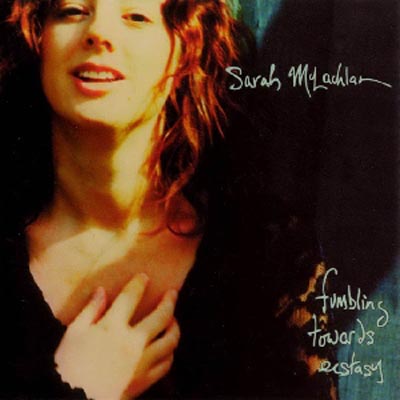
Mini-review: Fumbling Toward Sarah

Sarah McLachlan, Fumbling Towards Ecstasy (1993).  I can’t explain why this album means so much to me, but it does.  I love McLachlan’s voice and her very effective use of hammond organ as well as her Talk Talk-esque atmospherics.

While the album as a whole has a very pop feel, especially after the much more experimental and minimalist first two albums (Touch and Solace), it still holds together brilliantly.  Even 19 years later.

The second half of Fumbling Toward Ecstasy is especially powerful.  In particular, the best songs are the searching “Ice,” the driving “Hold On,” and the whimsical “Ice Cream.”  Really, when one puts the song writing together with the production, one can only reasonably cry “genius.”  Then, if you add “Fear” to this, there’s really nothing to do but drop one’s jaw.  “Fear” is, simply put, one of the finest songs ever written.  Every aspect of it is perfection defined.  Words, meaning, arrangement, production.  I might go so far as to argue this is the single best “pop” song ever written–and, yes, I’m not forgetting the Beatles.  The Beatles never captured this depth of meaning or intent.

Wind in time rapes the flower on the vine/Nothing yields to shelter

And, importantly, Fumbling lacks the nasty anti-religious cant of her middle work (I’m not a purist about this, by any means, as Rush is one of my favorite bands; I can only take in your face skepticism a little more than I can take in your face evangelicalism).  Her followup albums, especially Surfacing and Afterglow, are not only are weak lyrically, they’re weak musically, ranging into pure sap at times.  “Angel” embodies the worst of McLachlan, though I’m sure she made an absolute mint on it.

Her latest album, Laws of Illusion, while not nearly as sappy or poppish as her middle work, is also not as interesting as her earliest work.  Frankly, I hope McLachlan follows other serious pop artists such as Natalie Merchant, going into the more artistic realm rather than the more commercial.  I assume she no longer needs the money to be commercial?   Her voice could fit so perfectly in more experimental venues.

When I worked at the Organization of American Historians in graduate school, we would play all three of the first cds as we played Quake on the network (after business hours, of course).  What a contrast.  Yet, it worked.  That, or we were all a little schizophrenic.  Ok, let’s take this line of reasoning no further.

Believe it or not, I’ve seen McLachlan as many times in concert as I’ve seen Rush.  Each performance is a delight.  Indeed, she’s as good as anyone I’ve ever seen live.  She completely throws herself into every performance.  I very hope she will do the same with her forthcoming album.