
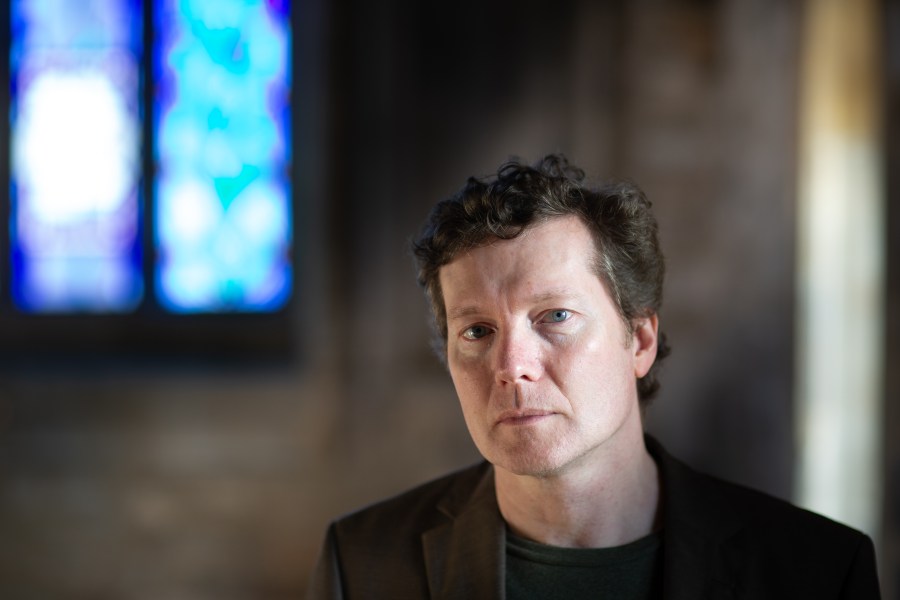
Tim Bowness first made waves in the art-rock world in the 1990s via No-Man, his longtime collaboration with Steven Wilson; albums like Flowermouth and Wild Opera led to Bowness’ working with Robert Fripp, Phil Manzanera, Nosound’s Giancarlo Erra (on Memories of Machines’ Warm Winter) and many others. Since 2014, Bowness has also pursued a solo career, with a trio of critically acclaimed albums released on Inside Out Music.
Bowness’ latest album, Flowers At The Scene, is out on March 1. Having previously interviewed Tim in 2015 and 2017, it’s been exciting for us at Progarchy both to hear the new album in advance — and to talk about it with Tim in depth. In the first part of a 3-part interview, Tim lays out what’s led up to Flowers At The Scene, and how it’s different from his previous solo albums — and also teases No-Man’s first new music in more than a decade!
So first of all, congratulations on the new album; I’ve really enjoyed listening to it. What a prolific run in the last five years!
Thank you! Yep!
Could you unpack for us how the albums you’ve made for Inside Out, starting with Abandoned Dancehall Dreams – how have they led up to Flowers at the Scene?
Well, I think that Flowers At The Scene is kind of a statement in itself, really; it feels like a reset of the solo career. And I think that the other three Inside Out solo albums really were leading up to Lost In The Ghost Light. I think that was the conclusion of a particular way of working.
It started off really with – when I’d written Abandoned Dancehall Dreams, that was an album that I presented to Steven Wilson as a possible No-Man album, and it was pretty much how we’d done No-Man’s Schoolyard Ghosts – that I’d written songs and I’d co-written songs, and I’d brought what I thought was the best of that to Steven and had an idea for an album. And with Schoolyard Ghosts, we then worked on the material together, produced the material together, Steven added to what I’d written and so on. But with Abandoned Dancehall Dreams, he was in the middle of working on his Raven album, and just said, “Look, I’ll mix it; this is your album. Release a solo work!”
So that’s how the recent run of solo albums started; it was something I’d assembled with a No-Man album in mind, and it became what feels like my debut solo album. (I know it’s my second solo album, but it feels like my debut solo album!) Stupid Things That Mean the World emerged out of that, really, in that Abandoned Dancehall Dreams had got a very positive reaction and I was feeling very energized by that, really, so I was writing quite a lot of the time.
And with Lost In The Ghost Light, that was the conclusion of a project that I’d kind of been working on probably for about ten years. And some of the songs in that concept had been on Schoolyard Ghosts, some on Abandoned Dancehall Dreams, some on Stupid Things That Mean the World. And I didn’t think I was going to complete it! But there was a certain point in 2016 when I focused on it and it all came together.
And with Lost In The Ghost Light, it felt like a conclusion to a particular way of writing and working, and I think specifically that pieces like “Smiler at 50” from Abandoned Dancehall Dreams or “Sing to Me” from Stupid Things That Mean The World, that it was almost like an album-length exploration of that type of music. And of course, it had a very specific overall concept, which is the first time that I’ve ever worked, really, with a kind of narrative concept album. The Lost In The Ghost Light story was one that I’d been writing about for years and one that I really wanted to finish. So I was delighted when it was finished!
But after that, it really felt like I needed to do something completely fresh, completely refresh my own musical palette to keep things exciting.
Thanks! The other thing that you’ve done recently is you’ve also gone back even deeper into your past. I know that you worked with Brian Hulse and David K. Jones to re-record the music of your very first band, Plenty. And It Could Be Home is a really delightful album. Was that part of your process for trying to find something new? How did that project feed into this new album?
I think you’re right; I think it did feed into this album in some ways. Because what was interesting is that we’d not worked together for thirty years, and it was actually very creative. Going back to that material, we wanted to be faithful to it. But what was exciting was that we were doing something new with it, and it was taking us to new places. Partly, in my case, it was re-introducing me to ways of singing and writing I’d long abandoned. And so, as much as it was old material, it really felt like it was a new project. And we enjoyed doing that so much that Brian and I continued writing together.
And we just felt that what we were coming up was something that wasn’t Plenty, and it was kind of hinting at what I wanted to do on my next solo album. So it definitely directly fed into Flowers At the Scene, the fact that we just continued to write, record, produce together. And eventually there was a project that we were both excited about, and that became Flowers At The Scene. And of course, there are other collaborations and other methods of writing used on the album. But yeah, I think the Plenty experience directly led to this and fed into it.
Continue reading “The Progarchy Interview: Tim Bowness, Part 1”





 Progarchy