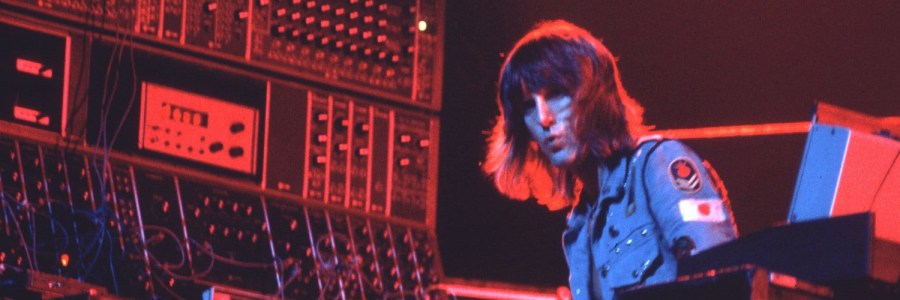

Keith Emerson was one of my most lasting musical heroes. His swashbuckling performance style, his virtuosic playing and his remarkable compositional mix of aggression and lyricism turned my head at the tender age of 16, sending me headlong into the vintage highlights of Emerson Lake and Palmer’s catalog, along with their numerous attempts to recapture lightning in a bottle over the decades. So when Emerson committed suicide on the eve of a Japanese tour in early 2016, it hurt — and none of the tributes to the musician and the man that followed could completely take away the sting.
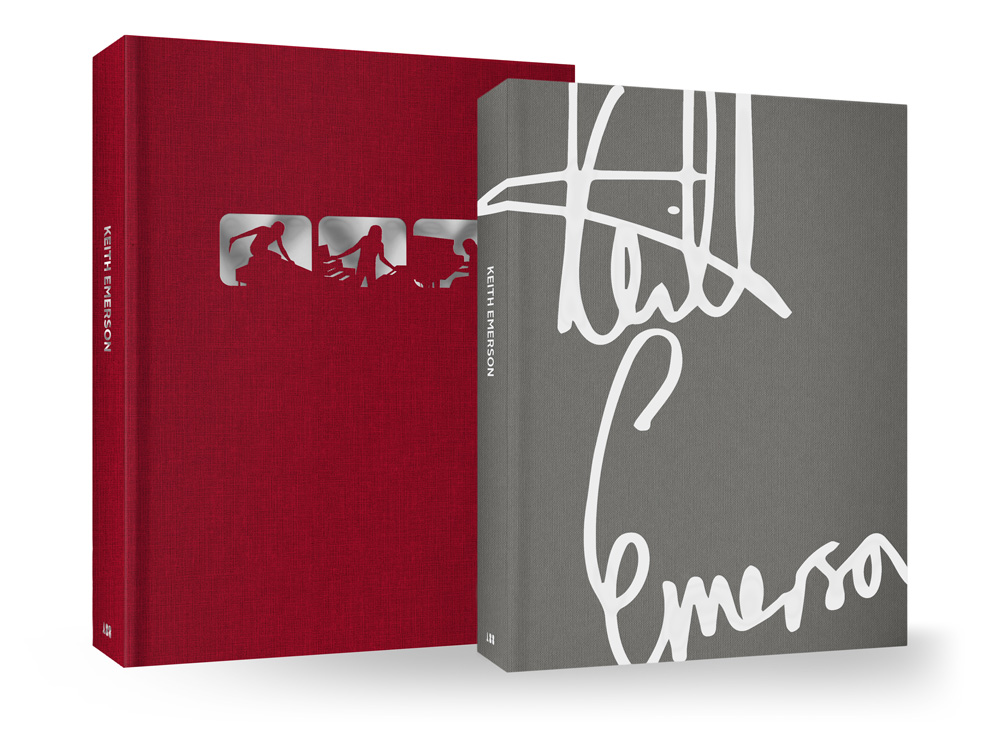
Emerson’s career in and contributions to ELP have been well served in print throughout the years – there’s the fan-based band bio The Show That Never Ends, Edward Macan’s in-depth musical analysis Endless Enigma and Emo’s own bawdy, devil-may-care memoir Pictures of an Exhibitionist. Now, the British publishers Rocket 88 (who issued an “as-told-by” ELP book last year) are about to release Keith Emerson, “A lavish, fully illustrated book in which family, friends, colleagues, and fans talk to author Chris Welch about [his] life, work, and legacy.”
Rocket 88, whose fine books on Porcupine Tree and Talk Talk already grace my shelves, have done a first-class job. Scoff at the coffee table book format if you choose, but the mouthwateringly rich treasury of images — ranging from family and early professional snaps of a young Keith to widescreen shots of him in his pomp onstage — turns out to be utterly essential to the story told here. Long-standing rock journalist Welch, who knew Emerson throughout his career, proves a strong enough focal figure for the narrative to hold its own; without putting himself forward, he’s consistently able to coax out both the outline of Emo’s life and the raw material behind his myth through interviews with his partners, children and grandchildren (two of whom have followed in his footsteps as piano players), relatives, colleagues and peers in the music industry.
The tale told here is one of a life lived with bracing gusto and deep devotion to the muse — but also a life into which shadows fell, then gathered. In the wake of ELP’s late-1970s meltdown, Emerson bounced from project to project — solo albums, film soundtracks, a joint project with Greg Lake and drummer Cozy Powell (who I caught live in 1986), the trio 3 with Carl Palmer and Robert Berry — none of which gained lasting traction. The ELP reunion in the early 1990s (which I saw in concert in 1993) showed promise; but brought down by the rise of grunge and cumulative nerve damage to Emerson’s right hand from years of driven playing, it shrank to opening act status for Jethro Tull and Dream Theater, with the plug pulled after the trio disagreed on production credits for a comeback album.
Here’s where the book becomes most revealing, especially as Emerson’s later partners, guitarist/vocalists Dave Kilminster and Marc Bonilla, detail their experiences. Briefly reviving his innovative late-60s band The Nice, then manfully working to re-establish himself as a solo artist, Emerson’s stars refused to align; first Kilminster (who I saw with Emerson opening for Scorpions and Tesla in 2004) was poached by Pink Floyd’s Roger Waters, then Emo’s follow-up tour with Bonilla (promoting an excellent 2008 album) was cut short by focal dystonia in his right hand. From out of the blue, ELP pulled together one more time for a London festival show in 2010, winning acclaim despite Emerson’s physical problems and growing stage fright. But in the wake of Palmer’s refusal to continue and unexpected major illness for Emerson, nothing further followed.
There were alternatives afoot, as Emerson began an intriguing transition to orchestral conducting. And he continued to be loved and valued by the musical community in Los Angeles, where he’d settled with longtime partner Mari Kawaguchi. His spontaneous sense of fun, his love for his family, and his constant flow of new musical ideas all remained. But growing depression poorly treated, an increasing aversion to demanding Internet-based fans, and a hectic schedule with little to show for it all took their toll — and on March 11, 2016, a final spiral of despair led to tragedy in the classic sense. Keith Emerson, brought low by the thought of the heights he’d once scaled and his inability to live up to the standards he’d previously set, took his own life.
The impact of that tragedy still lingers, and it undeniably colors the final chapter of Keith Emerson, as his family and friends struggle to make sense of life without Emerson and remember the joy he brought into their lives as a musician and a human being. Their reminiscences and their mourning, as much as anything in this compelling book, bring the man out from behind the shadows of the myth, where he ultimately wins our respect and empathy. In the end, it’s this eyewitness testimony of Emerson’s triumphs and struggles — the highs and lows of a regular guy thrust into a larger than life story — that make the book well worth reading for fans of ELP in particular and of progressive rock in general.
Classic and limited Signature Editions of Keith Emerson can be purchased directly from Rocket 88, with November delivery currently expected.

— Rick Krueger


I missed this album when it came out, although I remember reading about it in Prog magazine. I came to appreciate Pain of Salvation with their 2020 album, Panther, which was my top album of the year. I finally started to dig into their back catalog this summer, and I’ve been blown away. In The Passing Light Of Day is a brilliant tour-de-force of emotions. Some of the lyrics I think are too sexually explicit, which is primarily why I rank it at number 10 and why I almost kicked it off my top ten. But the music and melodies are so good, and most of the lyrics are incredibly profound. I also think Ragnar Zolberg brought a lot to the table and was a great balance to Daniel Gildenlöw.
It was hard to pick one of the
Portals is a brilliant album. It is unique on this list for being a live release, but it is also unique for being a live-in-studio release – a product of the pandemic. I suppose that’s why I don’t rank it higher on this list, but I’ve been listening to it a ton since it came out. I even broke down recently and bought the fancy deluxe CD/DVD/Blu-ray edition. I think most of the tracks on here sound better than they do on the original albums. The album also introduced me to the band, as well as to the world of djent. The way the band blends djent riffs with Floydian spacey motifs is just perfect. One of the finest bands in the world right now.
I go in spurts when listening to Haken (like I do with many bands). The Mountain has a magnificent blend of metal with splashes of 70s golden age prog. Songs like “Atlas Stone,” “The Cockroach King,” “Falling Back to Earth,” and “Pareidolia” have become prog metal classics, in my book. I’ve come to think Haken isn’t as compelling in their quiet tracks as bands like Riverside of TesseracT, but this entire album is still very listenable nine years later.
Marillion’s F.E.A.R. was my introduction to the band, and I’ve thoroughly enjoyed diving back into their catalog. I’d have to say I think this is one of their best with Hogarth. Their latest album, “An Hour Before It’s Dark,” comes very close to it, but “Reprogram the Gene” knocks it down a peg for me. F.E.A.R. combines musical prowess with cultural critique to wonderful effect, even if I may disagree with Hogarth at points.
I had a hard time deciding which of Riverside’s three studio albums from the past decade to choose. Love, Fear and the Time Machine and Wasteland are both brilliant, and if I had allowed myself to choose multiple albums from the same artist in a top ten, Wasteland would probably be here too, but I think Shrine edges both of them out. It’s heavy, both musically and lyrically. Several of the songs turn into real earworms for me, and I’m never disappointed when I return to this record. And it’s another one on this list that I discovered several years after its release.
Oak is my favorite new band of the last decade. Both their 2013 (2016 release on CD) album Lighthouse and 2018’s False Memory Archive are brilliant albums, if not perfect. This record was my top album of 2018, and Lighthouse was my top album of 2016 (I didn’t realize at the time it had been released digitally earlier). The Norwegian melancholic aesthetic is dripping from both albums. It was hard to pick one of the two, but the closing track on False Memory Archive, “Psalm 51,” is one of the finest album closers I’ve ever heard. I think that gives this record the edge.
I was blown away by Devin Townsend’s Empath when it came out – so much so that I bought the 2CD deluxe version that year and the super deluxe version when Inside Out funded that project the next year. The record masterfully blends all the aspects of Devin’s career into a truly unique and truly Devin experience. It has the heavy bombast of Strapping Young Lad at points, yet it’ll soar into orchestral and even operatic highs elsewhere – or even at the same time. Pure musical theater in the best way. Devin’s vocal performance on “Why?” is stunning, and the message of hope on “Spirits Will Collide” is always a pleasant reminder that life is worth living. The production side of things, with Devin’s famed “wall of sound,” is unmatched in his career, or anyone else’s for that matter.
Here we come to one of the truly great albums of our time. I would certainly rank this in a top 10 best albums of all time. Back in 2015, this album was my number 3 pick, with The Tangent’s “A Spark in the Aether” coming in at number 1. Now I still think that’s a great record, and I wrestled with whether or not to include it in my top 10, but I think over time Wilson’s masterpiece has proven to be a generational album. Both the music and the story sound fresh, even seven years and many listens later. The themes of isolation and loneliness in city life (or life in general) will always be relatable. Someone 100 years from now could listen to this record, and while they may miss some of the references (even I still miss some of them), the underlying theme will still connect. That’s what places this record up there with the likes of Pink Floyd’s The Wall.
The defining band and defining album for the last decade of prog. Looking back, this record was the one that got me into the contemporary progressive rock scene. Returning to it today is a special treat, as I hope it always will be. It contains everything you might want out of a quintessentially “English” progressive rock band. It has the rock, the folk elements, the complex musicality, the well-told stories. And then there’s David Longdon’s voice, showing us his command of the material and his command of the upcoming several years in the prog scene. When I traveled to England in 2015 (which to me felt like a longer distance between its release than it feels between now and that visit – it’s weird how your perception of time changes as you grow older) I really wanted to listen to this album while being out in the hedgerows and fields. I can still remember sitting on a bus traveling between towns listening to English Electric (I wrote more about this in a